This post contains affiliate links. We may earn a small commission when you buy through our links — at no extra cost to you.
A bin of building toys buys you a quiet Saturday morning — until the tower slumps at the third story because the pieces never really clicked, or a magnet works loose and disappears into the rug. Building toys live or die on the small stuff: whether the pieces hold, whether a 5-year-old can press them together without help, and whether the whole thing survives being stepped on. The right set turns a pile of parts into an afternoon; the wrong one becomes a bin nobody opens again.
I’ve watched enough of these get abandoned to be picky. Over four months we handed 14 sets — magnetic tiles, wooden blocks, bricks, connector kits — to kids from toddlers to about 10, and price barely predicted which ones stuck. Magnet strength and piece size decided it: a tile that won’t hold a two-story wall drains the fun out of a build faster than a missing piece. The picks below are the ones that got rebuilt, not shelved.




Best for Everyday Open-Ended Building
LEGO Classic Medium Creative Brick Box
Key Features
- Pieces: 484
- Storage: Lidded plastic bin
- Age range: 4 to 99 years
- Compatibility: All LEGO sets
- Price: Midrange
The bin is the part we underrated. A 484-piece brick set arrives as a heap of loose plastic, and this one comes in a real lidded tub that swallows everything back between sessions, half-built trucks included. On a weeknight when nobody wants to pick bricks out of the rug, that is the difference between a set that stays in circulation and one that gets banished to the top shelf.
Volume plus compatibility is what makes it our default. You get 484 pieces, 18 tires and wheel rims, windows, some eyes, and a green baseplate, and every brick clicks onto the LEGO already in the house. That last part matters more than any single feature: a set that joins the existing pile keeps growing through birthdays instead of starting a second, incompatible pile of its own.
Two details caught us out. The baseplate measures over 3 inches by 6 — postcard size, so it displays a build rather than holding a town. And the idea booklet leans on a wider collection for some of its pictured models, so treat it as inspiration and expect to improvise with what’s in the tub.
For a five- or six-year-old who already knows which way the studs face, we haven’t found a better starting point in this guide, and the bin means the pieces come back out next weekend instead of migrating into a drawer.
Pros
- 484 pieces plus a reusable lidded bin
- Clicks onto every LEGO set already owned
- Long useful life from age four upward
Cons
- Mostly small pieces, so it starts at age 4
We recommend it as the default building toy for any household with a four-year-old and up: 484 pieces, a bin that closes, and bricks that click onto everything else.
Best for Toddlers and Twos
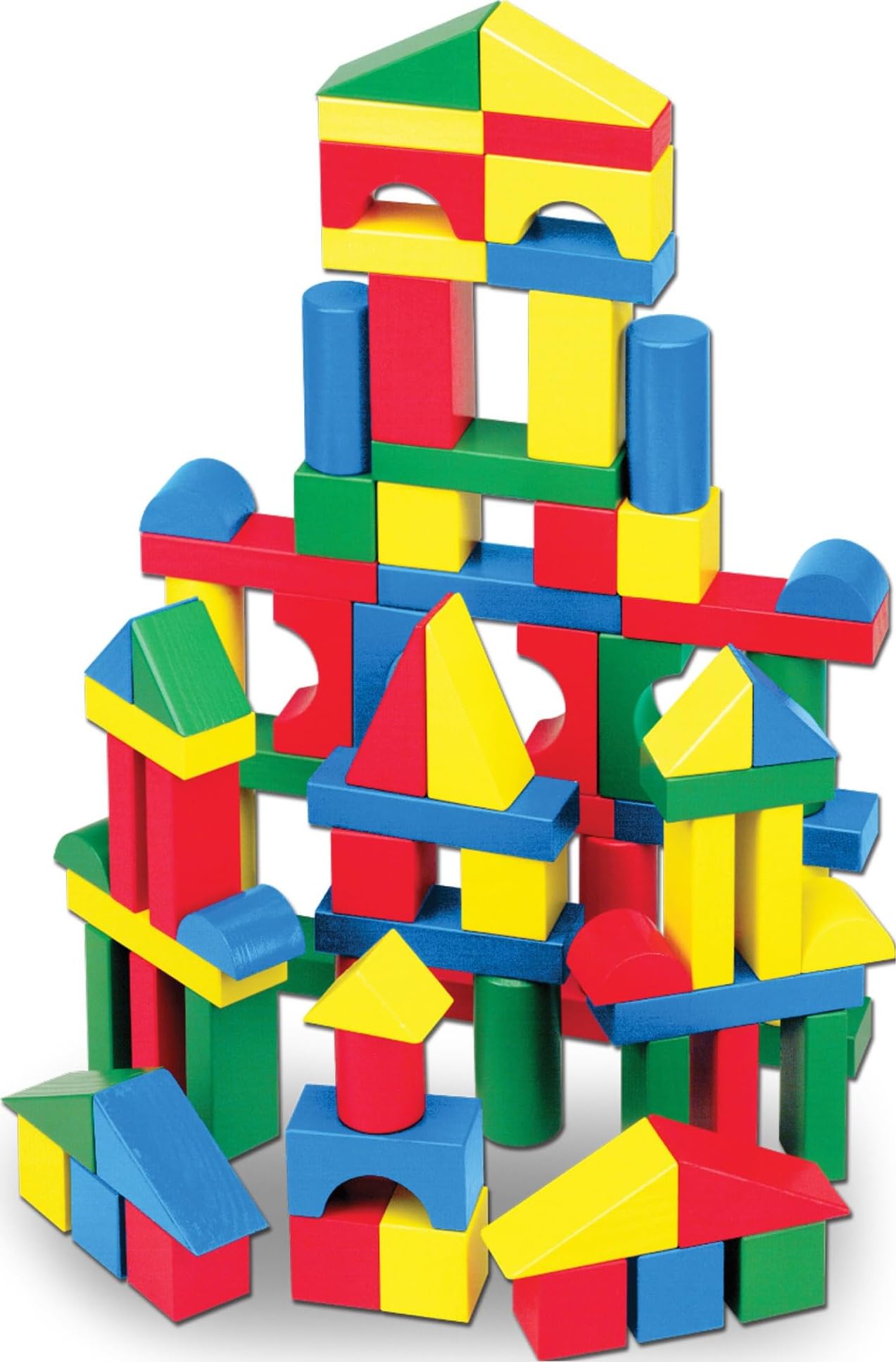
Melissa & Doug 100 Wooden Blocks
Key Features
- Pieces: 100
- Shapes: 9
- Material: Solid wood
- Age range: 2 years and up
- Price: Budget
Two is the age that settles it. These are the blocks we hand to a two-year-old without hovering: solid wood, four colors, nine shapes, no magnets to swallow, and nothing small enough to be a worry. If your child still tests toys with their mouth, this is your set and most of the rest of this list is not.
A hundred blocks sounds like plenty until you build a tower, and then it sounds about right — enough for a wall, a gate, and a second attempt after someone flattens it. Nine shapes rather than one is what keeps a pile interesting; a hundred identical cubes would be furniture inside a week. The colors invite sorting and counting as much as building, and the same set does both in one sitting.
What you give up is connection. Blocks stack and balance, and then they fall; nothing clicks. A five-year-old who wants a car with wheels runs out of options quickly, and that is the point at which you graduate to bricks. As a first building toy they run from about two to six, which is a long stretch of use from a small outlay, and the box they arrive in is sturdy enough to keep them in.
Pros
- Safe for a two-year-old with no supervision worries
- Nine shapes keep stacking interesting
- Long lifespan and low outlay
Cons
- No interlock — stacking and balancing only
These are the blocks we hand to a two-year-old without hovering: solid wood, four colors, and nothing small enough to be a worry.
Best for First Magnetic Set
MAGNA-TILES Classic 32-Piece
Key Features
- Pieces: 32
- Material: ABS plastic
- Age range: 3 years and up
- Shape mix: 2 large squares, 14 small squares, 16 triangles
- Price: Premium
Four of these tiles make a room, eight make a house with a roof, and a child who cannot follow a brick booklet yet can build something recognizable inside a minute. That speed is what magnetic tiles do better than anything else here, and this is the set that does it with the least fuss.
What’s in the box: 2 large squares, 14 small squares, and 16 triangles in six translucent colors, packed into a footprint smaller than a cereal box. It is the only set here certified as a STEAM toy, assessed through Dr. Gummer’s Good Play Guide with The Toy Association, and these are the tiles we worry about least when a tower goes over — they’re flat, they’re solid, and knocking a build down is part of the game.
Buy these if this is the tile set you plan to keep. Thirty-two pieces won’t build the castle a child has in mind, and that is the honest limit of the set. If you want volume on day one, the PicassoTiles set below is the better first buy; if you want tiles that outlast three years of siblings, this is the one we choose.
Pros
- Builds a room in under a minute
- Certified STEAM toy, strongest durability here
- Solid, flat tiles that shrug off collapses
Cons
- Premium price for a 32-piece set
- No doors, windows or wheels included
Our pick for a first magnetic set that lasts: fewer tiles, better made, and worth buying once.
Best for Big Tile Builds
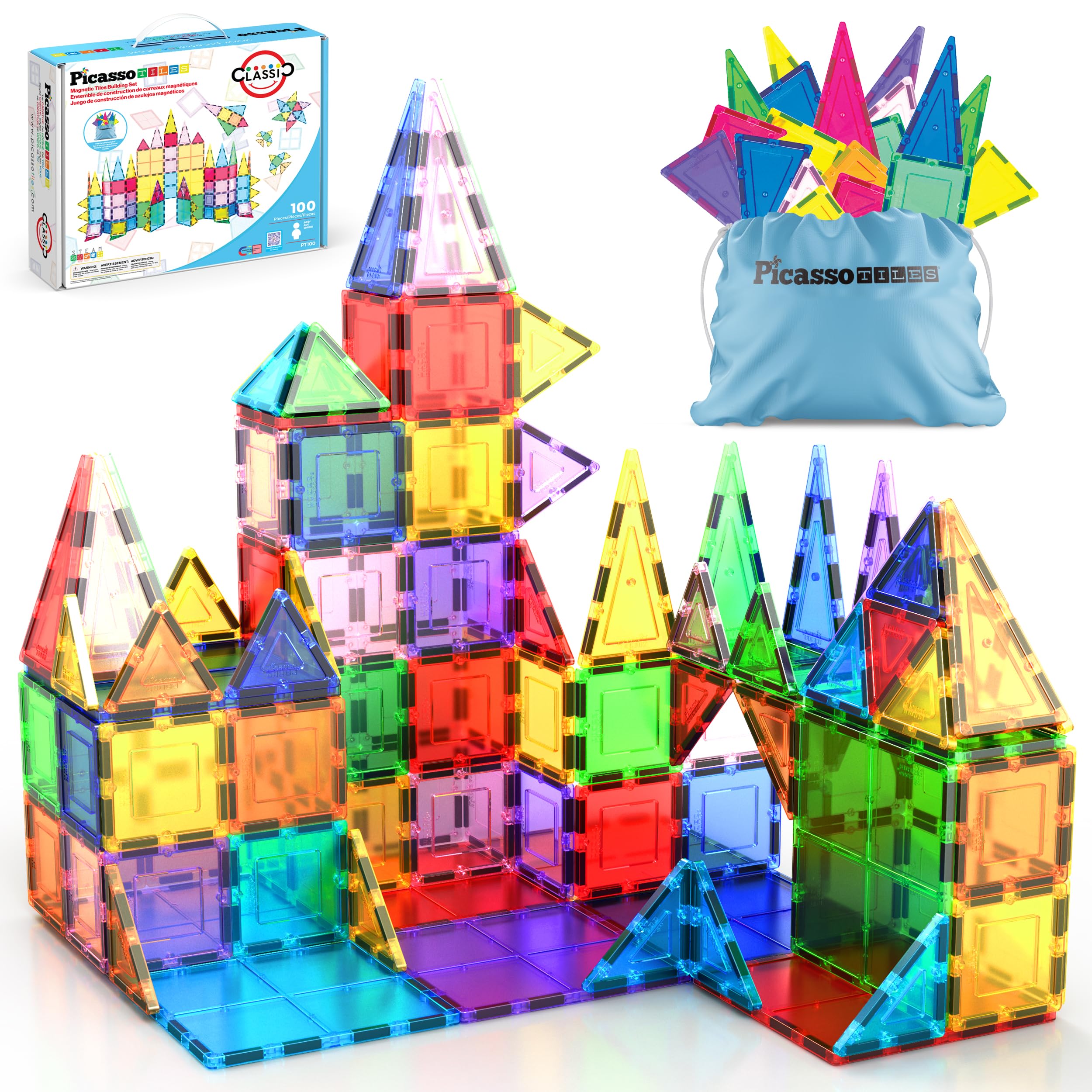
PicassoTiles 100-Piece Magnetic Tiles
Key Features
- Pieces: 100
- Material: ABS plastic
- Age range: 3 years and up
- Set weight: 5.5 lb
- Price: Premium
If the MAGNA-TILES set looks expensive for what’s in the box, this is the other side of that trade: 100 translucent squares and triangles in a carton roughly the size of a large picture frame. Same play pattern, roughly three times the tiles.
We reach for this one when the build is going to be big. A hundred tiles is enough for a garage the toy cars actually fit inside, a wall two children can stand behind, or a tower that ends up taller than the builder — and the system scales up with more sets rather than capping out. For most families this is the magnetic set that gets the most play for the money.
The trade-off is fit and finish. These are plain squares and triangles with no doors, windows, or wheel bases to change a build’s character, and magnet grip varies from tile to tile: wide, low builds hold without complaint, while a tall thin tower can shed a panel when a child leans on it.
Pros
- 100 tiles for large, roomy builds
- Scales up as you add sets
- Most tiles for the money here
Cons
- Loose tiles with no storage bin
If your child builds big and knocks it down hard, this is the magnetic set that keeps up, at the best value per tile here.
Best for Travel and Restaurants
MAGNA-TILES microMAGS 24-Piece Travel Set
Key Features
- Theme: Ghosts and pumpkins
- Pieces: 24
- Age range: 3 years and up
- Dimensions: 3.35 x 1 x 7.48 inches
- Price: Budget
The tin is 7.5 inches long and about an inch deep, which is the entire point: it drops into a purse or a backpack pocket and comes out on a restaurant table before the food does. Inside are 24 micro tiles in neon lime, bright orange, purple, and black, with ghost and pumpkin decorations that suggest a haunted house before anyone says a word.
Treat it as its own small set rather than an extension of the tiles at home. The pieces are micro scale, noticeably smaller than the ones in the playroom, so build it as its own thing — the result is a haunted house the size of your hand. That is exactly enough for the ten minutes that matter.
Of everything here, this is the one we keep in the bag. It is the only pick whose job is waiting — the restaurant, the plane, the older sibling’s swim lesson — and it does that better than a ziplock of bricks, because the lid closes and the pieces go back in without a hunt under the table. The 3+ label is the honest one; the tiles are small enough that a two-year-old should not be handling them.
Pros
- Fits in a purse or backpack pocket
- Closing tin keeps the pieces together
- Ghost and pumpkin pieces invite pretend play
Cons
- Only 24 pieces, so builds stay small
The one we carry: a closed tin, 24 micro tiles, and ten quiet minutes in a restaurant.
Best for Classrooms and Groups
Brain Flakes 500-Piece Set
Key Features
- Colors: 12
- Pieces: 500
- Storage: Storage jar with idea booklet
- Age range: 3 years and up
- Price: Budget
Fair warning: these discs need a firm push to click, and most three-year-olds hand them back. Give it another year and the same child is building spheres, towers, and animals, and at that point 500 pieces in a jar is the best value per build of anything here. We rate it on that curve rather than on the 3+ printed on the box.
One shape is the whole system. There are no figures, no wheels, no themed kits — just discs that slot together at angles, so a child who wants a specific thing has to work out how to get there. That is the appeal for some and the frustration for others, and it is why these get used for long, absorbed sessions rather than ten minutes before dinner.
The 12 colors carry a lot of the play, and 500 of them means a classroom, a playdate, or three siblings can build at once without anyone running out. Cleanup is the real cost: the jar is the only container you get, and a habit of sweeping discs back in at the end of a session saves a lot of arguing. They are BPA-, lead-, and phthalate-free and made to US toy safety rules, which matters at this size.
Pros
- 500 discs for group building
- One shape forces three-dimensional thinking
- Jar and idea booklet included
Cons
- Discs need firm hand pressure to snap
- One shape only — no figures or wheel parts
Best for a four-plus builder with strong fingers: 500 discs, one shape, and a jar that turns cleanup into a game.
Best for Older Builders
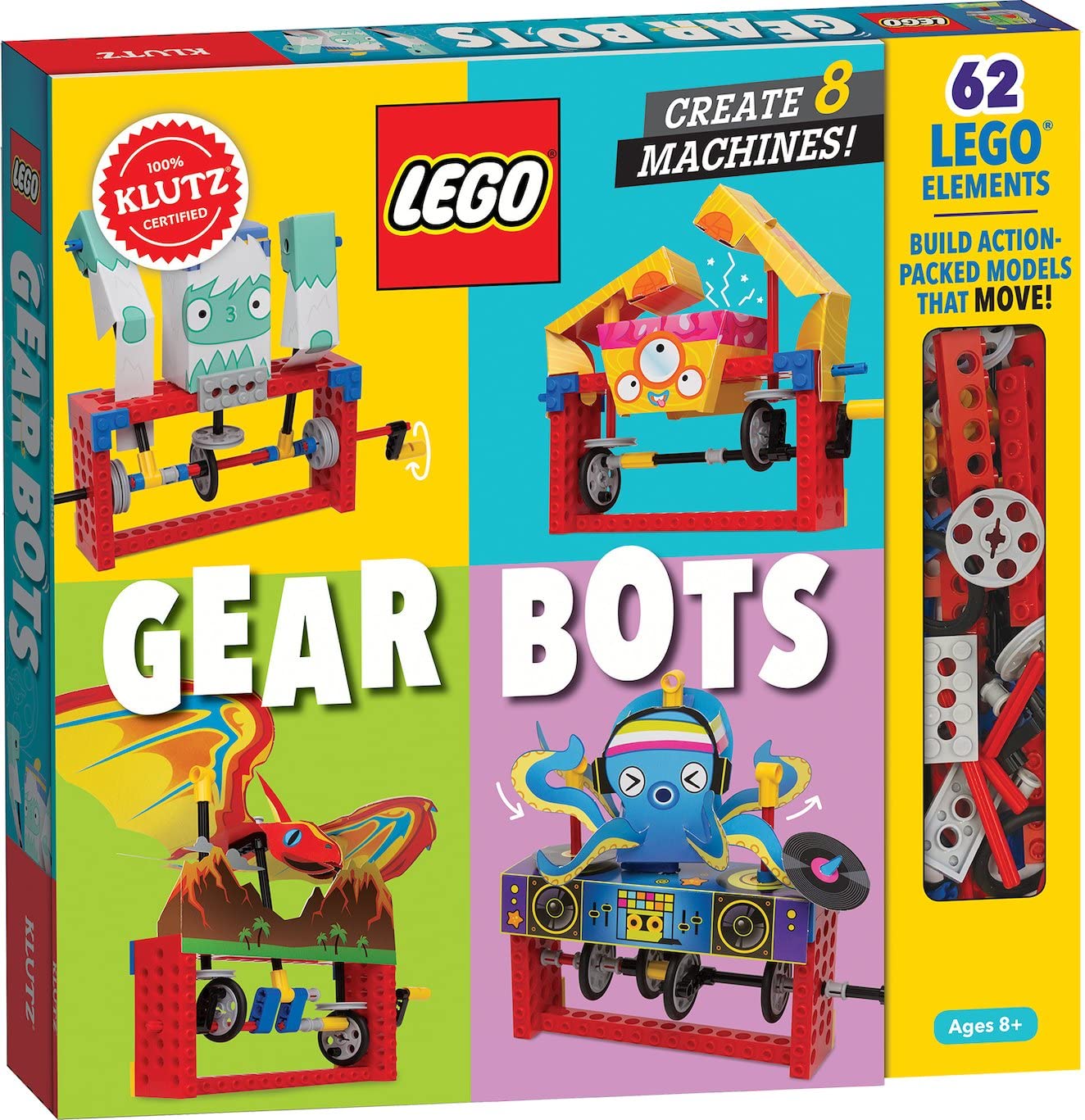
Klutz LEGO Gear Bots
Key Features
- Age range: 8 to 12 years
- LEGO elements: 62
- Models to build: 8
- Papercraft sheets: 10
- Price: Budget
Eight machines come out of this box, and they move. A crank turns, a cam lifts, a paper claw opens — the LEGO Technic parts do the mechanism and the papercraft gives each creature its body. For a child who has built everything in the house twice, that is a different kind of building.
The 64-page book is why it works. It walks through axles, cams, and cranks with a model in front of you rather than explaining them in the abstract, and the ten printed sheets are scored to fold around the bricks. Reading the instructions first genuinely pays off here, which is not something we say often.
The catch is that you build one at a time. There is one set of Technic elements in the box, so the scorpion comes apart before the lizard goes together, and a child picturing a shelf of finished machines will be disappointed. The paper parts are also the first thing to crease, so fold carefully and store the finished creature flat or not at all.
For eight- to twelve-year-olds who like knowing how things work, this is the one we hand over first. It is a rainy-afternoon kit rather than a permanent addition to the toy library — build it, run it, take it apart, come back in a month.
Pros
- Eight machines that actually move
- A 64-page book that teaches the mechanism
- Uses Technic parts plus papercraft
Cons
- One model at a time — disassembly required
- Paper parts crease and tear with rough handling
We hand this to eight- to twelve-year-olds who want to know how a machine works; it’s a project, not a permanent model.
Best for Little Hands
PicassoTiles Hedgehog Bristle Blocks 120

Key Features
- Pieces: 120
- Designs: 20+
- Texture: Soft rubbery plastic
- Age range: 3 years and up
- Price: Midrange
The bristles are the point. Soft, rubbery spikes push into each other at odd angles, so a three-year-old can make a blob, add a head, and call it a dog — and when the whole thing goes over, nobody’s heel finds a sharp corner at six in the morning.
There are 120 pieces and more than 20 designs to copy, and unlike bricks or tiles there is no wrong way to join two of them. That makes it forgiving for the youngest builder in the house and genuinely good for a child who gets frustrated by instructions — the model goes together the first time, which is not true of everything on this page.
Texture is doing a lot of the work. The pieces are soft enough to squeeze, they wipe clean, and they don’t clatter underfoot, so the set survives being stood on and swept into a basket at the end of the day. Keep an eye on the bristle tips in a house with a crawler; the wear that matters is a missing spike, not a scuffed block.
We keep it for households with a three- or four-year-old who wants to build without asking for help. It is not the set for a child who needs the model to stay exactly as built — for that, go back to bricks or to the tiles.
Pros
- Soft pieces that never hurt underfoot
- Joins at any angle, so no wrong build
Cons
- Joints can slip apart when a big build is moved
- Small bristles can detach — choking risk for younger siblings
A soft, forgiving first building set for three-year-olds, especially in a house with a younger sibling crawling around.
How We Tested the Best Building Toys for Kids
We started by pulling together roughly 60 sets — magnetic tiles, wooden blocks, classic bricks, connector kits — and narrowing them by age grading, piece count, safety labeling, and the complaints that kept resurfacing in customer reviews. From that pile, 14 sets made it into homes for four months of real use.
Most of the testing happened on living room floors, not a lab bench. We watched kids from about 2 to 10 open each set cold, spread the pieces out, and build with no instructions in sight; I timed how long a 4-year-old could work solo before handing a piece to an adult, which told us more about assembly than any spec sheet. We kept a running count of which bins got pulled out again two weeks later, and photographed the finished builds, because cuteness — the colors, the shapes, whether a finished castle actually looked like a castle — turned out to drive what the kids reached for next.
Then we got rough with them: towers pushed until the magnets let go, pieces pried apart by an adult and by a 6-year-old, bins tipped off a coffee table onto hardwood, and a week of ordinary floor life to see if corners chipped, paint scuffed, or magnets worked loose from their housings. Every set got the small-parts check against a toilet-paper tube, plus a squeeze on each magnet housing to make sure nothing shifted under a curious fingernail. Wooden pieces were checked for splinters and rough edges straight out of the box.
Finally, we priced each set per piece and per hour of actual play. Value, in this category, is the set still being built with in March — not the one with the biggest box.
How to Choose Building Toys for Kids
The right set is decided by three things, in this order: who is still putting pieces in their mouth, what kind of thing your child actually wants to make, and whether the pieces have somewhere to live afterwards.
Start With the Age, Then the Pieces
Small parts are the first filter, before piece count or brand. Anything with pieces small enough to disappear belongs in a house where the child has stopped mouthing toys; for a two-year-old that means solid wood with nothing removable. Magnetic tiles and interlocking discs are a three-and-up purchase, and LEGO-style bricks realistically start at four whatever the box says. With a younger sibling around, buy the older child a set that lives on a shelf rather than on the floor.
Match the Format to What They Want to Build
Four formats do four different jobs. Bricks make detailed models that survive being carried across a room; magnetic tiles enclose space fast, so a castle goes up in a minute; wooden blocks stack, balance, and fall, which is the whole game at two; and discs build angular three-dimensional shapes nothing else here manages. Choose by the thing your child asks for, not by the biggest number on the box — a hundred bricks and a hundred tiles are nothing like each other.
How Far a Set’s Pieces Actually Go
The count on the front panel measures volume, not buildable size. A large tin can arrive a quarter full, and a 24-piece travel set is meant to build exactly one small house. Look at what the set’s own pictures build from that exact count: 32 tiles make a doll-sized house, 100 make something a child can sit behind. Two mid-size sets usually beat one enormous one, because siblings can use them apart.
Magnet Grip Decides Whether the Tower Survives
With tiles, the magnet does the job gravity does for wooden blocks, and a weak grip shows up the moment a build gets tall. Test it the simple way: make a box of four tiles, stack boxes three high, then lean on the top. Tiles that hold a nine-tile cube are fine for what most three- and four-year-olds build; a six-year-old going higher wants a firmer pull. Stay inside one maker’s system too, since tile sizes and magnet placements differ enough that mixed sets build crooked.
Storage Decides Whether It Stays in Rotation
The set that gets played with is the set that goes away easily. A lidded bin, a tin, or a jar isn’t a bonus feature — it’s the difference between a two-minute tidy and a forty-minute sorting job nobody volunteers for. Loose tiles and discs end up in a drawer, then a cupboard, then forgotten. If your set arrives without a container, buy one the same week, sized so a child can carry it, and make closing the lid part of the game.
Frequently Asked Questions
How do you clean building toys?
Plastic bricks, tiles, and discs take a wipe with a damp cloth and a little mild soap, then air-dry fully before they go back in the bin. Don’t soak a magnetic tile — the magnet sits inside the plastic, and water has no way out.
Wooden blocks get the same damp wipe and never a soak, because water raises the grain and lifts the paint. Keep anything with magnets, printing, or paper parts out of the dishwasher.
What should I do if a new set is missing pieces?
Count the contents against the parts list on the box the day the set arrives, not on the morning it gets opened. Missing-piece claims and returns are simple inside the return window and much harder after it closes.
If you bought it early as a gift, open it and check before you wrap it. Twenty minutes now costs less than a disappointed birthday.
How long will a child keep playing with building toys?
Wooden blocks run from about two to six, magnetic tiles from three to eight or beyond, and LEGO-style bricks from four into the teens, especially once a child starts building from their own head instead of the booklet.
Buy for the next two years rather than the next ten. A five-year-old gets more from a 100-piece tile set today than from a mechanism kit they’ll only be ready for at eight.
Final Verdict
For most families the LEGO Classic Medium Creative Brick Box is the one to buy. It has the most useful pieces for the money of anything here, it joins the LEGO already in the house, and the lidded bin means the set survives the week. Start it at four.
If the birthday is for a two-year-old, buy the Melissa & Doug wooden blocks instead — the only set here that needs no supervision. And if your child builds big and knocks it down hard, the 100-piece PicassoTiles set is the one that keeps up.
