This post contains affiliate links. We may earn a small commission when you buy through our links — at no extra cost to you.
Pages stop responding, magnets crack, and feeding mechanisms jam — within weeks of unwrapping, many electronic toddler toys fail. The market pushes flashy lights and sounds, but reliability suffers: a $30 learning laptop that dies in two months is worse than a $15 set of building blocks that holds up through a second child. Wooden and simple construction toys consistently outlast their battery-powered counterparts, and bilingual options add genuine educational value without the failure risk. The real choice isn’t between expensive and cheap — it’s between a toy that keeps working and one that ends up in the recycling bin before the child outgrows it.



Best for First learning toy
LeapFrog 100 Words Book
Rating: 4.8 ★ | Price: $17.99 | Age Range: 18–48 mo | Educational Focus: Bilingual vocabulary | Durability: Tactile plastic pages | Interactivity: Sound, touch pages
Bilingual vocabulary building with durable tactile pages and strong gift appeal – the safest bet for a toddler’s first electronic book.
Twelve touch-sensitive pages teach 100 words in English and Spanish across categories like animals, food, and colors. The spiral-bound book survives drops and page-turning from 18-month-olds, and toddlers independently trigger the sound effects and simple questions for minutes at a time. Battery life holds up to daily use, and the volume control lets caregivers set a reasonable level.
Best suited for families wanting early bilingual exposure or a reliable first electronic toy for 18–24 month olds. The drawbacks: a small percentage of units arrive with unresponsive pages or speaker glitches. Given 145,000+ reviews and the low failure rate, that risk is manageable, but check the return policy if buying as a gift.
Pros
- Teaches 100 words in two languages with touch-activated sounds and simple quiz modes
- Spiral-bound pages and hard plastic cover withstand toddler handling and falls
- Holds attention for long stretches, making it a reliable travel and quiet-time tool
Cons
- Some units have unresponsive touch pages or speaker issues out of the box
- Battery compartment requires a screwdriver to open – inconvenient for quick swaps
Buy this if you want a durable, bilingual learning toy that most toddlers actually engage with. Skip it if you can’t tolerate the small chance of a defective unit or prefer non-electronic toys.
Best for First building set
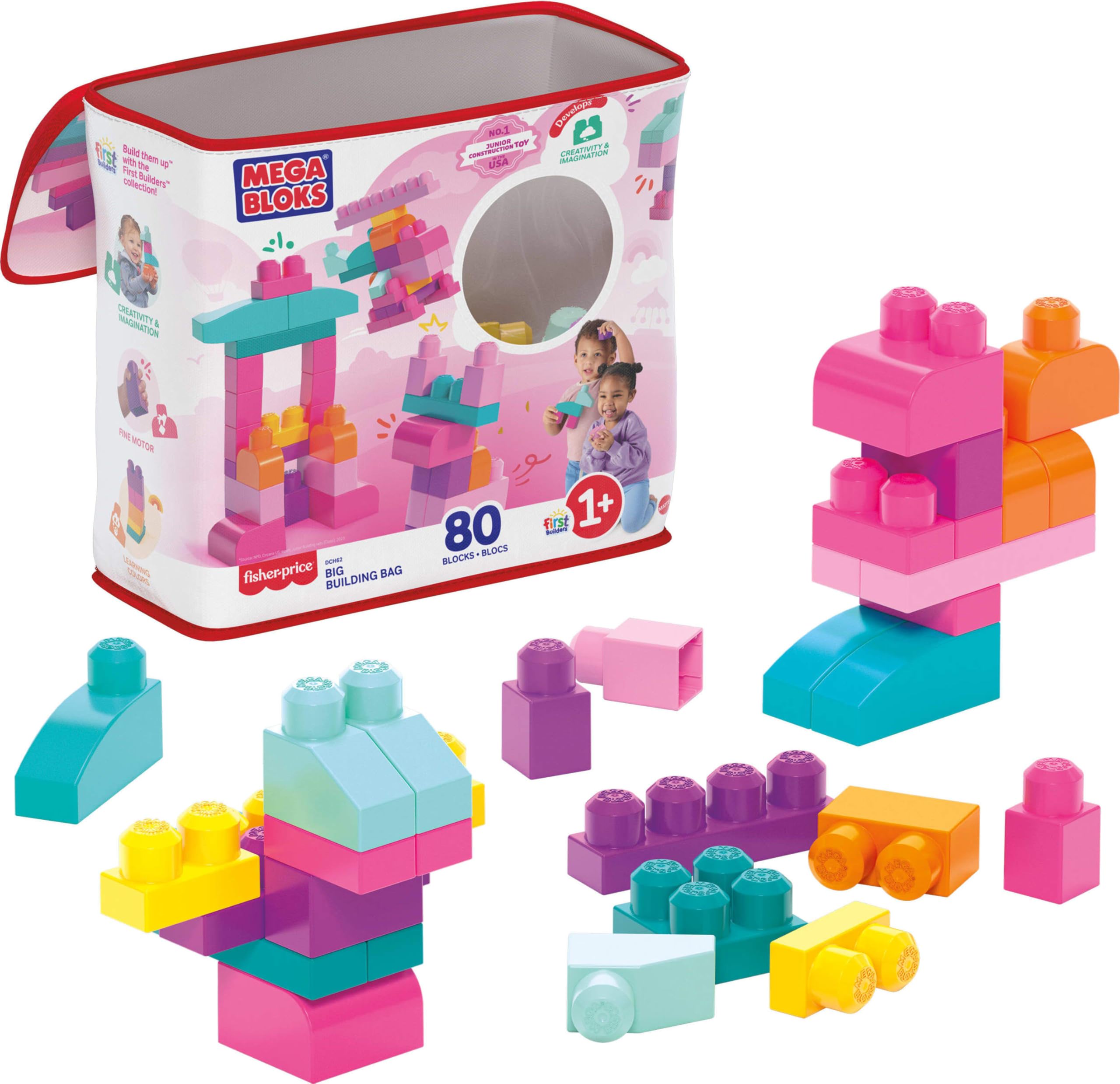
Mega Bloks 80-Piece Blocks
Rating: 4.8 ★ | Price: $14.97 | Age Range: 12–60 mo | Educational Focus: Fine motor, creativity | Durability: Hard plastic, non-toxic | Interactivity: Open-ended stacking | Storage / Portability: Reusable bag included
80 large blocks for under $15 – safe for 1-year-olds, includes storage bag. Classic open-ended building, but blocks don’t interlock tightly.
These blocks are huge (no choking risk), cheap per piece, and come in a reusable bag – a straightforward first building set. The trade-off: bricks fit loosely, so towers tip over easily. That makes them better for free-form scatter play than for kids who want stable structures. Best for 1-3 year olds just learning to stack, not for older toddlers who expect builds to hold.
Pros
- Large blocks sized for tiny hands and safe for 1-year-olds – no small parts
- Encourages open-ended creative play and fine motor development
- 80 pieces for under $15 – one of the most affordable building sets available
Cons
- Blocks do not interlock tightly; towers collapse easily, which can frustrate children expecting sturdy builds
Buy this if you want a safe, screen-free, budget-friendly first block set for a 1-3 year old who won’t mind wobbly towers.
Best for Preschool builders
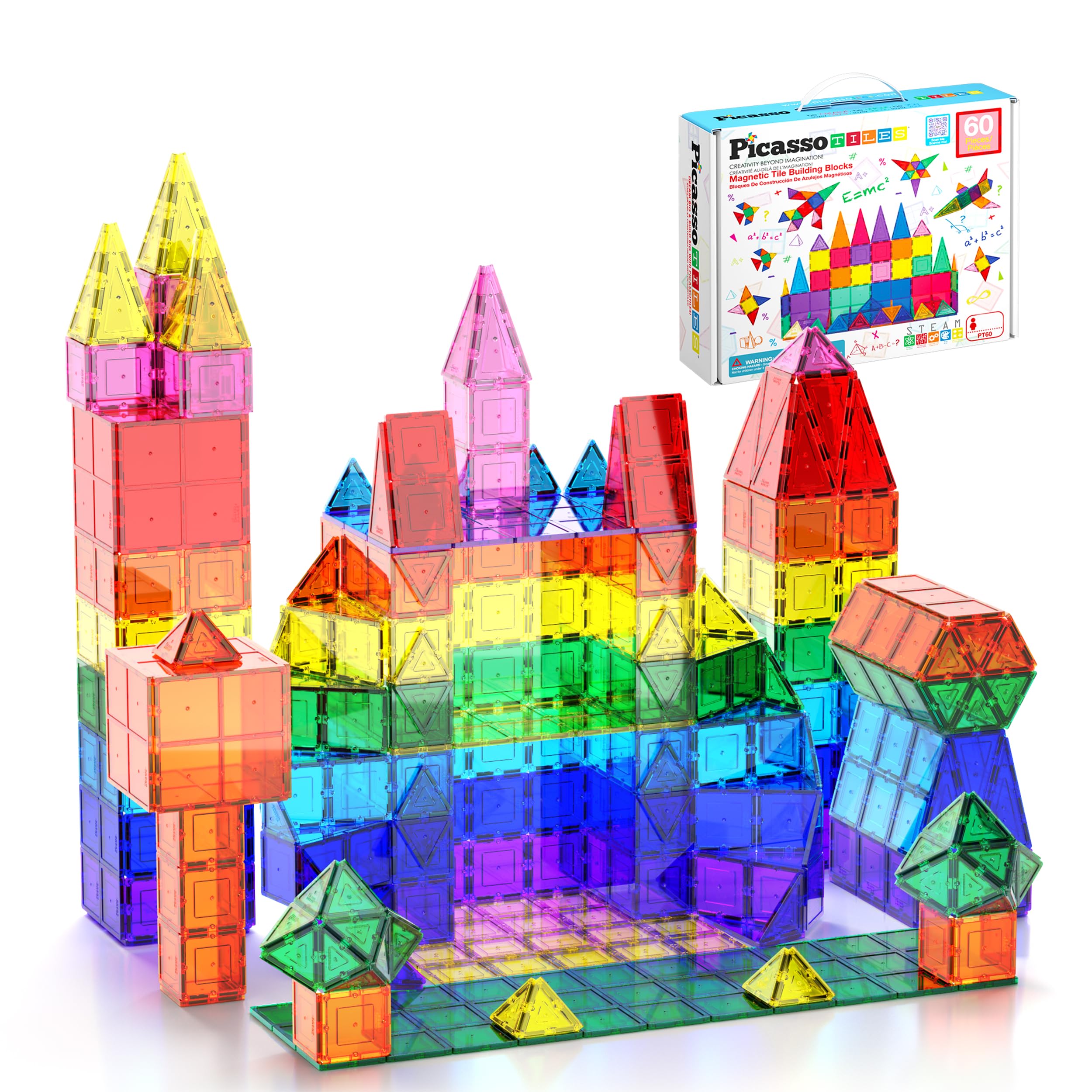
PicassoTiles 60-Piece Magnets
Rating: 4.9 ★ | Price: $19.54 | Age Range: 3+ years | Educational Focus: STEM, spatial reasoning | Durability: Plastic, magnets may weaken | Interactivity: 3D magnetic builds
60 clear magnetic tiles that work with Magna-Tiles – great for 3D creativity, but durability trails premium brands.
These 60 magnetic tiles connect on all sides, enabling 3D structures that traditional stacking blocks cannot match. They work with Magna-Tiles, so an existing collection can expand. However, magnets feel weaker than premium brands, and some tiles crack or lose magnets after rough play. Over time, durability declines faster than expected. For families wanting an affordable entry to magnetic building or a gift for preschoolers 3+, it sparks hours of STEM-encouraging creativity – but not the longevity of expensive sets.
Pros
- Children build 3D structures for hours without losing interest.
- Encourages STEM learning and creative problem-solving through open-ended play.
- Compatible with Magna-Tiles and other standard magnetic tile brands, expanding play options.
Cons
- Some tiles crack or magnets come loose after rough play.
- Magnetic strength is weaker than premium brands, limiting structural stability.
Buy this if you want an affordable magnetic tile set that works with Magna-Tiles and inspires 3D creativity. Skip it if your child plays roughly or you expect a set that lasts years without issues.
Best for Mess-free travel art
Crayola Color Wonder Set
Rating: 4.8 ★ | Price: $20.29 | Age Range: 3–5 years | Educational Focus: Creativity, color recognition | Durability: Paper mats, markers dry out | Interactivity: Mess-free coloring, stamps | Storage / Portability: Carrying case included
Markers that only work on special paper — no stains on furniture or clothes — make this the cleanest coloring option for travel.
Markers only work on the included special paper, so no stains end up on furniture, clothes, or car seats — a genuine relief for parents of toddlers. The set includes 24 coloring sheets, stamps, and a carrying case, making it ready for restaurants or waiting rooms. Colors appear muted and the red marker reads closer to orange, a known trade-off for the mess-free chemistry. A faint chemical smell from the markers is noticeable on first use. For pure stain-free portability, this delivers; for color accuracy, it does not.
Pros
- Truly mess-free – markers only work on special paper, no stains on furniture or clothes
- Great for travel and restaurants, keeps kids engaged quietly
- Colorful and fun activity that encourages creativity
Cons
- Some colors appear off (red looks orange); markers have a chemical smell
Buy this if you need a truly stain-free coloring activity for toddlers on the go.
Best for Educational electronic toy
VTech Chomp & Count Dino
Rating: 4.8 ★ | Price: $19.97 | Age Range: 12–36 mo | Educational Focus: Numbers, colors, feeding | Durability: Hard plastic, durable | Interactivity: Sound, food pieces, buttons | Storage / Portability: Pull-along string
An interactive dinosaur with 130+ songs, 8 food pieces, and a pull-along string that teaches counting and colors through cause-and-effect play.
The VTech Chomp & Count Dino packs 130+ songs, sound effects, and eight food pieces into a pull-along toy that teaches numbers, colors, and food names. Unlike the nurturing pet carrier, this dino prioritizes cause-and-effect learning and fine motor practice. The trade-off: the feeding slot requires a precise angle that can frustrate younger toddlers, and the toy remains noticeably noisy even with volume control. Best suited for families who want an engaging educational toy that grows with the child, but not for those seeking quiet play or children easily frustrated by fine-motor challenges.
Pros
- Teaches numbers, colors, and food names through interactive feeding action.
- Highly engaging – toddlers enjoy feeding the dino and pressing buttons repeatedly.
- Durable construction holds up to daily use and multiple children.
Cons
- Feeding slot requires a precise angle; can frustrate younger toddlers.
- Toy is noisy even with volume control; not suitable for quiet environments.
Buy this if you want a highly interactive dinosaur that teaches basic skills and keeps toddlers entertained, but be prepared for the feeding slot precision and noise level.
Best for Indoor active play
Mollybee Scavenger Hunt Cards
Rating: 4.8 ★ | Price: $11.04 | Age Range: 2–4 years | Educational Focus: Vocabulary, observation | Durability: Thick cardstock, wipeable | Interactivity: Search-and-find game | Storage / Portability: Ring keeps cards together
Wipeable cards on a ring – instant indoor activity with no setup, but limited long-term engagement.
Wipeable cards on a ring make this an instant indoor activity with no setup. Each card lists common household items for toddlers to find, turning ordinary rooms into a search game that builds vocabulary and focus. Best for ages 2–3, it gives screen-free engagement for curious kids and frazzled parents. The trade-off is real: once every item on the 20 double-sided cards has been found, interest tends to drop. This isn’t a daily driver toy – it works best as a periodic prompt for learning and movement. Keep it in the diaper bag for restaurants or rainy afternoons.
Pros
- Engages toddlers in an active search game that teaches object names and attributes
- Ring-bound cards stay organized and wipe clean after messy hands
Cons
- Interest drops after all household items are found; limited long-term reuse
Buy this if you need a quick, no-screen indoor activity for a curious toddler. Skip it if you want something with lasting replay value.
Best for Pretend play helpers
Melissa & Doug Cleaning Set
Rating: 4.8 ★ | Price: $34.82 | Age Range: 3–5 years | Educational Focus: Pretend play, life skills | Durability: Wood and plastic | Interactivity: Role-play tools | Storage / Portability: Stand for storage
Wooden cleaning tools for little helpers, but the brush and mop may break after a few months of use.
This 6-piece set gives toddlers real-looking wooden tools to mimic grown-up chores—a refreshing break from electronics like the top pick’s sound-and-song approach. The broom, mop, duster, and stand are scaled perfectly for ages 3–4, and the wood construction feels sturdier than most plastic alternatives. However, the brush and mop head are known to separate or break after a few months of regular play, so heavy-handed kids are likely to be disappointed.
Pros
- Realistic wooden tools encourage role-play and life-skill practice
- Child-sized dimensions let toddlers comfortably mimic adult cleaning
Cons
- Brush and mop heads detach or break after a few months of normal use
- Price is higher than many plastic cleaning sets
Buy this if your toddler loves helping with housework and you prefer wooden toys over plastic; skip it if the child is rough with toys or you need something that lasts years.
Best for First riding toy
SEREED Balance Bike 4-Wheel

Rating: 4.8 ★ | Price: $29.97 | Age Range: 12–24 mo | Educational Focus: Gross motor, balance | Durability: Aluminum frame, TPU wheels | Interactivity: Riding, scooting | Storage / Portability: Lightweight (3.5 lbs)
Four wheels and tool-free assembly – ideal for first-time riders 12-18 months, but outgrown quickly.
This 4-wheel balance bike offers extreme stability for very young toddlers just learning to scoot, with tool-free assembly and a cute design. However, the seat runs small; many children outgrow it well before 18 months, limiting its useful life.
Pros
- Extremely stable with four wheels – ideal for very young first-time riders
- Easy to assemble without tools
Cons
- Seat may be too low for some 18-month-olds; size runs small
Worth considering if your toddler is 12-18 months and needs a stable first bike for smooth surfaces.
Best for Sensory play
Kinetic Sand Ice Cream Set

Rating: 4.7 ★ | Price: $9.99 | Age Range: 3+ years | Educational Focus: Sensory play, imagination | Durability: Sand may dry out | Interactivity: Scented, moldable sand | Storage / Portability: 1 lb sand, tools included
Three scented kinetic sand colors with tools for mess-free sensory play.
The three scented colors and tools encourage imaginative pretend play without the mess of regular sand, making it great for short sensory sessions. However, the 1-pound quantity is small and the scent fades after a few uses, so refill sand may be needed for repeated play.
Pros
- Scented sand provides an extra sensory layer that appeals to young children.
- Mess-free alternative to traditional sand that cleans up easily from surfaces.
Cons
- Small amount of sand can be used up quickly if played with frequently.
Worth considering if you want a low-commitment, mess-free sensory toy for occasional play and don’t mind supplementing with extra sand.
Best for Dress-up jewelry
PinkSheep 24 Jewel Rings

Rating: 4.7 ★ | Age Range: 3+ years | Educational Focus: Dress-up, imagination | Durability: Metal/plastic, stones fall off | Interactivity: Adjustable rings | Storage / Portability: Box included
24 unique, adjustable rings in a storage box – perfect for party favors, but durability is poor.
Includes 24 different sparkly rings in a storage box, each adjustable to fit small fingers. The variety and low price make them great for dress-up or party favors. However, stones pop off easily and the metal can turn fingers green, so expect some pieces to break quickly.
Pros
- All 24 rings are different, sparkly designs – no duplicates.
- Rings adjust to fit both small and slightly larger fingers.
Cons
- Stones/ornaments fall off easily; metal may discolor sensitive skin.
Worth considering if you need a bulk set of play jewelry for a party or short-term dress-up, but not for daily wear or sensitive skin.
Best for Pretend pet care
VTech Care for Me Carrier

Rating: 4.8 ★ | Price: $29.99 | Age Range: 9 mo –3 yrs | Educational Focus: Empathy, responsibility | Durability: Plastic, plush puppy | Interactivity: Songs, light-up buttons | Storage / Portability: Carrier handle, portable
A light-up carrier with 100+ songs and a plush puppy that encourages nurturing play, but some toddlers lose interest quickly.
This carrier combines a plush puppy with a light-up handle that plays over 100 songs, making it easy to take on trips. It teaches empathy through pretend feeding and grooming. However, many children lose interest after a few sessions, and at $29.99 it costs more than simpler plush sets that offer longer engagement.
Pros
- Plush puppy and carrier design encourage nurturing pretend play.
- Carrier handle makes it portable for trips; includes bottle, bowl, comb, and ball.
Cons
- Some toddlers lose interest after a few play sessions, reducing long-term value.
Worth considering if you want a portable toy to encourage nurturing pretend play for a toddler who loves animals, but be aware that engagement may be short compared to other options.
How to Choose
The most important factor in choosing a toddler gift is whether the toy will survive daily use and keep the child engaged beyond the first week.
Age Range
Toys labeled for 3+ may contain small parts or complex mechanisms that frustrate younger toddlers. Always check the lower age limit — a toy that’s too advanced will sit unused, while one too simple gets quickly outgrown. Balance bikes, for instance, often run small, so measure your child’s inseam before buying.
Educational Focus
Decide whether you want a toy that builds vocabulary, fine motor skills, or social-emotional learning. Bilingual options add long-term value, and open-ended building sets encourage creativity without a script. Electronic toys teach specific skills but often have a shorter shelf life once the child masters them.
Durability and Material Quality
Wood and thick plastic generally outlast electronics with moving parts. Look for non-toxic materials and avoid toys with thin plastic hinges or small glued-on pieces. Many electronic toys fail within months — a simple, robust construction often proves more cost-effective.
Interactivity
Lights, sounds, and moving parts keep toddlers engaged, but they also increase the chance of breakdown. Mechanical simplicity (stacking, sliding, pushing) often holds attention just as well and won’t stop working when batteries die. Test if the toy can be enjoyed without its electronic features.
Portability and Storage
Toys that store compactly (collapsible, bags included) travel better and keep the home tidy. Large building sets without storage create clutter; a bag or bin can make cleanup part of the play. Portable options like scavenger cards or mess-free art kits are lifesavers for waiting rooms and car trips.
FAQ
Do LeapFrog books still work after the batteries die?
Yes, the book still functions as a regular board book with pictures and words, but the audio and interactive features stop. Many parents replace batteries after a few months. The book’s durability is not affected by battery life.
Are Mega Bloks compatible with Duplo?
Mega Bloks and Duplo are not fully compatible. Mega Bloks are slightly larger and have a looser fit, so they won’t interlock securely with Duplo bricks. Stick with one brand for consistent building play.
Why does my toddler’s balance bike seat feel too low?
Many balance bikes, especially 4-wheel models for young toddlers, have a fixed seat height that runs small. If your child’s legs are fully bent or they can’t push, the bike may be too small. Always measure the seat height against your child’s inseam before buying.
How long do Crayola Color Wonder markers last before drying out?
Crayola Color Wonder markers typically last for several weeks of regular use, but they can dry out faster if the caps are left off. Some parents report that the markers stop working after a few sessions. The paper mats remain reusable with any standard dry-erase markers if you want to extend play.