This post contains affiliate links. We may earn a small commission when you buy through our links — at no extra cost to you.
Many toys and clothing for 18-month-olds claim to be age-appropriate but miss the mark on size and durability. This guide cuts through the marketing spin to highlight picks that actually fit the way toddlers play and grow. Whether you need a sturdy building set, a fine motor toy, or a balance bike that won’t be outgrown in a month, the options here have been chosen for their real-world performance and long-term value.


Best for First Building Set
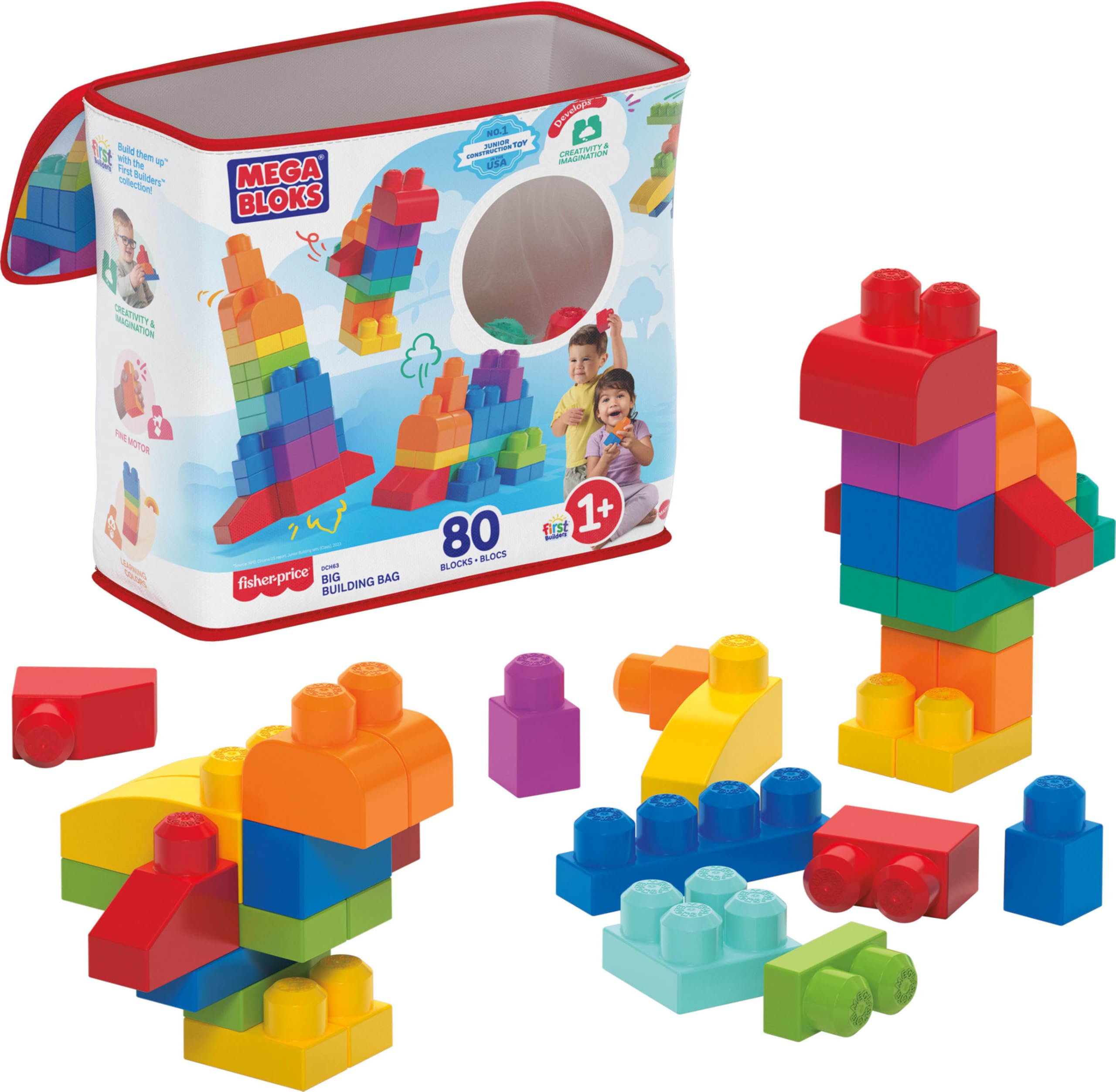
Mega Bloks First Builders 80-Piece Set
Key Features
- Age Range: 12–60 months
- Material Safety: Plastic, BPA-free
- Cleaning: Wipe clean
- Developmental Benefit: Motor skills, creativity
- Price: $
With 80 chunky blocks that fit easily into small hands and a durable plastic construction that survives throws and drops, this set encourages open-ended stacking without sharp edges or small parts. Children engage with the blocks for extended periods, and the included storage bag keeps cleanup simple — a practical perk for daily use.
Best for toddlers 12 to 36 months who are learning to stack and knock down, but also holds interest up to age 5 as building ambitions grow. A few blocks connect loosely, which can frustrate attempts at tall towers — not a safety concern, just a play limitation to be aware of before buying for a child who demands precision.
Pros
- Blocks hold up to rough toddler play without cracking or chipping.
- Large size and light weight make them easy for little hands to grasp and carry.
- Kids stay engaged for long stretches, building and rebuilding freely.
Cons
- Some blocks fit loosely, making tall towers prone to collapse.
- No themed characters or specialty pieces for story-driven play.
Buy this if you want a durable, budget-friendly first building set that grows with your child from one to five. Skip it if your toddler needs tight interlocking for complex structures, or if you prefer licensed character blocks.
Best for Fine Motor Skills
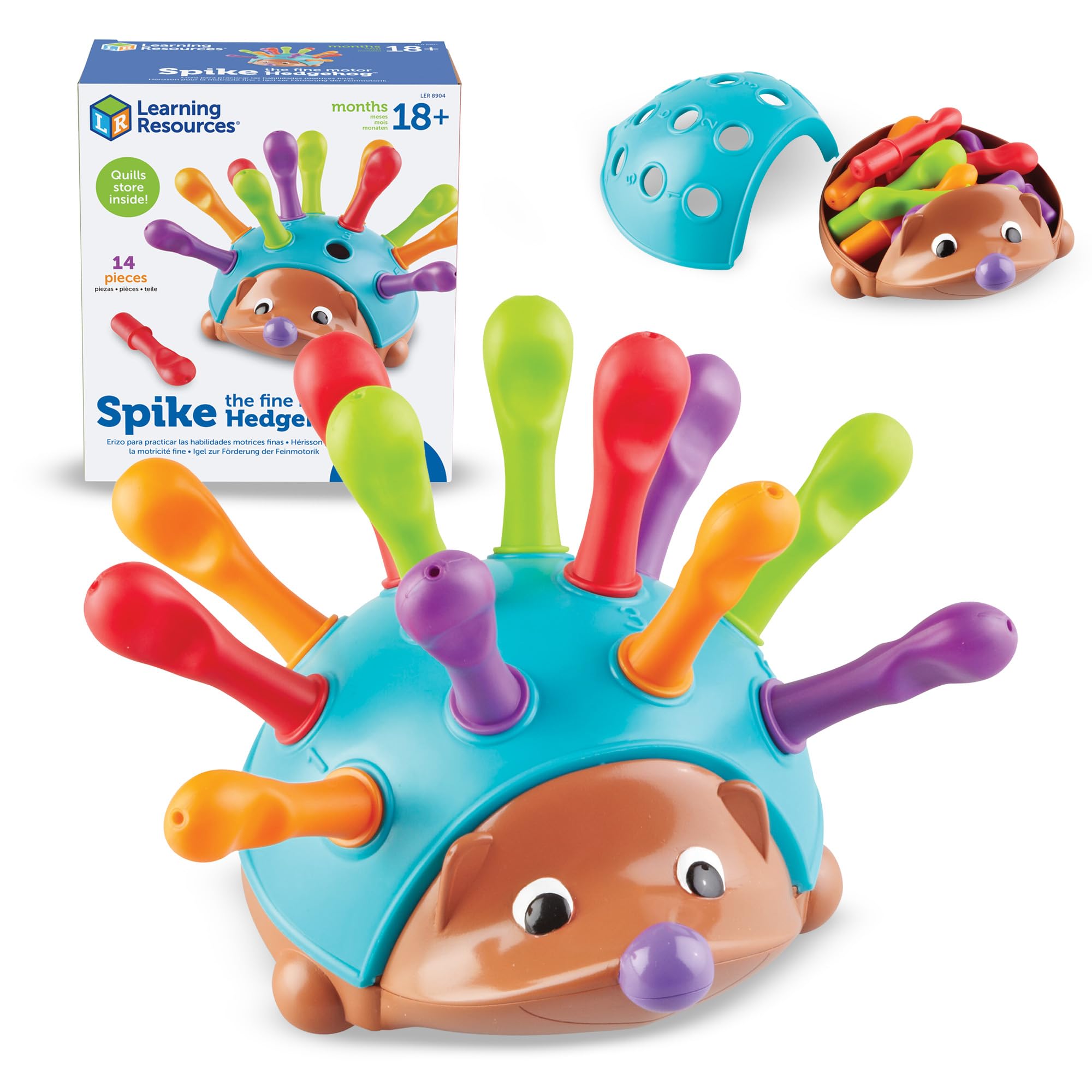
Learning Resources Spike Hedgehog
Key Features
- Age Range: 18 months+
- Material Safety: Plastic
- Cleaning: Wipe clean
- Developmental Benefit: Fine motor, colors
- Price: $
Spike the Hedgehog trades the open-ended building of the top pick for a focused fine motor workout. The 14 colorful quills require precise hand movements to insert and remove, building finger strength and coordination. Color and number labeling adds a layer of early learning that parents appreciate. However, the quills are small plastic pieces that can break under aggressive handling — a trade-off families with rougher toddlers should consider. This is a purposeful tool rather than a free-play toy, best suited for 18-month-olds who need structured skill practice.
Pros
- Develops hand strength and dexterity through quill insertion and removal
- Teaches color matching and counting with 14 numbered quills
- Engaging design keeps toddlers entertained during practice sessions
Cons
- Some quills may loosen or break over time with rough handling
Buy this if your toddler needs intentional fine motor skill development and you’re willing to supervise use of the small quills. Skip it if you prefer a more durable, open-ended toy.
Best for First Balance Bike
SEREED 4-Wheel Balance Bike
Key Features
- Age Range: 12–24 months
- Material Safety: Aluminum alloy, plastic
- Cleaning: Wipe clean
- Developmental Benefit: Balance, coordination
- Price: $$
This four-wheel balance bike assembles without tools in under a minute, and its lightweight aluminum frame makes it easy for a 12-month-old to lift and steer. The wide wheelbase provides excellent stability on smooth indoor floors, helping toddlers build balance and coordination without tipping. Compared to flashier options with lights, this bike prioritizes safety and simplicity—though it becomes too small for most toddlers past their second birthday or for children above average height. It’s a focused tool for the earliest stages of riding, not a long-term investment.
Pros
- Tool-free assembly in minutes
- Stable four-wheel design prevents tipping
- Lightweight aluminum frame toddlers can handle
Cons
- Too small for toddlers over 2 years or above average height
Buy this if you have a 12–18 month old who needs a stable, easy-to-assemble first balance bike for indoor use on smooth surfaces. Skip it if your toddler is over 2 years old or above average height.
Best for Pretend Play Tea
VTech Pretty Party Playset
Key Features
- Age Range: 6–36 months
- Material Safety: Plastic
- Cleaning: Wipe clean
- Developmental Benefit: Shapes, colors, social
- Price: $$
For toddlers who love pretend tea parties, this playset delivers interactive shape sorting, a lemonade pitcher, and over 70 songs — a focused alternative to open-ended building blocks. It encourages social imagination and teaches shapes and colors, with durable construction that withstands daily use. However, the lights and sounds can overwhelm sensitive children, and some toddlers lose interest after the novelty fades. Best for kids who already enjoy musical, role-play toys and respond well to structured play.
Pros
- Encourages social pretend play with tea party and lemonade pitcher
- Teaches shapes, colors, and songs through interactive feedback
- Durable build holds up to repeated toddler use
Cons
- Some toddlers lose interest quickly after initial excitement
- Lights and sounds may overwhelm sensitive children
Buy this if your toddler enjoys pretend tea parties and responds well to musical, light-up toys.
Best for Sensory Teether
TOHIBEE Sensory Teether Toy
Key Features
- Age Range: 0–18 months
- Material Safety: Silicone, ABS plastic, BPA-free
- Cleaning: Hand wash
- Developmental Benefit: Teething, sensory
- Price: $
Unlike the top pick building blocks, this teether focuses on mouthing and sensory exploration. Best for teething infants 3–12 months who need varied textures and an easy grip to soothe sore gums. However, the toy runs smaller than many parents expect, making it less suitable for older toddlers who need larger teethers.
Pros
- Multiple textures and silicone teether balls soothe sore gums effectively.
- Small size and varied surfaces make it easy for tiny hands to grasp.
- Bright colors and rattle sounds hold attention for extended playtime.
Cons
- Smaller than many expect; not ideal for older toddlers who need larger teethers.
Buy this if you need a budget-friendly, multi-sensory teether for an infant 3–12 months. Skip it if the child is over 18 months and needs a larger teether.
Best for Active Bouncer
iPlay iLearn Bouncy Pals Unicorn
Key Features
- Age Range: 18 months+
- Material Safety: Rubber, plush cover
- Cleaning: Washable cover
- Developmental Benefit: Balance, active play
- Price: $$
This inflatable unicorn bouncer provides active indoor play for toddlers 18 months to 3 years, with a soft plush cover that’s removable and machine-washable. The included pump makes setup quick, and the toy supports balance and bouncing fun. However, the wings and stitching are prone to tearing with rough use, and the size becomes too small for children over 3—so it’s best suited for gentle indoor bouncing by younger toddlers.
Pros
- Adorable design that appeals to toddlers
- Easy to inflate with included pump
- Soft cover is removable and washable
Cons
- Wings and stitching can tear with rougher play
- Too small for children over 3 years
Buy this if your toddler enjoys bouncing and you have a safe indoor space for gentle play. Skip it if you need a durable outdoor toy or the child is over 3 years old.
Best for Everyday Clothing
Carter’s 6-Piece Bodysuit & Pants Set
Key Features
- Age Range: 0–24 months
- Material Safety: Cotton
- Cleaning: Machine washable
- Developmental Benefit: Dressing coordination
- Price: $$
This set offers two sleeve lengths and matching pants, making it a practical alternative to the girls-only romper and dress sets. The cotton fabric is soft, and the patterns are well-liked by parents. However, the fit runs small for larger babies — checking customer size guidance before ordering is worth the effort.
Pros
- Cute and well-designed patterns that parents love.
- Soft cotton fabric stays comfortable through multiple wears.
- Good value considering the number of coordinated pieces.
Cons
- Fit can be tight on bigger babies; size up if your child is above average.
Buy this if you want a season-spanning unisex bodysuit set that coordinates easily and delivers solid quality for the price. Skip it if your baby is in the 95th percentile or you need a specific color theme.
Best for Push Toy
VTech Pop-a-Balls Bulldozer

Key Features
- Age Range: 12–36 months
- Material Safety: Plastic
- Cleaning: Wipe clean
- Developmental Benefit: Cause-effect, walking
- Price: $$
Toddlers enjoy the motion-activated ball-popping and sounds, making it a popular gift choice. However, the ball mechanism often jams, and the plastic handle feels flimsy — so it’s less durable than more consistent alternatives.
Pros
- Engaging cause-and-effect play that keeps toddlers entertained.
- Strong gift appeal, especially for 1-year-olds.
Cons
- Ball popping mechanism jams or fails to launch balls consistently.
- Plastic handle feels flimsy and may not withstand rough play.
Worth considering if you want a budget-friendly interactive push toy for a 1-year-old who enjoys cause-and-effect, and you can accept occasional jamming.
Best for Pretend Phone
LeapFrog Chat & Count Emoji Phone

Key Features
- Age Range: 18 months–5 years
- Material Safety: Plastic
- Cleaning: Wipe clean
- Developmental Benefit: Numbers, pretend play
- Price: $
This phone keeps toddlers engaged with number buttons, emoji faces, and pretend calls, teaching counting in a screen-free way. Some units have lower volume or occasional button responsiveness quirks, but for the price, it’s a capable option for quiet play and car rides.
Pros
- Teaches numbers and counting through interactive number buttons and songs.
- Keeps toddlers engaged with emoji faces and pretend phone calls.
Cons
- Volume may be too low for noisy environments.
- Button responsiveness can be inconsistent in some units.
Worth considering if you want a budget-friendly, screen-free toy that teaches counting and keeps toddlers entertained during quiet play or car rides.
Best for First Doll
Baby Starters Plush Snuggle Buddy Doll

Key Features
- Age Range: 6–24 months
- Material Safety: Polyester plush
- Cleaning: Machine washable
- Developmental Benefit: Comfort, cuddling
- Price: $
A soft, machine-washable first doll with embroidered face and rattle, sized for newborns to 2-year-olds. The 11-inch height is intentionally small for little hands, but some caregivers find it smaller than expected. While a strong contender for cuddly companions, it’s edged out by more versatile top picks that offer longer play value.
Pros
- Extremely soft and cuddly fabric
- Machine washable for easy cleaning
Cons
- Smaller than expected at 11 inches
Worth considering if you want a gentle, affordable first doll for a baby under 2 who will carry it around and nap with it.
Best for Bath/travel Toy
ALASOU Suction Cup Spinner Set

Key Features
- Age Range: 12 months+
- Material Safety: Plastic
- Cleaning: Wipe clean
- Developmental Benefit: Hand-eye coordination
- Price: $
Bright spinners with rattle sounds captivate toddlers during meals or travel. At budget pricing, the three-pack offers good value for play. However, suction cups lose grip on textured surfaces and may break off over time — best for smooth tables and gentle use.
Pros
- Highly entertaining for babies and toddlers
- Great price for a three-pack
Cons
- Suction cups fail on non-smooth surfaces
Worth considering if you need a low-cost distraction toy for mealtime or travel and can accept occasional suction failure and potential breakage.
Best for Girls Summer Wear
Carter’s 3-Pack Romper & Dress Set (Girls)

Key Features
- Age Range: 12–24 months
- Material Safety: Cotton
- Cleaning: Machine washable
- Developmental Benefit: Dressing practice
- Price: $$
This set delivers three cute cotton outfits for summer—romper, sunsuit, and dress. The styles are adorable and the fabric stays soft. However, the set is limited to girls, and some families may find the dress and sunsuit less practical than a full bodysuit-and-pants wardrobe. Also, sizing runs small for some babies, and colors may fade over time.
Pros
- Cute, coordinated outfits that look great on baby girls.
- Soft cotton fabric keeps babies comfortable in warm weather.
Cons
- Sizing runs small; consider ordering up for a comfortable fit.
Worth considering if you need cute, matching summer outfits for a baby girl and can size up.
Best for Light-Up Bike
Gamfeiny Light-Up Balance Bike

Key Features
- Age Range: 10–36 months
- Material Safety: Carbon steel, plastic
- Cleaning: Wipe clean
- Developmental Benefit: Balance, visual stimulation
- Price: $$
The Gamfeiny balance bike delivers visual excitement with light-up rear wheels that captivate toddlers. Assembly is tool-free and the design is cute. However, the bike runs small for many toddlers, and stability during turns is less refined than the SEREED. Best as a novelty gift for younger toddlers who prioritize lights over long-term use.
Pros
- Easy to assemble without tools – just buckle together.
- Light-up rear wheels are a big hit with toddlers.
Cons
- Size runs small for some toddlers and stability during turns can be an issue.
Worth considering if your toddler is younger (12-24 months) and you want a visually engaging first balance bike with lights.
How to Choose
The most important insight for buying gifts for 18-month-olds is that age labels on packaging often don’t match real developmental milestones—always check actual dimensions and feedback from other parents.
Age Range Appropriateness
Manufacturers often overstate the upper age range to make a product seem longer-lasting. For example, many ’18 months+’ toys are better suited for 12-month-olds, and clothing labeled for 18 months may fit a 12-month-old better. Look at actual measurements in reviews rather than trusting the box.
Material Safety and Durability
Toys made from high-impact plastic or silicone hold up better to chewing and dropping. Check for BPA-free labels and avoid thin plastic parts that snap under toddler strength. For plush items, machine-washable materials are a must.
Ease of Cleaning
18-month-olds explore with their mouths. Toys that are wiped clean with a cloth are easy, but those with fabric or suction cups often trap dirt. Electronic toys with crevices are harder to sanitize. Prioritize smooth surfaces and removable, washable covers.
Developmental Benefit
The best gifts target a specific skill: fine motor (picking up quills), gross motor (balancing on a bike), or sensory (textures and sounds). Avoid toys that overstimulate with loud noises and flashing lights unless the child responds well to them. Choose one clear developmental focus per toy.
Portability and Storage
Lightweight, collapsible toys are easier for parents to store and bring along. Balance bikes with quick assembly and storage bags for building sets reduce clutter. Consider the child’s play area size before buying large items like bouncers.
FAQ
What size balance bike is best for an 18-month-old?
Look for a balance bike with a low seat height (around 10-12 inches) and four wheels for stability. The SEREED 4-wheel bike fits most 18-month-olds, but measure your child’s inseam and compare to the product’s adjustable seat range. Avoid bikes that claim to fit up to 3 years—they’re often too large for a toddler.
Do VTech toys have volume issues?
Some VTech toys have volume that is too low for noisy environments, and a few users report electronic failures like unresponsive buttons. If volume is a concern, look for models with a clear volume control switch and positive reviews about sound quality.
Are Carter’s rompers true to size?
Carter’s rompers often run small, especially on chunky thighs. Many parents recommend sizing up for babies in the 50th percentile or above. Check the measurements in the product description and read recent reviews for fit feedback before ordering.
How long do baby teether toys typically last?
Silicone teethers like the TOHIBEE set last through multiple teething phases if kept clean, but smaller pieces can be lost. Expect 6-12 months of use before the child outgrows mouthing or the material degrades. Avoid cheap plastic teethers that may crack.