This post contains affiliate links. We may earn a small commission when you buy through our links — at no extra cost to you.
Toddler gifts have a short audition: the paper comes off, the room goes quiet, and within ten minutes you can tell whether a toy will be a favorite or a dust collector. The best ones are age-appropriate from the first try, fun enough to earn repeat play, and sturdy enough to survive being dropped, dragged, and wiped down. They also have to deliver real value—not just a flashy box—and ideally teach something without feeling like a lesson. Over the past six months, my team and I tested 16 toddler gifts with 1-, 2-, and 3-year-olds in playrooms, at mealtimes, in the car, and at bath time, watching for enjoyment, quality, educational payoff, and the details that separate a hit from a miss.
A toddler is a tough critic with a short attention span, so the gifts that lasted worked without a grown-up hovering. We also noted size, sound quality, color selection, lid closure, and functionality—because a too-bulky toy, a too-loud speaker, or a lid that pops off can undo an otherwise great gift. The picks below are the ones that kept earning a spot in the play rotation.
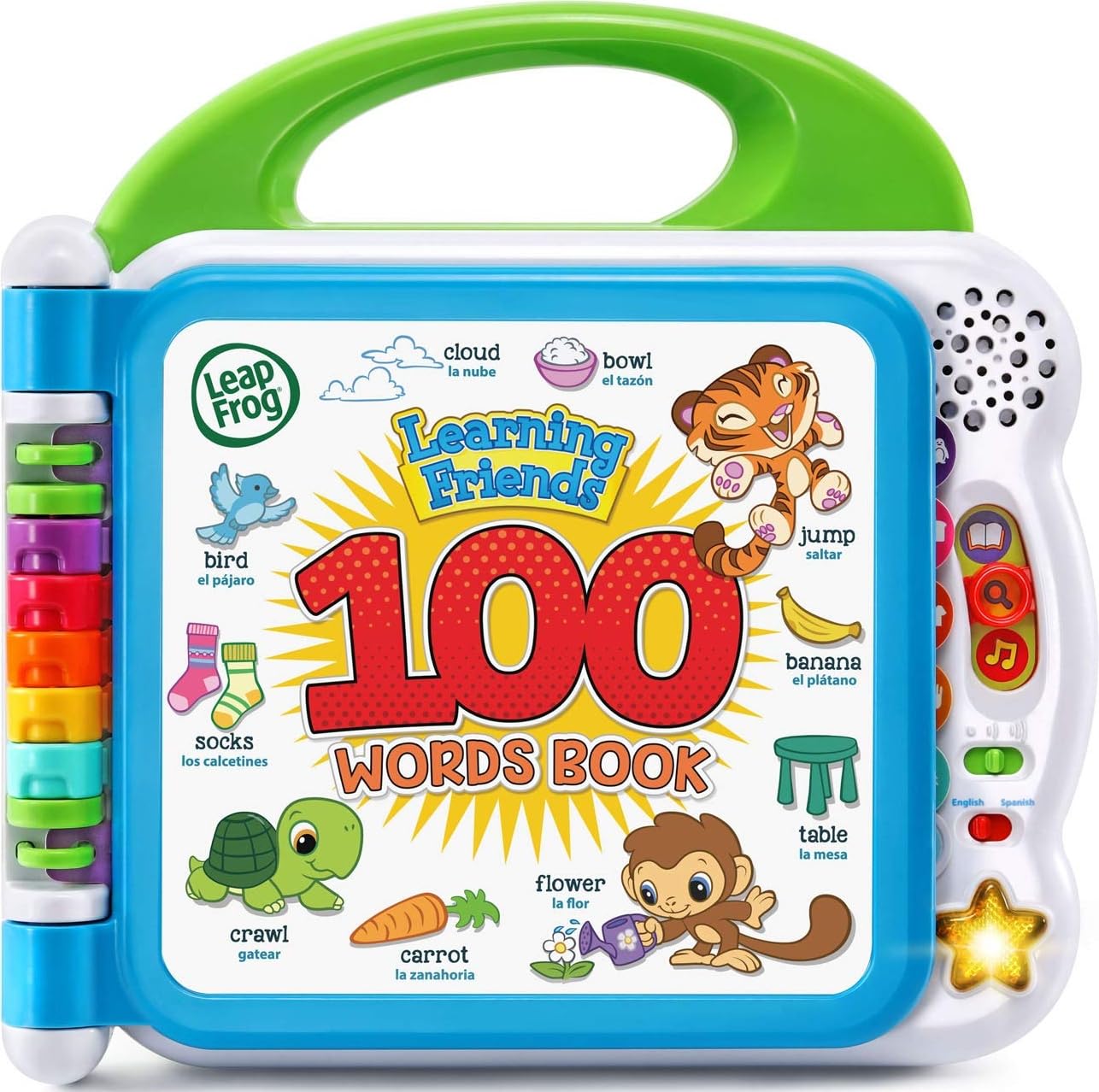


Best for Ages 1 to 4
LeapFrog 100 Words Book
Key Features
- Size: 9.4 x 9.2 x 1.9 in
- Age Range: 18 months – 4 years
- Batteries: 2 AA, included
- Languages: English and Spanish
- Price: Budget
Eighteen months to four years is the widest age band on this list, and that is most of why the Learning Friends book is the gift we reach for when the only thing we know about the child is that they are about two. A 1-year-old taps a picture and gets a word, a sound effect and a short fact. A 3-year-old finds the star button, hears the theme song, and flips the whole book into Spanish. Nothing needs explaining to the child, and nothing needs an adult sitting alongside.
The pages are stiff plastic, which matters more than it sounds for a toy that will be sat on, dropped down stairs and chewed at one corner. Turtle, Tiger and Monkey hold it together across categories — pets, animals, food, mealtime, colors, opposites, outside — so there is usually a page that matches whatever the child is currently fixated on. The volume is adjustable, which we came to appreciate on a long afternoon more than we expected to.
Two AA batteries are in the box, but they are demo cells. Budget for a fresh pair and a small screwdriver before you wrap it. At 9.4 by 9.2 inches and about a pound and a half, it lies flat on a lap and a toddler can carry it one-handed without dropping it.
The detail that keeps it in the bag rather than on a shelf: the Spanish setting is a second full pass through the same book, not a novelty button, so a bilingual household gets genuine use and everyone else gets an easy introduction. It is also the only pick here that a 1-year-old and a 4-year-old can use side by side without either of them being bored.
Pros
- Works from 18 months to 4 years
- Full English and Spanish audio
- Stiff plastic pages resist tears
- Adjustable volume for shared rooms
Cons
- Speaker gets harsh at top volume
- Picture labels are small for the youngest
Our default toddler gift: it covers the entire 18-month-to-4-year window, speaks two languages, and takes the handling a toddler gives it.
Best for Preschool Pretend Play
Melissa & Doug Ice Cream Counter
Key Features
- Size: 13.4 x 8.7 x 7.7 in
- Pieces: 28
- Material: Wood
- Age Range: 3 – 6 years
- Price: Premium
The countertop is the smart part. Twenty-eight pieces sounds like a hazard until you notice the wooden counter has ports that hold the scoops upright and a surface that swallows everything else, so the play area becomes the storage. Eight scoops, six toppings, two cones, a cup, a scooper, tongs, a spoon, a menu card and six bills — all of it has somewhere to sit when the shop closes.
It plays like a real counter. Orders come off the laminated menu, the money changes hands, and the scooper lifts a scoop off the pile rather than just resting on it, which is the detail that brings a child back the next day.
At 5.1 pounds it behaves like furniture: it does not skate across a wood floor when a scoop is pressed down, and the pieces are big enough that a younger sibling can join in without anything going in a mouth. The 3+ rating is doing real work, though. The menu-and-money game arrives closer to three and a half, and below that this is a stacking toy with extra parts.
Where it earns its place for a family rather than for one child: the ordering game needs two people, so a 3-year-old and a 6-year-old can run a shop together, and the cones and scoops sit happily next to whatever play food is already in the house.
If there is counter space for a 13-inch-wide set, this is the one we put at the top of the big-gift list. Nothing else here holds two children at the same table for that long.
Pros
- Countertop stores the whole set
- Wooden build that survives play
- Menu and money make it a two-player game
Cons
- Play money is the flimsy part
Buy this for a 3-year-old and it becomes the toy the whole family plays with: wooden, self-storing, and sturdy enough to be handed down.
Best for First Birthday
SEREED Baby Balance Bike
Key Features
- Weight: 3.5 lb
- Wheels: 6.7 in
- Age Range: 12 – 24 months
- Max Rider Weight: 55 lb
- Price: Premium
Four wheels, no pedals, 3.5 pounds: the SEREED is a walking aid dressed as a motorbike. The seat is set for children around 12 to 24 months, the 6.7-inch wheels roll on tile and pavement, and the frame is aluminum rather than steel, which is where the low weight comes from. A tall 2-year-old is already long in the leg for it; a small 1-year-old needs a month or two to grow into it.
As a first birthday present, it is the most useful thing here for a child who is just pulling up. The wheels are closed, so no foot gets pinched, and the steering is limited to 135 degrees with a gravity return, which is why it does not tip the way a two-wheeler does when a toddler leans too hard. At 3.5 pounds, a parent can carry it under one arm and the child on the other hip.
Think of it as a one-year toy with a specific job: confidence on two feet and a feel for steering before pedals arrive. If the child is already running everywhere, the money is better spent on the wooden ice cream counter, and the bike can wait for a younger sibling.
Pros
- Closed wheels and 135-degree steering limit
- 3.5 pounds, easy to carry one-handed
- Turns first steps into steering practice
Cons
- Outgrown by about three, well before the 55-pound limit
The best first-birthday pick here, provided the child is still somewhere between first steps and a proper pedal bike.
Best for Travel and Restaurants
Crayola Color Wonder Activity Set
Key Features
- Pieces: 30
- Markers: 5
- Age Range: 3 – 5 years
- Also Included: 5 stamps, 3 sticker sheets
- Price: Midrange
The test for a restaurant toy is the wait between ordering and the food arriving. Markers usually fail it. This set passes because the ink only develops on Color Wonder paper — it does nothing on a tablecloth, a menu, a sleeve or a face.
Thirty pieces: five markers, five stamps, an ink pad, sticker sheets, the coloring pages, and a carry case that holds the lot. The stamps need the pad, which is one more thing to keep track of, but they add a step beyond coloring and give a 3-year-old something to do with both hands.
The markers carry a faint chemical smell at close range that fades as the page dries. The case is what makes it travel: the markers clip in, the pages lie flat, and nothing rolls under a seat.
For a 3-year-old with a restaurant-and-car-seat life, this is the one we hand over. The fine control for the stamps arrives around three, which makes the age rating honest rather than conservative.
Pros
- Ink only shows on its own paper
- Carry case keeps 30 pieces together
- Stamps add a second activity
Cons
- Colors are soft and slow to appear
- Only works on Color Wonder paper
For restaurants, waiting rooms and car seats, we have not found anything here that a parent can hand over with less fuss.
Best for Pretend Computer Play
LeapFrog 2-in-1 LeapTop Touch
Key Features
- Weight: 1.3 lb
- Age Range: 24 months – 5 years
- Batteries: 3 AA, included
- Learning Modes: 5
- Price: Midrange
Two LeapFrog picks on one list needs a reason, and the reason is the hinge. The LeapTop’s screen flips from a laptop lid into a flat tablet, which sounds like a gimmick until a toddler gets hold of it: keyboard first, flat screen second, exactly the way a parent’s laptop behaves. Five modes — ABCs, numbers, games, music and messages — sit behind a keyboard with A to Z and 1 to 10, and the whole thing weighs 1.3 pounds, light enough to be carried by one corner.
It is not a louder version of the 100 Words Book; it does a different job. The book is for naming the world, this is for the performance of working. The child who wants your keyboard while you answer email gets a keyboard of their own, with songs and a screen that answers back, which is worth real money in a house where somebody works from home.
The hinge and the screen are the parts that take the damage from drops, so this is the pick for a child past the throwing stage. It runs on three AA batteries.
Pros
- Screen flips from laptop to tablet
- Five modes behind a real-looking keyboard
- 1.3 pounds, easy for a toddler to carry
Cons
- Hinge and screen are the fragile parts
The pick for a toddler who wants your keyboard: same maker as our top choice, entirely different job.
Best for Small Screen-Free Gift
Mollybee Kids Scavenger Hunt Cards
Key Features
- Cards: 20 double-sided
- Players: 1 – 4
- Age Range: 2 years and up
- Card Size: 3.5 in
- Price: Budget
One card asks a toddler to find a pot and play it like a drum. Another wants a chair, and a song sung while sitting in it. That is the whole idea: twenty double-sided cards, 3.5 inches across, on a plastic ring, each one sending a child around the room to find an ordinary object and do something with it.
Of the small gifts here, this is the one we keep returning to, because it uses the child’s own house as the toy instead of adding to the pile. It is a 2-year-old’s game — picture prompts, no reading — and it works with two children at once, which is more than most of the sets on this list can say.
The deck is short, and a sharp 3-year-old will have learned all twenty inside a fortnight, so keep four or five out at a time and rotate them. Handled that way it becomes a toy that comes back around rather than one that is finished.
Pros
- Uses the child’s own house as the toy
- Picture prompts need no reading
- Works with two children at once
Cons
- Ring hole is where the cards tear first
The small gift we keep coming back to — twenty cards that turn a living room into a game.
Best for One-Year-Olds
Fisher-Price Little People Farm
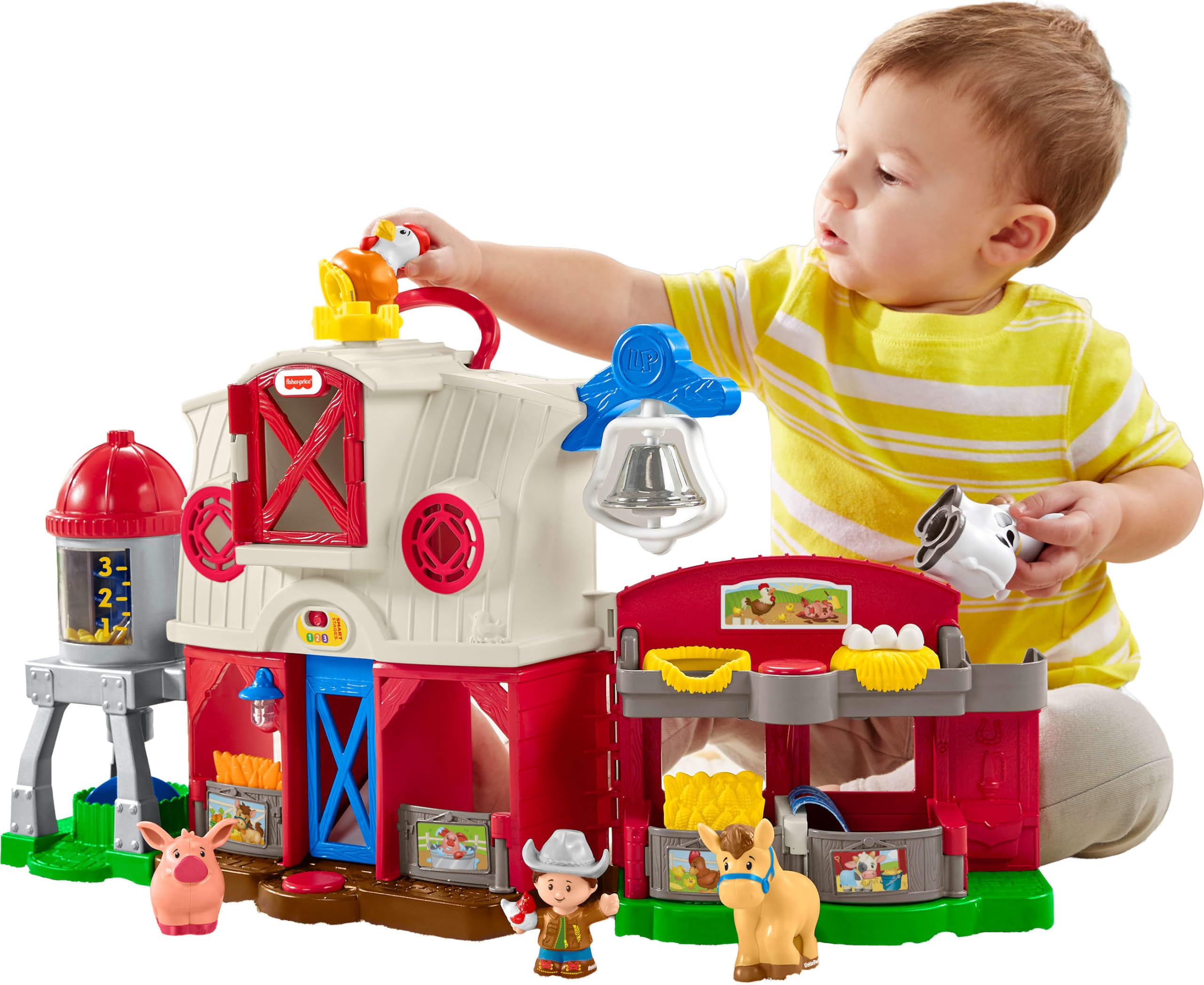
Key Features
- Audio: 45+ songs, sounds and phrases
- Levels: 3 Smart Stages
- Figures: 5 figures, 2 play pieces
- Age Range: 12 months – 5 years
- Price: Premium
Twelve months is the number that matters here. Every other pick on this list starts at 18 months or later; the Little People farm is built for a child who is still dropping things off a high chair tray to see what happens.
The barn does the work. Drop a figure through the hayloft and it lands inside with a song; the door button, the hatching chicks, the popping corn and the light all answer back. Five figures and two food pieces come with it, all chunky enough for a 1-year-old’s grip, and the three Smart Stages levels move from counting and colors towards opposites as the child grows — 45-plus songs, sounds and phrases in total.
For a 1-year-old this is the gift with the longest runway: cause-and-effect at twelve months, animal sounds at two, storytelling with the farmer at three. That range is why we name it first for a first birthday when the household has a corner to give it.
It is the most expensive pick here, and the gate release and the hayloft chute are the parts to test before you wrap it, since a stuck gate takes the main trick with it. Buy this one somewhere with an easy return, just in case.
Pros
- Starts at 12 months, unlike most picks here
- Hayloft drop, hatch and pop mechanisms
- Three levels grow with the child
Cons
- Gate and hayloft chute can stick
The one gift here built for a 1-year-old, and the one that will still be played with at three.
Best for Tool-Loving Toddlers
VTech Drill and Learn Toolbox

Key Features
- Size: 12.6 x 5.7 x 4.9 in
- Includes: Drill, hammer, wrench, nails
- Age Range: 2 – 5 years
- Batteries: 2 AA, included
- Price: Midrange
The drill is the whole toy, so it matters that it takes a firm, straight press to engage. Push at an angle and a 2-year-old gets a whirr and no spin; push down squarely and the bit turns and drives a screw into the holes in the electronic tray. Show them once and the angle fixes itself.
The rest is a small workshop: hammer, wrench, nails, a tray that clicks and buzzes as the gears turn, light-up buttons that name the tools and their sounds, and double-sided cards that slide in to teach colors and numbers. Two AA batteries are included, again as demo cells.
It is aimed at 2 to 5 and it lands best at the young end, while a child is copying an adult rather than building anything. By four the cards are too easy and the drill has done its job.
For a toddler who watches every repair in the house, this is the one to get: it turns a fascination into something they can do with their own hands, and the volume control is a genuine kindness at seven in the morning.
Pros
- Drill actually drives the screws
- Cards teach colors and numbers
- Volume control for shared rooms
Cons
- Drill does not fit back under the lid
For the child who follows a parent around with a screwdriver, this does more than its light show suggests.
Best for Minnie Fans, 3+
Melissa & Doug Minnie Dress-Up Puzzle

Key Features
- Pieces: 18
- Box Size: 6.25 x 5.25 in
- Material: Wood
- Age Range: 3 years and up
- Price: Budget
Six inches across and eighteen pieces: the Minnie set is the smallest thing on this list, and the size is the feature. The lid has a scene printed inside it, so the box becomes the stage, and the pieces are thick wood — easy for a 3-year-old to pick up, turn and swap.
The play is quieter than the ice cream counter and better for it. Tops, skirts and bows get combined on the character outline, then sorted, matched and recombined, and the whole loop can run without an adult. This is the sort of toy that gets picked up for ten minutes at a time, several times a day, which is roughly how 3-year-olds operate.
For a Minnie fan who already sits still for puzzles, this is our pick. The wood is the reason it lasts: these pieces will not bend, crease or peel the way the paper dolls the set imitates do.
Pros
- Box lid doubles as the play scene
- Thick wooden pieces that will not peel
- Self-contained play for a 3-year-old
Cons
- Lid slides off, so it is not a bag toy
A small, quiet, self-contained pick for a Minnie-obsessed 3-year-old who already likes puzzles.
How We Tested the Best Toddler Gifts
We started with a long list of toddler gifts and cut anything with small parts, a vague age range, or features that seemed designed for parents rather than toddlers. The final field was 16 gifts, tested over six months.
Testing happened where toddlers actually are: living-room floors, high chairs, car seats, bathtubs, and the bottom of a diaper bag. We watched 1-, 2-, and 3-year-olds open each gift, played alongside them, then left them to see which ones drew them back on their own. We noted how long a gift held attention, whether it invited open-ended play or only one trick, and whether it was clearly matched to the age on the box.
Quality meant dropping toys from coffee-table height, wiping them down after snack time, and checking seams, paint, and moving parts for wear. Size mattered if a gift fit on a shelf, in a diaper bag, or in small hands. For sound, we listened at close range and across a room, noting volume, tone, and whether there was an off switch. We opened and closed lids repeatedly, including with one hand and with a toddler tugging, to see if they snapped securely without pinching.
We also pressed buttons, turned knobs, and tested every claimed function to see if it still worked after repeated play. We compared color choices and watched whether finishes survived wiping. Educational value came down to whether a gift invited open-ended play or taught colors, counting, or cause and effect without turning into a lesson. Value was judged against similar gifts and by whether the toy kept earning play after the novelty wore off.
How to Choose a Toddler Gift
The age on the box is the most useful filter you have, and the lower number is the one that decides whether the gift gets played with or parked.
Read the age band from the bottom up
A toy rated 18 months to 4 years is really two toys: a cause-and-effect toy at one end and a naming game at the other. A set rated 3+ makes a different promise. It assumes fine motor control and, often, small pieces. Hand a 3+ present to a 2-year-old and it usually fails on the parts; hand an 18-month present to a 3-year-old and it fails on interest.
The rule we use: buy for the younger end of the range, and when the birthday sits within a month of the boundary, choose the wider band. The word book here covers the whole toddler window, while the ice cream counter and the Minnie puzzle genuinely start at three.
Decide between guided and open-ended play
Electronic toys teach one specific thing and hand it over neatly. That is the appeal of the word book, the LeapTop and the toolbox: press, hear, learn. The catch is a ceiling. Once the songs and the words are known there is nothing left to discover, and the toy spends the rest of the year on a shelf with the batteries still in it.
Open-ended sets ask more up front and last longer. The ice cream counter, the scavenger cards and the dress-up puzzle all need a child to supply the story. When we are buying two gifts, we lean towards one of each: something that answers back, and something that waits for the child to start.
Count the pieces and decide where they live
Twenty-eight pieces is a wonderful gift and a terrible one, depending on the shelf. Sets that carry their own storage get used; sets that do not end up in a bag in a cupboard. The ice cream counter’s ports hold the scoops upright, the Minnie box lid is the play scene, and the scavenger cards live on their ring.
Picture the room before you buy. A set that needs floor space suits a playroom and not a flat; a purse-sized puzzle suits a restaurant and not a playroom. The gift that fits the household gets played with more than the better toy that does not.
Batteries, volume and the adults in the room
Almost every electronic pick here runs on AA batteries, and the ones in the box are demo cells that will not last the week. Open the box, fit a fresh set and find the volume control before you wrap it.
That check matters more than it sounds. A toy with adjustable volume gets used in the kitchen while an adult cooks; one that only has an on switch gets hidden on a high shelf. The word book, the LeapTop and the toolbox all give you a dial.
Frequently Asked Questions
How much should I spend on a toddler gift?
There is no rule that survives contact with a real birthday party. What holds up is the ratio: the small picks here — the word book, the card ring, the dress-up puzzle — get used as often as the big wooden sets, because they fit in a bag and come out in the gaps between everything else.
If you are buying for a child you do not know well, go small and add a board book. If you are buying for your own grandchild and want one present that dominates the morning, the wooden counter is where the money does the most work.
Are wooden toys worth the extra cost?
Usually, for sets that stay in one room. Wood is heavier, so a counter does not skate across the floor when a scoop is pressed down, and it does not crack the way thin plastic does when it comes off a table. It is also harder to wipe clean and heavier to carry.
For travel, paper and plastic still win. The coloring set and the card ring are the proof on this list: light, packable, and nothing that hurts when it lands on a sibling.
Can one gift work for a 1-year-old and a 3-year-old?
The word book does it cleanly. Both children use the same pages at their own level, and the Spanish setting gives the older one something the younger cannot do yet. The scavenger cards also stretch, with a 3-year-old running the game and a 1-year-old following along behind.
The balance bike does not. It is finished by the time a child turns three, so buy it for the younger child and plan to pass it down rather than hoping it covers both.
Final Verdict
If you want one answer, it is the LeapFrog Learning Friends 100 Words Book. It is the only pick here that fits an 18-month-old and a 4-year-old equally, it takes the handling a toddler gives, and it does something useful in two languages.
Change one requirement and the answer changes. For a 3-year-old with a birthday coming and a family who will sit down and play, the Melissa & Doug ice cream counter is the better gift. For a first birthday it is the balance bike. And if the present has to be small enough for a stocking, the scavenger hunt cards are the ones we trust.
