This post contains affiliate links. We may earn a small commission when you buy through our links — at no extra cost to you.
A baby carrier should feel like a second pair of arms, not a harness you’re wrestling while a baby arches away from your chest. I learned that on a grocery run with a newborn who decided, halfway through aisle seven, that she’d rather be anywhere else. The right carrier fixes the small things that make or break a walk: shoulder straps that don’t dig into your collarbone, a waistband that stays put when you squat, and a panel soft enough for a sleeping cheek but structured enough to feel secure. It also has to fit a taller or broader torso without burying you in nylon.
Over six months, two other dads and I rotated 12 carriers through grocery runs, weekend hikes, airport terminals, and the at-home shuffle. The keepers were easy to get a wiggly baby into solo, felt secure without being bulky, and still seemed worth the money after repeated washes. Quality showed in stitching and buckles, softness in fabric that didn’t stiffen, and enjoyment in whether we’d grab one for a fussy evening walk.




Best for One Do-Everything Carrier
Ergobaby Omni Classic
Key Features
- Care: Hand wash only
- Straps: Cross-back or H-back
- Weight range: 7-45 lb
- Carry positions: 4
- Price: Premium
Seven to forty-five pounds, four positions, and a waist belt with enough adjustment for a broad frame: that combination is why the Omni Classic is the carrier we steer most dads toward. It’s one of the few here that takes a newborn facing in and a toddler on your back without a second purchase, which turns the higher price into a one-time cost rather than a first installment.
What dads notice first is the strap arrangement. You can wear the Omni with the shoulder straps crossed behind you or running straight down in an H, and the crossed setup keeps a heavier child’s weight off the outside of your shoulders. The padded waist belt and lumbar panel carry the rest. The three-way head support flips up behind a sleeping baby’s neck and folds down when they want to see where they’re going, and the mesh fabric on the version we handled makes a real difference on a warm afternoon.
Two things to accept. The shoulder padding is generous, which is exactly why it stays comfortable with a toddler and exactly why it feels like a lot of fabric under a winter coat. The waist belt is wide in the same way, so the carrier sits outside a jacket rather than beneath it. On a July walk you’re glad of all of it; in January you’ll notice.
Where it quietly wins is the hip position. A toddler who wants up for one block and down for the next doesn’t need a full back carry, and the seat holds them against your hip while you keep a hand free for the stroller. That’s the mode we came back to most, and it’s the reason this one lives in the car rather than in the closet.
Pros
- Four positions from 7 to 45 pounds
- Cross-back straps spread a toddler’s weight
- Lumbar panel and padded waist belt
- Hip carry for up-and-down toddlers
Cons
- Hand wash only, no machine cycle
We recommend it when you want one purchase to cover a newborn and a walking toddler; four positions, a lumbar panel and a long waist belt are why.
Best for Dad Styling
Tactical Baby Carrier
Key Features
- Extras: MOLLE panels, sun shade
- Fabric: Cotton, machine wash
- Weight range: 8-33 lb
- Carry positions: 2, front in and out
- Price: Premium
Coyote brown, MOLLE webbing, and buckles that look borrowed from a range bag: the Tactical Baby Carrier is the only one here that looks like it belongs to a dad who never wanted a pastel print. The body is cotton with a padded cotton interior, it’s machine washable, and a clip-on shade comes with it for a baby who falls asleep mid-walk.
We think it earns its money for a particular buyer: a dad with a broad frame who wants a structured front carrier and would rather it look purposeful than cute. The webbing runs longer than most here, and the cross-strap arrangement pulls the load in toward your chest instead of out at the shoulders. What you give up is the back carry — at 33 pounds, all of that weight stays in front of you and there’s no way to shift it around on a long hike.
The straps are also our reservation. On a small baby they can sit close to the face, so it’s worth checking the fit every time you tighten, and they press down on the tops of the shoulders more than the cross-back carriers in this guide. Everything else is thoughtfully done: UTX buckles, an open back that lets a diaper bag sit against you, and hip-healthy certification alongside ASTM and CPSIA compliance. The shade is the piece we didn’t expect to use as often as we did.
Pros
- Machine-washable cotton, unusual at this price
- Straps run long enough for a big frame
- MOLLE panels take extra pouches
- Sun shade included for naps
Cons
- No back-carry position
Our pick for the dad who wants a machine-washable front carrier that looks like his own gear and fits a broad frame — as long as back carry isn’t on the list.
Best for First Carrier on a Budget
Infantino Flip 4-in-1
Key Features
- Care: Machine wash
- Head support: Adjustable
- Weight range: 8-32 lb
- Carry positions: 4
- Price: Budget
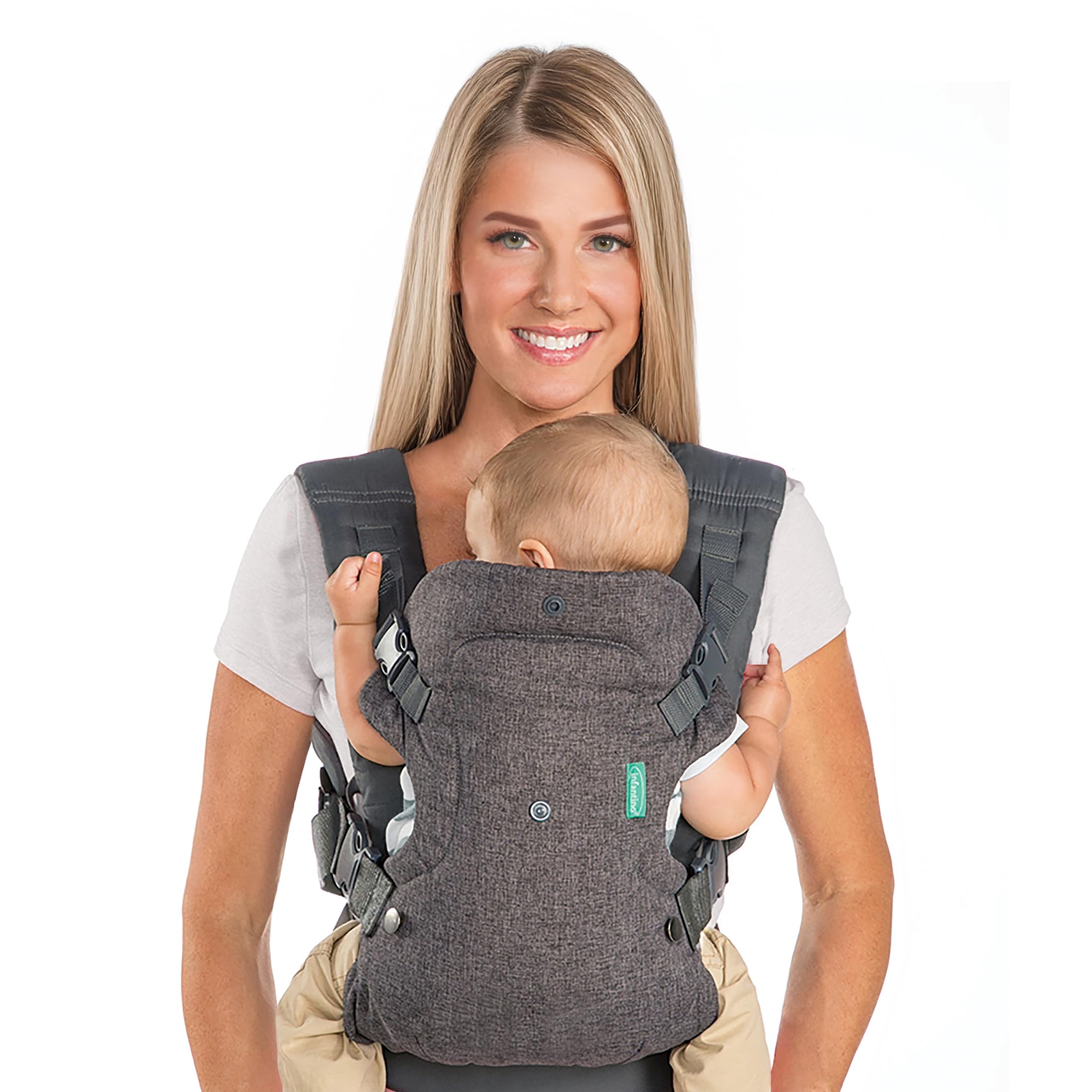
The Flip is the least expensive structured carrier in this guide, and it’s the one we suggest to a dad who isn’t sure yet how much babywearing he’ll actually do. Four positions, a machine-washable body, and a seat that narrows for a newborn and widens as the legs grow — at this end of the range, nothing else here covers as much.
The saving shows up in the support. The waist belt is a padded strap rather than a structured lumbar panel, and the shoulder straps are soft rather than shaped, so a small baby rides comfortably while a thirty-pound toddler on a two-hour walk is asking too much of it. The buckles take a few goes to learn, and the first attempt in a parking lot will not be elegant. Give it three tries before you judge it.
What we appreciated most in the early weeks was the adjustable head support, which folds up behind a newborn’s neck without a separate insert, and the leg openings that widen as they grow. It’s also the carrier that lives buckled in the car, ready for a five-minute errand where a stroller is more trouble than the walk.
Pros
- Four positions at the lowest price here
- Machine washable, no fuss
- Adjustable head support for newborns
Cons
- Minimal lumbar padding
- Buckle-heavy for a first-timer
We point first-time dads here: four carry positions, a washable body and enough support for a small baby, for less than any other structured carrier in this guide.
Best for Long Walks
Bebamour 6-in-1 Hip Seat
Key Features
- Extender: 16 in included
- Waistband: 65-118 cm (25-46.5 in)
- Max weight: 32 lb
- Carry positions: 6
- Price: Midrange
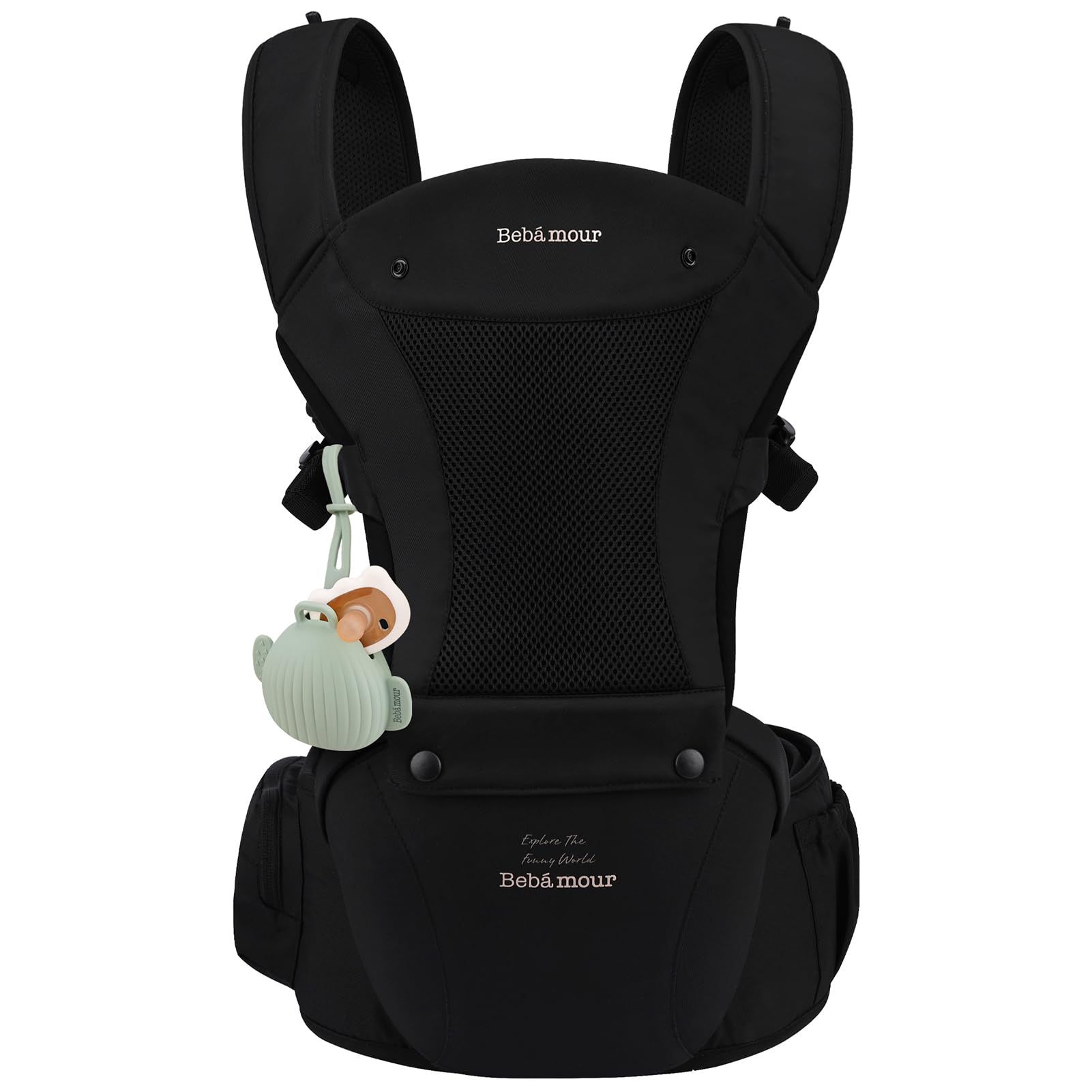
A hip seat changes where the weight lands. Instead of hanging a child off your shoulders, the Bebamour’s firm padded seat takes the load on your hips, and the wide waistband — listed at 65-118 cm (25-46.5 inches), with a 16-inch extender in the box — spreads it across your middle. For a dad whose lower back gives out before his legs do, that’s the difference between a long walk and a short one.
Six positions cover cradle, hip, front-in, front-out and back, and the detachable pouch and bib set are genuinely useful rather than box filler. Mesh panels keep air moving on a warm day, the whole thing is machine washable, and the seat closes with velcro plus buckles — two closures to defeat before a baby can slide out, which is the redundancy we want on a carrier holding a toddler.
It is bulky around the middle. The seat is a cushion and it shows under a jacket, so this is a carrier for a walk rather than one that disappears into your silhouette. The waistband also runs large at its tightest setting, which suits a bigger frame and leaves a smaller one with a length of strap to tuck away.
Where it earns its place is the long day out: the zoo, the airport, a hike with a toddler who walks the first two miles and wants carrying for the last one. It’s also the pick that doesn’t fold into a bag, so it stays by the front door rather than in the stroller basket — a fair trade for how much it saves your back.
Pros
- Hip seat carries weight on your hips
- Waistband to 46.5 inches plus extender
- Six positions including a back carry
- Machine washable with detachable accessories
Cons
- Waistband runs large at its tightest
The carrier we reach for when the walk is long, because the padded hip seat takes a toddler’s weight off a tired lower back instead of loading your shoulders.
Best for Travel and Stowage
Tula Lite
Key Features
- Fabric: Ripstop
- Weight range: 12-30 lb
- Carrier weight: 1.1 lb
- Carry positions: Front in, back
- Price: Midrange
At 1.1 pounds, with a body of ripstop that folds into its own pouch, the Tula Lite is the carrier that rides at the bottom of the diaper bag and gets forgotten until you need it. It’s rated from 12 to 30 pounds and carries front-in or on your back, with lightly padded mesh shoulder straps and a waistband.
We think it’s the best carrier here for travel and for the dad who wants a carrier in the car rather than on his shoulders all day. The weight sits evenly, the waistband gives a bigger frame the extra inches some carriers don’t, and the fanny-pack section holds a phone, a card and keys. What it doesn’t have is padding — after an hour with a 28-pound toddler, you feel exactly where the straps are.
The other boundary is age: twelve pounds and head control are the entry requirements, so this isn’t the carrier for the newborn weeks, where a wrap or a newborn-rated structured carrier does the job. Past that, it’s the one that goes in the stroller basket and stays there.
Pros
- Packs into its own pouch
- 1.1 pounds, barely noticeable in a bag
- Waistband gives plus-size wearers extra room
Cons
- Not intended for newborns
- Thin padding on long carries
For travel and the bottom of a diaper bag, this is the one we take: light, packable, and rated from twelve pounds with a back carry for later.
Best for Newborn Months
KeaBabies Wrap
Key Features
- Fit: One size, self-tie
- Care: Machine wash cold
- Fabric: Stretch knit
- Weight range: 7-35 lb
- Price: Budget
A single long panel of soft, stretchy knit is the entire product, and that simplicity is the point. The KeaBabies wrap ties on, holds a baby from seven to thirty-five pounds, machine washes cold, and packs into a bag small enough to live in the diaper bag. It’s also certified hip-healthy, which matters more in the first months than at any other stage.
The honest part is the learning curve. The first two or three attempts take a mirror and some patience, and the fabric should be wrapped tighter than feels right, because it gives as the baby settles in. Once it’s on there are no buckles to check and nothing to adjust — the tension is the fit, which is why it works on a six-foot frame and a five-foot one with the same piece of cloth.
For the newborn months, we think it’s the best carrier in this guide. Nothing else here holds a two-week-old against your chest so completely, and for a dad who is sure he wants to babywear from the start it’s one of the cheapest ways in. Past six months, though, a wriggling toddler wants buckles.
Pros
- Fits any wearer because it ties
- Soft stretch knit that stays snug
- Machine washable and packs small
Cons
- Warm for both of you in summer
- Tying takes both hands and practice
If your baby is still a newborn, we think this is the one to start with — soft, close, and adjustable to any frame because you tie it yourself.
Best for Pockets and Value
MOMTORY 6-in-1

Key Features
- Care: Hand wash only
- Storage: Bottle, phone and key pockets
- Hip seat: Zip-off seat
- Carry positions: 6
- Price: Midrange
Six carry positions, a hip seat that unzips from the back panel, and pockets for a bottle, a phone and keys: the MOMTORY behaves more like a small backpack than most carriers here. It’s rated from seven pounds, the shell is cotton and polyester, and the tummy panel is soft against a baby’s legs.
Fit is the variable. The waistband runs big on some frames and snug on others, which is the usual story with a one-size belt, and the top back clip sits high enough that reaching for it behind your head is a stretch. Clipping it before you slide the carrier on solves that; doing it one-handed with a baby already inside does not.
What we came back to is the storage. A bottle sleeve, a zipped pocket and a phone slot mean the diaper bag can stay in the car on a short trip, and that matters more day to day than any single specification on the box. The seat unzips so you can use the panel alone with a smaller baby, and that flexibility is most of what you’re buying.
Pros
- Pockets that replace a diaper bag
- Zip-off hip seat for two configurations
- Lumbar support beyond most midrange carriers
Cons
- Hand wash only
Worth a look if you want a hip seat and pockets deep enough to leave the diaper bag behind, without paying premium-carrier money.
Best for Quick Hip Carries
Momcozy Hip Seat

Key Features
- Storage: Front and side pockets
- Waist fit: Up to 45 in
- Weight range: 7-44 lb
- Carry positions: 6
- Price: Midrange
The seat rotates. That’s the feature separating the Momcozy hip seat from the other hip-seat carrier in this guide: a baby can face you, turn outward, or ride on your hip without being unclipped and rethreaded. Six positions, seven to forty-four pounds, and a waistband listed to fit up to 45 inches.
The X-shaped back is the second thing we noticed. Instead of two straps meeting in an H behind your shoulder blades, the straps cross low, and the contoured waist support spreads pressure across your waist and abdomen rather than digging into one spot. It goes on solo from start to finish, which isn’t true of every carrier with this much structure.
The fit is the compromise. The waistband can run large even cinched down, so a smaller wearer runs out of adjustment while a bigger frame is well served, and the seat itself is a solid block that shows under a coat. Neither is a problem on a summer errand; both are noticeable in January.
Between the car and the checkout, this is the one we reach for. A toddler rides on your hip with one arm free, the pockets take a phone and keys, and the turn from facing-in to facing-out takes a second. Where it stops is the long hike: the seat is a platform, not a suspension system.
Pros
- Rotating seat changes facing without rethreading
- X-structure goes on without help
- Storage for phone, keys and a bottle
Cons
- Waistband can run large at its tightest
We think the rotating seat is the reason to choose this hip seat: a baby can look around without you unclipping a strap.
How We Tested 12 Baby Carriers for Dad Duty
We started by scanning manufacturer specs and owner reviews for carriers with adjustable torso ranges, generous waistband sizing, and clear safety instructions. We filtered out models whose buckles or strap routing drew repeated complaints, then bought 12 carriers at retail so no brand could seed the test.
For six months, each carrier went into rotation for at least a week with three dads of different heights and builds, using our own babies from about 12 to 24 pounds. We wore them on grocery runs, up and down apartment stairs, through airport security, and on weekend trails.
We timed how long it took to load a squirming baby solo and checked whether the chest clip and shoulder straps stayed where we set them after 20 minutes of walking. Safety checks included tugging every buckle, watching that the baby’s chin stayed clear, and confirming the seat supported a rounded squat rather than dangling legs. We also noted where the waistband landed when seated, whether the back panel swallowed smaller frames, and how much carrier remained after folding it into a diaper bag. After two washes, we compared fabric softness and stitching, and at checkout asked whether the included sun hood, drool pad, or storage pocket justified the cost; the ones we kept reaching for were the ones we forgot we were wearing.
How to Choose a Baby Carrier That Fits a Dad
A carrier that fits your partner but not you is a carrier you stop using by the third week, so fit your own frame first and the baby’s weight second.
Fit the waistband before anything else
Shoulder straps get the attention, but the waistband decides whether a carrier works on a bigger frame. A short belt rides up and hands the load back to your shoulders, however much padding sits on the straps. Look for a stated waist range rather than a size label: the Bebamour lists 65-118 cm (25-46.5 inches) and includes a 16-inch extender, and the Momcozy hip seat is listed to 45 inches. Near the top of a range, expect a snug fit with a jacket on.
Sharing matters too. A carrier that takes a mirror and two hands to readjust between parents ends up used by one of them, so favor sliding buckle adjusters over ties.
Decide whether you need a back carry
Everyone starts in front: facing in for a newborn, facing out once head control arrives. A back carry is what keeps a heavier toddler bearable, because the weight moves behind your center of gravity instead of hanging off your chest. The Tactical carrier is front-only up to 33 pounds; the Ergobaby does front, back and hip to 45 pounds. If your baby is already past twenty pounds, buy for the back carry now rather than adding a second carrier later.
Work out where the weight lands
Three designs, three different feelings at the end of a walk. A padded waist strap, as on the Infantino Flip, is light and inexpensive and fine with a small baby. A structured lumbar panel, as on the Ergobaby, presses into your lower back and earns its keep as the child gets heavier. A hip seat, as on the Bebamour and the Momcozy, puts the child’s weight on your hips and is the most forgiving of a tired back — at the cost of bulk around the middle.
Try the belt on over the clothes you actually wear outdoors. A carrier that only fits over a T-shirt is a summer carrier.
Read the wash label and the fabric
Carriers collect milk, spit-up and sunscreen, and a hand-wash-only model turns a five-minute cleanup into an evening job. Cotton and mesh take a machine cycle; both the Ergobaby and the MOMTORY specify hand wash. Fabric matters in heat as well — mesh and ripstop run cooler than brushed cotton or a stretch wrap, which is worth thinking about if you walk in the afternoon sun.
Frequently Asked Questions
Do I need a newborn insert for a baby carrier?
Usually not, if the carrier is rated for a newborn in the first place. The Ergobaby, the Infantino Flip and the KeaBabies wrap all list a minimum of seven or eight pounds with head support built in, so no insert is required. The Tula Lite starts at twelve pounds and is not a newborn carrier. Check the minimum weight on the label before the first week rather than after.
Can I wear a backpack with a baby carrier?
Yes, with the right carrier. A low, open back like the Tactical’s leaves room for a daypack over the top, and its MOLLE panels take small pouches directly. Cross-back straps make a backpack sit awkwardly, so fasten the carrier first and put the pack on last — and keep the pack light, since the heavier weight is already in front of you.
Is a baby carrier bad for a baby’s hips?
Not when the seat supports the thighs. You want the knees level with or slightly above the hips, with fabric under both thighs rather than a narrow strip between the legs. The Ergobaby, the Tactical and the KeaBabies wrap are all described as hip-healthy, and Ergobaby states that the International Hip Dysplasia Institute has determined its carriers hip-healthy. If the legs dangle straight down, the carrier is not adjusted right.
Final Verdict
If you want one carrier that starts with a newborn and finishes with a toddler, and that your partner can use on a Saturday, the Ergobaby Omni Classic is the one we point to. Four positions, a lumbar panel and a 7-to-45-pound range are the reasons.
Two requirements change that answer. If back carry does not matter and you want a machine-washable carrier that looks like your own gear, the Tactical is the better buy at the same money. If your lower back is what limits you on long days, the Bebamour’s hip seat does more for you than either.
