This post contains affiliate links. We may earn a small commission when you buy through our links — at no extra cost to you.
A good baby gym does two jobs at once: it gives your baby something worth looking at and gives you somewhere safe to put them down for a minute. That’s a taller order than it sounds. Plenty are charming in the box and forgotten by week three, either because the toys hang in the same spot forever or because the frame skates across the floor the moment your baby starts kicking. The right one buys you a stretch of happy floor time and looks good enough that you don’t hide it when someone rings the doorbell.
Over the past six months I’ve had 12 of them living in my living room, and the gap between a gym my baby ignored and one she’d lie under happily for 20 minutes came down to details you only notice in use. Babies outgrow the newborn phase of these quickly, so an adjustable one earns its price and a pretty-but-static one doesn’t—even if it photographs beautifully. The picks below are the ones worth the floor space.



Best for Everyday First Gym
Fisher-Price Deluxe Kick & Play Piano Gym
Key Features
- Mat: Machine-washable, thick, with toy loops
- Play modes: 4: lay, tummy time, sit, take-along
- Included toys: 5 linkable toys plus 2 maracas
- Songs and phrases: 65+ across 3 Smart Stages levels
- Price: Midrange
The keyboard sits exactly where a newborn’s heels land, and that one decision is why this is the gym we tell most families to buy first. Kick, and a key lights up and plays; the link between ‘I moved’ and ‘something happened’ is the first lesson a playmat can teach, and this one makes it impossible to miss. Lay and play, tummy time, sit and play, take along — the same purchase follows a floppy newborn through to a baby who can sit up and hammer the keys with a fist.
The toy set is generous without turning into clutter: a mirror, a BPA-free elephant teether, a crinkle panda, a rattle lion and monkey clackers, plus two soft maracas. All five link on and off the mat’s loops, which is the detail that keeps this useful — the mirror moves to eye level for tummy time, and the clackers hang where a sitting baby can reach them. The keyboard detaches, so the music can travel, though floor time at home is where it earns its keep.
Sixty-five-plus songs, sounds and phrases come in three Smart Stages levels, and the songs are the rare nursery soundtrack that doesn’t wear through your patience by the tenth repeat. The mat is thick and soft over hardwood, and it’s machine washable, so a spit-up is a laundry cycle rather than a scrub.
It runs on three AA batteries, which is worth knowing before the music quits mid-tummy-time. Otherwise the housekeeping is minor: the take-along mode gets the least use around here, because the piano’s appeal is really about being on the floor with the whole gym around it.
Pros
- Kicking triggers lights and music, teaching cause and effect
- Four play modes span newborn to toddler
- Thick mat goes in the washing machine
- Songs that stay bearable on repeat
Cons
- Large footprint once the arch is up
We tell most families to start here: the kick-and-response piano gives a newborn something to do on day one, and four modes keep it in the room long after head control arrives.
Best for Design-Led Nurseries
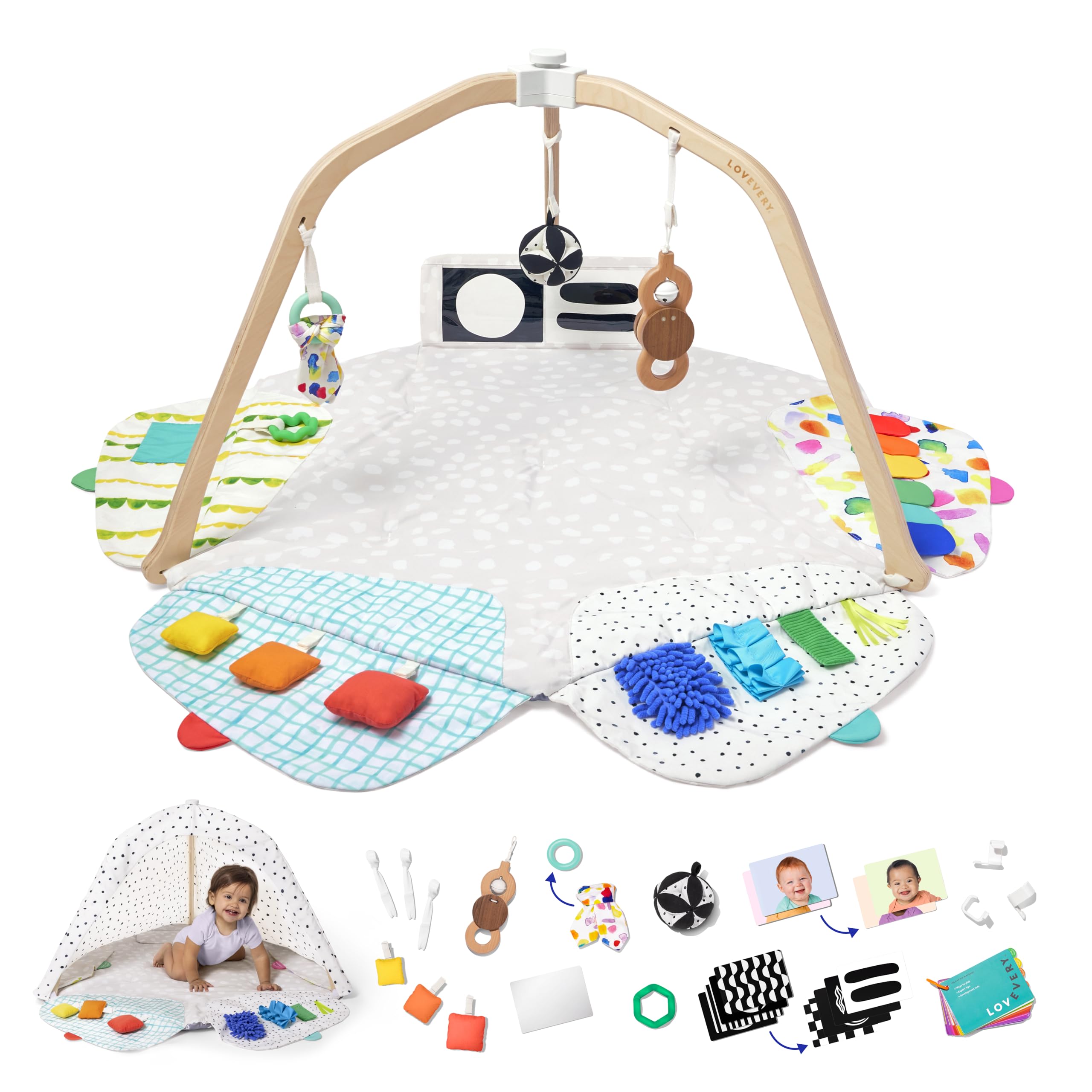
Lovevery The Play Gym
Key Features
- Included: Play guide, 4 card sets, teethers, batting ring, ball, cover, clips
- Materials: FSC-certified wood legs, organic cotton
- Play stages: 5 zones across the first year
- Assembled size: 43 x 38 x 24 inches
- Price: Premium
Some households want the playmat in the living room and don’t want it to look like a toy aisle. This is the gym for them: FSC-certified wooden legs, an organic cotton teether, a soft rainbow palette and a frame that reads as furniture rather than baby gear. The high-contrast ball and the batting ring are the two pieces that get the most use early, and both are the sort of thing you leave out on a shelf.
What earns the premium is the scaffolding it gives the adult. Five development zones reveal or conceal as your baby grows — you cover the busy ones early to avoid overstimulation, then uncover them — and the play guide tells you what to do with a six-week-old who can’t yet do anything at all. That’s the part we keep coming back to: with most gyms you’re left to invent the games yourself, and here somebody has already thought through the sequence for you.
The mat is the thing to plan around: it’s thin, and over hardwood you’ll want a rug or a play pad underneath. Beyond that it’s a quiet gym by design — no lights, no batteries, no songs — which is either the entire appeal or a dealbreaker, depending on the baby you have.
Pros
- Five developmental zones that reveal as your baby grows
- Play guide gives you age-by-age activities
- Wooden frame and organic cotton feel considered
Cons
- Frame doesn’t fold away between uses
For a nursery you’ll be looking at for a year, this is the gym we choose: staged zones, a real play guide, and materials that feel considered rather than plastic.
Best for Newborn Tummy Time
Tiny Love Gymini Deluxe
Key Features
- Mat: Machine-washable; doubles as changing pad
- Arches: Adjustable and removable
- Contrast: Black-and-white newborn palette
- Age range: 1-12 months
- Price: Midrange
Newborn eyes need contrast before they need color, and this gym is built around that fact: a black-and-white mat with high-contrast animals, a mirror, and toys with genuinely different textures. If you’re setting up for a baby who is still weeks away from batting at anything, that palette does more work than a flashing keyboard.
The arches are the practical half. They adjust into different configurations and lift off completely so tummy time happens on the floor, which means the same mat serves a two-month-old staring upward and a five-month-old pushing up on their forearms. The take-along hedgehog adds lights and music when you want a bit of theater, and the mirror is what buys extra tummy-time minutes in our experience — a baby who catches sight of himself has a reason to keep his head up.
It’s the most compact gym here, which is a real advantage in an apartment and a real limit once your baby starts rolling. We treat it as a first gym rather than a year-long one: buy it for the newborn stretch, when contrast and a mirror are the whole curriculum, and expect to hand it on to the next baby.
Pros
- High-contrast palette built for newborn vision
- Arches adjust or lift off for floor play
- Washable mat that doubles as a changing pad
Cons
- Compact play area, outgrown by sitting age
Buy this one for the newborn months: high-contrast patterns and a mirror do more for very young eyes than lights, and the arches lift off for floor tummy time.
Best for Guided Developmental Play
Skip Hop Discoverosity Play Gym
Key Features
- Included: 4 toys, 5 parent guide cards, tummy-time pillow
- Age range: 0-2 years
- Activities: 25+ across 3 play modes
- Assembled size: 42 x 33.5 x 19 inches
- Price: Midrange
Skip Hop developed this one with Montessori educators and shipped the lesson plan in the box: five parent guide cards, four nature-inspired toys and more than twenty-five activities for a baby who is mostly lying down. The cards are the reason to look twice — they hand you a specific game for the stage you’re in rather than a mat and a hopeful shrug.
We like that the guidance is concrete. A new parent staring at a playmat often has no idea what to actually do with it, and a card that says try this today closes that gap better than another dangling toy. The three modes — overhead, tummy time, seated — carry through to age two, and the four toys are graded rather than repetitive: different sounds, textures and shapes instead of four variations on a rattle.
The mat is plush and properly padded, with a soft top and a fold down the middle for storage. It’s mostly light fabric, so it will show every spill; it cleans up, but you’ll be cleaning it. And the frame is one of the bigger ones in this group, so measure the corner before you commit to it.
Pros
- Five stage-by-stage guide cards take the guesswork out
- Overhead, tummy-time and seated modes in one
- Plush mat with generous padding
- Looks like nursery decor, not a toy
Cons
- Big frame needs a measured corner
Worth it if you want to be taught how to play — the guide cards turn a mat and four toys into a week-by-week plan, on a genuinely padded surface.
Best for Small Rooms
Ingenuity Cozy Spot Activity Gym
Key Features
- Mat: Reversible plush duvet, machine washable
- Power: None required
- Toy bar: Wooden bar folds into the mat
- Assembled size: 19.3 x 32.3 x 32.3 inches
- Price: Midrange
The whole gym folds into its own mattress. The wooden toy bar collapses, the duvet wraps around everything, and two built-in handles let you carry the lot into another room or stand it in a closet between sessions. For anyone whose living room has to become an adult room again at eight in the evening, that’s the feature that decides it.
Unfolded, it’s a plush reversible duvet with two neutral prints, one on each side, a cloud-soft top and a wooden bar carrying five toys made from natural materials — a silicone apple, a plush bear, a wooden ring and a mirror among them. The tummy-time pillow comes included, so propping a chest up doesn’t mean buying anything else.
No batteries, no songs, no lights: the bar and the toys are the whole entertainment, and after a day of electronic nursery gear that quiet is a relief. The duvet cover comes off and goes in the machine, and the toys and bar wipe clean, which matters because a plush surface is exactly where a spit-up lands.
This is the pick for a small home, a shared room, or a baby who is content to bat at a wooden ring. If your baby needs a light show to stay engaged, one of the musical gyms will hold attention longer; if you want something that looks like a blanket and stores like one, this is the one we reach for.
Pros
- Folds with the mat into one carryable bundle
- No batteries or electronics to replace
- Plush, machine-washable reversible duvet
Cons
- Wooden bar hardware can chip or break
This is the small-space answer: it folds into its own mattress with the toys inside, and there isn’t a battery in sight.
Best for Budget Nursery
Blissful Diary Baby Play Gym Mat
Key Features
- Care: Machine washable, non-slip backing
- Toys: 6 detachable sensory toys
- Storage: Folds flat
- Mat size: 33.46 x 33.46 inches
- Price: Budget
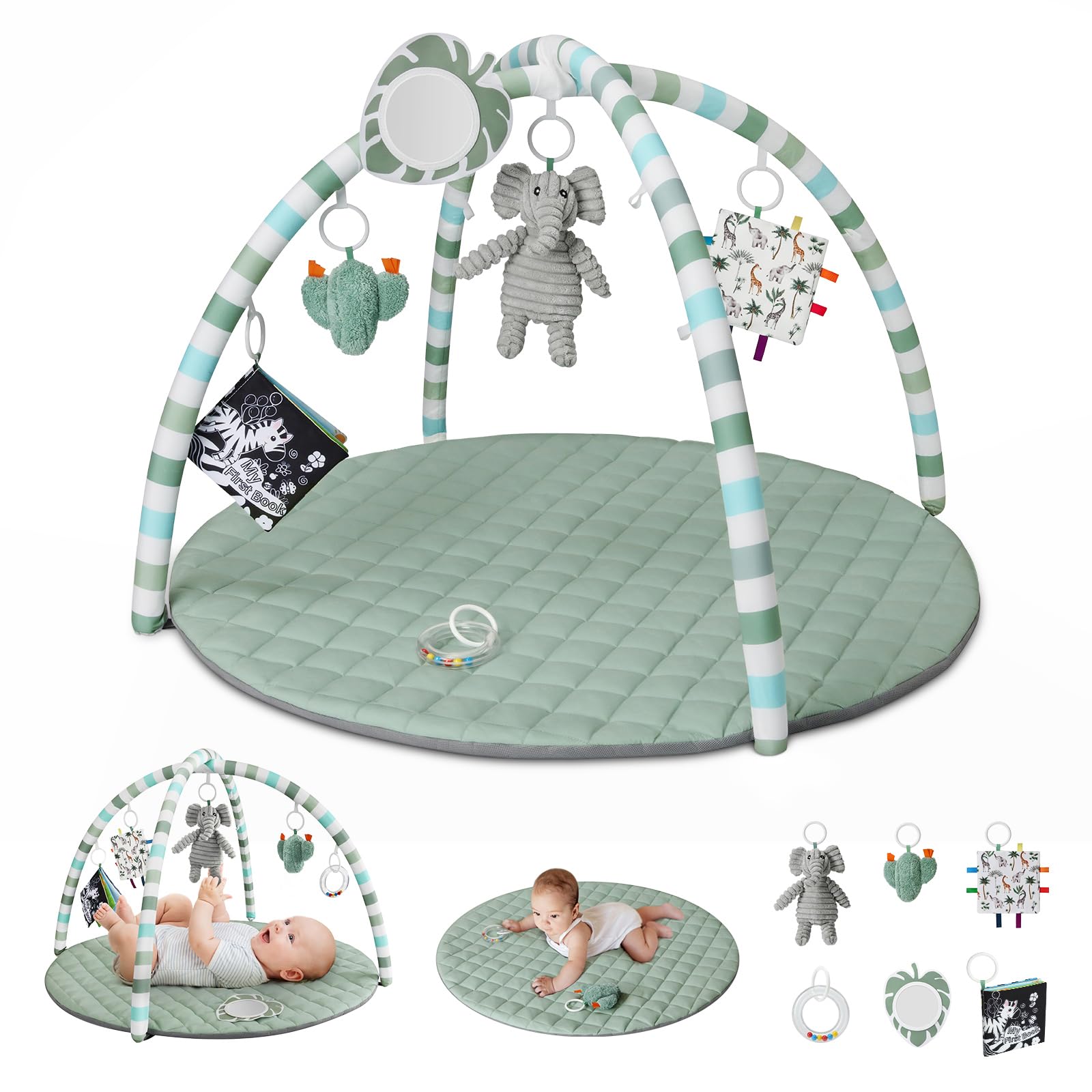
Six toys, a padded mat just under three feet square, and a muted sage green that doesn’t shout from the corner of the room: this is the version of a baby gym we hand to value-minded shoppers, and nothing about it feels like a compromise at the age when it matters most.
The toys are a sensible set — a mirror, a crinkle element, a teether among them — and all six clip off, so the mat can go to a grandparent’s house with two attached and come back with different ones. Setup is two bars and a mat; takedown is the reverse. The whole thing goes in the washing machine, non-slip backing and all, which is the spec that matters once a baby starts spitting up on everything.
The mat is soft rather than thick, which is fine over carpet and thin over tile, and the square shape gives a rolling baby more usable room than a long rectangle. It’s also the gym we’re happiest leaving out for everyday use, because it reads as a rug rather than a nursery appliance.
Pros
- Machine washable with a non-slip backing
- Six detachable toys for variety
- Calm sage green that suits a grown-up room
Cons
- No lights, music or sound
Our value pick: six clip-off toys, a washable padded mat and a calm palette, with no electronics to break or batteries to buy.
Best for Second Mat
Mallify Washable Tummy Time Mat

Key Features
- Care: Machine washable, non-slip backing
- Toys: 6 removable sensory toys
- Extras: 12 milestone cards
- Mat size: 35.4 x 35.4 x 0.78 inches
- Price: Budget
Thirty-five inches square and padded, with six toys and a dozen milestone cards in the box — this is the biggest flat play surface in this group relative to what it costs, and the cards are a genuinely useful extra for the monthly photo you’ll otherwise forget to take.
The mat is machine washable with an anti-slip backing, the poles buckle together without tools, and the whole thing folds for storage. It’s a simpler build than the big-brand gyms: fabric, a light frame, and toys that clip on and off. If your plan is a mat on the floor for tummy time and somewhere to park a rolling baby, that covers it.
Where it sits for us is a second mat or a first gym on a tight budget. The toys are charming but simple, and the frame is the lightest here, so treat this as a floor-level play space rather than something a toddler will haul himself up on. The mat is the part that earns its place: it washes well, and it’s big enough that a baby can actually roll across it.
Pros
- Large 35-inch square play surface
- Machine washable with a non-slip base
- Twelve milestone cards included
Cons
- Frame feels light next to the big-brand gyms
The pick for a second mat or a very tight budget: a large washable surface, six toys and milestone cards, with a frame that stays out of the way.
How We Tested 12 Baby Gyms at Home for Six Months
We started by pulling every baby gym sold in the U.S. and sorting by the things that actually matter: mat size and padding, frame material, whether the arches adjust or detach, whether the covers machine wash, price, and what the whole thing looks like from across the room. That cut a long list down to 12, which we bought ourselves and set up for six months.
Testing happened where these products actually live, which is the living room floor. Each gym got morning wake-up time, the late-afternoon stretch when I needed both hands to start dinner, and tummy time, and several were tested alongside a toddler running through the room. We logged how long each baby stayed content before fussing, which toys got batted at and which never earned a second look, whether the arches held position after being grabbed and yanked, and whether the mat stayed put when a baby pushed off it.
Durability got the least glamorous treatment. Mats were wiped down daily and covers machine washed weekly, and we checked seams, pilling, and whether the padding flattened where knees and elbows landed. We tugged the arches and toy clips over and over to see if links stretched or fasteners loosened, then folded each one, stored it, and set it back up to see if it held its shape. At the end we weighed what each cost against the months of use we actually got out of it, which is where a few of the prettier, pricier options slipped in the rankings.
How to Choose a Baby Gym
The gym that works is the one your baby will lie on for fifteen minutes without complaint, so buy for the surface and the reach height first and the songs last.
Start with the mat, not the melody
The mat is what your baby actually touches, and the floor underneath decides how much padding you need. Over carpet, most of these mats are fine as they are. Over hardwood or tile, a thin mat turns tummy time into a wrestling match, and the cheaper fix is a rug or a separate play pad rather than a different gym entirely.
Look for a mat that goes in the washing machine, ideally with a removable cover, because spit-up lands on the mat rather than the toys. The Fisher-Price and Blissful Diary mats both wash, and that’s the spec you’ll use most in the first six months.
Modes versus months
A four-mode gym costs more than a newborn-only one and is usually the better buy: lay-and-play, tummy time, sit-and-play and take-along cover most of the first year, while a contrast-focused newborn gym is at its best for three or four months. The trap is buying only for the baby you have today — a newborn can’t use a seated mode and doesn’t need seventy songs, but the same frame matters enormously once they start batting at things.
If you want one purchase to last, pay for the modes. If you’re assembling a short newborn kit, the Tiny Love Gymini does the early work well and takes up very little floor.
Check the structure that holds the toys
This is where gyms disappoint. The arches and toy bars take the kicking, the grabbing and eventually the pulling-to-standing, and a frame that flexes or clips that let go are the failures we watch for first. Look at how the arch attaches and whether toys hang from fixed points or loose loops.
Fewer joints means less to work loose. A folding wooden bar, like the one on the Ingenuity Cozy Spot, has a simpler job to do than a multi-piece plastic arch, and a mat with a low, wide base is harder to tip than a tall one.
Folding, storage and the size on the box
Compact in a listing usually means folded, not set up, so check the assembled footprint before you commit a corner of the room. A fixed frame like Lovevery’s effectively becomes furniture; a fold-away like the Ingenuity Cozy Spot or the Blissful Diary mat disappears into a closet between sessions.
If the gym has to share a living room, folding matters more than any single feature. If it has its own corner in a nursery, buy the bigger play area and leave it standing.
Frequently Asked Questions
Do I need a baby gym if we already have a playmat?
A mat gives you a safe surface; a gym adds toys at the height a baby’s hands and feet actually reach, which is the part that keeps them there. If your mat is thick and washable, add a toy bar or a gym with a removable arch rather than replacing what you own. If your mat is thin, put the money into padding first.
Can you do tummy time in a baby gym on a bed or sofa?
No. Tummy time belongs on a firm, flat floor with an adult nearby; a soft surface lets a baby’s face sink and makes pushing up harder work than it should be. The prop pillows that ship with some gyms, including the Skip Hop Discoverosity and the Ingenuity Cozy Spot, support the chest on the floor — they aren’t a way to prop a baby up on furniture.
What is the difference between a baby gym and an activity center?
A gym is a floor mat with toys overhead, where a baby lies on their back or tummy and moves freely. An activity center or jumper seats a baby upright with toys arranged around them, which is a different job for a different stage. For head control, reaching and rolling, the floor version is the one to buy first.
Final Verdict
Start with the Fisher-Price Deluxe Kick & Play. It covers the widest stretch of the first year of any gym here, and the kick-triggered piano gives a two-month-old a reason to stay on the mat, which is the whole game.
If your living room is small or has to reset every evening, take the Ingenuity Cozy Spot instead: it folds into its own mattress and skips the batteries entirely. And if the nursery has to look a certain way, Lovevery’s staged frame is the one that earns its corner.
