This post contains affiliate links. We may earn a small commission when you buy through our links — at no extra cost to you.
A play mat has one job: turn a hard floor into a place where a baby can sprawl, roll, and practice sitting without you hovering. The trouble is that plenty of mats look plush online and then flatten under a knee, curl at the edges, or greet you with a chemical smell when you unroll them. I’ve spent the past six months with 12 play mats in my living room, my sister’s playroom, and my parents’ den, and the difference between a mat you keep and one you stash in the garage comes down to thickness, softness, and how it holds up after real use.
Density matters more than decoration: a mat should cushion a knee and a sitting baby without swallowing their balance, and it should stay put when a toddler pushes off it. We tested for all of that, plus quality of seams and edges, comfort during long floor sessions, and whether the fun factor held up once the novelty wore off. The mats below earned their floor space; I’d leave any of them out for an afternoon.



Best for Newborn to Sitting
Fisher-Price Deluxe Kick & Play
Key Features
- Mat: Machine-washable, thick
- Batteries: 3 AA included
- Play modes: 4 (lay, tummy, sit, take-along)
- Songs and sounds: 65+ with 3 Smart Stages
- Price: Midrange
Four configurations is the pitch, lay and play, tummy time, sit and play, and take-along, and that last one is what makes this gym outlast most of the others here. The keyboard lifts off the frame, so it becomes a floor piano for a baby who has grown past the overhead toys, and the two maracas in the box keep working long after the arch comes down. Set up, it holds a corner about three feet wide, the smallest footprint of the full activity gyms in this set.
We think it earns the top spot on the mat rather than the music. The playmat is thick, soft, and machine washable, with loops for five linkable toys: a mirror, a BPA-free elephant teether, a crinkle panda, a rattle lion, and monkey clackers. Three Smart Stages levels carry more than 65 songs, sounds, and phrases about animals, colors, shapes, and numbers, and the songs are the rare kind you can leave running through a second cup of coffee. If your main play surface is tile or hardwood, plan for a foam mat underneath, because this is a padded fabric mat rather than a 1.3-inch cushion, and a baby learning to sit will feel the difference.
Batteries are the ongoing cost. Three AA come in the box, and the piano is the piece that gets carried from room to room, so it runs down before the rest of the gym does. Beyond that we have little to complain about. It is the one we set up first and the one we have left standing.
Pros
- Four stages from newborn to sitting
- Thick, machine-washable mat with toy loops
- Songs and sounds that hold up on repeat
- Keyboard detaches for floor and travel play
Cons
- Runs on three AA batteries, replacements add up
We tell new parents to start here: it covers tummy time through sitting, the mat goes in the wash, and the songs won’t drive you out of the room.
Best for Developmental Play
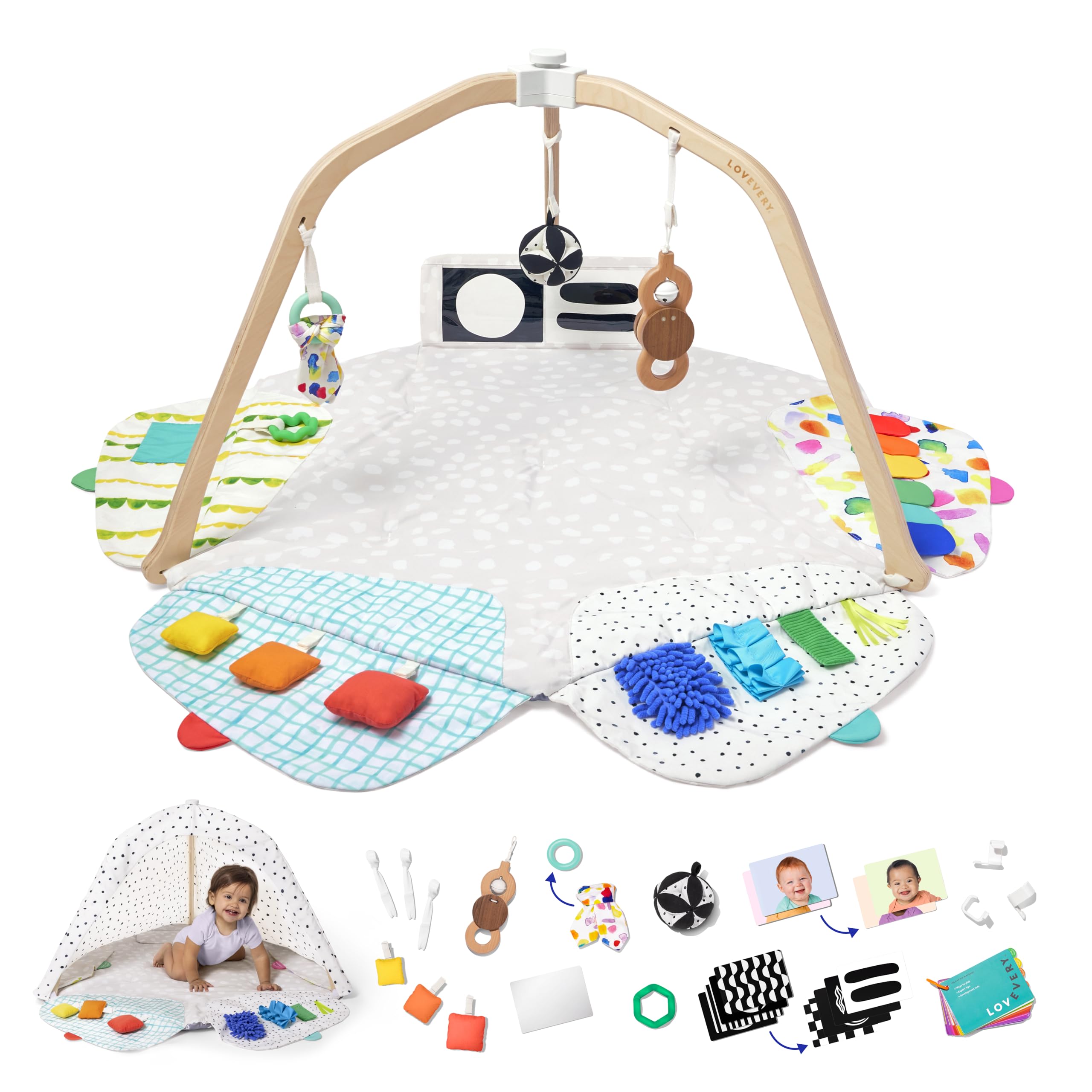
Lovevery The Play Gym
Key Features
- Mat: Organic cotton, thin padding
- Frame: FSC-certified wooden legs
- Included: Play guide and four card sets
- Stage range: 0-11 months, 5 zones
- Price: Premium
This is the play gym we recommend to anyone who wants to be told what to do next. Five development zones reveal or conceal as your baby moves through the stages, a printed play guide walks you through age-appropriate activities, and three adjustable clips hold the black-and-white, mirror, common-object, and faces cards at whatever angle a newborn can actually focus on. It is the difference between owning a mat with toys clipped to it and owning a plan for the first year.
The materials carry the rest. The legs and batting ring are FSC-certified wood, the teether and teething rings are organic cotton, and the frame sits high enough that a baby can move underneath it rather than around it. It also converts to a play tent for the second year, which is more afterlife than any other gym here offers. What the materials do not buy is cushioning: the mat is a thin quilted layer, so on hardwood put a rug pad underneath before you set it up.
The trade is floor space. At 43 by 38 inches it is the biggest gym in this set, and it does not fold, so it claims a corner of a room rather than coming out for an hour at a time. In a dedicated nursery that is fine. In a small apartment it is the reason to look at the Blissful Diary instead, and the reason we mention the footprint before the philosophy.
Pros
- Stage-by-stage play guide for the first year
- Wooden frame and organic cotton teethers
- Converts to a play tent later
Cons
- Large footprint that does not fold away
This is the gym we hand to parents who want a plan: five stages, a week-by-week guide, and materials that look like furniture rather than baby gear.
Best for Small, Neutral Rooms
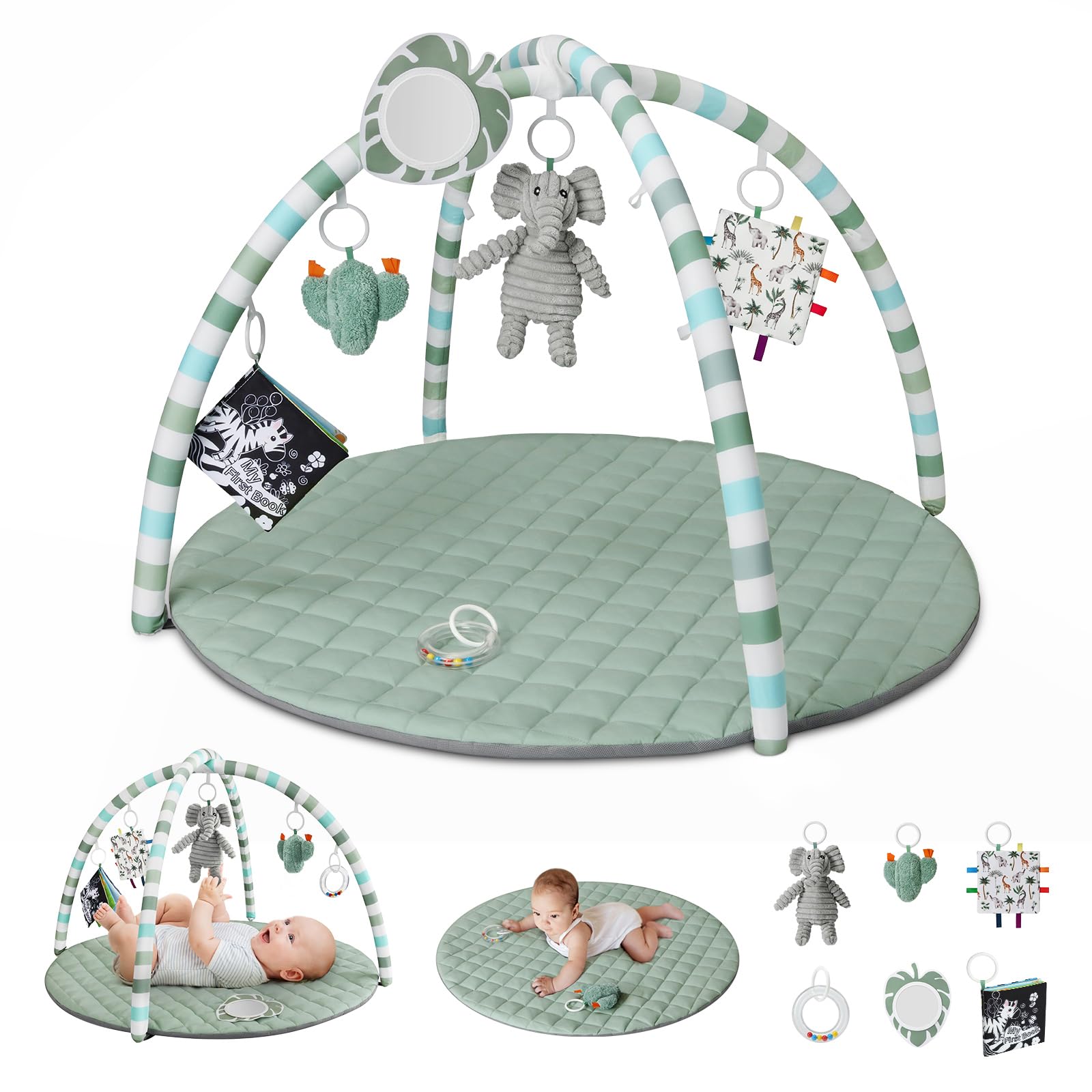
Blissful Diary Play Gym Mat
Key Features
- Care: Machine washable, non-slip backing
- Toys: 6 detachable sensory toys
- Design: Sage green, folds flat
- Mat size: 33.46 x 33.46 in
- Price: Midrange
Sage green, 33.46 inches square, six toys on the bar, and no batteries anywhere. The Blissful Diary is the gym for a room you care about. The muted palette and minimalist frame sit beside a sofa far more comfortably than a light-up piano does, and the whole thing folds down when the play space has to become a living room again.
Setup is tool-free and takes about a minute, and it comes apart as easily. The six sensory toys, a self-discovery mirror among them, clip on and off, so you can rotate what is within reach and take a favorite in the car. The mat is polyester over a non-woven non-slip backing and it goes in the washing machine, which matters more than any feature list once a baby is spitting up on it twice a day.
The footprint is the limit. Thirty-three inches is generous around a newborn and tight around a one-year-old who wants to roll the length of it, so this is a first-year mat rather than a first-three-years one. As a gift, though, it is the one here that looks chosen rather than ordered in a hurry, and the packaging backs that up.
Pros
- Neutral sage palette that suits a room
- Six detachable toys, no batteries
- Folds down and machine washes
Cons
- No music, lights, or sounds
For a small nursery or a living room you actually like the look of, this is the gym we point to: quiet, washable, and gone in a minute.
Best for Large Playpens
Blissful Diary Floor Mat
Key Features
- Top: Washable fabric cover
- Design: Earth tones, foldable
- Backing: Non-slip dots
- Mat size: 71 x 59 in
- Price: Midrange
Seventy-one by fifty-nine inches is the number that decides this one. Laid across the end of a family room or inside a large playpen, it leaves room for two adults to sit down with a baby and for a crawler to make a full circuit without reaching the edge. The earth-tone leaf pattern is the second thing people notice, and it does its part by hiding the small marks a mat collects.
Cushioning is why we rate it above the thinner mats here. The foam is dense enough that sitting down on it does not feel like sitting on the floor, and the fabric top is soft under a cheek during tummy time. It is also the mat we reach for after a stomach bug, because the cover is machine washable, and ours went through the drum and came out intact, which is not true of every padded mat we have washed.
Folding is the catch. It bends in half for storage rather than folding into a tidy stack, and it is too bulky to put away between play sessions, so this is a mat that stays down. In a small room, measure first: 71 inches runs past the end of a standard rug and takes the floor space of a small sofa.
Pros
- Large 71 x 59 inch surface
- Machine-washable fabric top
- Dense cushioning for rolling and sitting
Cons
- Folds in half, not compact
Our pick for a playpen or family room where the mat stays put: big, softly cushioned, and washable rather than wipe-only.
Best for Hardwood Floors
Huloo Sleep Play Mat
Key Features
- Care: Wipe and vacuum
- Mat size: 50 x 50 in
- Thickness: 1.3 in memory foam
- Certification: OEKO-TEX, CPSIA, ASTM
- Price: Midrange
One and three-tenths inches of slow-rebound memory foam is the whole argument for the Huloo. Put it down on hardwood and the floor stops being something you brace against: a baby learning to sit can tip over without you wincing, and an adult can kneel on it for a diaper change without paying for it later. The certification is spelled out too, OEKO-TEX fabric standards with testing to CPSIA and ASTM requirements, which is more than most mats here say about themselves.
The 50-inch square is a playpen mat first. It drops into a standard square playpen with little to spare, wipes clean with a damp cloth for sticky spills, vacuums for crumbs, and rolls away when you need the floor back. The surface is a tatami-style polyester in dark grey, so it does not show much, and it does not add much to a room either.
It arrives folded, and the creases take a few days to relax; a little steam speeds that up and saves you wondering whether the mat is defective. Once flat it stays flat, and the non-slip backing holds on tile and wood without creeping. If you want the same thickness for less, the SEPARO does the job with a velvet face and no machine wash. The Huloo is the one we leave down.
Pros
- 1.3-inch slow-rebound memory foam
- OEKO-TEX, CPSIA, and ASTM tested
- Wipes clean and vacuums easily
Cons
- Only one dark grey colorway
The mat we put on a hardwood floor inside a playpen: genuinely thick, certified, and quick to wipe.
Best for Playpen Padding
SEPARO Thick Baby Play Mat

Key Features
- Storage: Two elastic bands
- Surface: Velvet, wipe clean
- Mat size: 50 x 50 in
- Thickness: 1.3 in memory foam
- Price: Budget
The SEPARO and the Huloo are the same idea, a 50-inch square of 1.3-inch memory foam for a playpen, and the difference is the surface. SEPARO’s top is a velvet that feels warmer under a bare leg and slightly firmer when you press a palm into it, so a baby learning to sit gets a little more support and a little less sink.
It needs a day to itself before it is ready. The mat expands over 12 to 24 hours after you open it, so set it out the day before you plan to use it rather than the morning of. Two elastic bands come in the box for rolling it up, which sounds like a throwaway until you are trying to store a 50-inch slab in a hall closet.
Cleaning is where it gives ground: velvet and wipe-clean-only instructions mean milk and puree get spot-treated rather than machine washed. In a playpen that is usually enough, since most of the mess lands on the baby rather than the mat. As thick as anything in this set and firmer than the Huloo, it is the one we point to when a playpen needs a floor and the budget has already been spent on the playpen.
Pros
- Dense 1.3-inch foam support
- Velvet top wipes clean in seconds
- Elastic bands for rolling it up
Cons
- Wipe-clean only, not machine washable
If you want the thickest surface inside a playpen without stretching the budget, this is the one we hand people.
Best for Living Rooms
Little Bot Ofie Mat

Key Features
- Design: Reversible, two patterns
- Mat size: 78 x 55 in
- Material: Waterproof TPU foam
- Thickness: 1.5 cm
- Price: Premium
Two patterns, two sides, and a surface that reads as a rug rather than a piece of baby equipment. The Ofie is the mat for the room guests sit in. At 78 by 55 inches it is the largest thing here, and because the reverse carries a different geometric design, you can flip it when one side has been looked at for a year.
Day to day it is the easiest of the floor mats to live with. The TPU surface is waterproof, so a spilled cup wipes up, and it vacuums and mops like a rug without holding on to dog hair. Little Bot also states what is not in it: no PVC or EVA foam, and none of the heavy metals, BPA, lead, formaldehyde, phthalates, or flame retardants that parents ask about. That matters when the mat is going where a baby spends hours on their stomach.
Cushioning is where it gives ground. At 1.5 cm it is less than half the thickness of the 1.3-inch foam mats, so this is a mat for a baby who is already sitting and crawling rather than one for softening a topple. On a hard floor, add a pad underneath if you want the protection a Huloo gives you out of the box.
Then there is the white side, which yellows. It is the most consistent complaint about this mat, and it happens gradually enough that you notice one afternoon rather than one week. Buy it for the look and know the look has a shelf life; buy it for a wipe-clean surface in a visible room and nothing else here does that job as well.
Pros
- Two reversible patterns, rug-like look
- Waterproof surface wipes and vacuums
- Stated free of BPA, lead, and phthalates
Cons
- White side yellows with use
- 1.5 cm gives less cushion than foam mats
We rate it for a room guests see and a surface that wipes clean in seconds; we don’t rate it for deep cushioning under a sitter.
Best for Budget Playpens
VIVIDVIBEBEARPAS Foldable Mat

Key Features
- Care: Machine washable
- Design: Dinosaur print, folds flat
- Mat size: 50 x 50 in
- Thickness: 0.8 in
- Price: Budget
The least expensive mat here is also the thinnest and the most fun to look at: a 50-inch square of 0.8-inch foam printed with dinosaurs, folding flat enough to slide behind a sofa. As a second mat, for a playpen at a grandparent’s house or the corner of a kitchen, that combination is genuinely useful.
It handles the practical jobs. The diamond-textured backing keeps it from skating across tile, the whole thing goes into a washing machine on a gentle cycle, and it dries overnight on the back of a chair. Spit-up and juice both come out, and the busy print hides what does not.
Two things to know before it goes down. The padding is 0.8 inch, which takes the chill off a hard floor but will not cushion a backward topple the way the 1.3-inch mats here do. And it can arrive smelling of the factory: unroll it in a spare room for a couple of days, and send it back if the smell is still there after a week.
Sizing is the other wobble. These tend to land a little under their listed 50 inches, so measure the inside of the playpen before you count on a snug fit rather than a gap at the edges. At this end of the range, treat it as the spare rather than the main event, and it is a good spare to have.
Pros
- Machine washable and quick to dry
- Folds flat for storage and travel
- Non-slip diamond backing
Cons
- 0.8-inch padding is thin for hard floors
- Runs smaller than the listed 50 inches
We keep this one as a second mat for a playpen or a grandparent’s house: air it out first, and don’t count on deep cushioning.
How We Tested 12 Baby Play Mats
I started by reading specs and customer reviews for more than 30 mats, then filtered for thickness, material, size, edge construction, and price. I ordered 12 that represented the range—foam tiles, one-piece mats, and foldable styles—and put them through six months of daily use in my hardwood living room, my sister’s carpeted playroom, and my parents’ den.
I measured each mat’s thickness with a ruler, then knelt and sat on it for a 20-minute story session to see whether it bottomed out under my hip bones or left my knees aching. I watched three babies—my nephew, a neighbor’s crawler, and a toddler who treats every mat as a launchpad—during tummy time, rolling practice, and block towers, noting whether they stayed on the mat and whether toys rolled off its edges. Every mat was unrolled in a closed room and sniffed at one hour, 24 hours, and one week; the ones that still smelled like a factory went to the curb.
To check durability and quality, I folded and unfolded each mat weekly, wiped up mashed berries and yogurt, and inspected seams, edges, and surface indentations after each month. I also dragged them across the floor and let a 30-pound toddler stomp on them, because a mat that curls at the edge is a trip hazard. For value, I compared what each mat included—coverage, thickness, ease of cleaning—against what it cost, not just the sticker price. The mats that survived without curling, tearing, or losing their cushion are the ones below.
How to Choose a Baby Play Mat
The first decision is not brand or pattern, it is whether you need a toy bar for tummy time or a slab of foam between your baby and a hard floor.
Gym or floor mat: start with the job
The two products under this keyword do different work. An activity gym gives a baby something to look at and reach for during tummy time, and its mat is usually fabric, soft under a newborn and thin over tile. A foam floor mat is cushioning first: it turns hardwood into a surface a baby can roll on, sit up on, and topple onto.
If tummy time is the daily battle and your baby is under four months, buy the gym. If you already have a crawler and a hard floor, buy the mat. Plenty of families end up with both, and the Fisher-Price Deluxe paired with a 50-inch foam mat covers nearly everything a first year asks for.
What thickness actually buys
A 1.3-inch memory-foam mat absorbs a sitting baby’s backward topple. A 0.8-inch mat takes the edge off a hard floor and not much else. The Little Bot, at 1.5 cm, behaves more like a rug than a crash mat. The trap is the word thick itself: plenty of listings use extra thick for something well under an inch, so find the actual number before you decide.
Under an inch, treat it as a rug for a carpeted room. At 1.2 inches and up, it is a play surface that can sit on tile or hardwood on its own, which is why the two 1.3-inch mats here are the ones we send people to for playpens and rentals with unforgiving floors.
Cleaning: three levels, three kinds of ownership
Machine washable is the easiest to live with. The Blissful Diary floor mat and the fabric gym mats go in the drum once the toys come off the loops. Wipe-clean foam, like the SEPARO and the Huloo, handles spills and crumbs in seconds but keeps the stains. A waterproof surface such as the Little Bot wipes and vacuums like a rug.
The trap: washable only helps if the mat fits your machine. A 71-inch mat will not go into a small drum, so plan on spot-cleaning the big ones and save the full wash for real accidents.
Fit, storage, and how long it stays useful
Measure the inside of the playpen, not the outside. Fifty inches square is the common playpen size, and it is why so many mats here are 50 by 50. A 71 by 59 mat is a room decision and stays where you put it. Gyms work the other way: a 36 by 27-inch frame holds a corner for months, so pick the corner before you pick the gym.
On lifespan, the overhead toys do their work early and the mat and the piano carry on. Detachable pieces are what get you past the first birthday, and the two we have watched longest are the Fisher-Price keyboard, which lifts off the frame, and the Lovevery clips and cards, which move as your baby’s focus does.
Frequently Asked Questions
Can my baby sleep on a play mat?
Not for a nap or overnight. A play mat is a supervised floor surface, and sleep belongs on a firm, flat crib or bassinet mattress with a fitted sheet and nothing soft added. Foam mats, quilted gym mats, and the padded base of an activity gym all sit in the same category here. Keep the mat out of the sleep space entirely and you won’t be tempted to improvise at 3 a.m.
When can I start tummy time on a play mat?
From the first weeks, in short stretches with you right there: a minute or two at a time, several times a day, building up as your baby tolerates it. Put something to look at within reach. The Lovevery comes with black-and-white and mirror cards, and the Fisher-Price Deluxe has a mirror and a crinkle toy hanging on the bar.
If your baby protests, roll them onto their back and try again later the same day.
Can I use a play mat on carpet?
Yes, though the grip changes. The dotted and textured backings on the Blissful Diary and SEPARO mats are built to hold on hardwood and tile; on plush carpet there is less to bite into, and a determined crawler can shift them. A rubber rug grip underneath fixes it. Carpet already supplies the cushioning, so a thinner mat is enough there, and the difference in cost is better spent on a gym with toys your baby will reach for.
Final Verdict
The Fisher-Price Deluxe Kick & Play is where we point new parents first, because it does two jobs at once: a soft, washable surface and a toy bar that gives tummy time a reason to last another minute. The keyboard detaching is what keeps it in the room after the arch stops being interesting.
If your floors are hardwood and your baby is already rolling, put the money into cushioning instead: the Huloo inside a playpen, or the Blissful Diary mat across a family room. A fabric gym mat is not a 1.3-inch foam mat, and a crawler will tell you the difference.
