This post contains affiliate links. We may earn a small commission when you buy through our links — at no extra cost to you.
There is a particular kind of panic at 2 a.m., when you unzip a onesie and find a rash blooming across skin that was clear at bedtime. The right baby powder calms that down—absorbing moisture, cutting friction, and helping skin feel comfortable again. The wrong one cakes in the creases, perfumes the nursery, or sends up a cloud that settles on the crib, the rug, and your last clean shirt. After four months with 16 baby powders, the differences are not subtle.
Some powders are silky and nearly weightless; others feel like fine sand and clump the second they hit damp skin. Scent is another split: a few smell clean and faint, while others are so perfumed they announce themselves from the hallway. Because babies put hands—and everything—in their mouths, I watched how much powder ended up on fingers and pacifiers, and whether it left a chalky taste or film. You will find picks below for everyday changes, angry heat rash, sensitive skin, and the parent who just wants a container that shakes out evenly without a dust cloud.



Best for Diaper Rash Prevention
Caldesene Medicated Protecting Powder
Key Features
- Scent: Fresh scent
- Free from: Talc, dyes, parabens
- Pack size: 5 oz, pack of 5
- Key ingredient: Zinc oxide & cornstarch
- Price: Midrange
Zinc oxide is the ingredient that separates Caldesene from every other powder on this list, and it is the reason we put it first. Cornstarch absorbs what is already there; zinc oxide leaves a film that keeps the next wet diaper from reaching skin at all. On a baby who goes pink in the same creases every week, that second part is what actually changes things.
The powder itself is finer and silkier than the drugstore cornstarch powders, and a light shake covers more surface than you expect, so a five-ounce bottle goes further than the size suggests. Deep folds are the one place it needs care — rubbed in, it can pill into a soft grit. We smooth it on with two fingers instead of working it, and the pilling stops.
Five bottles is the other half of the appeal. One lives at the changing table, one in the diaper bag, one in the bathroom, and two sit in reserve, which means nobody is carrying a bottle up the stairs at two in the morning. It is also the one here that does not feel like a compromise for adults: the same powder handles chafing, prickly heat, and the inside of a summer shoe.
It is medicated, and that is worth saying plainly. This is a barrier powder for intact skin that is prone to redness, not a treatment for a rash that has already broken open — that needs a cream and a call to your pediatrician. As a daily preventative the whole household can share, though, nothing else in this group does as much.
Pros
- Zinc oxide adds a real moisture barrier
- Five bottles cover every room and bag
- Talc-free with no dyes or parabens
Cons
- Scent is stronger than a plain cornstarch powder
If you want one powder that prevents rash rather than just drying it, this is the one we recommend — the zinc oxide barrier earns its keep over a plain cornstarch powder.
Best for Everyday Budget Use
Johnson’s Baby Powder with Cornstarch
Key Features
- Testing: Hypoallergenic, dermatologist-tested
- Free from: Parabens, dyes, sulfates
- Pack size: 15 oz, pack of 3
- Key ingredient: Cornstarch, aloe & vitamin E
- Price: Budget
Three fifteen-ounce bottles, and the arithmetic lands well below anything else in this guide. If the goal is simply to keep powder in the house without thinking about it for the next several months, Johnson’s is the answer, and the gap is wide enough that we stopped looking for a cheaper option.
The formula is naturally derived cornstarch with aloe and vitamin E, hypoallergenic and dermatologist-tested, and free of parabens, dyes, and sulfates. There is no zinc oxide and no calamine in it, so it absorbs rather than blocks or cools. For routine changes on skin that is not already angry, that is plenty — it is the bottle we reach for without a second thought, and the one we hand to a friend who has just had a baby.
Two things stood out in use. The texture is smoother and finer than the old talc powders, but it does not have the same slip; between the fingers it reads a touch grainier, closer to baking starch than to silk. And the wide shaker gives up more powder in one tilt than a single diaper change needs, so a light wrist is worth learning.
Where it falls short is character. There is nothing in here to settle skin that is already pink, and the powder is not the finest of the group. If a rash keeps returning to the same spot, spend a little more on a zinc oxide powder. If you just want a good, mild powder in quantity, this is it.
Pros
- Lowest cost per ounce of anything here
- Cornstarch with aloe and vitamin E
- Hypoallergenic and dermatologist-tested
Cons
- Scent won’t suit fragrance-free households
For sheer value and a mild everyday formula we keep coming back to Johnson’s three-pack — buy it if your baby’s skin is already calm and you want powder that lasts.
Best for Natural-First Parents
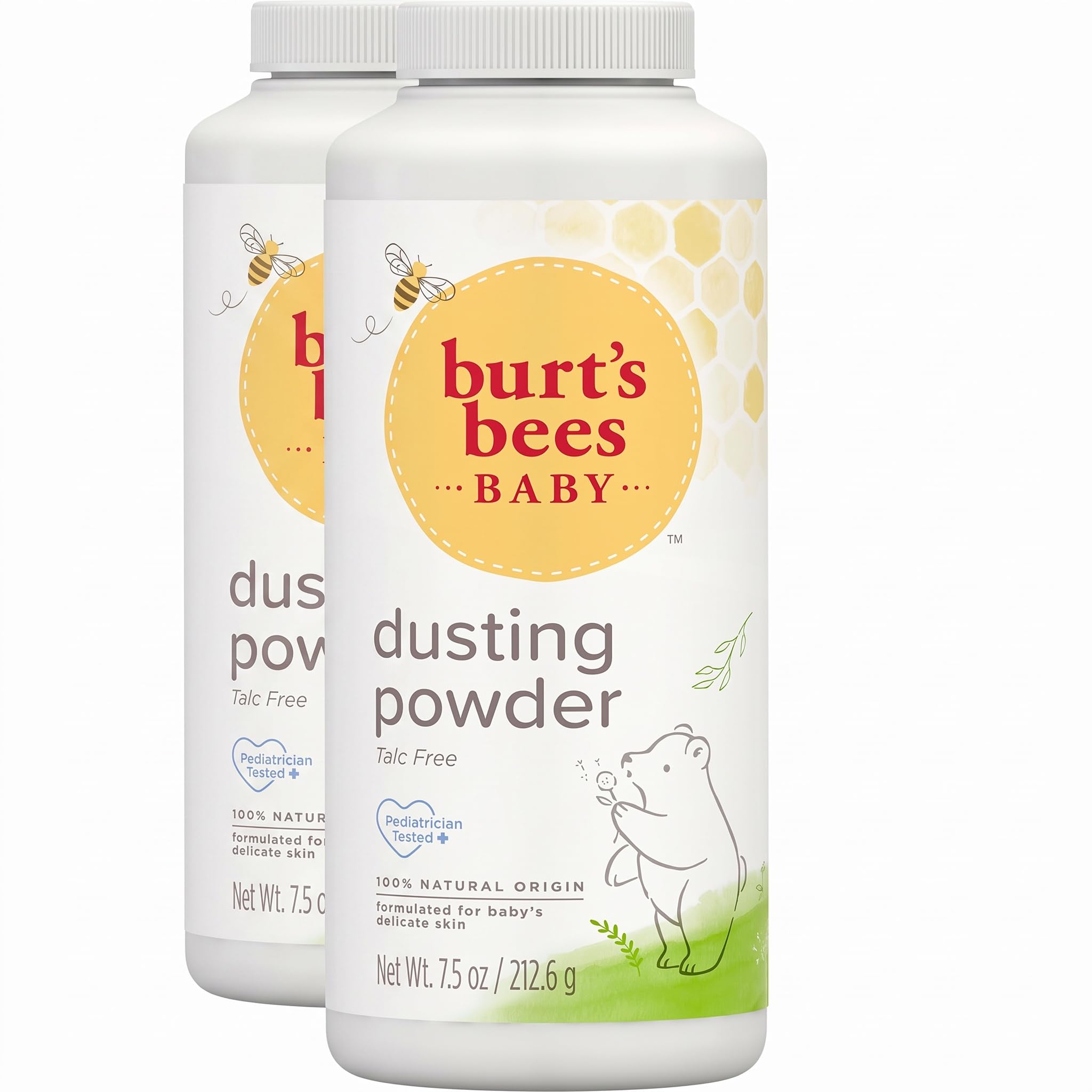
Burt’s Bees Baby Dusting Powder
Key Features
- Testing: Pediatrician tested, hypoallergenic
- Free from: Talc, parabens, phthalates, SLS
- Pack size: 7.5 oz, pack of 2
- Key ingredient: 100% natural origin cornstarch
- Price: Midrange
The scent is the first thing anyone notices, and it is sweeter than a baby powder has any right to be — closer to a soft floral than the clean nursery smell you might expect. It stays on the skin after the change is finished. We happen to like it. A household that wants a baby to smell like nothing at all will not.
Underneath the fragrance it is a straightforward formula: cornstarch, no talc, no parabens, phthalates, petrolatum, or SLS, and pediatrician tested and hypoallergenic on the label. Of the natural-origin claims in this group, Burt’s carries the most weight, though natural and non-irritating are two different promises.
In use it is silky and light, absorbs quickly, and does not leave a chalky film on a onesie or transfer to the changing pad. It also resists clumping in the bottle, which cornstarch powders left in a steamy bathroom often do not. That reliability is the part we did not expect to care about.
Pros
- 100% natural-origin, talc-free formula
- Silky texture that doesn’t transfer to clothing
- Pediatrician tested and hypoallergenic
Cons
- Can irritate very reactive skin
We recommend it to parents who want a natural-origin formula and don’t mind a sweet scent — take it slowly if your baby reacts to everything.
Best for Fragrance-Sensitive Babies
Noodle & Boo Delicate Baby Powder
Key Features
- Size: 4 oz
- Scent: Clean, fresh scent
- Free from: Talc
- Key ingredient: Cornstarch, aloe & allantoin
- Price: Premium
At four ounces in a slim bottle, this is the powder that lives in the diaper bag rather than on the shelf. It drops into a side pocket, the cap seats firmly, and you are not carrying a fifteen-ounce canister to a restaurant.
The formula is cornstarch with aloe and allantoin, talc-free, and it is the quietest powder here by a distance — a clean, fresh smell that fades instead of sitting on the skin. We reach for it at night, when the baby is half asleep and a cloud of perfume over the crib is the last thing anyone wants.
The grain is genuinely fine, finer than the drugstore powders, and it works into creases without clumping or leaving visible white patches. Aloe and allantoin give it a softness plain cornstarch does not have. For a newborn’s first months, when the nursery is small and everything smells like everything, that restraint is worth more than the ounce count.
Pros
- Subtle, clean scent that doesn’t announce itself
- Fine grain that spreads without clumping
- Aloe and allantoin soothe while it dries
Cons
- Premium price for a four-ounce bottle
Our pick when a strong-smelling powder is the problem: the scent is barely there, the grain is fine, and the small bottle suits a diaper bag.
Best for Chafing Relief
Anti Monkey Butt Baby Powder

Key Features
- Scent: Light fragrance
- Free from: Talc, parabens, phthalates
- Pack size: 8 oz, pack of 2
- Key ingredient: Cornstarch & calamine
- Price: Midrange
Calamine is what makes Anti Monkey Butt different from everything else here. It is the pink stuff in poison-ivy lotion, and suspended in a powder it does the same job: takes the heat out of skin that is already irritated and leaves a cooling film behind.
The base is cornstarch, talc-free, with no parabens or phthalates, and it goes on light — closer to a dusting than a coating. It clings well enough to still be there at the next change and does not cake in the folds the way heavier powders can. Two eight-ounce bottles is a serious amount of powder for one baby, which makes it the pack you share.
Where Caldesene builds a wall, this one cools, and that distinction is why it earns a place. On a baby whose creases are hot and pink after a sweaty afternoon, or a toddler chafing under a swim diaper, the calamine is doing something the plain cornstarch powders here cannot. We keep it as the second bottle rather than the only one — it is a specialist, and specialists do not need to be on the changing table every day.
Pros
- Calamine cools irritated, chafed skin
- Absorbs moisture and reduces friction
- Talc-free with no parabens or phthalates
Cons
- Fragrance may be more than a newborn needs
We reach for this one when skin is already hot and chafed; the calamine cools in a way the plain cornstarch powders here cannot match.
How We Tested 16 Baby Powders
We started by pulling every baby powder we could find on shelves and online—talc-free formulas, cornstarch bases, oat and clay blends—then cut the list by reading ingredient labels, checking price per ounce, and tossing anything with a heavy perfume or a shaker top that looked prone to clogging. That left 16 powders, which we used for four months during daytime diaper changes, overnight changes, and the post-bath fold-and-cream routine. A few of us also dusted them into summer chafing spots and sneakers to see how they held up outside the nursery.
At each change, we sprinkled powder onto damp skin and watched whether it absorbed quickly, sat on top, or turned into paste in the creases. We noted the texture between fingers—silky, chalky, gritty—and whether the container shook out an even layer or dumped a clump. Because babies grab at everything, we paid attention to how much powder ended up on our hands, their hands, and nearby pacifiers, and whether it left a taste or film that lingered. We sniffed each one right after opening and again after a few hours, since a scent that starts soft can turn sharp in a warm diaper.
We also tracked skin irritation: any redness, dryness, or tightness after use, and whether the powder soothed existing heat rash or made it sting. Moisturizing mattered too—some powders left skin soft, others left it dusty and dry. And we kept a running tally of how long a container lasted through daily changes, because a fine powder that costs little but vanishes in a week is not a bargain.
How to Choose a Baby Powder
The powder that works best for your baby is the one whose main ingredient matches the problem: starch to absorb, zinc oxide to block, calamine to cool.
Start with the ingredient doing the work
Cornstarch is the default because it is cheap, absorbs fast, and disappears into the skin. It is an absorber and nothing more, which is fine for a baby who just needs to stay dry between changes. Zinc oxide is the next step up: it leaves a film that keeps moisture from reaching skin in the first place, which is why it turns up in rash creams and in our top pick. Calamine is the third option and the least common — it cools skin that is already hot and irritated rather than preventing anything.
Match the powder to the state of the skin. Intact and dry: cornstarch is enough. Intact but going pink in the same creases every week: a zinc oxide powder holds a barrier longer. Already hot, chafed, and fussy: calamine earns its place. And more is never better — a thick visible layer cakes in the folds and holds moisture against the skin, which is the opposite of the job.
Talc-free is the floor, not the selling point
Every powder here is talc-free, so the word tells you a maker is paying attention rather than telling you which one to buy. What separates them is what replaced the talc: plain cornstarch, cornstarch with zinc oxide, cornstarch with calamine, or a natural-origin blend with aloe and allantoin.
Treat the other labels the same way. Hypoallergenic, pediatrician tested, and 100% natural origin are claims about a formula and how it was assessed, not a promise about your baby’s particular skin. A natural cornstarch powder can still redden a reactive baby, and a synthetic one can suit a sensitive one perfectly. Dab a little on a small patch of thigh and wait a day before you commit to a full change.
Decide how much scent you want
Scent is the most argued-about line on any of these labels, and it is the one thing you cannot change after you buy. If your baby’s skin is reactive, if you use powder at night in a small nursery, or if you simply do not want your baby to smell like anything, choose the quietest formula you can find — Noodle & Boo is the most restrained of this group.
If you like a scented powder, you have more room. Caldesene and Burt’s Bees are the two here that get noticed in the room; Johnson’s sits in the middle with a light, familiar smell. There is no right answer, only the answer that keeps you using the bottle instead of leaving it in a cupboard.
Buy by the ounce, not by the bottle
Powder goes a long way — a shake or two per change — so the number that matters is cost per ounce, not the sticker on the shelf. Bulk cornstarch multipacks are the cheapest way to keep a household supplied, and the large tubs last months when one baby is the only user.
The trap is the small premium bottle, which looks like the modest choice and is usually the most expensive way to buy powder by a wide margin. Buy a small one deliberately, for the diaper bag where its size is the entire point, and keep the bulk pack at home where the volume does the work.
Frequently Asked Questions
How do you apply baby powder without it going everywhere?
Shake it into your palm or a folded washcloth first, away from the baby, then pat it on. Never shake directly over the crib or near the face, where airborne powder is easy to breathe. A light dusting is enough — a visible layer cakes in the creases and traps moisture instead of wicking it. Close the container and store it somewhere dry, since cornstarch powders clump in a steamy bathroom.
Can you use baby powder on a rash that has already broken the skin?
No. Powder on weeping or open skin turns into a paste, which is exactly the environment you do not want. Use a barrier cream until the skin is intact again, and see a pediatrician if a rash is bright red, spreading, or has not improved after a few days. Powder is a preventative for healthy skin, not a treatment.
Can adults use baby powder too?
Yes — cornstarch powders are common for chafing, sweat, and summer heat, and both Caldesene and Anti Monkey Butt are marketed for adults as well as babies. If a pack will be shared around the house, buy the larger multipack; keep a small bottle for the diaper bag, where the compact size is the reason to own it.
Final Verdict
Buy Caldesene. It is the only powder here that pairs absorbency with a zinc oxide barrier, which is the difference between drying a baby’s skin and protecting it, and the five-bottle pack means one can live wherever changes happen. If quantity and a mild everyday formula matter more, Johnson’s three-pack is the cheapest per ounce here and does the plain job well. And if fragrance is the thing you are trying to avoid, Noodle & Boo is the pick — quiet scent, fine grain, small bottle.
