This post contains affiliate links. We may earn a small commission when you buy through our links — at no extra cost to you.
Most cause-and-effect toy listings promise educational magic but overlook what actually matters: whether a button is too stiff for a 9-month-old to press, or whether the pop-up sound startles instead of delights. Parents end up with toys that gather dust because the mechanism fights the baby instead of rewarding them. This guide cuts through the marketing and focuses on toys that deliver reliable, satisfying feedback — a simple press that produces a clear sound, a stack that spins without collapsing, a hammer that pops a peg every time. The best cause-and-effect toys respect a simple truth: the baby is the one who should be doing the learning, not struggling with the toy’s design. Each pick here was chosen for how well its action matches the intended age and how consistently it works over weeks of use, not how many features its box lists.
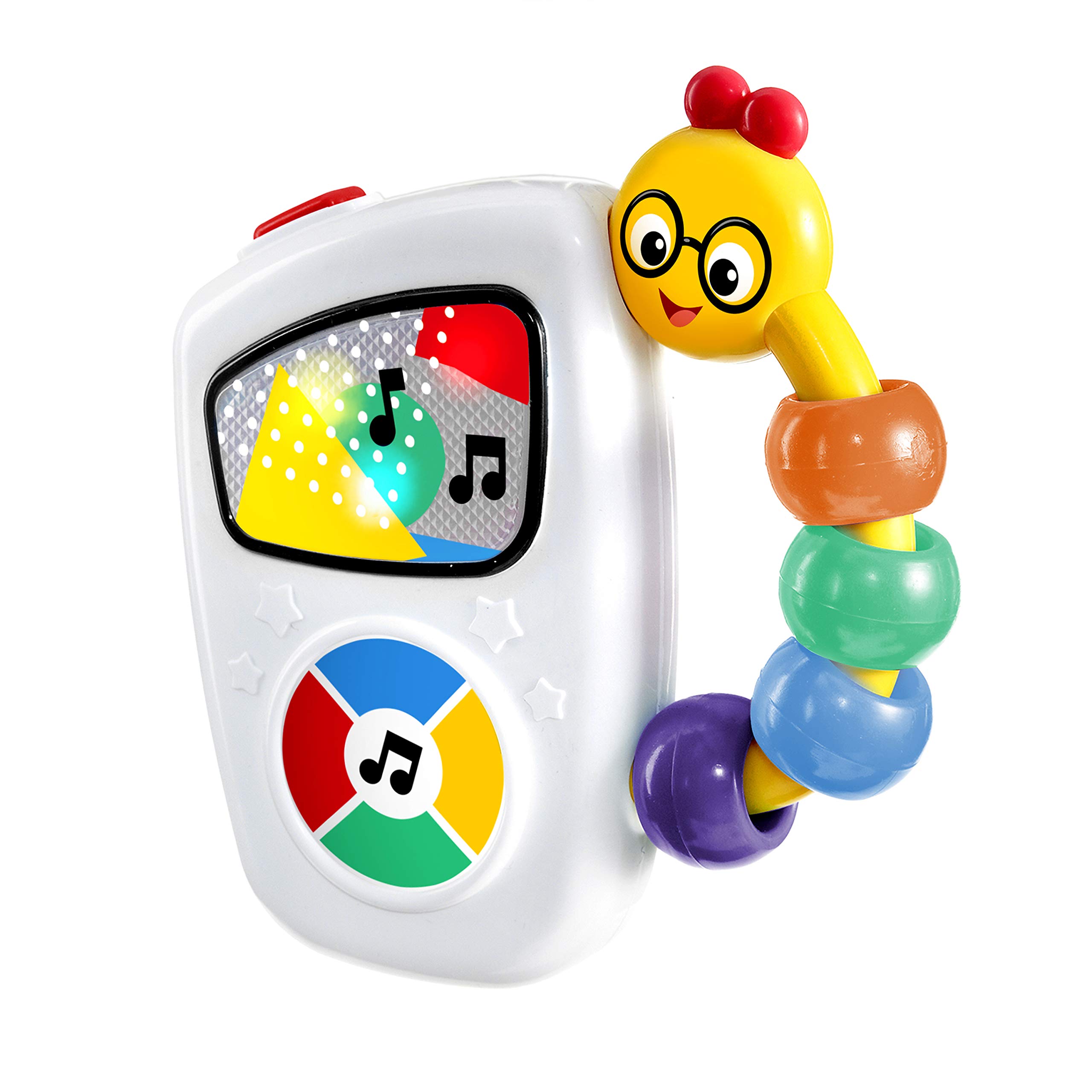


Best for Newborns & Travel
Baby Einstein Take Along Tunes
Key Features
- Age Range: 3–36 months
- Interaction: Push button
- Power Type: 2 AA
- Price: $
A single oversized button triggers a short burst of classical music and flashing lights — no apps, no menus, no fuss. The toy fits easily in a diaper bag or stroller pocket, and the handle lets babies carry it themselves once they start grabbing. The music is pleasant enough that parents don’t mind repeated plays, and the lights hold attention even in dim settings. Over thousands of customer reports, the toy handles everyday drops and bumps without issue, though a small number of units show damage after repeated hard falls.
Best for families who want a simple, mess-free entertainment option for babies as young as three months. The sound comes from a rear speaker, so placing the toy directly on a hard floor muffles it — keep it elevated for best audio. If you need a louder or more varied sound output, this will disappoint. Similarly, parents seeking a toy with multiple cause-and-effect mechanisms (stacking, sorting) should look elsewhere. The toy’s budget price makes it an easy addition to any diaper bag.
Pros
- Engaging lights and music with one easy press button
- Compact and portable with handle, ideal for travel
- Classical music selection is parent-friendly and not grating
Cons
- Sound muffled when toy is placed on floor due to rear speaker
- Occasional durability issues after repeated drops
Buy this if you want a no-fuss, travel-ready cause-and-effect toy for a newborn or young infant. Skip it if your baby needs louder or more varied sounds, or if you’re looking for multi-step interactive play.
Best for Grasping & Sensory
Bright Starts Grab & Giggle Monkey
The Oball open-grip design makes this rattle extremely easy for young babies to hold and shake, unlike the button-press of the top pick. Crinkle ears, satin ribbons, and motion-activated lights provide multi-sensory feedback that supports fine motor development from 3 months onward. Best for infants who are just learning to grasp rather than toddlers seeking structured cause-and-effect. One trade-off: size feedback is polarizing – some find it too small, others too large – and the music has no volume control.
Pros
- Oball structure makes it nearly impossible for babies to drop during play.
- Lightweight and safe for babies to shake without hurting themselves.
- Supports fine motor and grasping milestones from an early age.
Cons
- Size perception varies; some parents find the toy too small or too large for their baby.
Buy this if your baby is just learning to grasp and you want a lightweight, easy-to-clean toy with sensory feedback. Skip it if you need a quiet toy or your toddler expects more structured cause-and-effect.
Best for Educational & Fine Motor
Fisher-Price Smart Stages Piggy Bank
Key Features
- Age Range: 6–36 months
- Interaction: Drop coins
- Power Type: 2 AA
- Price: $$
This piggy bank turns drop-and-clink into a structured learning loop. Insert 10 coins into the slot, open the door to retrieve them, and repeat — each action triggers songs, numbers, or color names in English or Spanish. The two Smart Stages automatically adjust content difficulty, keeping the toy relevant from 12 to 24+ months. Compared to a simpler cause-effect toy, you get more academic value per play session, but the trade-off is volume: many families find it too quiet, and some versions lack a volume control. Best for parents who want fine motor practice paired with early math and language exposure.
Pros
- Builds fine motor skills through coin insertion and door opening.
- Teaches counting, colors, and Spanish words in an engaging way.
- Durable enough to survive drops and rough toddler play.
Cons
- Volume is quiet for many households; some versions lack any volume control.
Buy this if you want a mid-range toy that combines fine motor practice with counting, colors, and bilingual exposure for toddlers 12–24 months. Skip it if your child plays in a noisy environment and you need adjustable volume.
Best for Spinning & Fine Motor
Fat Brain Toys SpinAgain
Unlike simpler cause-effect toys that offer instant feedback, the SpinAgain rewards patience with a mesmerizing spinning descent that can occupy toddlers for 20+ minutes. The stacking discs and colorful shapes also support hand-eye coordination. However, the base does not lock onto the pole — lifting the toy scatters discs across the floor — and the premium price reflects the high build quality and battery-free design, not universal value. Best suited for parents who prioritize sustained independent play over simplicity and are willing to overlook the occasional cleanup.
Pros
- Mesmerizing spinning action keeps toddlers engaged for extended periods
- Supports hand-eye coordination and color recognition through stacking and spinning
- Durable ABS plastic withstands heavy play from 1–3 year olds
Cons
- Base detaches from pole when toy is lifted, causing discs to scatter
- Premium price may feel high for a simple stacking toy
Buy this if you want a battery-free toy that holds a toddler’s focus for long stretches and don’t mind the occasional disc scatter. Skip it if you prefer a simpler, more portable cause-effect toy or are on a budget.
Best for Hammering & Building
Melissa & Doug Deluxe Pounding Bench
The Melissa & Doug Pounding Bench delivers a satisfying physical cause-and-effect loop: hammer the pegs and they pop up on the opposite side. Made of wood with bright non-toxic paint, it requires no batteries and offers heirloom potential. However, durability varies — some units have splintering or pegs that stick, and the mallet is heavy enough that adult supervision is wise. Best for toddlers 18 months and up who enjoy active, screen-free play, and for parents who prefer a classic toy over electronic alternatives.
Pros
- Teaches cause-and-effect through satisfying hammer-and-pop action.
- Sturdy wood construction with bright, non-toxic paint.
Cons
- Occasional quality control issues with wood splintering or pegs that don’t pop correctly.
- Mallet is heavy; adult supervision recommended for younger toddlers.
Buy this if you want a battery-free, active cause-and-effect toy for a toddler who loves hammering and you value wood construction. Skip it if you need guaranteed durability or a toy safe for unsupervised play.
Best for Walking & Classic
Fisher-Price Corn Popper
This push toy stands out by rewarding walking with bright bouncing balls inside a clear plastic dome — immediate visual cause-and-effect that keeps toddlers motivated. The stable handle and lightweight build make it easy for new walkers to push, and no batteries are needed. However, the popping sound is significantly quieter than the original Corn Popper, which may disappoint parents expecting the classic racket. This trade-off makes it best suited for toddlers learning to walk in quieter environments rather than as a nostalgic noisemaker.
Pros
- Encourages walking with bright visual popping feedback
- Sturdy handle and lightweight design for easy gripping
Cons
- Popping sound is muted compared to original version
Buy this for a toddler learning to walk who will be motivated by the visual popping action without requiring loud sound. Skip it if you want the noisy, vigorous popping of the classic version.
Best for Tummy Time & Bilingual
Baby Einstein Glow & Discover

Key Features
- Age Range: 3–36 months
- Interaction: Press buttons, spin rattle
- Power Type: 3 AA
- Price: $$
This light bar shines with three modes in three languages, making it a strong option for multilingual families. Babies enjoy the lights and music during tummy time, and the toy works seated as well. However, the stand is flimsy and collapses easily, requiring manual support to stay upright.
Pros
- Teaches colors, animals, and music in English, Spanish, and French.
- Engages babies during tummy time with lights and music.
Cons
- Stand collapses easily when locked; requires manual support.
Worth considering if you want a bilingual tummy time toy that transitions to seated play; expect to provide manual support for the stand.
Best for Shape Sorting & Drum
VTech Sort and Discover Drum

Key Features
- Age Range: 6–36 months
- Interaction: Drop shape blocks, tap drum
- Power Type: 2 AAA
- Price: $$
This drum identifies each shape block by name as it’s dropped in, while the drum surface encourages tapping for sounds and lights. The shape-sorting and audio features earn strong approval, but the lid is difficult for toddlers to open independently, forcing adult assistance and limiting independent play.
Pros
- Identifies each shape block by name, reinforcing vocabulary.
- Drum surface responds to tapping with lights and sounds.
Cons
- Lid is hard for toddlers to open, requiring adult help to retrieve shapes.
Worth considering for toddlers 12–24 months learning shapes with adult help, especially if you’re okay retrieving the blocks.
Best for Hammering & Maze
Battat Pound & Roll

Key Features
- Age Range: 12–96 months
- Interaction: Hammer balls into holes
- Price: $$
This hammer-and-roll toy delivers a clear cause-effect loop: kids pound balls into holes and watch them navigate a maze. It’s a solid fit for high-energy toddlers and OT goals, though some balls occasionally stick in the track or fly out, and paint can chip from aggressive hammering. These quirks keep it from the top spot, but the durable plastic and stow-away storage make it a worthwhile mid-range option for screen-free play.
Pros
- Engaging cause-effect loop keeps toddlers returning to hammer and retrieve.
- Durable plastic withstands drops and rough toddler use.
Cons
- Balls can get stuck in tracks or pop out during play.
Worth considering if your high-energy toddler needs a battery-free cause-effect toy and you can tolerate occasional ball tracking hiccups.
Best for Color Matching & Gears
Melissa & Doug Rainbow Caterpillar

Key Features
- Age Range: 18–36 months
- Interaction: Place gears on pegs, spin
- Price: $$
The Rainbow Caterpillar offers affordable, battery-free spinning that helps toddlers match colors and build fine motor skills. Its simpler mechanics compared to more dynamic stacking toys and the ease with which gears detach when the toy is moved mean it’s best as a calm, stationary activity rather than a portable or high-energy option.
Pros
- Spinning gears teach cause and effect while holding toddler attention.
- Color-coded gears build fine motor skills and color recognition.
Cons
- Gears detach easily when the toy is lifted or moved.
Worth considering if your toddler enjoys calm, repetitive spinning and you prefer a battery-free toy over more dynamic mechanical feedback.
Best for Vehicle & Battery-Free
iPlay iLearn Press to Go Cars

Key Features
- Age Range: 6–36 months
- Interaction: Press head, car zooms
- Price: $
Press the car’s head and it shoots forward — instant, satisfying cause-and-effect with no batteries needed. The set includes four cute animal designs in bright colors that toddlers enjoy. However, quality control is inconsistent: some cars arrive unable to move or stop working quickly, so checking function on arrival is wise.
Pros
- Simple press-and-go action delights toddlers
- Cute animal designs and bright colors appeal to children
Cons
- Some cars arrive non-functional or stop moving soon after purchase
Worth considering if you want a simple, battery-free car toy for a vehicle-loving toddler and are willing to inspect each car upon arrival.
Best for Older Toddlers & Ot
Battat Pop-Up Pals

Key Features
- Age Range: 18 months+
- Interaction: Push, flip, slide, turn buttons
- Price: $
This battery-free toy offers four distinct button mechanisms — push, flip, slide, turn — each triggering a different animal to pop up. It’s easy to clean and durable. However, the buttons require significant force, and the loud pop-up sound can startle younger or sensitive toddlers. Best suited for children 18 months and older who can handle stiff mechanisms.
Pros
- Four button types (push, flip, slide, turn) offer varied fine motor challenges.
- No batteries required; easy to clean and durable plastic construction.
Cons
- Buttons are stiff and pop-up sound is loud, frustrating or startling younger toddlers.
Worth considering if you have an older toddler (18+ months) who needs fine motor practice and can handle sturdy, battery-free play.
Best for Budget Spinning Stacker
JUXUE Spinning Stacking Toys

Key Features
- Age Range: 12 months+
- Interaction: Stack discs on threaded pole
- Price: $
This set offers the same spinning disc concept as the premium SpinAgain at a lower price. Toddlers enjoy stacking the rainbow discs and spinning them down. However, the base detaches easily when lifted, causing discs to scatter, and the build quality feels less durable with potential wobbling. It’s a decent budget option for light play.
Pros
- Vibrant colors and spinning action keep toddlers engaged.
- Supports fine motor development and cause-effect understanding.
Cons
- Base can detach when lifting the toy, causing discs to scatter.
Worth considering if you want a low-cost spinning stacker and don’t mind occasional disc spillage when moving the toy.
How to Choose
The single most important insight: parents consistently prioritize simplicity and reliability over fancy features – a toy that consistently delivers clear cause-effect feedback will keep a baby engaged far longer than one with a dozen modes.
Age Range
Cause-and-effect toys are most effective when the action matches the baby’s developmental stage. A 3-month-old can only manage a single button press; an 18-month-old can handle multiple steps like dropping coins or hammering pegs. Check the recommended age range, but also consider whether the mechanism is easy enough for your child to activate independently – frustrating toys get abandoned.
Interaction Type
The type of interaction – push, press, pound, stack, spin – determines how the baby engages. Simple pressing (like a button) works for younger infants; more complex actions like stacking or hammering suit older toddlers who need fine-motor challenges. Choose one that matches your child’s current interests: if they love spinning, a gear or stacking toy will hold attention longer.
Power Type
Battery-powered toys offer lights and sounds that can be very motivating, but they require ongoing battery cost and can be too loud or too quiet. Battery-free toys (like pounding benches or push toys) are more durable, never run out, and often provide more satisfying mechanical feedback. Consider whether you want a toy that can be used anywhere without worrying about batteries.
Volume Control
Volume control is a make-or-break feature that many parents overlook until it’s too late. A toy that’s too quiet frustrates the baby’s learning; one that’s too loud can be overwhelming or annoying. If the toy has sounds, look for a volume switch or at least a way to moderate the output – some toys are permanently fixed at one level.
Durability and Cleaning
Baby toys get dropped, chewed, and dragged across floors. Look for materials that can withstand repeated drops – wood and thick ABS plastic are more forgiving than thin plastic. Cleanability matters too: toys with hard, smooth surfaces can be wiped down, while those with fabric or crevices may trap food and drool. A toy that can be thrown in the dishwasher or wiped with a cloth is a long-term win.
FAQ
What age is best for cause and effect toys?
Cause-and-effect toys can be introduced as early as 3 months with a simple button-press toy like the Baby Einstein Take Along Tunes. For babies 6–12 months, look for grasping toys or simple push toys. From 12 months onward, stacking, hammering, and shape-sorting toys become appropriate. The key is matching the mechanism’s difficulty to the child’s fine motor skills – not just the label on the box.
Do cause and effect toys need batteries?
Not necessarily. Many excellent cause-and-effect toys are battery-free – including pounding benches, stacking toys, push toys, and gear toys. These rely on mechanical feedback (pop, roll, spin) rather than lights and sounds. Battery-free toys are often more durable, cheaper to maintain, and encourage more active problem-solving. Battery-powered toys can be more engaging for some babies but come with the trade-off of volume control and battery replacement.
Why does my baby’s pop-up toy scare them?
Some pop-up toys, like the Battat Pop-Up Pals, produce a loud, sudden popping sound that can startle sensitive babies or younger toddlers. This is a common complaint. If your child is easily startled, look for toys with softer mechanisms or those that offer volume control. Alternatively, introduce the toy gradually by showing the pop-up action slowly before letting the child operate it themselves.
How do I clean baby cause and effect toys?
Cleaning method depends on the toy’s materials. Plastic toys with no batteries can often be wiped down with a damp cloth or mild soap and water. Avoid submerging battery-operated toys. Wooden toys should be wiped (not soaked) to prevent warping. Toys with fabric parts (like crinkle ears) can be spot-cleaned. Always check the manufacturer’s instructions, but as a rule, simpler surfaces are easier to keep clean.