This post contains affiliate links. We may earn a small commission when you buy through our links — at no extra cost to you.
A kids ski helmet has one job: protect your kid’s head on a mountain that is cold, hard, and full of other people. The trouble is that a helmet can pass the squeeze test in the shop and still turn into a battle by lunchtime—too tight over the temples, too loose when a kid looks down, or so warm that goggles fog on the first run. What you’re really shopping for is a shell that stays put, keeps ears warm, and doesn’t make your kid feel like a bobblehead.
We spent one full ski season with 12 kids ski helmets, from ski school drop-offs to backyard sledding, and the differences came down to fit and adjustability more than flashy graphics. A good dial or chinstrap can make a helmet last through a growth spurt, but only if the padding and shell shape are right to begin with; otherwise you’re just cinching a bad fit. The picks below are the ones kids actually kept on—and the ones parents didn’t regret buying.

Best for First Seasons
Odoland Kids Ski Helmet Set
Key Features
- Size: XS (49-53cm/19.3-20.9in)
- Included: Helmet, goggles, carry bag
- Ventilation: 10 vents
- Certification: ASTM, CPSC, CE
- Price: Midrange
Buying a kids’ helmet often turns into two purchases, and then you find out the goggles you already own do not sit properly on the new shell. This set skips that entirely: helmet, matched goggles and a carry bag arrive together as one buy, and it is the set we point most families to. The helmet is certified to ASTM, CPSC and CE standards, so the safety question is settled before you get to anything else.
Sizing is where we slow down. The listing says six to fourteen years; the shell says 49 to 53 centimetres. Believe the centimetres. That band comfortably covers a lot of five- to nine-year-olds and leaves a bigger ten-year-old out in the cold, so measure before you order. Once it is on, the dial at the back takes up the slack, which is how one helmet survives more than one season — and the removable liner, ear pads and chin band mean it does not get funky by February.
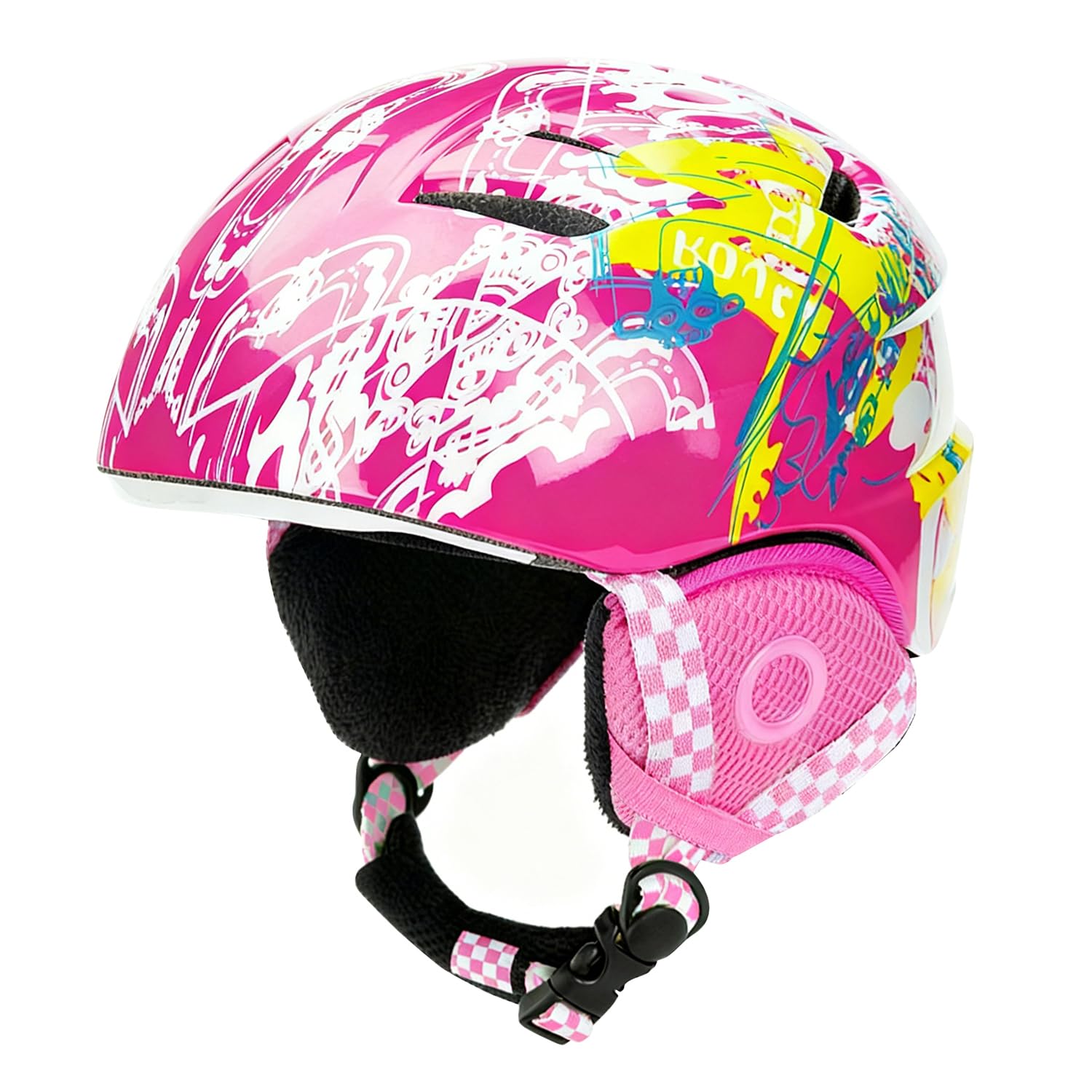
The goggles adjust on a band that stays put on the shell, which is the piece matched sets usually get wrong. The pink shell we tried is also easy to pick out of a lift line, and that stops being a trivial detail the first time you are scanning a crowded beginner slope. The one real limit is that size ceiling: past 53 centimetres, look at the visor model below.
Pros
- Helmet and goggles arrive as one matched set
- Certified to ASTM, CPSC and CE standards
- Dial fit takes up room as they grow
- Liner, ear pads and chin band come out for washing
Cons
- One XS shell, so it stops at 53cm
For most families, this is the set we point to first: certified, dial-adjustable, and sold with goggles that fit the shell.
Best for Maximum Protection
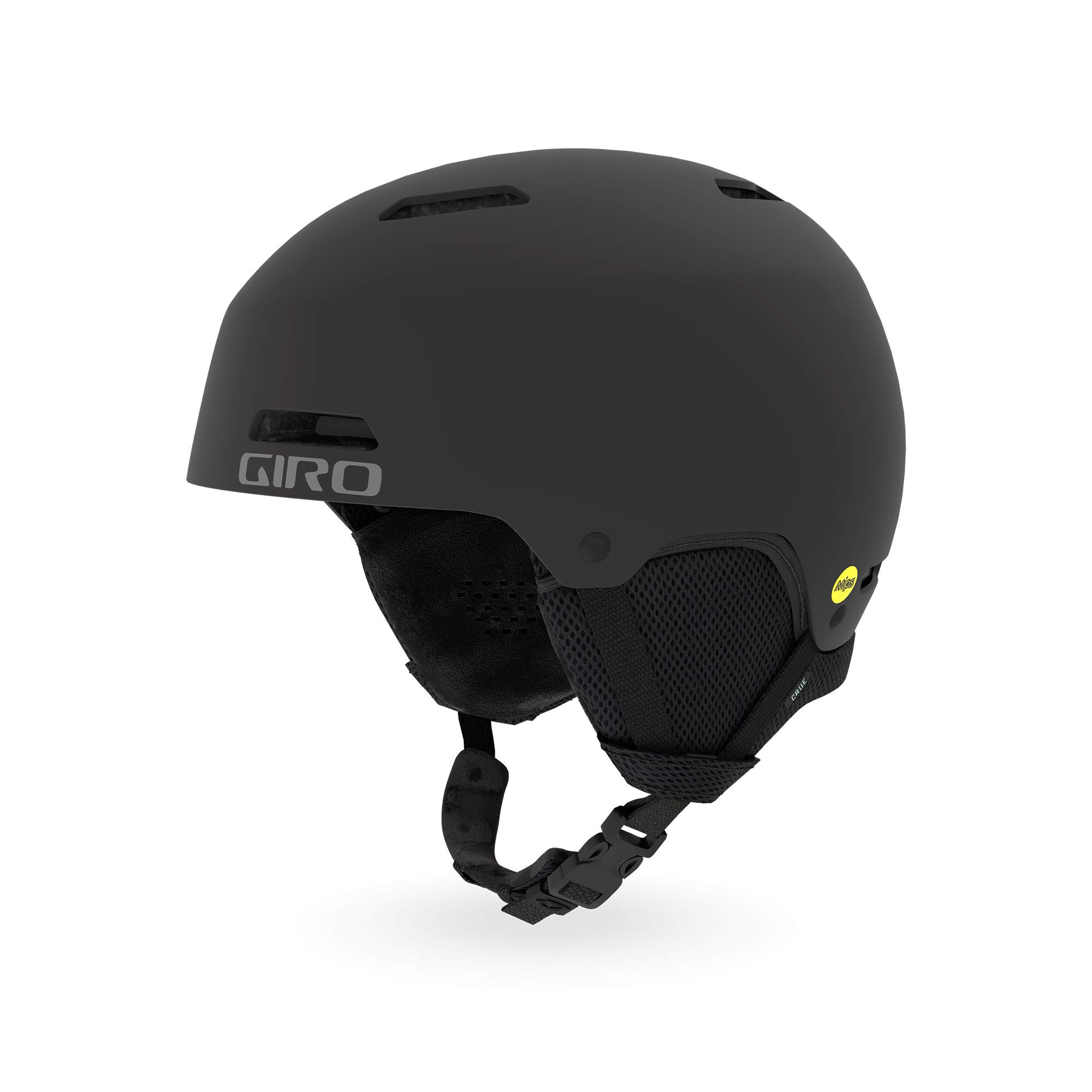
Giro Crue MIPS
Key Features
- Size: X-Small
- Included: Helmet and matching goggles
- Ventilation: Stack Vent, Super Cool Vents
- Impact protection: MIPS
- Price: Premium
This is the most expensive helmet in this group, and MIPS is the reason. The slip layer sits between the liner and the shell and lets the helmet rotate a few millimetres against the head in an angled fall — the kind that happens when a kid catches an edge and goes down sideways rather than straight on.
Our answer to whether it is worth it: yes, once, if the budget reaches. A helmet is the one piece of kit doing its job at the exact moment you cannot do anything to help, and MIPS is the only upgrade in this category that is about the crash rather than the comfort. Everything else on the Crue is solid rather than showy — a hard ABS shell over EPS foam, a Stack Vent at the front that lines up with the goggles, and Super Cool Vents across the top.
We were also impressed by how much thought has gone into the small stuff. The ear pads come out, so the helmet carries into spring, and they are audio-compatible if you want to drop in aftermarket speakers. The matching goggles use a dual lens with an anti-fog coating and double-layer face foam, and they seat against the shell without a gap. The chin strap is soft, which matters more than it sounds when a kid is already cold and cross.
What you cannot do is size up. This is a single X-Small shell, so get the tape measure out first and be prepared to look elsewhere if the head lands outside it. What you are paying for is the layer between the foam and the head, and that is the last place we choose to save money.
Pros
- MIPS layer for angled impacts
- Stack Vent lines up with the goggle
- Removable, audio-compatible ear pads
Cons
- Most expensive helmet in this group
- Sold in one X-Small size only
The safest helmet on this page, and the only reasons to hesitate are the single X-Small shell and the price.
Best for Older Kids
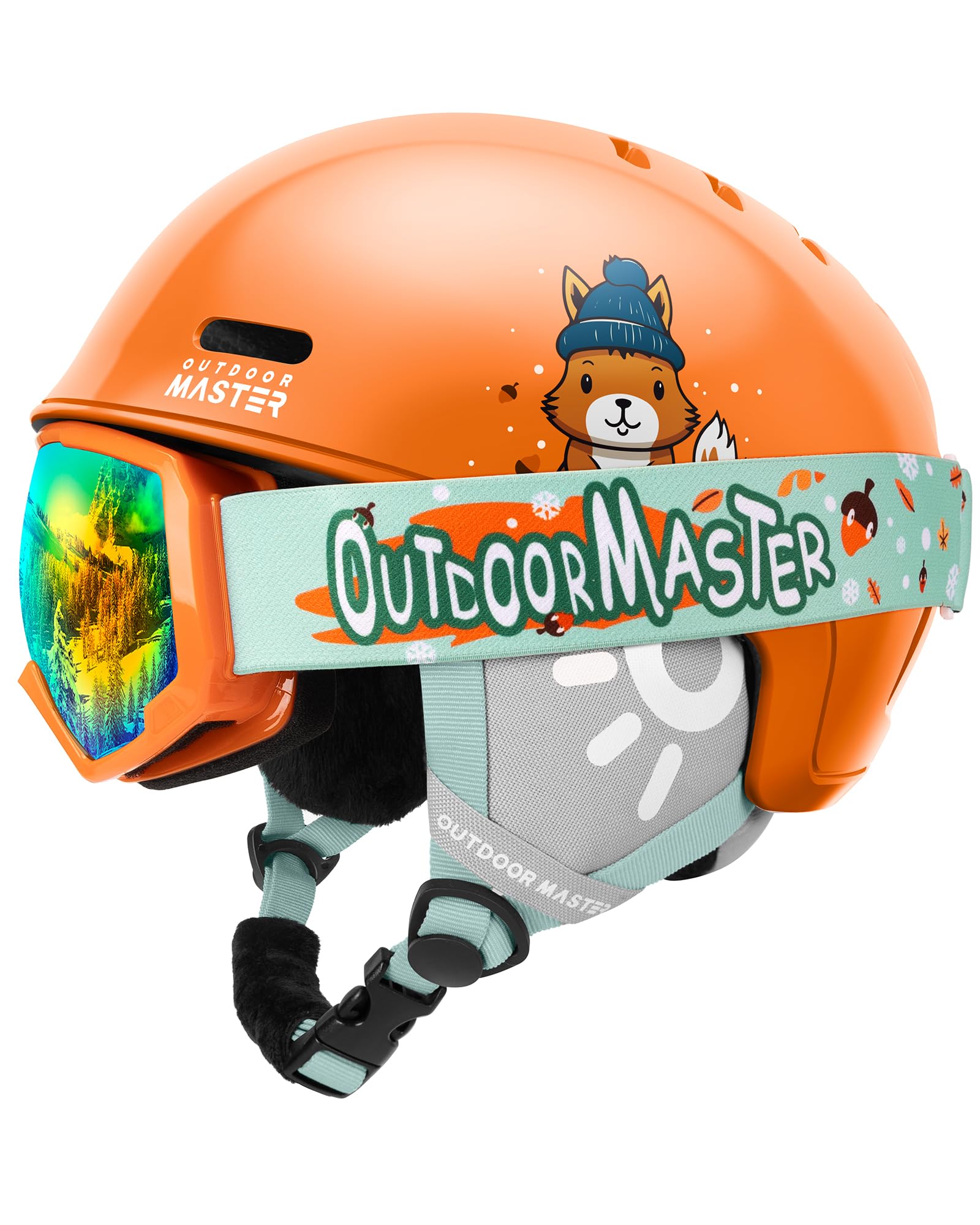
OutdoorMaster Kids Helmet Set
Key Features
- Size: 52-56cm Small
- Included: Helmet and goggles
- Ventilation: 12 vents
- Construction: In-mold polycarbonate
- Price: Midrange
Small is a misleading word on this listing. The shell measures 52 to 56 centimetres, which lands at the big end of the kids’ range: a seven-year-old at 51 centimetres rattles around inside it, while a ten-year-old who has outgrown a first helmet slots straight in. Check the measurement before anything else.
What is inside is a step up from a basic hard shell. In-mold construction fuses the polycarbonate shell to the foam, which keeps weight down and lets the helmet take a more sculpted shape. Twelve vents and a mesh cap move air, the fleece liner and plush earmuffs lift out, and the dial at the back is easy enough that kids put the helmet on and take it off themselves — a small thing that becomes a big thing when you are juggling two sets of gloves in a car park.
For the eight-to-twelve crowd, this is the set we recommend most often. It sits in the same price league as our top pick, the goggles are matched to the shell rather than an afterthought, and the removable liner takes the helmet from a cold January morning into a slushy March one. The earmuffs come out entirely too, which matters more than it sounds: plenty of kids run hot on a sunny spring day and simply refuse a padded helmet.
The reservation is the size, and only the size. There is no smaller shell here, and the five-years-and-older label is optimistic for something this big. If your kid is on the small side, our top pick covers the same ground in a smaller shell.
Pros
- In-mold shell keeps weight down
- Twelve vents with removable fleece liner
- Dial kids can work unaided
Cons
- 52-56cm only, too big for younger kids
Once your kid’s head passes 52 centimetres, this is the set that makes the most sense — in-mold, well vented and properly sized.
Best for Goggle Refusers
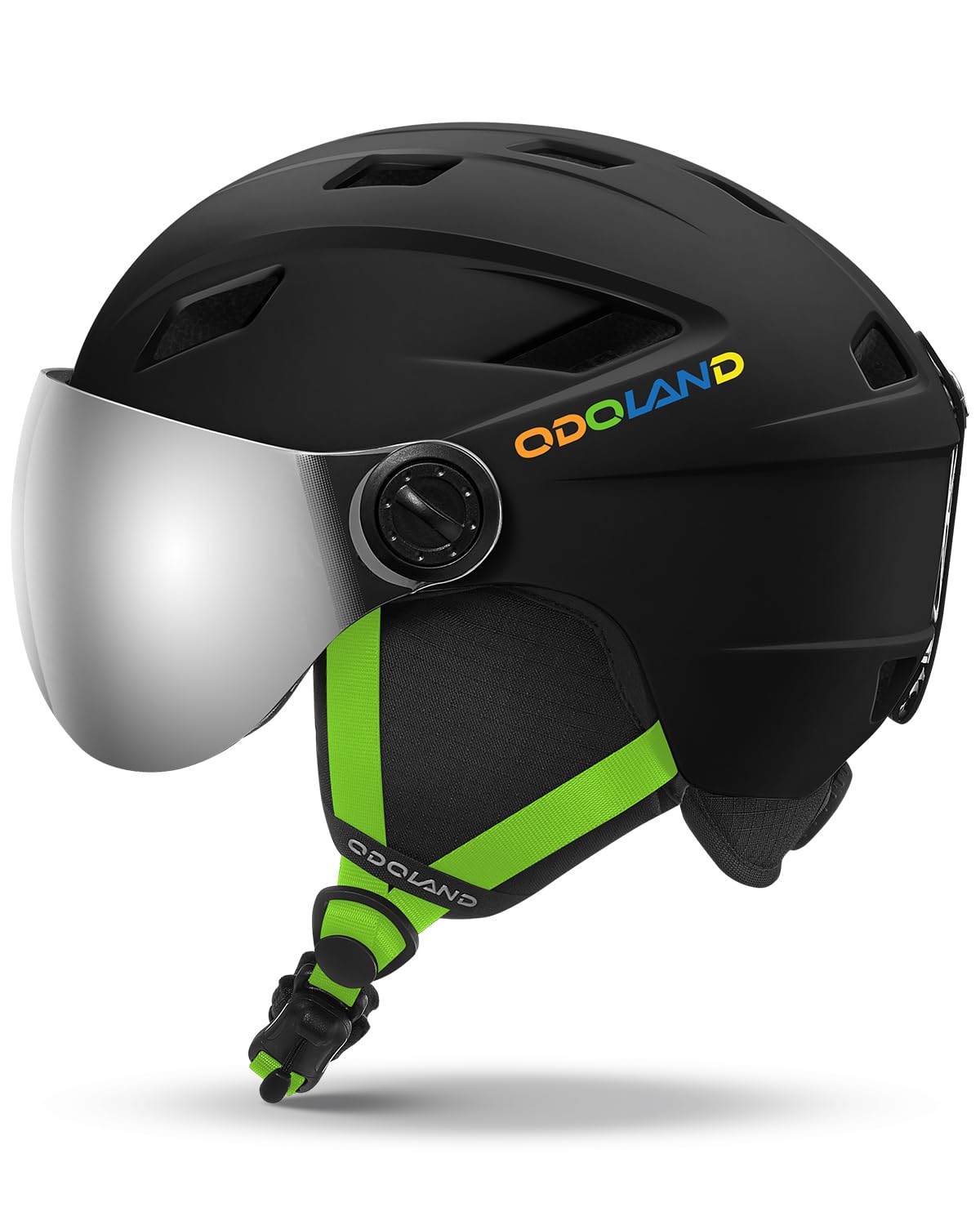
Odoland Visor Ski Helmet
Key Features
- Size: S (52-55cm/20.47-21.65in)
- Goggles: Integrated flip-up visor
- Fastening: Magnetic buckle
- Certification: ASTM
- Price: Premium
The first time you watch a four-year-old rip their goggles off halfway down a run, a visor helmet starts to make sense. Here the lens flips up and down on the helmet itself — no strap to lose, no frame to fight with, nothing swinging by the neck — and the magnetic buckle is built to be worked with mittens on, which is the detail that decides whether the morning goes smoothly.
The rest of the package is certified and properly adjustable. It is ASTM certified, the polycarbonate shell covers an EPS liner, and ten vents plus a streamlined lens are there to keep fog moving. The dial wraps an internal band a full 360 degrees rather than pinching at the back, and Odoland quotes 180 degrees of side vision and 120 up and down — which matches what we saw, and explains why kids in this helmet turn their heads less.
Sizing runs S, 52 to 55 centimetres, aimed at roughly five to twelve years old. Again, the centimetres are the honest number, and this shell will not suit a small five-year-old. It is also one of the pricier picks here, so you are paying for the visor mechanism rather than a cheaper build. One thing to sort before ordering: an integrated visor is a single lens, so check the tint you are getting against the light you actually ski in.
Pros
- Integrated visor replaces the goggle strap
- Magnetic buckle works with mittens
- ASTM certified with ten vents
Cons
- 52-55cm only, so older kids fit
- Premium price for the visor mechanism
If goggles are the daily battleground, buy this one: the visor flips up with one hand and never gets left on the lift.
Best for Toddlers
BeBeFun Toddler Ski Helmet
Key Features
- Size: Small
- Weight: 12.3 oz
- Age range: 2-6 years
- Certification: ASTM
- Price: Budget
Three hundred and fifty grams does not sound like a specification worth arguing about until you put it on a two-year-old. A toddler’s neck is doing that work all day, and a heavy helmet tips forward, slides down over the eyes and gets refused by lunchtime. This is one of the lightest shells here, and that is the reason it earns a place.
The other half of the toddler problem is size. Most helmets in this group are built around school-age heads, and a small child ends up in a shell that sits high and rocks. This one is built around a genuinely small head and labelled for ages two to six, and it carries ASTM certification — so you are not trading safety for the smaller fit.
It is an ABS shell, simple and tough, and the finish is cheerful enough that kids do not fight it. BeBeFun also points it at sledding and general snow play, which is what most two-year-olds are actually doing: twenty minutes in the backyard rather than a morning of laps.
Call it the first helmet for a family whose youngest is just getting onto snow. The point is not the feature list — it is that a light, small helmet actually stays on a small head. If your toddler is tall for their age, or you want one helmet to cover four winters, the 49-centimetre bottom end of our top pick is the better bet.
Pros
- 350g shell eases neck strain
- Built around a genuinely small head
- ASTM certified and fine for sledding
Cons
- One small size, outgrown in a season or two
For a two- or three-year-old’s first winter, the light shell and the small fit matter more than any feature list.
Best for Tight Budgets
Retrospec Comstock

Key Features
- Size: 48-51cm X-Small
- Weight: 1.08 lb
- Ventilation: 10 vents
- Construction: ABS shell, EPS liner
- Price: Budget
The least expensive helmet here, and for a family kitting out two kids at once that counts for something. It is a straightforward ABS shell with EPS foam inside, ten vents, a mesh cap, plush ear pads and a clip at the back for goggles.
The fit is where we slow down. The shell is 48 to 51 centimetres — genuinely small — but the cradle at the back is fixed, and the only thing you can change is the chin strap. That makes it a one-shot fit: it lands right on your child’s head or it does not, and the window is narrower than the price suggests. Measure carefully, and do not count on it growing with them.
What it does, it does simply. The ear pads are soft, the colour is bright enough to spot across a beginner slope, and the price leaves room for a proper pair of goggles — which you will need, because none are included. For a second child, a spare, or a first season you are not sure will stick, that is a reasonable trade.
Pros
- Least expensive helmet here
- Ten vents and a rear goggle clip
- Bright colour is easy to spot
Cons
- Rear cradle does not adjust
- Narrow 48-51cm fit window
A solid, cheap first helmet when the measurement lands in a narrow window, and a frustrating one when it does not.
Best for Value Sets
SNOWER Kids Ski Helmet Set
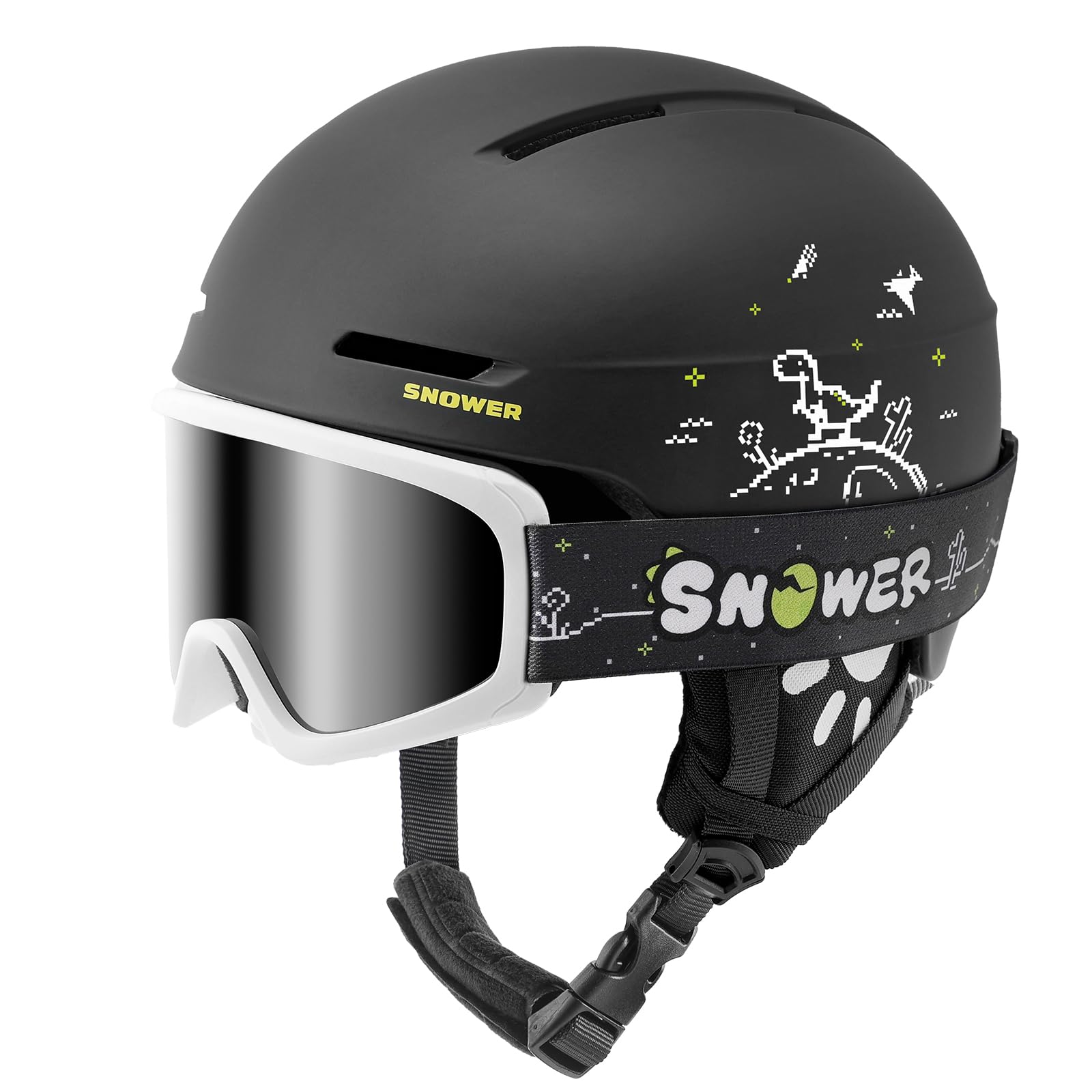
Key Features
- Size: Small
- Shell: Polycarbonate
- Included: Helmet and OTG goggles
- Age range: 5 years and up
- Price: Budget
The thing that sold us on this set happens at the top of the lift: the goggles push up onto the shell and stay there. They clip to the helmet instead of perching on a forehead, so they fog less from the inside and they do not end up dangling by one strap.
It is a two-piece set — helmet and OTG goggles — with an anti-fog coating and UV protection on the lens, an adjustable dial at the back, a soft chin strap and a run of vents across the top. The polycarbonate shell over an EPS liner is the same construction as sets that cost more, and the sizing is aimed at school-age kids rather than toddlers.
We think this is the value pick of the group. It is not the least expensive helmet here, but it is close, and it is the one that arrives complete: goggles that fit the shell, a dial that takes up a season’s growth, and a price that stings less when they leave it on the bus. It suits a kid who is still learning rather than charging, and a tidy, uncomplicated set is exactly right at that stage.
The limit is sizing. One Small shell, listed for five and up, so it will not help a family with a three-year-old at one end or a twelve-year-old at the other — and if you need a visor instead of goggles, the Odoland above is the one.
Pros
- Goggles clip to the shell and stay up
- Anti-fog lens with UV protection
- Adjustable dial and soft chin strap
Cons
- One small size, listed for five and up
A complete, tidy set at a sensible price — the one we reach for when the goggles keep disappearing.
Best for Wide Head Range
Natuway Kids Ski Helmet Combo
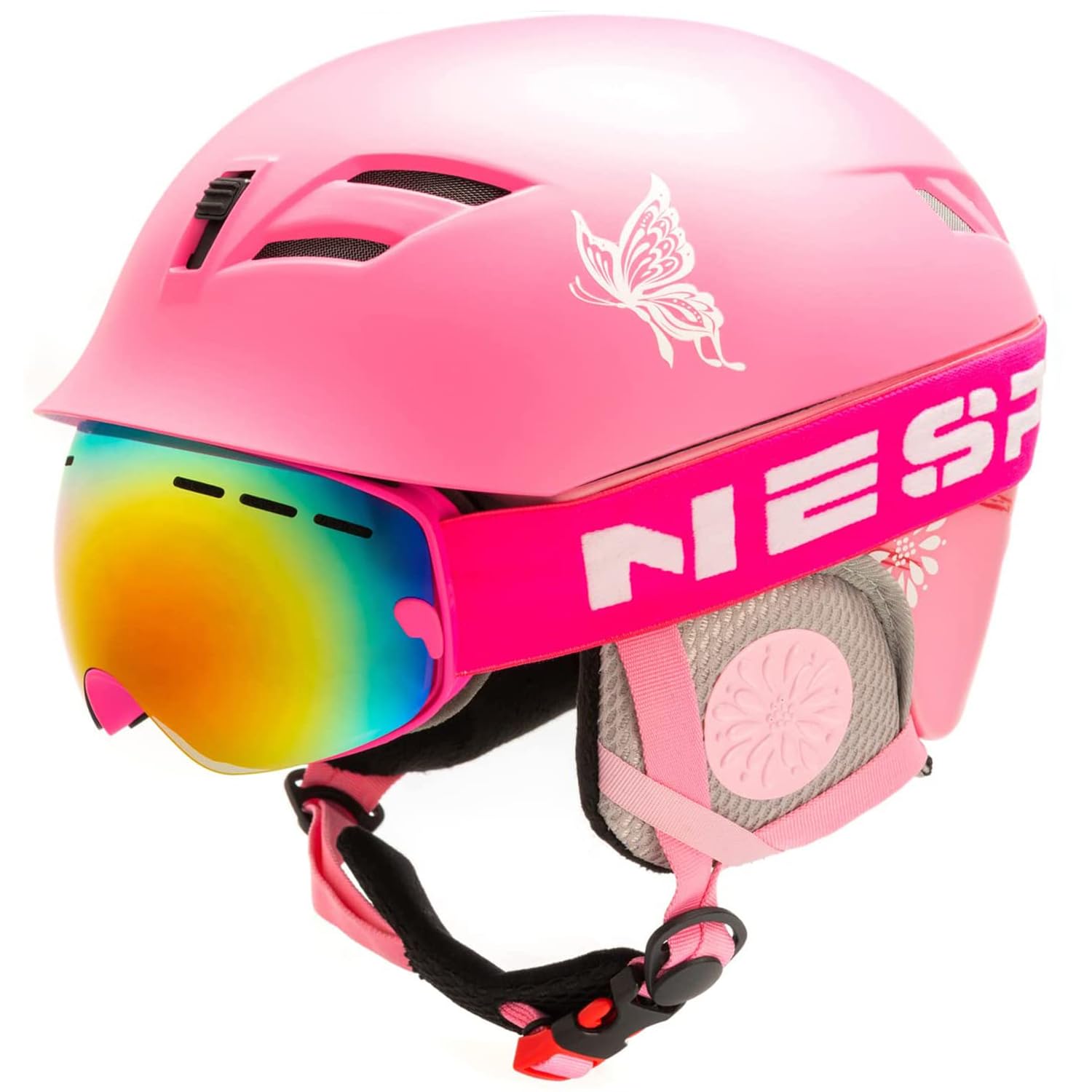
Key Features
- Size: 20-22in/3-12 year
- Included: Helmet and matching goggles
- Ventilation: 14 vents
- Certification: ASTM F2040-11
- Price: Premium
A three-to-twelve age range on a single helmet is a bold claim, and worth reading as a marketing number rather than a fit guide. What actually matters is the 20-to-22-inch circumference, which covers a big slice of the school-age market on one shell and leaves the dial doing a lot of the work.
The specification list is the strongest in this group. Fourteen vents is more than anything else here, the shell is certified to ASTM F2040-11, the buckle is a one-click quick-release, and the size dial is a proper adjuster rather than a strap.
The goggles are the detail we liked most. A semi-mirror lens lets you see your child’s eyes from outside — useful when you are working out whether they are squinting into the sun or just tired — and the frame is shaped to seat against the shell rather than float above it.
Where it gives ground is at the edges of that size band. Twenty to twenty-two inches on one shell is a lot of ground for a dial to cover, and a small eight-year-old ends up with more helmet around them than a dedicated small shell would give. At this price you are paying for vents and certification rather than a visor or a MIPS layer, both of which come cheaper elsewhere in this group.
Pros
- Fourteen vents, more than any other here
- Certified to ASTM F2040-11
- One-click buckle and adjust dial
- Semi-mirror lens lets you see their eyes
Cons
- One shell for 20-22 inches of head
- Premium price without MIPS or a visor
The best-ventilated helmet here, with certified protection and a proper dial — just check the measurement, because one shell spans a lot of ages.
How We Chose and Tested Kids Ski Helmets
We built a shortlist of more than two dozen kids ski helmets, filtering by size ranges, certification labels, weight, liner materials, and price, then narrowed it to 12 to test for one full ski season.
Testing happened where helmets actually live: in the car on the way to the mountain, at ski school drop-off, in lift lines, on green runs and magic carpets, and in the backyard after the resort closed. We checked fit with goggles on and off, asked kids to pull the chinstrap and turn the dial themselves with mittens on, and noted where pressure points showed up after an hour—red marks on foreheads, ears folded over, or a shell that tipped forward when a kid looked down.
Warmth got its own check on cold chairlift rides and windy summit lunches, where we watched whether ears stayed covered and whether kids wanted the helmet off the moment we stopped moving. For appearance and value, we listened: did they reach for the same helmet every morning, or negotiate for the one with the better color? We also inspected buckles, padding, and shell coverage after a season of being tossed into gear bags and cubbies, because protection is only useful if the helmet holds up.
How to Choose a Kids Ski Helmet
Start with a tape measure rather than the age on the box, because circumference is the only number that decides whether a helmet protects or just perches.
Measure the head, not the birthday
Run a soft tape around the widest part of the head, just above the eyebrows, and write the number down before you open a single listing. Age labels on these helmets are generous in both directions — one here claims six to fourteen years on a shell that stops at 53 centimetres — and a helmet that is too big rocks back on the head, which is worse than one that is slightly snug.
Then look at how the rear adjusts. A dial takes up a couple of centimetres of growth and forgives a measurement that is a little off; a fixed cradle has to be right on the day. If your child sits between sizes, size up only when there is a dial to take up the difference.
Certification is the floor, MIPS is the upgrade
A snow-sports helmet should carry ASTM F2040 or CE EN1077 on the label. A bike helmet is tested to a different standard and is not a substitute, however similar it looks. Beyond that, the shell matters less than you might think: in-mold construction fuses the plastic to the foam and usually saves weight, while a hard ABS shell is tougher against scrapes and cheaper to make.
MIPS is the one upgrade we think is worth paying for. It adds a low-friction layer that lets the helmet rotate slightly in an angled fall, and angled falls are most of what happens to beginners. It is not a reason to accept a bad fit — buy the fit first, then the technology.
Decide how the goggles attach
There are three arrangements: a clip at the back for goggles you already own, a bundled set with matching goggles, and an integrated visor. The trap is the middle one. The goggles in a set are often the weakest part, and a goggle that does not seal against the shell lets cold air in and fogs on the first run. Check that the frame sits flush against the helmet rather than up on the forehead.
If your child pulls goggles off mid-run, skip the argument and buy a visor. It is one less thing to lose, and it flips up with one hand rather than a negotiation.
Weight, warmth and the mitten test
Grams matter more on a small neck than on a big one. A toddler shell around 350 grams stays where you put it; something much heavier tips forward and gets refused by lunchtime. Warmth is a separate question: ear pads and a fleece liner make a January morning bearable, and removable ones let the same helmet work in March.
The last test happens in the car park. Can your child work the buckle with gloves on? A magnetic or one-click buckle is the difference between a kid who sorts themselves out and a parent kneeling in slush. Fit the helmet over the balaclava they will actually wear, then recheck the dial.
Frequently Asked Questions
How tight should the chin strap be?
Snug enough that the helmet does not lift when your child looks up, and sitting flat against the skin rather than twisted. You should be able to slide a finger under it, not a whole hand. Then have them shake their head: if the helmet rocks independently of their scalp, tighten the dial and the strap before you get anywhere near the lift.
Can we pass a ski helmet down to a younger child?
Only if it has not taken a hard hit. Check the shell for cracks and the foam for compression or crumbling, and make sure the liner and ear pads still clip in properly. A helmet that has been through a real crash should be retired even if it looks fine, because the foam that absorbed the impact does not spring back. The younger child’s head also has to measure inside the shell’s stated range.
Can a ski helmet double as a bike helmet?
No. Snow-sports helmets are built and tested to a different standard, ASTM F2040 or EN1077, with different coverage and impact speeds than cycling helmets. Sledding, skating and general snow play are all fair use for a snow helmet. For riding a bike, buy one that carries a bike standard on the label.
Final Verdict
Buy the Odoland set for most families. It is certified, it adjusts on a dial, and the goggles come matched to the shell — which is the part that goes wrong when you assemble a kit yourself. Measure the head first, because that shell stops at 53 centimetres.
If protection outranks price and the shell fits, the Giro Crue MIPS is the one we reach for. And if your skier is ten with a 55-centimetre head, skip both and go straight to the OutdoorMaster set, which is built for exactly that kid.
