This post contains affiliate links. We may earn a small commission when you buy through our links — at no extra cost to you.
Most kids drones in the budget range promise long flights but deliver just 5–7 minutes per battery – barely enough for a single game of catch. Add wind sensitivity and hit-or-miss quality control, and a first drone can quickly become a frustration. This guide cuts through those common complaints to focus on what actually matters for young pilots: safety, durability, and enough total flight time to keep a child engaged.
You’ll find picks that balance essential safety features like propeller guards and obstacle avoidance against battery life and ease of use. Some prioritize crash protection for indoor rooms, others add a camera for aerial photos. The right choice comes down to your child’s age and where they’ll fly – not between brands, but between features that fit your home and your kid’s skill level.
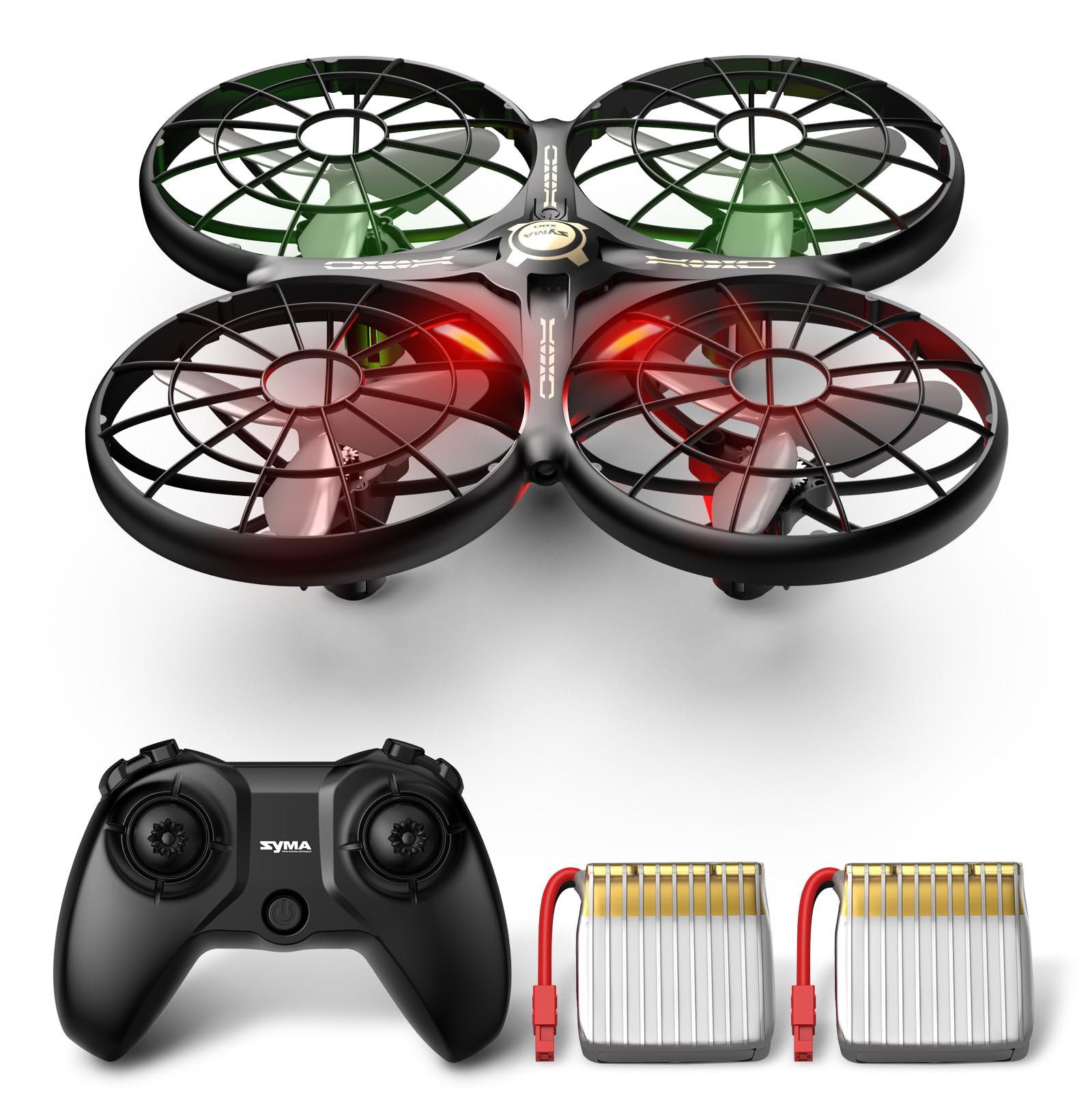


Best for Safe Indoor Fun
SYMA X100
Key Features
- Flight Time: 20 min total (2 batts)
- Safety Features: Full guard, obstacle avoidance
- Ease of Use: Altitude hold, headless mode
- Durability: Survives bumps, full guard
- Price: Budget
The SYMA X100 stands out with automatic obstacle avoidance using 4-way infrared sensors that effectively prevent crashes with walls and furniture indoors. Kids as young as 4 can fly it easily thanks to altitude hold and headless mode. The full propeller guard and durable build survive bumps without damage. One-key 360° flips and bright LEDs add excitement. Each battery delivers about 10 minutes of flight; the second battery extends total playtime to 20 minutes. Some users report a brief learning curve with the controls, but most master it quickly. The avoidance system is indoor-optimized; outdoor use in wind may reduce effectiveness.
This drone is best for parents who prioritize safety and want a first drone for kids aged 6–12 to fly indoors. The obstacle avoidance and guard protect both the child and furniture. However, it is not suitable for teens seeking a camera drone or for outdoor use in windy conditions. The battery life per battery is short, but the two-battery system helps stretch play sessions.
Pros
- Obstacle avoidance effectively prevents crashes, reducing damage to drone and surroundings.
- Easy for young kids to learn and fly, even without prior experience.
- Durable design with full guard withstands bumps and crashes.
Cons
- Battery life per battery is only about 10 minutes; the second battery helps but some want more.
- Controls have a slight learning curve; some beginners find them tricky at first.
Buy this if you want a safe, crash-avoiding indoor drone for kids ages 6–12. Skip it if you need a camera drone or longer flight times.
Best for Aerial Photos/videos
Pallton X80
Key Features
- Flight Time: 24 min total (2 batts)
- Ease of Use: One-key start, altitude hold
- Durability: Foldable, carrying case
- Camera: 1080p FPV
- Price: Budget
The Pallton X80 stands out among budget drones for its 1080p camera with live FPV feed, letting kids and beginners capture aerial photos and videos without a steep learning curve. Unlike the top pick (SYMA X100) which prioritizes obstacle avoidance, this model trades some crash protection for a camera that actually delivers decent quality for the price. It comes with two batteries and a carrying case, making it easy to grab and go for outdoor family adventures. However, the camera quality isn’t comparable to expensive drones, and the app can be glitchy for some users — a trade-off worth noting if reliable connectivity is a priority.
Pros
- 1080p camera with FPV live view delivers clear aerial footage for the price.
- Easy to fly out of the box with one-key start and altitude hold.
- Two batteries and carrying case provide good value and extended playtime.
Cons
- Each battery provides about 12 minutes of flight — sufficient with two, but shorter than some alternatives.
- Occasional app connectivity glitches reported by a minority of users.
Buy this if you want a budget-friendly camera drone for kids or beginners to take aerial photos and videos outdoors. Skip it if you need long single-battery flight times or rely heavily on a glitch-free app experience.
Best for Kids 5-10
Holy Stone HS210
Key Features
- Flight Time: 21 min total (3 batts)
- Safety Features: Propeller guards
- Ease of Use: Altitude hold, headless mode
- Durability: Survives crashes well
- Price: Budget
Three batteries set this apart from the folding drone in this roundup, giving beginners about 21 minutes of flight with altitude hold, headless mode, and 3D flips. Quality control varies — some units stop working after a few flights — but the vast majority of owners report a durable, easy-to-fly drone that survives crashes and builds confidence. Best for kids ages 5–10 who want a feature-rich first drone for indoor or calm outdoor play, and for budget-conscious gift-givers who value spare batteries over a camera.
Pros
- Easy to fly for young children (ages 5+)
- Survives crashes well for a mini drone
- Great value with multiple features and three batteries
Cons
- Battery life per charge is short (~7 min), though spares extend total time
- Occasional quality control issues; some units stop working after a few flights
Buy this if you want a feature-rich beginner drone with extra flight time for kids. Skip it if you need consistent long-term reliability or a camera.
Best for Indoor Evening Play
HASAKEE Q9s
Key Features
- Flight Time: 12 min total (2 batts)
- Safety Features: Full propeller guard
- Ease of Use: Altitude hold, headless mode
- Price: Budget
The HASAKEE Q9s stands out with vibrant blue and green LED lights (three modes) that kids love during low-light indoor play—an angle the top pick doesn’t emphasize. Controls are intuitive and setup is quick for young beginners. But the trade-off is clear: each battery provides a meager 6 minutes of flight, and the second battery extends total time to about 12 minutes. Quality control is uneven; some units falter after a handful of flights. For parents whose child values dazzling lights over extended play sessions, this is a budget-friendly option, but expect limited longevity.
Pros
- Eye-catching LED lights with three modes keep kids engaged during low-light play.
- Simple controls and quick setup make it easy for young first-time pilots.
- Two batteries and a build that holds up reasonably well for a budget drone.
Cons
- Very short battery life (~6 min per battery) limits playtime.
- Occasional quality control issues; some units stop working after a few flights.
Buy this if your child is enchanted by colorful lights and wants a simple drone for brief evening indoor fun. Skip it if you need dependable performance or longer flight times.
Best for Ultra-Portable Toy
Holy Stone HS190
Key Features
- Flight Time: 7 min total (1 batt)
- Safety Features: Propeller guards
- Ease of Use: Altitude hold, headless mode
- Price: Budget
The Holy Stone HS190’s defining trick is folding into its remote, making it small enough to slip into a pocket or backpack. That portability comes at a cost: a single battery delivers around 7 minutes of flight, and the ultralight design drifts badly outdoors — it’s really an indoor toy. Compared to the more battery-endowed model in this lineup, the HS190 trades total flight time for grab-and-go convenience. It’s best for supervised toddlers or as a cheap gift where losing it isn’t a big deal, not for kids expecting extended play or outdoor flights.
Pros
- Folds into the remote for true pocket portability
- Simple controls with altitude hold and headless mode ease learning
- Budget-friendly price makes it a low-risk first drone
Cons
- Only one battery gives about 7 minutes of flight time
- Not suited for outdoor use — light weight drifts or flies away in wind
Buy this if you need a tiny, ultra-portable drone for indoor fun and don’t mind short flights. Skip it if you want longer play sessions or outdoor flying.
How to Choose
Flight time per battery is often just 5–7 minutes; always count on having two or three batteries to get 15–20 minutes total play.
Flight Time
Real flight time per charge ranges from 5 to 12 minutes in this price bracket. Drones advertising “20 minutes” usually count multiple batteries. Check how many batteries are included and what the per-battery duration is – that’s the number that matters for each session.
Safety Features
Propeller guards are essential for protecting fingers, furniture, and the drone itself. Some models add obstacle avoidance sensors that automatically steer away from walls – a valuable feature for indoor flying with young children. Look for full guards that cover all propellers.
Ease of Use
One-key takeoff, altitude hold, and headless mode reduce the learning curve significantly. Altitude hold keeps the drone at a steady height without constant thumb input, and headless mode prevents orientation confusion. These features let beginners focus on steering instead of crashing.
Durability
Cheap drones often break after a few bumps. Reading user reviews about crash survival gives the best sense of real-world durability. Models with full propeller guards and flexible frames tend to survive more impacts. Avoid hand-operated drones – they have very high failure rates.
Camera
Most kids drones under $50 do not have a usable camera. If your child wants to take photos or videos, look for one with a genuine 1080p sensor and FPV live view. Be skeptical of listings that claim “HD” without resolution details – these often deliver blurry, unusable footage.
FAQ
How long do kids drone batteries actually last?
Most budget drones fly 5–10 minutes per charge. That’s normal for this price range. The total playtime depends on how many batteries come in the box – two or three batteries can extend a session to 15–25 minutes. Plan on recharging between flights.
Can I fly a kids drone outdoors safely?
Yes, but only in calm, wind-free conditions and preferably at dusk to avoid sunlight interference. Budget drones lack GPS and struggle with even light breezes. If the drone has infrared sensors (common in very cheap models), direct sunlight can cause loss of control. Indoor use is far more reliable.
Why does my drone fly away or stop responding?
Two common causes: dead controller batteries (the remote runs on AAs) or flying too far beyond radio range (typically 100–160 feet). Check that the controller has fresh batteries before each flight, and keep the drone close. Wind can also push a lightweight drone beyond control range.
What is headless mode on a kids drone?
Headless mode makes the drone’s controls relative to the pilot’s position instead of the drone’s nose. That means pushing forward always moves the drone away from you, regardless of which way it’s facing. It prevents the confusion of reversed controls when the drone spins around – a must for beginners.