This post contains affiliate links. We may earn a small commission when you buy through our links — at no extra cost to you.
Halfway along a rail-trail ride, my kid peeled one hand off the bar and shook it out: the grips had gone slick with sweat and both palms were red. That’s the moment cycling gloves stop being a costume and start being gear. Gloves solve the two complaints kids actually bring home — hands sliding around on the grips, and the sting of a handlebar, a scrape, or a long climb with a death grip on the bars.
We spent four months with 14 pairs, fingerless and full-finger both, on kids from 4 to 10. The pattern that emerged: fit beats padding every time. A glove that’s a size too big bunches in the palm, rotates on the bar, and creates the exact slipping you bought it to prevent — so measure the hand instead of guessing from your child’s age, because these run small and shrink at the wrist once they’re sweaty.
What surprised me most was how early the weak ones failed, at seams and wrist straps, long before any padding wore through. Below are the pairs that survived our crew, in both fingerless and full-finger styles.



Best for Everyday Riding
FINGER TEN Kids Bike Gloves
Key Features
- Palm: Gel padding
- Style: Half finger
- Design: Breathable lightweight
- Price: Midrange
The gel padding in the palm is the first thing we noticed, and it is the reason this pair earns the top spot. It sits under the heel of the hand, where kids land when they catch themselves, without turning the glove into a stiff mitt. The half-finger cut leaves fingertips free for brake levers and snack grabbing, and the breathable back keeps hands from turning into a swamp on a warm afternoon.
We tested the fit against the usual kid-size problem: a glove that is right in the palm but too long in the fingers. This one stays snug without bunching, and the wrist strap is easy to tighten. The padding is enough for paved paths, playground laps, and the occasional spill, but it does not feel bulky on a balance bike. For everyday riding, that balance is what we want.
The fit is the main thing to dial in. Start with the palm measurement, not the age range, and size up if your child is between sizes. Once the glove is on, the strap is easy to tighten and the fingers stay free for brake levers. It is the pair we hand to most kids first.
Pros
- Gel padding under the palm
- Secure half-finger fit
- Breathable back panel
Cons
- Durability may not survive hand-me-downs
We recommend the FINGER TEN as the default kids cycling glove: gel padding, a secure half-finger fit, and enough breathability for everyday rides.
Best for Toddlers and Preschoolers
Simply Kids Bike Gloves
Key Features
- Palm: 2-piece cushions
- Size: Medium (4-8 years)
- Material: Spandex
- Certification: CPSIA certified
- Price: Midrange
The unicorn print is what gets kids to put these on, but the two-piece palm cushions are what make them worth keeping. The padding is placed where a preschooler lands when they tip over, and the CPSIA-certified materials gave us one less thing to worry about. The Lycra back is breathable, and the hook-and-loop strap is easy for an adult to snug up.
This is a younger rider’s glove. The medium is listed for 4-8 years, and the cut is aimed at smaller hands that are still learning to grip the bars. The strap is easy to adjust with one hand, and the fingers stay free for balance-bike handlebars. The padding is not so thick that it turns the glove into a mitt, so little hands can still feel the grips.
The print is the kind of detail that gets a kid to keep the gloves on instead of peeling them off at the driveway. For a younger rider who wants fun colors and real palm protection, the cushioning is a strong draw. It is a good first glove for a kid who is still learning to keep gear on.
Pros
- CPSIA-certified materials
- Two-piece palm cushions
- Fun unicorn print
Cons
- Runs small for many kids
- Snug opening needs help for little hands
We reach for the Simply Kids pair when a younger rider wants fun colors and cushioned palms; just check the palm measurement.
Best for Full-Finger Coverage
Accmor Full-Finger Kids Gloves
Key Features
- Palm: Non-slip microfiber
- Size: Small
- Style: Full finger
- Closure: Hook and loop
- Price: Budget
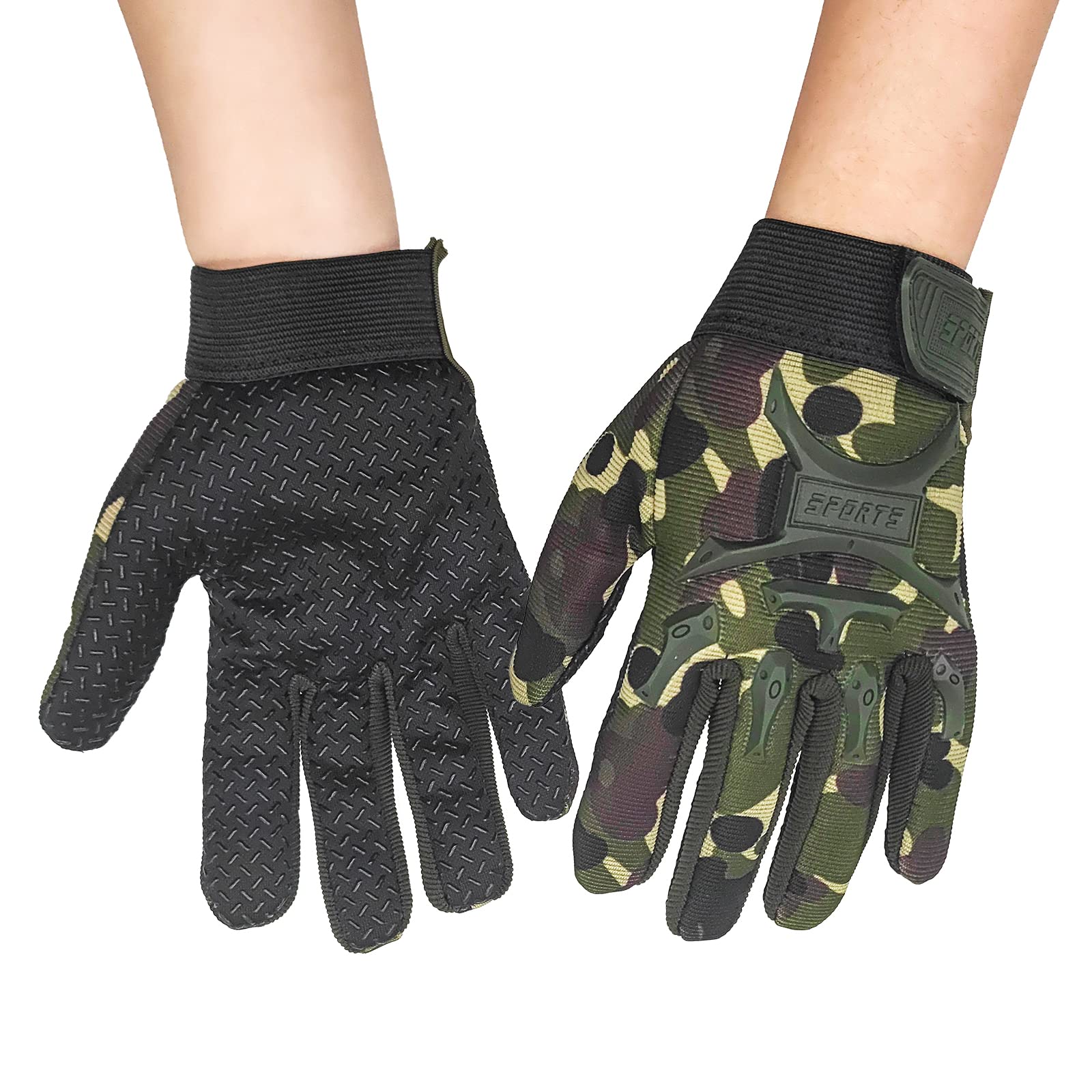
If your kid is the one who comes home with scraped knuckles, a half-finger glove leaves too much exposed. The Accmor full-finger pair covers the fingertips and the back of the hand without feeling like a winter glove. The spandex back is breathable and quick-drying, and the non-slip palm gives a useful grip on the bars. For cool mornings and brushy paths, that extra coverage is the point.
We like the adjustable wrist strap and the camo color, which reads as sporty without being cartoonish. The glove is flexible enough for braking and shifting, and the full-finger cut does not make the hand feel clumsy. It is a good choice for a kid who rides a bike, scooter, or playground bars and wants one pair to cover all of it. The palm grips well when hands are sweaty, and the quick-dry fabric is easy to live with.
The camo pattern has enough attitude for older kids without being loud, and the full-finger cut works for scooter handles and playground bars as well as bike grips. We like it as a transitional glove for a kid who is moving from a balance bike to a pedal bike and wants more coverage. It is a substantial glove without feeling heavy on small hands.
Pros
- Full-finger coverage
- Breathable spandex back
- Non-slip palm
Cons
- Fit can run small
- Durability is uneven
We like the Accmor full-finger glove for cool mornings and brushy paths, where covering fingertips matters more than maximum ventilation.
Best for Rugged Trail Rides
Long Keeper Full-Finger Tactical Gloves
Key Features
- Size: Medium
- Material: Leather, rubber
- Protection: Rubber knuckle
- Palm Circumference: 6.69-7.10 inches
- Price: Premium
The rubber knuckle guard is the feature that sets this pair apart from the other full-finger gloves here. It gives older kids a little more confidence when the ride turns rough, and the full-finger build covers the fingertips without feeling stiff. The anti-slip palm and adjustable closure keep the glove planted on the bars, and the leather-and-rubber material feels more substantial than the thin spandex pairs.
This is a glove for a kid who wants gear that looks serious. The camo finish and tactical details appeal to older riders, and the medium palm circumference of 6.69-7.10 inches is a useful number to check against your child’s hand. The padding is not bulky, so braking and shifting still feel natural. For the right-sized kid, the knuckle protection and sturdy feel are worth the premium.
The adjustable closure stays put when a kid is pulling on the bars, and the full-finger cut does not slow down braking or shifting. For a rider who wants one pair for trail rides, scooter sessions, and backyard adventures, the extra coverage is worth it. It is the most rugged full-finger option in this group.
Pros
- Rubber knuckle coverage
- Full-finger protection
- Anti-slip palm
- Substantial leather-rubber build
Cons
- Sizing stops at medium
- Seams can split with hard use
We recommend the Long Keeper full-finger glove for older kids who want knuckle coverage and a tactical look without giving up grip.
Best for Camp and Spares
Boao 3-Pair Kids Bike Gloves
Key Features
- Palm: Textured
- Size: 5 – 8 Years
- Material: Nylon
- Pack Count: 3 pairs
- Price: Budget
Three pairs in one pack is the whole pitch, and it is a good one for camp bags, school lockers, and the car. One pair can be in the wash, one can be lost in the yard, and one can actually be on your kid’s hands. The gloves are simple: a lightweight nylon back, a lightly textured palm, and a hook-and-loop wrist strap. For casual riding and playground play, that is enough.
These are not the pair for a serious trail session. The palm is lightly textured rather than padded, so it takes the edge off friction but will not cushion a long, rough ride. The upside is that they are easy to pull on and off, which matters when a kid is running out the door. The colors are fun, and the three-pair format makes them easy to share or stash.
We treat the Boao pack as a practical spare-pair buy. It is the pair you can leave in the car, send to camp, or hand over when a friend forgets theirs. The simple build is the point: nothing precious, nothing fussy, and enough grip for the riding most kids do around the neighborhood. For a family that loses gloves as fast as kids outgrow them, the math works.
Pros
- Three pairs per pack
- Lightweight nylon back
- Easy on and off
Cons
- Runs small for some kids
- Durability is inconsistent
We keep the Boao pack around for camp bags and spare-pair duty; three simple gloves make sense for casual riding and playground play.
Best for Small Hands
SAGA SPORTS Kids Cycling Gloves
Key Features
- Palm: Non-slip padded
- Size: Medium [6 – 8]
- Style: Half finger
- Material: Lycra
- Price: Budget
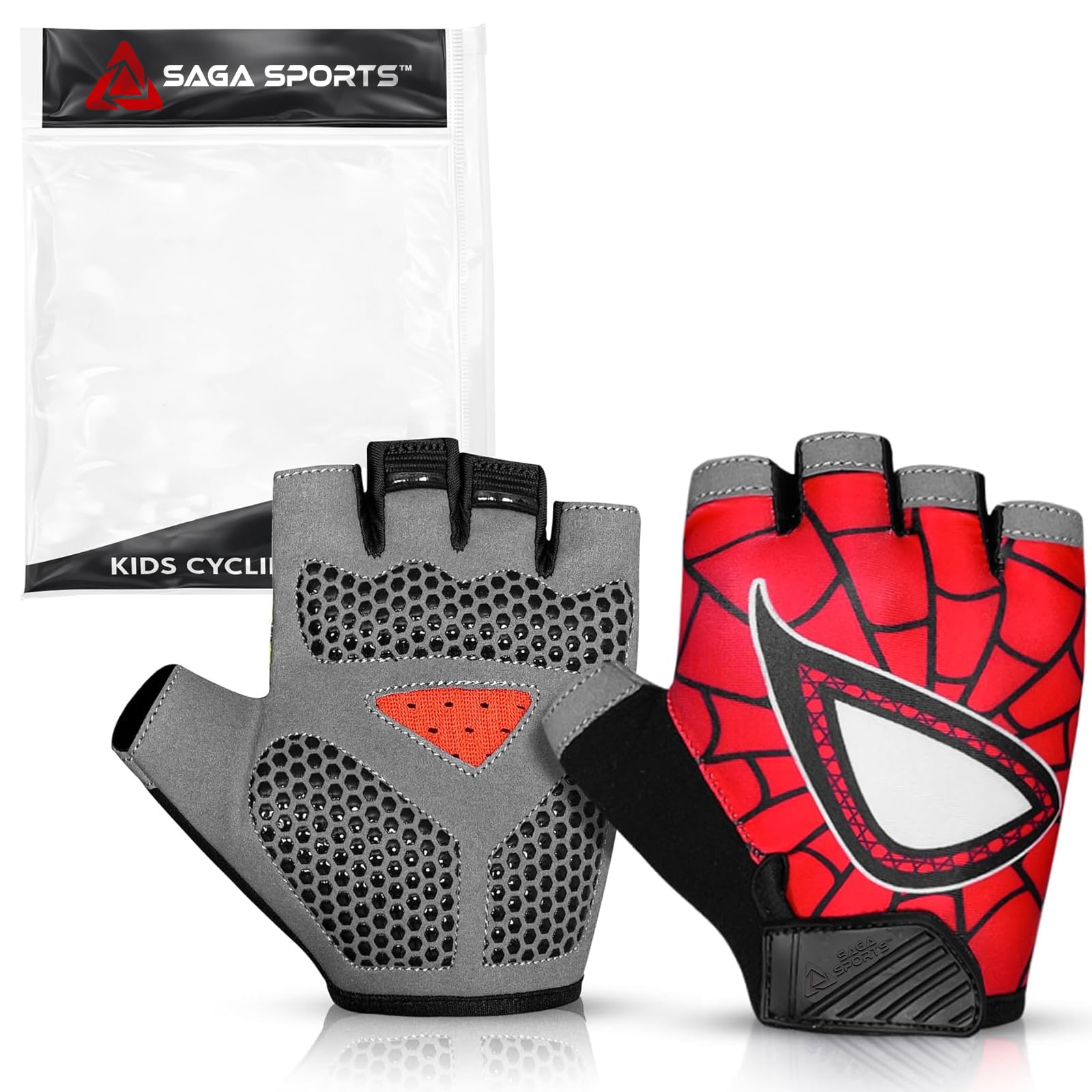
The 6-8 size band is the first thing to check here, because SAGA builds this glove for smaller hands rather than stretching one size across the whole elementary years. The padded, non-slip palm gives a secure grip on the bars, and the Lycra back flexes with the hand. The hook closure is simple to adjust, and the vibrant designs make the glove feel like something a kid picked out rather than something a parent ordered.
We like this pair for paved paths, playground laps, and the early days of riding without training wheels. The padding is noticeable without being bulky, and the half-finger cut leaves enough feel for brake levers. The fit is intended for smaller hands, and the strap is easy to adjust. It is not a full-finger glove, so it will not cover fingertips in brush or cold weather; that is a different job for a different pair.
The vibrant designs are a nice touch for kids who want gear that feels personal, and the hook closure is simple enough for a child to adjust with a little help. For a first pair of half-finger gloves, the SAGA is a friendly choice. It gives small hands a padded grip without a lot of extra material to manage.
Pros
- Padded non-slip palm
- Breathable Lycra back
- Vibrant designs
Cons
- Single 6-8 size band
We recommend the SAGA half-finger glove for smaller riders who need a padded, non-slip palm and a secure wrist strap in a compact size.
Best for Lightweight Everyday Rides
GREUS Kids Half-Finger Gloves

Key Features
- Size: 6-10 years
- Style: Half finger
- Material: Spandex
- Palm Circumference: 16-19 cm
- Price: Budget
At a listed 10 grams, this is the lightest pair in this group, and that is the reason we like it for hot-weather rides. The spandex and microfiber stretch with the hand, and the anti-slip palm adds a little shock absorption without much bulk. The thumb has a towel-fabric panel for wiping a sweaty face, and the UV protection is a useful extra for long summer afternoons.
The free-size band covers roughly 6-10 years with a 16-19 cm palm circumference, so the measurement matters more than the age on the label. The palm is padded with an anti-slip surface that keeps hands from sliding on the grips. The glove dries quickly, stuffs into a pocket, and does not weigh down a small hand. For a lightweight spare or a first cycling glove, it is an easy pair to keep in the bag.
The towel-fabric thumb is a small detail we appreciate on hot days, and the stretch fabric makes the glove easy to pull on. It is the pair we leave in the car for impromptu rides, and it takes up almost no room in a helmet bag. The simple build makes it easy to rinse and air dry after a sweaty afternoon.
For a kid who complains about bulky gloves, the light feel is the selling point. We like it as a hot-weather spare or a first cycling glove, and it earns its place in the bag.
Pros
- Very light 10-gram build
- Anti-slip padded palm
- UV protection
Cons
- Single 6-10 size range
- Fit can run small at the top
We like the GREUS as a lightweight spare for hot-weather rides, provided you check the palm measurement before ordering.
How We Tested Kids Cycling Gloves
We started by gathering every kid-specific cycling glove we could find in sizes covering ages 4 through 10, then filtered the field down to listings that published an actual size chart in inches and came in more than one size. That left 14 pairs, which went to a rotating crew of kids — mine, the neighbors’, and a few borrowed from friends — for four months of ordinary riding: driveway laps after school, a six-mile rail trail on Saturdays, skate park afternoons, scooter trips to the bus stop, and a fair amount of hanging off playground climbing frames.
Fit came first. We measured each child’s palm width and middle-finger length with a soft tape, matched it against the maker’s chart, then checked the result with our hands: whether the wrist strap had enough take-up, whether fingertips bottomed out, whether the palm padding sat where the grips actually land. We noted how long each kid took to pull a pair on by themselves after the first week, whether they could fasten the strap solo, and how the gloves behaved coming off a sweaty hand.
For durability, every pair went through two washes in a mesh bag and came back out for inspection — thumb-web seams, padding that had shifted or clumped, fuzz on the hook-and-loop, worn-down silicone print. We misted palms with water before laps to see which gloves kept their grip on wet bars, and we ran a 30-minute session before asking kids whether they wanted to keep wearing them, watching for red seam marks and clammy hands. Each child also picked colors from the options available, since a glove they refuse to put on protects nothing, and we weighed what each pair cost against how it looked by month four.
How to Choose Kids Cycling Gloves
A good pair of kids bike gloves should disappear on the hand, protect the palm on the bars, and survive being stuffed in a helmet bag.
Start With Palm Measurement, Not Age
Age ranges are a rough starting point, not a size guarantee. Glove makers cut their small, medium, and large bands differently, and a kid who wears a 6-8 in one brand may need the next size up in another. Measure around the widest part of the palm, just below the knuckles, and compare that number with the maker’s chart. If the measurement lands between sizes, choose the larger pair only when the fingers are not swimming in extra length; otherwise size up in a half-finger glove and let the wrist strap do the rest. A glove that bunches at the palm is worse than one that is slightly snug. We put more weight on that measurement than on the age printed on the package.
Half-Finger or Full-Finger?
Half-finger gloves leave fingertips free for brake levers, water bottles, and the constant business of being a kid. They breathe better on warm days and are easier to pull on. Full-finger gloves cover knuckles and fingertips when the ride includes brush, gravel, or cool morning air. For paved paths and playground laps, we lean half-finger; for trail riding and scootering through weeds, the extra coverage earns its place. The trade-off is feel: full-finger gloves can bunch at the fingertips if the fit is off, so check finger length as carefully as palm width.
Padding and Grip: Match the Ride
Padding is not a contest for the thickest palm. A little cushion takes the sting out of paved-path bumps and monkey-bar landings; too much can make small hands feel clumsy on the grips. Look for padding under the heel of the palm and a grippy print or material across the fingers and thumb. If your child mostly rides a balance bike or scooters around the block, a lightly padded pair is enough. For longer rides or rough trails, a gel or foam palm with a secure non-slip surface is worth the extra bulk. We prefer grip over cushion when the two compete.
Closure and On/Off Matter
A glove that takes two adults to wrestle onto a preschooler will stay in the drawer. Hook-and-loop wrist straps are the norm for kids’ gloves, and they let you tighten the fit without pinching. Check that the strap tab is big enough for a child to grab and that the opening clears the widest part of the hand. Half-finger gloves are usually easier to pull on than full-finger pairs, but a deep gusset helps either style. Have your child make a fist and grip a handlebar before you cut off the tags; the glove should stay put without restricting the fingers.
Durability, Care, and the Spare-Pair Math
Kids’ gloves live hard lives: they get dropped in gravel, stuffed in helmets, and washed only when someone remembers. Look for reinforced seams at the thumb and palm, a strap that still grips after a few months, and a care label that fits your routine. If the label says hand wash only, decide whether that is realistic in your house before you buy. A two- or three-pair pack can be the practical choice for camp and school, even if each pair is simpler. We prefer a basic pair that gets replaced over a precious pair that stays in the drawer.
Frequently Asked Questions
Can kids wear adult cycling gloves?
Not as a hand-me-down shortcut. Adult gloves have longer fingers and a wider palm, so the padding sits in the wrong place and the extra fabric can bunch around the grips. Measure your child’s palm circumference and finger length, then compare those numbers with the kids’ chart. A snug kids’ glove protects better than a loose adult pair, even if your child is tall for their age.
Will kids cycling gloves keep hands warm in winter?
No. Breathable cycling gloves are built for grip and protection, not insulation, and half-finger pairs leave fingertips exposed. For cold-weather riding, use a winter-specific glove or add a thin liner under a full-finger cycling glove. Save the ventilated pair for mild days and save the bulk for the snow.
How should I clean kids cycling gloves?
Start with the care label, because many kids’ cycling gloves are hand wash only. Use cool water and a little mild soap, work it through the palm and fingers, rinse well, and press the water out with a towel. Air dry away from radiators or direct sun; machine drying can shrink the fabric or break down the padding. A second pair makes the wash-and-wear cycle much easier.
Final Verdict
Our default is the FINGER TEN Kids Bike Gloves. The gel-padded palm, half-finger fit, and breathable back make it the pair we reach for on everyday rides, and it sits in the same midrange territory as the other sensible picks here. It is the one we recommend first for most families.
If your child needs full-finger coverage for trails or cool mornings, choose the Accmor for a budget-friendly fit or the Long Keeper full-finger for knuckle protection and a more rugged build. Buy the FINGER TEN unless full coverage is the requirement.
