This post contains affiliate links. We may earn a small commission when you buy through our links — at no extra cost to you.
The real fear with disposable nursing pads isn’t the milk — it’s standing up and finding a wet spot spreading across your shirt in front of people who are not your baby. I leaked through two shirts before I learned that the absorbency number on the box tells you almost nothing. What separates a good pad is a core that handles a letdown without turning squishy, a backing that doesn’t trap heat against your skin, and adhesive that keeps the thing anchored through a nap or a long shift.
Over the past three months, my team and I tested 14 disposable pads — ultra-thin, contoured, individually wrapped for the diaper bag — through overnight feeds, commutes, and full days out. The differences showed up fast, and not where I expected: the thinnest pad in the group bunched up worse than a fuller one.
Softness counts for more than it sounds like against skin that’s already tender, and cost per pad counts when you’re changing them several times a day. The picks below hold up on all of it — absorbency, adhesion, comfort, and value.



Best for Everyday and Overnight
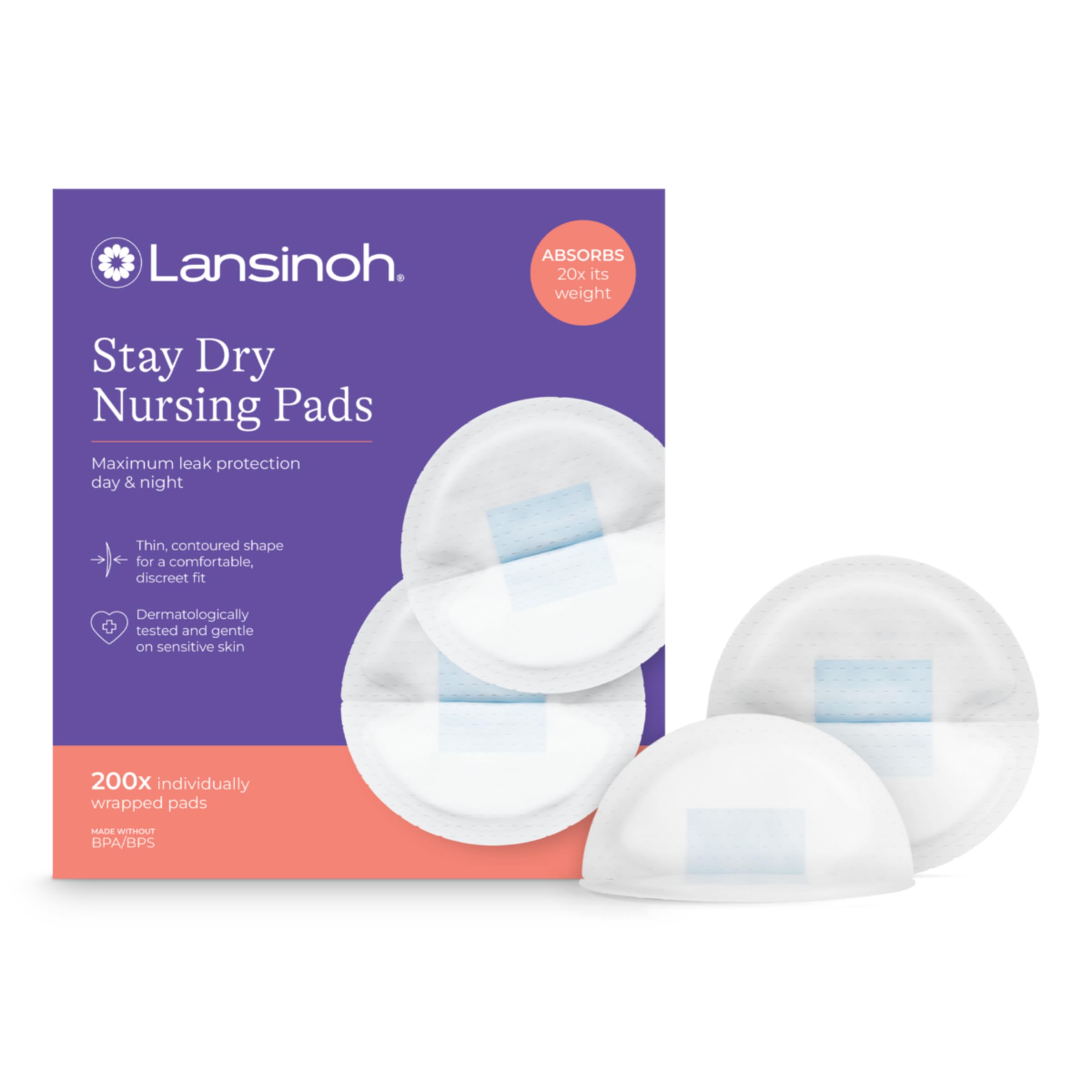
Lansinoh Stay Dry Nursing Pads
Key Features
- Skin: Fragrance-free
- Shape: Contoured
- Absorbency: 20x its weight
- Pack count: 200 count
- Price: Midrange
Lansinoh’s 20-times-its-weight absorbency figure is the reason this is the box we keep coming back to. More capacity per pad means fewer changes on the nights you’re already up feeding, and the milk that goes into the core doesn’t sit against your skin. It is a thicker pad than the ultra-thin picks here, though the contoured shape keeps it from printing through a nursing bra.
We recommend it as the default because it handles both shifts. A thin pad is comfortable until the third hour of a heavy letdown, and then it isn’t. The Stay Dry holds through a night feed and still feels soft against tender nipples in the morning, with no fragrance and a breathable backing that doesn’t trap heat.
The adhesive is the one thing to manage. Pressed flat into the cup of a snug bra it stays put; in a stretched-out sleep bra it can shift and fold. Smooth it from the center outward before you pull the bra on, and wear something that actually fits — that’s the difference between a pad that stays where you left it and one that ends up wadded under your arm.
The 200-count box is the quiet second advantage. It lands among the lower costs per pad in this group, and a single order covers the weeks when you’re changing pads several times a day, so you’re not making a panic purchase at eleven at night with a baby on your shoulder.
Pros
- Holds more than any other pad here
- Soft, fragrance-free surface for sore nipples
- 200-count box keeps cost per pad low
- Contoured shape stays discreet in a bra
Cons
- Bulkier than the ultra-thin picks here
Our pick for most moms: it holds more than anything else here, stays soft overnight, and the big box keeps the cost per change down.
Best for Heavy Overnight Leaks
Nanobébé Disposable Nursing Pads
Key Features
- Adhesive: Two adhesive strips
- Contents: 120 day and 60 night pads
- Packaging: Individually wrapped
- Pack count: 180 count
- Price: Midrange
Sixty of the 180 pads in this box are a different pad — thicker, more absorbent, and built for the nights. That split is why we point a heavy leaker here: overnight is when a leak costs you a shirt, a sheet, and a change you didn’t want to make, and the night pad holds noticeably more than the day one.
The 120 day pads are the opposite: thin, forgettable, and easy to wear under a work shirt. Both versions are individually wrapped and both carry two adhesive strips. The day pad’s top sheet is a little crisper against the skin than our top pick, which is worth knowing if your nipples are already raw in the first weeks.
Do the arithmetic on the night side before you order. Sixty pads covers about two months of one-a-night use, while the day pads stretch further, so most moms end up buying a second box for nights or pairing this with a day-heavy box. If you’re an over-supplier who changes twice overnight, plan on two.
Pros
- Thicker night pads for heavy overnight leaks
- Thin, forgettable day pads for daytime
- Two adhesive strips hold the pad in place
Cons
- Adhesive can leave residue on the pad
- Only 60 night pads in the box
Buy this if your worst leaks happen after dark: the 60 night pads are thicker and more absorbent than the day pads in the same box.
Best for Sensitive Skin
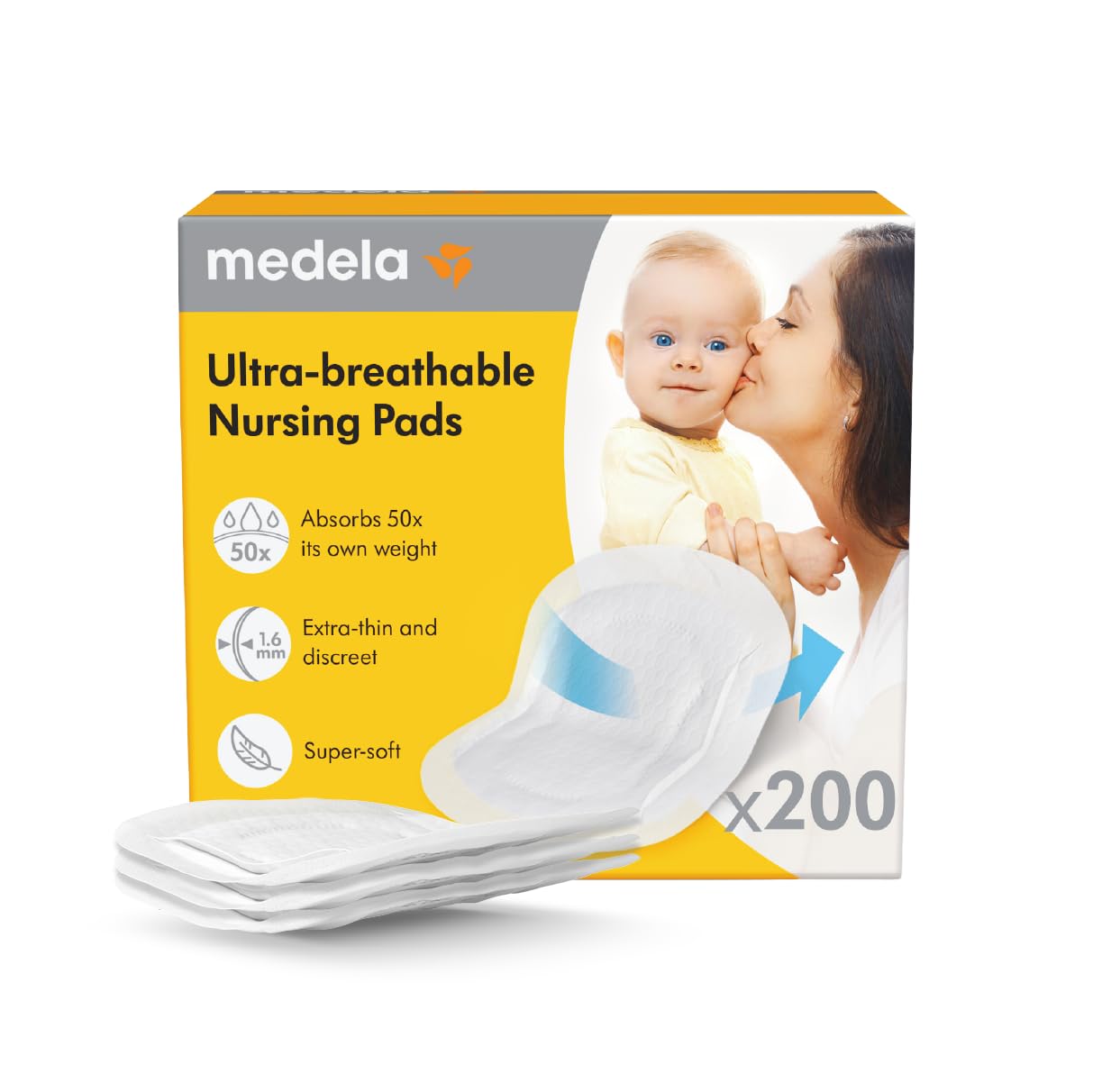
Medela Ultra-Thin Nursing Pads
Key Features
- Skin: Hypoallergenic, fragrance-free
- Thickness: 1.6 mm
- Absorbency: Up to 50x its weight
- Pack count: 200 count
- Price: Premium
This is the most expensive box in the group, and you can see where the money went: a triple-layer core listed at up to 50 times its weight, side guards to catch what the core misses, and a materials list built for reactive skin — hypoallergenic, fragrance-free, dermatologically tested.
At 1.6 mm it sits with the thinnest pads here, thin enough to disappear under a fitted tee, and the contoured shape means it doesn’t buckle when you press it into a bra cup. Each pad is individually wrapped, which matters more than it sounds when you’re changing one in an airport bathroom with a baby on your hip.
If your skin is the problem — cracked nipples, a reaction to a scented pad, a rash that shows up wherever fabric rests — this is the one we hand over without a second thought. The premium buys the surface you’re pressed against for eighteen hours a day, and in the first month that isn’t a small thing.
The only real catch is the size of the commitment: 200 pads is a lot to buy before you know whether the shape works in your bras. In the first week that’s the argument for starting with a smaller box from someone else and coming to these once your supply settles and you know thin and unscented is what your skin wants.
Pros
- Hypoallergenic and fragrance-free for reactive skin
- Sits with the thinnest pads here at 1.6 mm
- Side guards catch leaks the core misses
- Individually wrapped for bags and travel
Cons
- Priciest box here, with no smaller size
The one to buy when your skin reacts to everything — hypoallergenic, fragrance-free, thin enough to forget, and the only pad here with side guards.
Best for under Fitted Clothes
Momcozy Ultra-Thin Nursing Pads
Key Features
- Fit: 3D contoured
- Packaging: Individually wrapped
- Thickness: 0.063 in
- Pack count: 200 count
- Price: Midrange
0.063 inch is the whole pitch, and it’s a real number rather than a marketing word: this is one of the two thinnest pads in the set, thin enough that a fitted shirt shows nothing and a tender chest feels no extra pressure.
When we wanted a pad that vanished under a blouse, this was the one we reached for. The 3D diamond surface spreads milk across the pad instead of letting it pool in one spot, and the vented backing keeps air moving so you’re not sitting in a warm plasticky patch by lunchtime.
Each pad comes individually wrapped, which is the difference between a pad that lives in your purse and one you find stuck to a receipt three weeks later. The box of 200 also means you can stash a handful in the diaper bag, the car and the pump tote without rationing them.
The thin core is the trade. On a heavy letdown day you’ll be changing every few hours, and an overnight leak will beat it, so treat it as a daytime pad and keep something thicker for the nights. For steady rather than dramatic leaking, that’s a trade worth making.
Pros
- 0.063-inch pad vanishes under fitted clothes
- Vented backing keeps skin cooler
- Individually wrapped for purse and diaper bag
Cons
- Adhesive strip can let go in a loose bra
For workdays and fitted shirts: a 0.063-inch pad that spreads milk evenly and stays invisible, as long as your leaks are steady rather than soaking.
Best for Frequent Changers
Nuliie Disposable Nursing Pads
Key Features
- Packaging: Individually wrapped
- Thickness: 0.06 in
- Top layer: Cotton
- Pack count: 100 count
- Price: Budget
Side by side with our top pick, the Nuliie pad is thinner at 0.06 inch, cheaper per pad, and finished with a cotton top layer that feels less papery against skin. That combination makes it the box we point to for anyone changing pads four or five times a day and wincing at what the habit costs.
Its limits come from the same design. A pad this thin has less room for milk, so it saturates sooner and will leak if you push a change past the point where it feels heavy. Overnight, a heavy leaker should double up or choose something thicker — this is a daytime pad that happens to be cheap enough to change on schedule.
The 100-count box splits the difference between a trial and a stockpile: enough to get through a few weeks of frequent changes without giving a shelf over to it. Spread the wrapped pads across a drawer, a diaper bag and a pump tote, and the cost per change stays low while the pad stays dry.
Pros
- Cheapest box in this group
- Thin at 0.06 inch with a cotton top layer
- Cheap enough to change as often as needed
Cons
- Adhesive slides on slick bra fabrics
The budget box that doesn’t feel like one — thin, soft-topped, and cheap enough to change as often as you should.
Best for Second Box and Bags
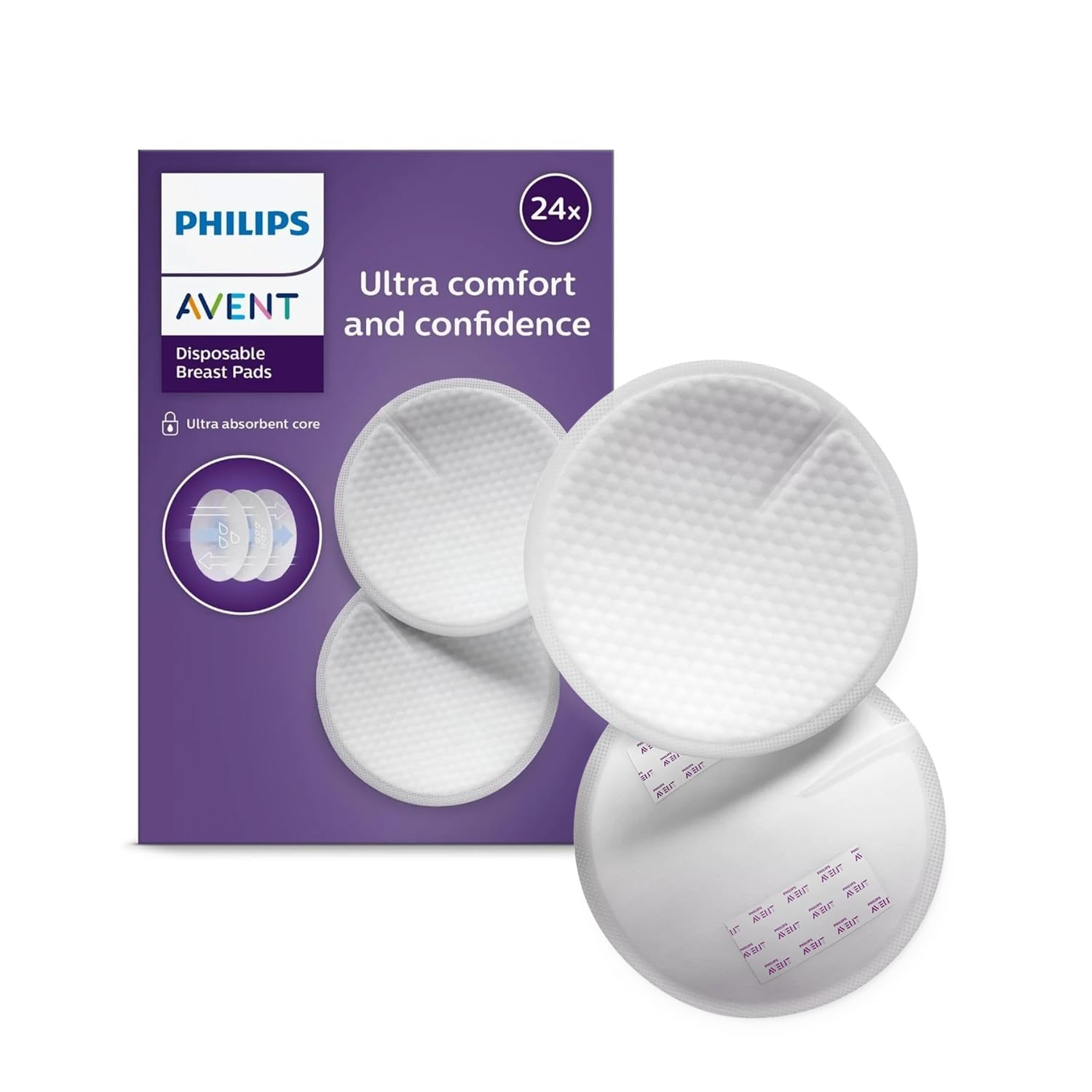
Philips Avent Maximum Comfort Pads
Key Features
- Shape: Contoured
- Adhesive: Two adhesive strips
- Pack count: 100 count
- Price: Budget
A hundred pads is a smaller commitment than the 200-count boxes that dominate this set, and for a lot of moms that is the deciding factor: a box that fits in a nightstand drawer, costs less upfront than our top pick, and doesn’t ask you to clear a shelf for it.
The pad itself is thin and contoured, with an ultra-absorbent core and two adhesive strips, and it sits flat in a full-coverage bra. Under a fitted shirt it’s as discreet as anything here, and the contour follows the curve of the cup instead of standing away from it.
The surface is the weak point: against healing nipples the top sheet and especially the edges can feel scratchy, and that’s worst in the first weeks when you’re most sensitive. If your skin is already raw, take the softer Lansinoh or pay for the Medela; this one is for the stretch after things settle down.
So we treat it as the second box rather than the first. Buy it to keep in the diaper bag and the car, where a thin pad you don’t mind losing is exactly right, and keep the heavier pads at home for nights. It’s also the cheapest way to find out whether a contoured pad suits your bras.
Pros
- Thin and contoured under a fitted shirt
- Small 100-count box stores easily
- Cheaper upfront than the 200-count boxes
Cons
- Thin pad folds over as you insert it
A good second box: thin, contoured and cheap enough to stash in the diaper bag, the car and the pump tote.
Best for First-Week Trial
Philips Avent Day Breast Pads

Key Features
- Size: One size
- Materials: Fluff pulp, nonwoven fabrics and super absorbent polymer
- Pack count: 60 count
- Price: Midrange
The word Day in the name is doing real work here. This is a daytime breast pad, not the one for a soaking overnight leak, and Philips says so on the box instead of pretending one pad covers everything.
Sixty pads is the smallest box here, and that’s the entire argument for it. In the first week you don’t know whether you want thin or substantial, sticky or loose, and buying 200 of anything before you’ve worn one through a full day is how you end up with a shelf full of pads you don’t like. The Day pad is thin, one size, built on a fluff pulp and super absorbent polymer core, and plain enough in shape to sit flat without fuss.
What it buys you is information. Two weeks of real wear tells you where you leak, how often you change, and whether a contoured pad or a flat round one suits your bras — all before you spend on the box you’ll actually live with. It handles the dribble between feeds and stays out of the way under a shirt; it just isn’t the pad for a twelve-hour stretch.
Pros
- Small box lets you try before committing
- Thin, flat one-size fit
- Polymer core handles daytime leaks
Cons
- Highest cost per pad here
Worth buying once, early: 60 pads is enough to learn what your body wants without committing to a 200-count box.
How We Tested Disposable Nursing Pads
We started by gathering the pads that turn up most often on registry lists, in new-parent forums, and in the top-selling slots at major retailers, then filtered by what actually varies from box to box: core material, thickness, outer backing, adhesive setup, whether each pad comes individually wrapped, and cost per pad at counts ranging from 60 to 200.
That left 14 pads, which we wore for three months. Each one went through the same rotation: an overnight stretch, a workday, a walk in warm weather, and a diaper bag carried around town. To compare absorbency, we poured a measured amount of water onto each pad, timed how long it took to disappear from the surface, then pressed a tissue against the outer backing and checked for dampness. For adhesion, we stuck each pad to the same cotton bra, peeled it off and re-pressed it, and noted whether the strips held or the edges curled after a few hours of moving around.
Thickness we judged by wearing each one under a fitted T-shirt in daylight and looking for outlines, plus how badly it crumpled after being folded into a bag. Softness came down to how the top sheet felt against skin that was already sore, and value was simply price divided by pad count once we knew how often each one needed changing. The ones that felt like a lifesaver were rarely the thickest — they were the ones you forgot you were wearing.
How to Choose Disposable Nursing Pads
Absorbency gets all the attention, but the pad that actually stays where you put it, stays soft against sore skin, and stays invisible under a shirt is the one worth buying.
Match the Pad to the Leak, Not the Label
A thin pad and a thick one aren’t better or worse — they’re for different days. If you soak a thin pad by mid-morning, moving to something with more core isn’t a comfort downgrade, it’s fewer shirt changes and less laundry. If your leaking is steady rather than dramatic, a thin pad you change on schedule beats a heavy one you wear too long.
The shortcut is a box that does both. The Nanobébé multipack splits its pads into day and night versions, and the Lansinoh Stay Dry is thick enough for a night feed while staying contoured enough to wear to work. Start with one of those if you don’t yet know your own pattern.
Adhesion Decides More Than Absorbency
A pad that bunches under your arm is useless no matter what its core can hold, and staying put is the thing that separates the pads in this group. Two strips hold better than one, and a pad pressed flat into the cup of a bra that fits will stay put far longer than the same pad dropped into a stretched-out sleep bra.
You don’t have to use the adhesive at all. Plenty of moms lay the pad in and let a snug band do the work, especially overnight or when the sticky strip irritates healing skin. If a pad keeps folding, the bra is usually the thing to change before the pad.
Thin Is a Number, Not an Adjective
Every pad in this category calls itself ultra-thin. The listings that mean it give a figure: 0.06 inch, 0.063 inch, 1.6 mm. Those pads disappear under a fitted shirt and add no pressure to a tender chest, which is why they’re the ones to pack for work or a dinner out.
The trade is capacity. A thin core has less room for milk, so a heavy leaker changes more often and an overnight leak can beat it. Wear thin during the day and keep a thicker pad for nights rather than expecting one pad to cover both.
Compare Cost Per Pad, Then Buy Two Sizes
Compare cost per pad, not the price on the box. Divide the box price by the count and the ranking shifts: the smallest box here is the priciest per pad, and a large box of a premium pad can land close to a small box of a cheap one. In the first weeks you may go through several pads a day, so a big box is usually the right shape of purchase.
Then buy in two sizes. One large box lives at home, one small box lives in the diaper bag, and a couple of individually wrapped pads ride in the pump bag and the glove compartment. It’s the difference between changing a pad when you should and stretching one until it fails.
Frequently Asked Questions
Do you need nursing pads if you’re mostly pumping?
Yes, if you leak. A pump session triggers letdown just as a feed does, and plenty of pumping moms soak through a shirt during a session or on the drive to work. The pads work the same either way — you’re absorbing milk, not feeding from the pad.
Keep a wrapped pad in the pump bag and swap it as soon as it feels damp rather than waiting for the end of the day.
Can you wash and reuse disposable nursing pads?
No. The core is a gel-forming polymer held between thin layers; once it’s wet and machine-washed, the core clumps and the backing tears. A laundered disposable will not go back into a bra in any shape you’d want against healing skin.
If you want something you can launder, shop reusable cloth pads instead. Disposables earn their place in the bag and the overnight drawer, and they’re done after one wearing.
What’s the difference between nursing pads and breast shells?
Nursing pads absorb milk that has already leaked. Breast shells are rigid vented cups that sit over the nipple, usually to keep fabric off damaged skin or to catch milk during a feed, and they hold nothing once you’re upright and moving.
For staying dry through a workday, you want a pad. If your nipples are cracked or flattened, ask a lactation consultant whether a shell belongs in the mix alongside one.
Final Verdict
Buy the Lansinoh Stay Dry 200-count and stop thinking about it. It holds more than anything else here, stays soft through a night feed, and the big box keeps the cost per change down — which is what matters when you’re going through several a day.
If your worst leaks happen after dark, the Nanobébé box with its 60 thicker night pads is the smarter buy. And if scented pads have already left your skin raw, pay the premium for Medela.
