This post contains affiliate links. We may earn a small commission when you buy through our links — at no extra cost to you.
The 3 a.m. feed is hard enough without a cold wet patch spreading across your shirt. Nursing pads are one of those small purchases that decide whether you can relax through a letdown or spend the next hour changing clothes and sheets. The right pad is well made, absorbs quickly, blocks leaks, feels soft against sore skin, and stays where you put it without showing through a T-shirt.
I began this round with a drawer of pads that either bunched, itched, or turned see-through under a thin top, and my team and I put 14 sets through three months of real feeds, naps, and stroller walks. Some were beautifully soft but too thick under a fitted shirt; others were slim and discreet but drifted out of place by mid-morning. What separated the keepers was boring and useful: reliable absorbency, a leak-proof backing, adhesive that actually held, and a size and thickness that matched the day. The picks below are the ones I reached for without thinking, and the ones that felt worth the cost per change.


Best for Everyday and Overnight
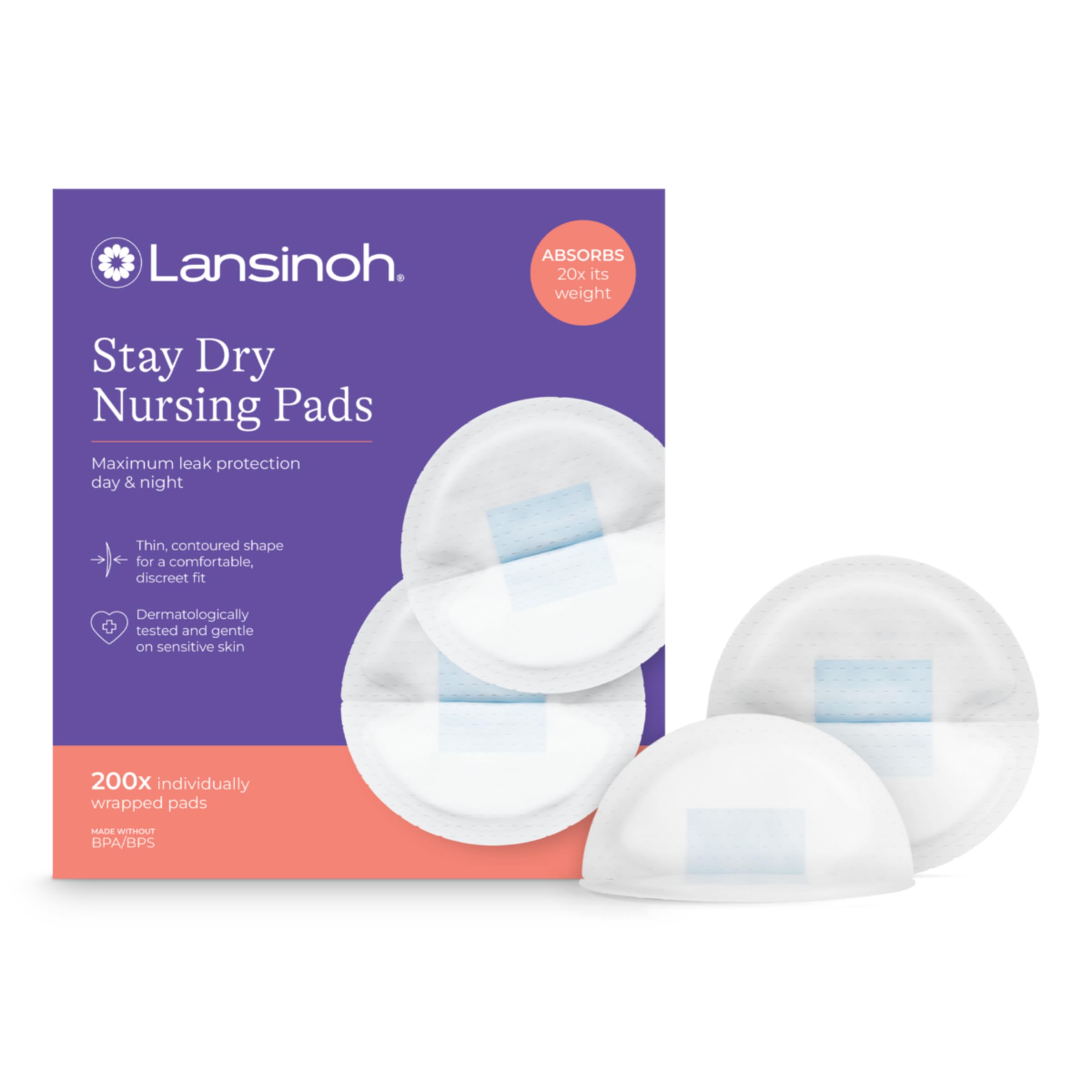
Lansinoh Stay Dry Nursing Pads
Key Features
- Skin: Dermatologist tested, fragrance free
- Type: Disposable, thin contoured
- Pack size: 200 pads
- Absorbency: Absorbs 20 times its weight
- Price: Midrange
The claim on the box is twenty times its weight in milk, and what that number buys you is the first moment of a letdown: the pad pulls moisture into its core instead of letting it pool against the nipple. That instant capture is why this is our pick for most people. It is thin and contoured, so it disappears under a nursing tank, and the surface stays comfortable on days when sore nipples cannot take a seam.
We wore these through the longest stretches in the rotation, a night feed and the morning that follows, then a workday where changing a pad means a trip to the bathroom. The core keeps holding once it is damp, and the breathable backing keeps skin from going clammy, which matters more than the absorbency figure once a pad has been on for hours. Fragrance-free and dermatologist tested is the sort of label that only matters if you have reacted before; if you have, this is a safe place to start.
Adhesion is the uneven part. The strips hold a pad flat in a snug cotton bra and let go on a slick seamless bra or a band that has stretched out, and a pad that folds can catch a tender nipple when you pull the bra down. Our fix: press the pad firmly into the cup, let the bra do most of the holding, and skip peeling the strips at all on days when your skin is sore.
Set against the reusable sets here, you give up nothing in comfort and gain the ability to throw a soaked pad away in a public restroom. If you are deciding between this and a washable set, the honest answer is both: this box for the diaper bag and the small hours, reusables for the days you are home and caught up on laundry.
Pros
- Absorbs a letdown fast and stays dry
- Thin and contoured under clothing
- Soft, fragrance-free surface for sore skin
- 200 pads per box
Cons
- Wrappers are fiddly one-handed at night
For most people this is the one: a thin pad that swallows a letdown without showing through a shirt, and the box we keep restocking.
Best for Washable Daily Wear
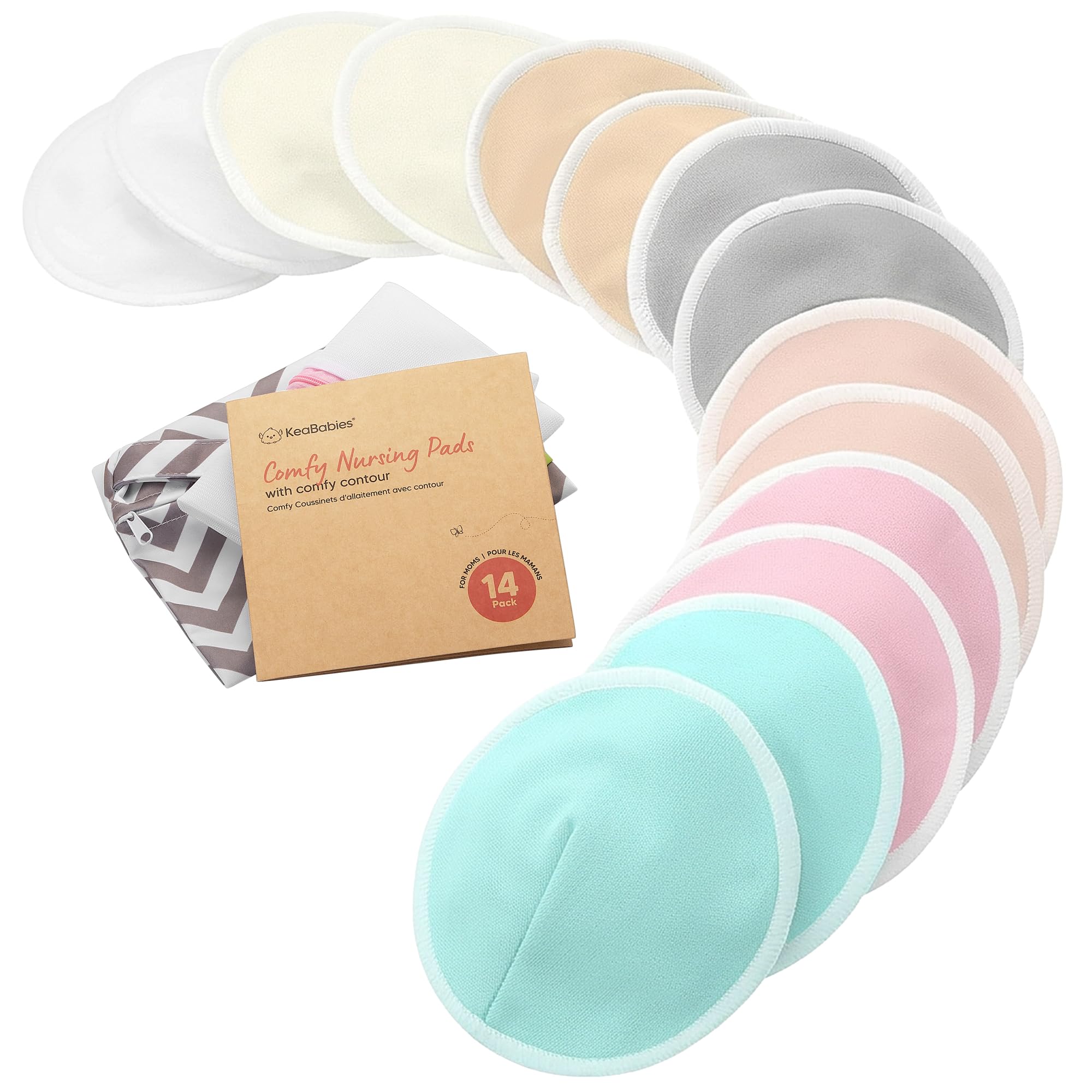
KeaBabies Comfy Reusable Nursing Pads
Key Features
- Diameter: 5 inches
- Included: Laundry bag and wet bag
- Pack size: 14 pads
- Construction: Three layers, waterproof backing
- Price: Midrange
Do the laundry math before anything else. Fourteen pads is sold as a week’s supply, which assumes two changes a day and a wash you actually run. If your laundry already piles up until the weekend, no reusable pad will work for you, however soft it is, and it is worth being honest about that before you spend on a set.
The reason we point people here first is the surface. Bamboo viscose against a sore nipple feels nothing like a disposable, closer to soft jersey, and it gets softer after the first few washes rather than pilling. Behind it sit three layers sealed with a waterproof backing, and the pad is a full five inches across, which covers more than most of the round pads in this set. The wash bag and wet bag come in the box, so the logistics are handled.
The limits are honest ones. Overnight is where these run out: a heavy leaker can soak through by morning, so for most people this is a daytime pad, paired with something beefier for the long stretch. They are also an investment in a habit. If you can keep fourteen pads cycling through the machine, they pay for themselves; if you cannot, a disposable box is the kinder choice.
Pros
- Soft on sore nipples, softer after washing
- Three layers with a waterproof backing
- Full five-inch coverage
- Wash bag and wet bag included
Cons
- Thick enough to show under a thin shirt
We recommend it as the reusable set to start with: soft enough for sore nipples, wide enough to cover, and fourteen pads get you to laundry day.
Best for under Fitted Clothes
Momcozy Ultra-Thin Disposable Nursing Pads
Key Features
- Fit: 3D contoured, anti-slip strip
- Type: Disposable, individually wrapped
- Pack size: 200 pads
- Thickness: 0.063 inch
- Price: Midrange
Next to our top pick, the Momcozy pad is the thinner of the two, 0.063 inch with a 3D face that curves into the bra rather than sitting flat, and the difference is visible under a fitted shirt. If pad lines are what you notice in the mirror, start here rather than with absorbency charts.
Thin does not mean slow. The diamond-patterned top layer spreads milk across the core instead of letting it bead in one spot, and the vents along the bottom let air through, so a pad worn since morning does not turn warm and damp against the skin. Each one is individually wrapped, which is the detail we appreciated most in a diaper bag: take one, peel it, done, no fumbling with a stack of loose pads.
Where it earns its place is the working day, when you want no laundry to keep up with and nothing showing under a blouse. The thin core is built for discretion rather than for a long overnight stretch, so keep a thicker pad for the small hours. And check the fit against your bras: the anti-slip strip does better on a structured cup than on a soft sleep bra, which is the same story as every adhesive pad here.
Pros
- Thinnest pad in this set
- Spreads milk fast and vents well
- Individually wrapped for the diaper bag
- Disappears under a fitted shirt
Cons
- Adhesive can let go in a soft bra
- Thin core needs changing sooner on heavy days
If the pad showing through your shirt is the thing you hate, this is what we hand people: thin, absorbent, and wrapped for the diaper bag.
Best for Heavy Night Leaking
Bamboobies Overnight Nursing Pads
Key Features
- Type: Reusable, machine washable
- Shape: Round, multi-layer
- Surface: Bamboo velour top layer
- Pack size: 4 pads
- Price: Budget
The problem at two in the morning is not absorbency in the abstract. It is a pad that has shifted sideways by dawn and left a wet ring on the sheet. Bamboobies makes these specifically for that stretch: round, thick, and wide enough to still be covering the nipple after a night of rolling over and feedings. That is the whole job, and it is why these live in the overnight rotation.
The top layer is bamboo velour, the softest surface in this set against a tender nipple, and it stays soft after a machine wash and a tumble dry instead of stiffening up the way some cotton pads do. The multi-layer build holds a heavy letdown without the wet-through that thin day pads give you, and there is no adhesive to peel, which suits a sleep bra.
Two things to know. The round shape is a lot of pad on a smaller frame, where it can bunch at the edge of the cup; on a fuller bust that same width is what keeps it covering all night. And these are a supplement to your daytime rotation, not a replacement for it. If you wake up wet, try this pair first; if you do not, a thinner reusable will feel like less pad for the same money.
Pros
- Soaks up a heavy overnight letdown
- Softest surface in this set
- Machine wash and dryer safe
- Wide enough to stay covering all night
Cons
- Only four pads per pack
For anyone soaking a shirt by morning, these are the ones we reach for: the widest, thirstiest pads here, built for a long stretch without a change.
Best for Day and Night
Nanobébé Day and Night Nursing Pads
Key Features
- Type: Disposable, individually wrapped
- Backing: Waterproof
- Adhesive: Two adhesive strips
- Pack size: 180 pads: 120 day, 60 night
- Price: Midrange
The box is the idea here: 120 thin day pads and 60 thicker night pads in a single order. That split is the reason to buy it. Most disposable boxes give you the same pad for a two o’clock meeting and a three o’clock feed, and you end up either under-protected at night or wearing a pillow all afternoon.
The day pad is genuinely thin, with two adhesive strips and a waterproof backing, and each one is wrapped, so a handful can live in the diaper bag and the glove box without picking up lint. The night pad is noticeably more substantial without being bulky, and it holds a longer stretch without the surface going slick.
Softness is where it trails the best disposables here. The surface has a slightly papery feel next to a bamboo pad, which is normal for the category and still noticeable on a sore day. If your nipples are raw in the first weeks, this is a box to use once things settle rather than on day three.
Buy it if you want one order that handles a full day without thinking, and if portability matters more to you than the last degree of softness. Then watch your own usage for a week: most people burn through day pads far faster than night pads, and it is worth knowing your ratio before the second box.
Pros
- Day and night pads in one box
- Thin, discreet day pad
- Individually wrapped and portable
- Two adhesive strips and waterproof backing
Cons
- Night pad is only a small step up
- Adhesive can leave residue on some bras
Our pick if you want one order to cover everything: a thin day pad, a thicker night pad, and wrappers that make both easy to carry.
Best for First Reusable Set
wegreeco Reusable Nursing Pads
Key Features
- Diameter: 4.7 inch
- Included: Laundry bag and travel bag
- Pack size: 14 pads
- Construction: Microfiber core, TPU backing
- Price: Budget
This is the cheapest reusable set here, and it arrives as a kit rather than a bag of pads: fourteen of them, a laundry bag, and a small travel bag for the diaper bag. The build is a microfiber core with a TPU backing, 4.7 inches across, which puts it on the smaller side of the reusables in this set.
The price shows in the hand-feel. The surface is a synthetic fleece and, next to the bamboo sets, it feels closer to sportswear than to cloth, though it washes and dries without stiffening. What decides whether these work is your bra. In a snug, molded cup they lie flat and vanish under a shirt; in a soft sleep bra the edges roll and the pad bunches into a ridge you can see through fabric. Buy them, wear them in the structured bras, and keep a nicer pair for the nights.
Pros
- Complete kit with laundry and travel bags
- Absorbent microfiber core with waterproof backing
- Least expensive reusable set here
Cons
- Synthetic surface feels less soft than bamboo
The least expensive way into reusables, and a complete kit: soft enough, absorbent enough, and genuinely good in a structured bra.
Best for Smaller Frames
Kindred Bravely Organic Reusable Pads

Key Features
- Shape: Contoured
- Diameter: 4.5 inch
- Material: Organic viscose from bamboo
- Pack size: 10 pads
- Price: Premium
Most reusable pads in this set are round. These are contoured, 4.5 inches across, and shaped to curve inside a bra cup rather than sit flat across it. That is the reason we included them: a five-inch round pad in a smaller cup has to fold somewhere, and a contoured pad is the shape that avoids it.
The fabric is organic viscose from bamboo with a brushed, velvety face, the kind of soft that does not need breaking in, and it stays that way through the wash. Ten pads and a small carry bag come in the set, and they go through the machine with the baby’s clothes without special handling beyond what the care card asks for.
Fit is the variable. In a snug band and a molded cup they sit still; in a soft sleep bra they can creep forward during a feed, which is true of nearly every pad here and not a reason to rule these out. The smaller diameter simply gives them less room to migrate. The carry bag also makes this the set that stays together in a hospital bag instead of scattering through the laundry.
Pros
- Contoured 4.5-inch shape for smaller frames
- Soft organic bamboo viscose
- Carry bag keeps the set together
Cons
- Ten pads is a smaller rotation than the 14-packs
For anyone whose round pads bunch at the cup edge, the contoured shape here is the fix: soft bamboo, a 4.5-inch diameter, and a bag to keep them in.
Best for Thin Disposables
Nuliie Featherlight Disposable Pads

Key Features
- Fit: 3D contoured
- Type: Disposable, individually wrapped
- Pack size: 100 pads
- Thickness: 0.06 inch
- Price: Budget
At 0.06 inch, this is the thinnest disposable in the set by a hair, and it behaves like it: light, soft, and easy to forget about under a shirt. If the reason you keep reaching for a disposable is that you do not want to feel one, this is a reasonable place to land.
The polymer core is quick. A letdown disappears into the pad instead of spreading across the surface, and the 3D contour keeps it from creasing down the middle. The top layer is cotton, which is the part we liked most, because it avoids the plasticky feel a lot of disposables get after an hour against the skin.
The trade-off for that thinness is capacity. On a heavy day, or across a long overnight stretch, one pad will not be enough, and a full pad can leak through rather than holding on. That is less a fault than the physics of a very thin pad, and it is why we treat this as a daytime box.
Grip is the other soft spot: the strips hold in a snug bra and give up in a loose one, and a pad that shifts will wrinkle under a thin shirt. So buy a box to try, keep it for daytime and structured bras, and pair it with something beefier at night. It is a fine thin disposable, just not the one to trust with an overnight oversupply.
Pros
- Very thin and comfortable under clothes
- Fast, contained absorption
- Cotton top layer next to the skin
- Individually wrapped
Cons
- Adhesive grip varies by bra
A thin, soft disposable worth trying if you mostly need daytime coverage and want the pad to disappear; keep something thicker for nights.
How We Tested Nursing Pads
We began by comparing materials, construction, absorbency claims, sizing, thickness, backing, adhesive, and price across the category, then narrowed to 14 sets that represented the range of shapes and styles. We ruled out pads with vague sizing, scratchy top layers, or a cost per change that only made sense if you changed them once a day. Every shortlisted set went into the same rotation rather than a single wear test.
Over three months, we wore them through overnight feeds, cluster feeds, stroller walks, and long work-from-home mornings. Each pad went under both a fitted and a loose shirt; we noted whether edges curled, adhesive tabs lifted, or the pad slid when we sat, bent, or carried the baby. We also compared lengths and thickness against everyday clothing, because a pad that feels soft in hand can show a visible line under a thin top.
For absorbency, we poured a measured amount of water onto the center of each pad and timed how quickly the surface stopped feeling wet. We then pressed the pad against dark cotton and checked for strike-through. Softness and comfort got the same direct treatment: we wore each one against skin for a full feed and noted scratchiness, stiffness, or seam rub, then checked reusable pads after washing for pilling, lost shape, curled edges, and backing separation. To judge value, we counted cost per pad and how many changes a day each one needed.
How to Choose Nursing Pads
The right pad is the one that matches your heaviest leak and the laundry you are actually willing to do; everything else, from thickness to diameter, is a refinement of those two questions.
Disposable or washable comes down to laundry
Reusable pads win on cost per use within a couple of months, but only if the rotation keeps moving. A fourteen-pack is sold as a week’s supply, which quietly assumes a wash happens before you run out. If your laundry already sits until the weekend, that arithmetic collapses and you end up buying disposables anyway, with a drawer of damp bamboo pads as a souvenir.
Our rule of thumb: if you are already running a baby load every other day, a reusable set folds into it with almost no extra effort. If you are not, a disposable box is the lower-risk purchase, and reusables can join later for the days you are home.
Match the pad to your heaviest leak, not your average day
Most people do not need one pad for everything. Day pads are thin, and thin is what keeps them invisible under clothes. Overnight pads are wider, thicker, and built to sit for a long stretch without a change. Buying one pad for both jobs means either a wet ring on the sheet at four in the morning or more pad than you need all afternoon.
If you soak a pad overnight, buy for that first: an overnight-specific reusable or a box that includes a separate night pad. If you only leak a little, thin disposables will cover everything you need and feel like less on.
Staying put is half pad, half bra
An adhesive strip is only as good as the fabric it is pressed against. It grips a cotton nursing bra and struggles on a slick seamless bra or a band that has stretched out. A pad that folds in half can then catch a sore nipple when you pull the cup down, which is the one failure mode worth avoiding.
Two things help. Press the pad firmly into the cup and let the bra do most of the holding rather than relying on the strips alone. And size the pad to the cup: a five-inch round pad in a small bra has nowhere to sit but in a fold, while a contoured pad curves with the cup instead.
Diameter and thickness decide what shows
The pads here run from 4.5 to 5 inches across. A wider round pad covers more and is forgiving if you shift in your sleep; a contoured pad trades a little coverage for a shape that sits inside the cup without bunching. Neither is better in the abstract, but one will fit your bras and the other will not.
Thickness is the other half of discretion. A 0.06-inch pad disappears under a fitted shirt, while a thick bamboo pad can read as a visible outline under a thin tee even though it feels far better against sore skin. That is the trade, and it is worth owning both rather than hunting for a pad that is somehow both.
Frequently Asked Questions
How do I wash reusable nursing pads?
Machine wash them warm and tumble dry low, with the baby’s clothes rather than a separate load. Use the mesh laundry bag that comes with most multipacks so the pads do not disappear into the drum, and skip fabric softener and dryer sheets, which coat the fibers a pad needs for absorbency.
Can I use nipple cream or ointment with nursing pads?
Yes, and keep using whatever your nipples need. The catch is mostly cosmetic: nipple creams and ointments can discolor bamboo and cotton pads, and a heavy ointment can leave the fabric feeling slick. Disposables are unaffected, so if you are applying ointment around the clock, keep a disposable box for those weeks.
How many nursing pads do I need?
Count your changes before you buy. At two a day, a fourteen-pad reusable set gets you to laundry day with a couple spare, and a 200-count disposable box covers roughly three months. Early weeks, or a heavy letdown, usually mean more changes, so buy the bigger pack or a second reusable set rather than running the machine every night.
Final Verdict
Lansinoh Stay Dry is the box we tell people to buy first. It is thin enough to disappear under a shirt, fast enough to catch a letdown before it spreads, and forgiving on the days when everything hurts. If waste or the recurring cost bothers you, KeaBabies’ fourteen-pad bamboo set is the reusable one to start with, soft and wide with the laundry kit included.
And if you are waking up wet, skip both and go straight to Bamboobies’ overnight pads. The decision changes with your heaviest leak, not your average one.
