This post contains affiliate links. We may earn a small commission when you buy through our links — at no extra cost to you.
A kids basketball hoop takes more abuse than almost anything else in the driveway — rim hangs, dunk attempts, a ball ricocheting off the backboard at dinnertime. What separates a hoop still standing in October from one leaning against the garage wall by August usually comes down to pole gauge, base capacity, and how honestly the height range was measured. Get those right and your kid plays outside instead of asking for a screen, and you stop tightening bolts every weekend.
My team and I spent nine months with 12 hoops — adjustable portables on driveways, wall-mounted units on garage faces, and a couple of over-the-door models in basements — and got picky about what survived. One thing first-time buyers rarely factor in: the height your kid actually shoots at is usually a notch below the one they ask for, so a wide adjustment range beats a tall maximum. And if your neighbors are close, the hollow thunk of a backboard at 8 a.m. is worth considering before you pick a spot. The picks below are the ones that held up.


Best for Toddlers and Preschoolers
Little Tikes Easy Score
Key Features
- Weight: 9 lb
- Height range: 2.5 to 4 feet
- Balls included: 3 junior-size soft balls
- Height settings: 6
- Price: Midrange
Six heights between 2.5 and 4 feet is the reason this set outlasts stands that look more modern. A two-year-old shoots at the bottom setting and the same backboard still gives a five-year-old something to aim at, so it covers four years of growing instead of one summer.
What we noticed first is the rim. It is oversized on purpose, and that forgiveness is the difference between a toddler who quits after three misses and one who keeps shooting. The three junior balls are genuinely soft — a miss into the living room is a non-event — and they reinflate, so a flat ball does not retire the set. One practical note: this listing is the pink Amazon exclusive, so check the color before ordering if that matters at home.
Setup is a screwdriver job, and the base wants sand before it feels planted; the water-resistant plastic means it can stay out in the yard between games. The one thing that nags us is the rim-to-backboard fit — it seats with less of a lock than we wanted, and the net works loose. Re-seat the rim after assembly, check the net every few weeks, and both stay where they belong.
Pros
- Six heights from 2.5 to 4 feet
- Oversized rim forgives toddler aim
- Three soft junior balls included
- Water-resistant for indoor and outdoor play
Cons
- Rim can droop and the net slips off
Our default pick for 18 months to five years: a stand that starts at 2.5 feet, ships with three soft balls, and takes outdoor use without complaint.
Best for Indoor Dunking, Ages 7+
SKLZ Pro Mini
Key Features
- Rim: 9-inch spring break-away
- Mount: Over-the-door
- Weight: 3.8 lb
- Backboard: 18 x 12 inches
- Price: Budget
Dunking is what kills mini hoops, so that is where we started with the SKLZ. The rim is a 9-inch spring break-away that folds under a hand and snaps back, the backboard is clear polycarbonate rather than the thin acrylic on cheaper door hoops, and the 30-ply net is built to survive the pull. Of the small hoops in this group, this is the one that feels like it expects to be abused.
Hanging it is a two-minute job: padded mounts slide over the top of a door, nothing gets drilled, and it moves between rooms when the novelty wears off. There is no height adjustment — the rim sits where the door sits — so it suits a kid who can already shoot at a rim above their head, not a toddler.
The trade is noise. A ball coming off a hollow door carries through the house, and the hard rubber ball in the box makes it worse; a softer replacement ball and a rug underneath take most of the edge off. The foam padding is the detail we ended up appreciating most, because the door frame comes out of it unmarked, which matters in a rental.
Pros
- Shatter-proof 18 x 12-inch backboard
- Spring break-away rim takes dunks
- Tool-free over-the-door mounting
- Padded mounts protect the door frame
Cons
- Fixed height, no adjustment as kids grow
- Indoor use only, not for outdoors
Hang this one for the kid who has outgrown soft-ball hoops — a shatter-proof 18-inch board and a spring rim that takes real dunks.
Best for Small Rooms, Tight Budgets
GMAOPHY Toddler Hoop
Key Features
- Weight: 16 oz
- Height range: 29.5 to 41.3 inches
- Balls included: 3 mini balls and pump
- Height settings: 5
- Price: Budget
Sixteen ounces. We carried this one from the playroom to the patio with two fingers while holding a coffee in the other hand, and that is most of its appeal: it is the hoop that comes out for twenty minutes and goes back against the wall.
Five slots take it from 29.5 to 41.3 inches, and the top number is the one that matters. Forty-one inches still gives a four-year-old something above eye level to shoot at, which is more than the shortest stands here manage. The box arrives complete — three soft inflatable balls, a pump, and the tools — so there is no separate shopping trip before the first game.
Two things to know. The base needs water or sand before it stops sliding across the floor, and even then an enthusiastic five-year-old can tip it. On some units the hoop also starts hanging forward after a few months of play. Neither has kept the toddlers we handed it to from playing, and the set costs less than the Little Tikes, which makes both easy to forgive.
Pros
- Light enough to carry one-handed
- Five heights up to 41.3 inches
- Three balls and a pump included
- Costs less than the Little Tikes set
Cons
- Hangs forward after months of play
- Top height is short for kids past four
A one-pound stand with five heights to 41 inches, three soft balls, and a pump — the value pick when the Little Tikes is more hoop than you need.
Best for Pool Decks and Patios
SUPER JOY Toddler Hoop
Key Features
- Weight: 4.9 lb
- Height range: 2.3 to 4.5 feet
- Balls included: 4 mini balls and pump
- Height settings: 5
- Price: Midrange
The bent pole is the trick. Leave the straight sections off and the backboard hangs low and angled over the pool edge, so a kid in the water can shoot without climbing out; add the poles and it becomes a 4.5-foot stand for the patio. Gear that earns its storage space is gear we keep, and this one does two jobs out of the same box of parts.
Five slots cover 2.3 to 4.5 feet, the widest spread of the plastic stands here, and the kit includes four soft balls and a pump rather than the usual three. At 4.9 pounds it is light enough to move around the yard, though not quite light enough to carry one-handed with a toddler on your hip.
Stability is where it asks for your help. The base takes water, an empty one tips when a child leans on the rim, and the rim is the part that gives when bigger siblings dunk on it. Fill the base, keep the big kids to jump shots, and it holds up for exactly the age it is aimed at, which is the deal with every plastic hoop at this size.
Pros
- Pool hoop and stand from one kit
- Widest height spread of the stands
- Four soft balls and pump included
Cons
- Rim is the first part to give under dunks
The only hoop here that doubles as a pool toy: run the bent pole alone at the water’s edge, or add sections for a full stand on the deck.
Best for Driveway, Ages 6-12
Yohood Kids Hoop
Key Features
- Base: Enlarged, fillable, with wheels
- Weight: 30 lb
- Height range: 4.82 to 8.53 feet
- Height settings: 12
- Price: Premium
The pole goes together in sections, and the base is the part that takes patience: it wants water or sand before anyone shoots at it. Fill it before the first shot rather than after the first lean. Front wheels mean one person can tilt the whole goal and roll it from garage to driveway, which is what keeps a big hoop in use instead of parked.
Twelve settings run from 4.82 to 8.53 feet, and that top number is the reason to buy it. Set it low for a six-year-old, raise a notch a year, and it finishes just under a regulation ten feet — right for a ten- or eleven-year-old, short for the teenager who wants the real thing.
The enlarged base is what keeps an 8.5-foot pole from walking in the wind, and a sandbag draped over it is cheap insurance where gusts are regular. Bolts work themselves loose over a season, so a wrench pass before each spring keeps everything tight.
The compromise is the backboard: it is small in person, smaller than the listing photos suggest, and bank shots are harder to judge because of it. Everything else about the goal is sized for a kid who is ready to play properly, which is exactly the step up from a toddler stand.
Pros
- Twelve heights from 4.82 to 8.53 feet
- Front wheels let one person move it
- Enlarged base fills with water or sand
Cons
- Small backboard relative to the rim
- Bolts loosen and need re-tightening
Twelve heights from 4.8 to 8.5 feet, a wheeled fillable base, and a board built for real shots — the driveway step up from a plastic stand.
Best for First Hoop, Ages 1-3
JOYIN Toddler Hoop
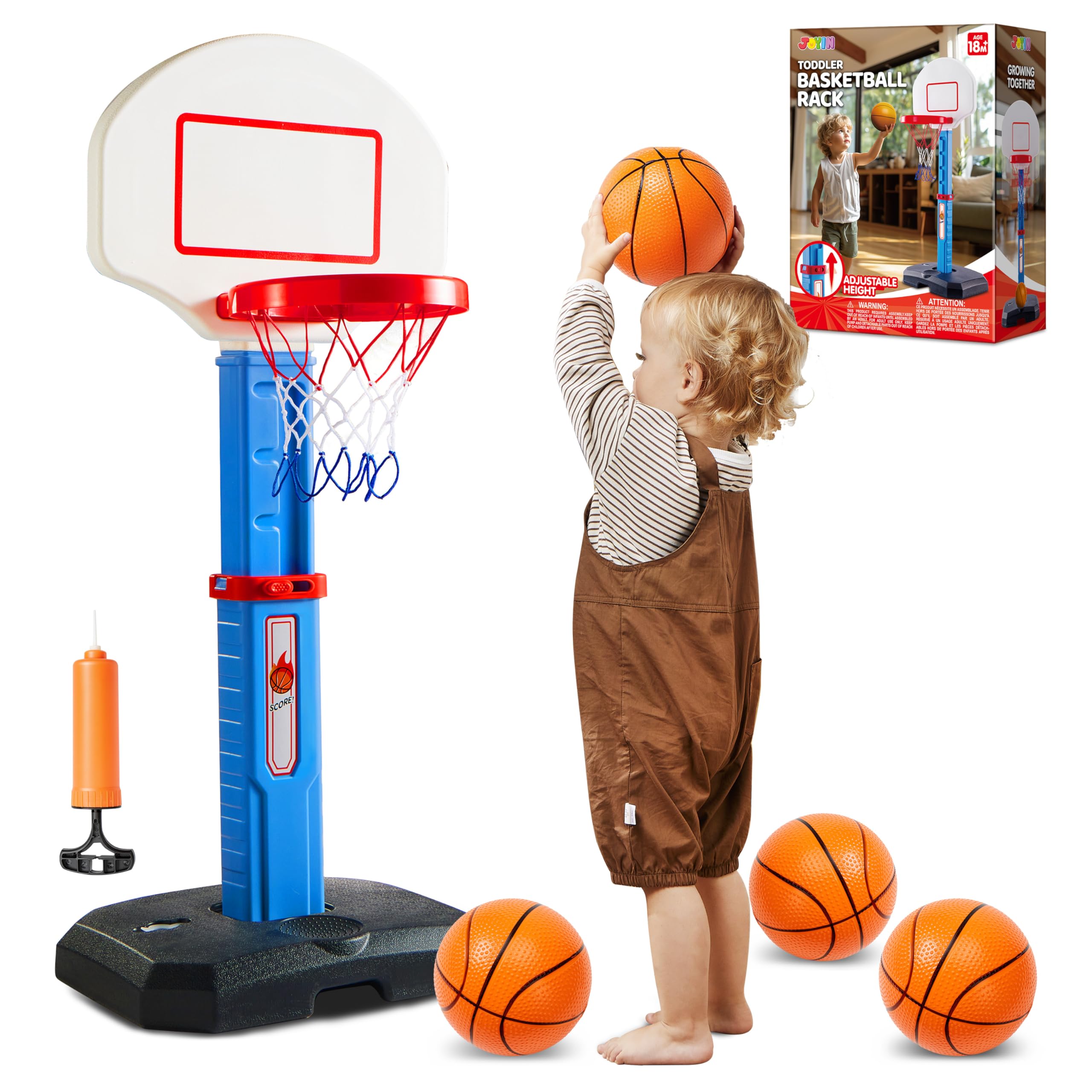
Key Features
- Rim: 18 inches
- Mount: Freestanding floor stand
- Height range: 2.5 to 3.5 feet
- Balls included: 4 mini balls and pump
- Price: Budget
A one-year-old does not need a four-foot hoop; they need a rim they can reach without a stool. That is the case for the JOYIN: 2.5 to 3.5 feet, an 18-inch rim that is forgiving next to the small balls, and four mini balls plus a pump in the box so nothing else has to be ordered before a birthday.
It is light, the edges are rounded, and the base is meant to be filled before play. Setup is the simple, parent-friendly kind, and the whole thing moves from the playroom to the yard without drama — which is what you want from a toy that gets dragged out for ten minutes at a time.
The catch is the ceiling. Three and a half feet is a height a four-year-old clears standing, so this is a two-year hoop rather than a five-year one; the range that makes it perfect at 18 months is the range that retires it. The plastic also feels lighter than the Little Tikes set, and it can crack when an older sibling takes a turn.
Pros
- Lowers to 2.5 feet for early shooters
- Wide 18-inch rim for easy makes
- Four balls and a pump included
Cons
- Outgrown by about age four
- Plastic can crack under older kids
If your shooter is still a toddler, shorter is better: 2.5 to 3.5 feet puts the rim where a one-year-old can actually reach it.
Best for Kids Who Want a Scoreboard
HopeRock Indoor Hoop

Key Features
- Ages: 5 to 12 years
- Mount: Over-the-door
- Scoring: Electronic scoreboard with lights
- Included: Ball and pump
- Price: Budget
The scoreboard is the whole pitch. Shoot and it counts the basket and cheers; miss and it does not. For a seven- or eight-year-old who has outgrown soft-ball hoops, that feedback is the difference between shooting for five minutes and playing until dinner is called.
The rest of it is a proper mini hoop: a steel spring rim, a shatter-proof backboard, a hook that goes over a door in a couple of minutes, and a ball and pump in the box. The spring rim means dunks are part of the game rather than a way to break it, and the five-to-twelve age band is the widest of anything here.
The electronics are the risk. The scorer can stop counting or refuse to power on, and a battery check and a reset are the first things to try. The board and the balls also run small against the photos. If the score is the reason you are buying, set it up and play a game the day it arrives.
Pros
- Scoreboard counts and cheers each basket
- Steel spring rim handles dunks
- Tool-free over-the-door hook
- Rated for ages five to twelve
Cons
- Scorer can stop counting or power on
- Board and balls run small
The pick for kids who want points on the board: an over-the-door hoop with a counting scoreboard, lights, and cheers when the shot drops.
How We Tested the Best Kids Basketball Hoops
We built the shortlist from the specs that actually predict failure: pole diameter, base capacity, backboard material, and the true height range once a base is filled. Reading through the one- and two-star reviews on roughly 40 hoops told us what breaks first — cracked backboards, rims that bend at the bracket, bases that leak after a season — and we bought 12 that covered toddler over-the-door models, adjustable portables, and wall-mounted units.
Assembly was timed alone, from box-open to first made basket, and we noted where the instructions quietly assumed a second adult. Then we filled each base (sand for some, water for others) and leaned hard on the rim to see how much it rocked before handing a ball to a kid. Height changes happened mid-session the way they do in real life, with a 5-year-old and a 10-year-old taking turns at the pole.
For nine months the hoops lived on driveways, a cul-de-sac, a basement floor, and the back of a garage door. We watched for what kids actually do — hanging on the rim, two-footed dunks, firing the ball at the backboard from point-blank — then checked bolt tightness, rust at the joints, and how loudly each backboard rang on a quiet morning. Footprint and backboard size got measured against the space each family had, since a hoop that doesn’t fit gets moved once and then ignored.
How to Choose a Kids Basketball Hoop
The hoop that actually gets used is the one your child can reach this year and still grow into next, so settle the mount and the maximum height before you look at the backboard.
Pick the mount before anything else
Three formats cover almost every home. A freestanding stand (Little Tikes, GMAOPHY, JOYIN, SUPER JOY) needs a patch of floor and a base you fill with water or sand; it suits a toddler who plays in whatever room you are in. An over-the-door hoop (SKLZ, HopeRock) turns any door into a court, but it needs a door that still shuts and a household that can live with a ball thumping against it. A wheeled pole goal (Yohood) is the driveway answer: bigger, heavier, and the only one here that grows toward regulation height.
The maximum height sets the shelf life
Every adjustable hoop is really two numbers: the low setting that fits a toddler now and the high setting that decides when you go shopping again. A stand that stops at 3.5 feet is finished by about four; 4 to 4.5 feet carries a child to five or six; a pole goal topping out near 8.5 feet suits a ten- or eleven-year-old.
Our preference is to buy one size ahead rather than all the way to regulation. A ten-foot goal is a teenager’s purchase, and the pole, base, and backboard that come with it are heavier and harder to move for a six-year-old who just wants to shoot.
The base is what keeps it upright
Sand is heavier than water for the same volume, so a hoop that lives outside where the wind reaches it is better off with sand in the base, topped with a bag if gusts are regular. An empty plastic base will slide across a patio the first time a child leans on the rim. Fill it before the first game, not after the first tip-over, and check the fill level at the start of each season.
Rims, balls, and the parts that wear
A toddler needs an oversized rim and a soft ball that will not take out a lamp; a seven-year-old wants a spring rim that gives on a dunk and snaps back. Inflatable balls ship flat, so a pump or a pump needle is the difference between playing today and playing after a store run. Nets and rim seats work loose on assembled stands; re-seat the rim when you build it and glance at the net once a month.
Frequently Asked Questions
How high should a toddler’s basketball hoop be?
Low enough that your child shoots up at the rim instead of down into it. Most toddler stands start around 2.5 feet, which suits an 18-month-old, and you raise one setting once they are making most of their attempts. By four, a 3.5-foot hoop is already too low, so the 4- to 4.5-foot settings start earning their keep.
Do I need to buy a ball and pump separately?
Usually not. Every hoop here ships with at least one ball, and the toddler stands include three or four plus a hand pump; the soft balls arrive deflated, so the pump matters on day one. The over-the-door models come with a single ball, and not all of them include a pump, so a pump needle for a standard ball pump is worth keeping in a drawer.
Can I leave a kids’ basketball hoop outside all year?
The plastic toddler stands are the ones built for it — the Little Tikes set is sold as water-resistant for indoor and outdoor use, and the wheeled goal is made for the driveway. Two habits keep either alive: bring the inflatable balls in when the weather turns, and tip a freestanding base to check it has not filled with rainwater. Over-the-door hoops belong indoors.
Final Verdict
Buy the Little Tikes Easy Score if your shooter is between one and five. The 2.5-to-4-foot range, the forgiving rim, and the three soft balls make it the easiest recommendation on this page, and it holds its value as the child grows.
Past soft-ball hoops, the SKLZ Pro Mini is the better indoor answer, and a driveway with a ten-year-old in the house points straight at the Yohood. If the room is small and the budget is tight, the GMAOPHY stand does most of the same job for less.
