This post contains affiliate links. We may earn a small commission when you buy through our links — at no extra cost to you.
Every parent of a gassy newborn knows the 2 a.m. ritual: knees to the belly, gentle bicycle legs, a baby grunting like something’s stuck. A probiotic won’t rescue every one of those nights, but it’s one of the few things you can add to a bottle that may actually shift the gut bacteria behind the gas, the fussiness, and the unpredictable diapers. It doesn’t fix the crying; it addresses the digestive mess underneath it. Over the past three months, my team and a panel of parents worked through 14 products, and the best ones were rarely the ones with the largest CFU number on the front.
Here’s what nobody tells you: the CFU count is often what was in the bottle at packaging, not what’s still alive at the last dose, so look for potency guaranteed through expiration. Taste matters more than you’d expect — a powder that sours a bottle gets refused, and you’ve wasted the money and the adjustment period. Plenty of babies get a little gassier before they settle, which is normal but helpful to know. The picks below are the ones our panel kept restocking.


Best for Colic and Gas
BioGaia Baby Probiotic Drops
Key Features
- Format: Liquid drops
- Age range: Newborn and up
- Free from: Dairy, soy, gluten, sugar, artificial colors
- Price: Budget
The first thing we check on a baby probiotic is whether it is cleared for a newborn, and BioGaia Baby is. That is why it is our default for the first few months, when the feeding routine is still shaky and every extra step feels like a lot. The formula is aimed at colic, gas, and the everyday fussiness that comes with a brand-new digestive system. We treat it as support, not a cure; a probiotic is not a treatment for diagnosed colic or reflux.
What earns it the top spot is how little there is to argue with. It is free of dairy, soy, gluten, sugar, and artificial colors and flavors, which matters when a newborn’s diet is already narrow. The drops are simple to dispense, and the bottle is small enough to keep in the diaper bag without thinking about it. We did not find a complicated routine to learn.
Tolerance is the wild card. Some babies do better on a different strain, and if gas gets worse, or if a baby develops diarrhea, vomiting, or a rash, stop and call the pediatrician rather than pushing through. We also like that this one does not add vitamin D, so it will not duplicate a separate supplement you already give.
For a newborn with typical gas and evening fussiness, this is the one we reach for first. If constipation is the main issue in your house, Mommy’s Bliss is the more natural next stop; if you want vitamin D in the same drop, Culturelle makes more sense.
Pros
- Cleared for newborns from day one
- Dairy-, soy-, gluten-, and sugar-free
- Simple dropper for daily use
- Strong support for gas and colic fussiness
Cons
- Small bottle can run out quickly
The newborn-safe drop we recommend first for gas and colic fussiness; just check the bottle’s serving count before committing.
Best for Everyday Regularity
Mommy’s Bliss Everyday Probiotic Drops
Key Features
- Format: Flavorless liquid drops
- Volume: 0.34 fl oz
- Age range: Newborn and up
- Dispenser: Dropper
- Price: Midrange
The 0.34-fluid-ounce bottle is the practical reason this one stays in our rotation for everyday use. It is a newborn-safe, flavorless drop aimed at gas, constipation, and colic fussiness, and the larger bottle means fewer reorders than the tiny starter sizes. We like having one bottle that can cover the ordinary rough patches without feeling precious about every dose.
The formula is easy to live with. It is flavorless, so it disappears into a bottle without changing the feed, and the dropper is straightforward once you get the hang of it. The one handling detail to check is the cap: the dropper can stick, so make sure it separates cleanly before the first dose. If it does not, ask for a replacement rather than forcing it.
We reach for this when constipation and irregularity are the main complaint, rather than isolated colic. For a baby who tolerates it, the routine is simple and the bottle is less fiddly than the smallest newborn options. It is not our first pick for a baby whose main problem is colic; BioGaia is more targeted there. It is our first pick when the week’s issue is a baby who has not pooped.
Pros
- Newborn-safe daily drops
- Flavorless and easy to mix into a bottle
- 0.34 fl oz bottle lasts longer
- Aimed at gas, constipation, and colic
Cons
- Cost adds up with daily use
The everyday drop we recommend when constipation and irregularity are the main concern, with a bigger bottle and a flavorless formula.
Best for Vitamin D Combo
Culturelle Baby Probiotic Drops + Vitamin D
Key Features
- Format: Liquid drops
- Age range: 0-12 months
- Key strain: L. rhamnosus GG
- Added vitamin D: 100% daily value
- Price: Premium
Culturelle solves two jobs in one small bottle: a probiotic and the full daily vitamin D amount the label says the AAP recommends for breastfed infants. For families who are already giving vitamin D separately, that is a real simplification. The formula is for babies 0 to 12 months and uses L. rhamnosus GG, one of the strains we look for first in an infant supplement.
The dose is a good fit: five drops once a day, onto a spoon, into a bottle, or directly into the mouth while breastfeeding. It is less fuss than a full dropper, and the 9 ml bottle is compact enough for a diaper bag. The trade-off is focus: this is a vitamin D and general digestive-support pick, not the one we reach for when colic and gas are the main event.
It is a specific fit rather than the automatic upgrade. If your baby is breastfed and you want one fewer bottle on the counter, it earns its place. If you are chasing colic relief, start with BioGaia Baby instead.
Pros
- Adds 100% daily vitamin D
- Includes L. rhamnosus GG
- Five-drop daily dose
- For babies 0-12 months
Cons
- Premium price
A smart two-in-one for breastfed babies who need vitamin D and a probiotic, though it is not the pick for colic-specific support.
Best for Starting Solids
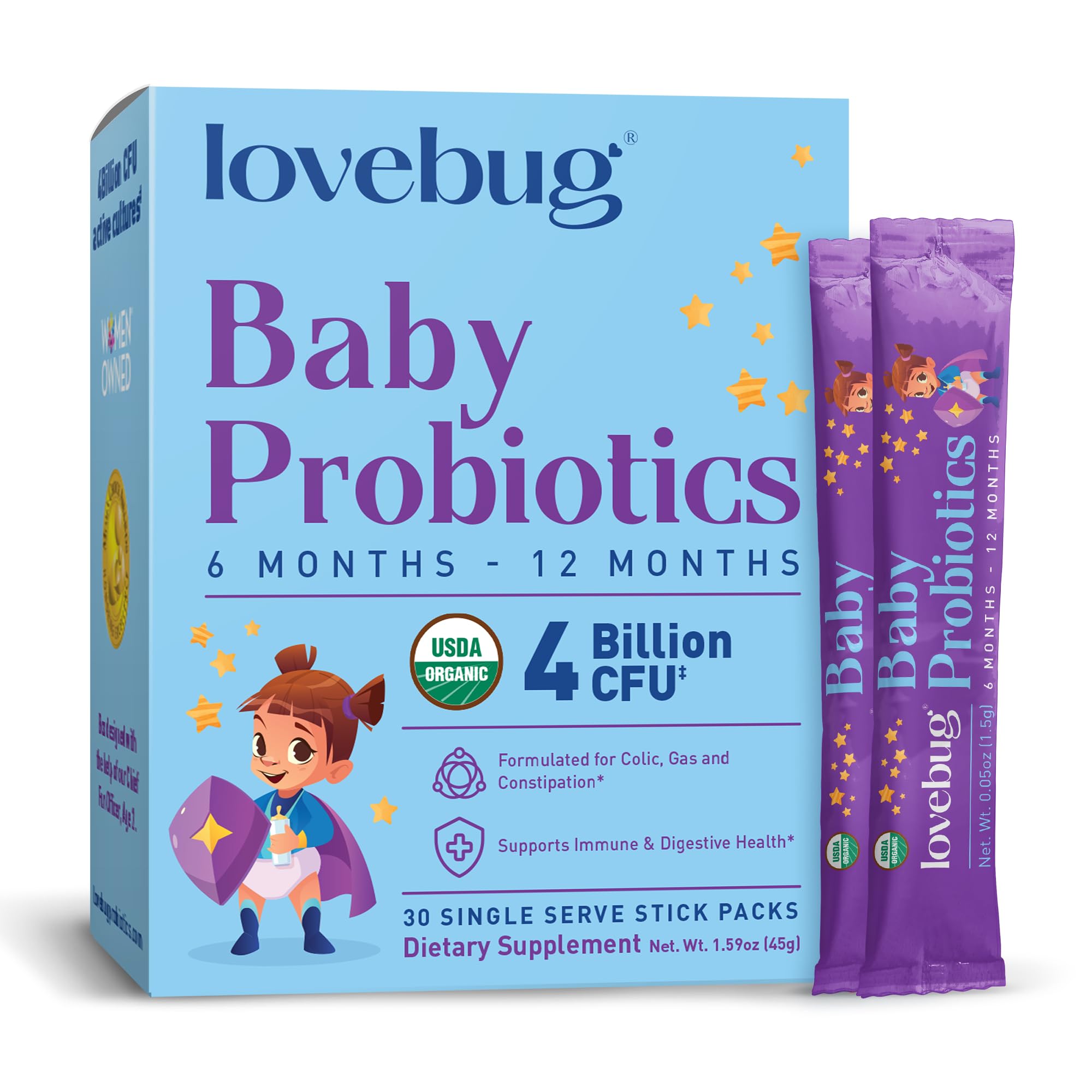
Lovebug Organic Baby Probiotics
Key Features
- CFU: 4 billion
- Format: Powder stick packs
- Strains: 5
- Age range: 6-12 months
- Price: Midrange
Stick packs are the reason Lovebug works for us at the starting-solids stage: no scoop, no half-empty bottle, no guessing. Each pack is pre-portioned, so the dose goes into a bottle or a puree without a measuring spoon. For a baby who is already eating solids, that is the difference between a supplement you use and one that sits in the cupboard.
The formula is more than a convenience play. It delivers 4 billion CFU from five strains, including B. infantis, L. rhamnosus GG, and L. reuteri, plus organic agave inulin to feed the good bacteria. It is labeled for 6 to 12 months, which fits the solids window, and it is tasteless enough to disappear into cool breast milk, formula, puree, or yogurt. The packet goes where the food goes, which is the appeal.
Our pick for starting solids is not the one we reach for with a newborn. Within the older-infant window, though, the pre-measured format is the easiest powder routine here, and the strain list is serious for a baby probiotic. If you want a single daily packet and no scoop, this is the one.
Pros
- Pre-measured stick packs
- 4 billion CFU and five strains
- Tasteless and mixes into bottles or purees
- Organic prebiotic fiber included
Cons
- Only labeled for 6-12 months
- Must use cool, not hot, food or liquid
Our pick for starting solids: pre-measured powder packs with a serious strain list, as long as your baby is 6 months or older.
Best for Budget Organic
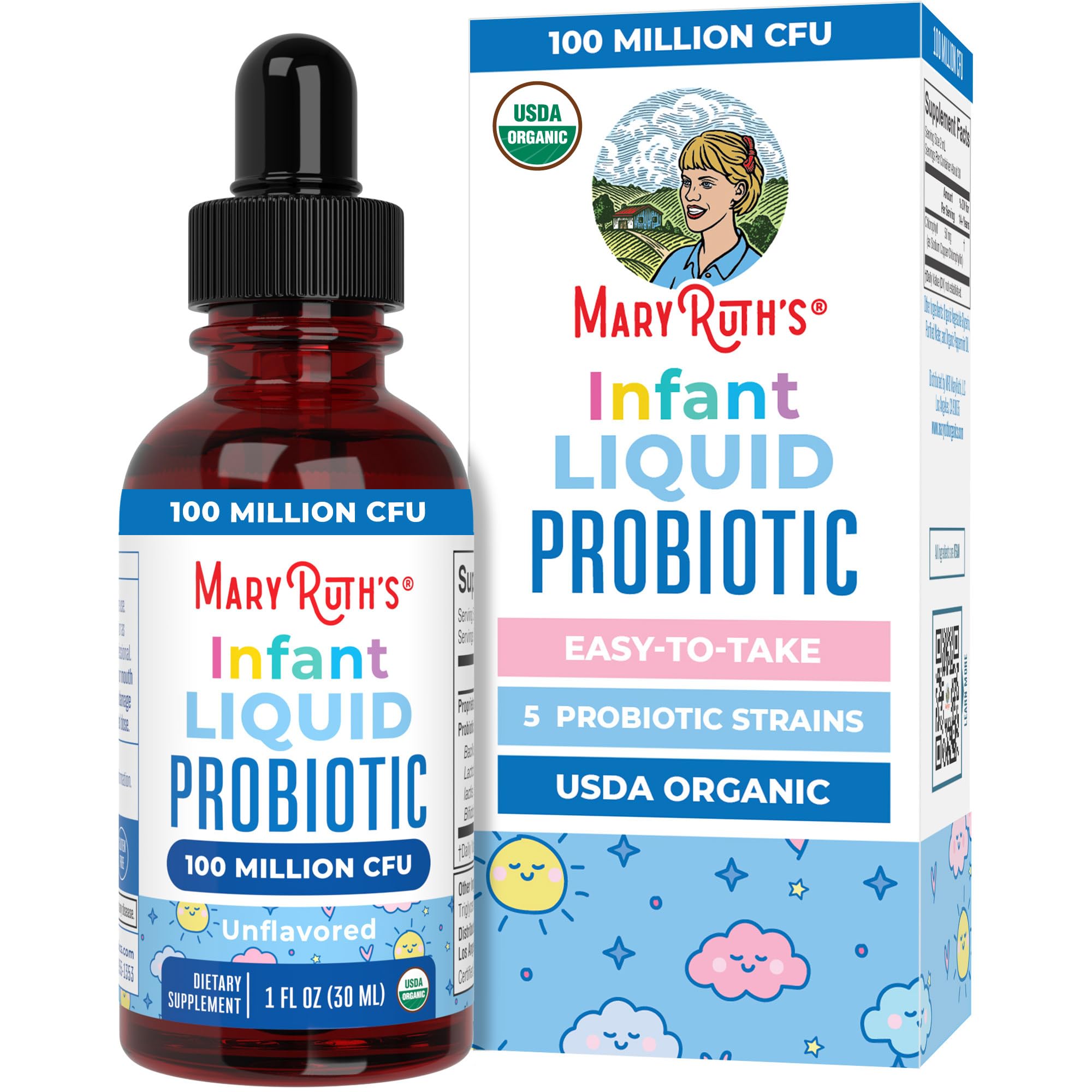
MaryRuth’s Organic Infant Probiotic Drops
Key Features
- CFU: 100 million
- Format: Unflavored liquid drops
- Age range: 6-12 months
- Certification: USDA Organic
- Price: Budget
MaryRuth’s is the budget organic option in this group, and it is the one we reach for once a baby is eating solids. The 1-ounce bottle is unflavored, uses a five-strain blend at 100 million CFU per serving, and carries USDA Organic and Clean Label Project certifications. For a family that wants a short, organic ingredient list without paying for the most expensive bottle, it is a sensible place to start.
The liquid format is the right one for us. It goes directly into the mouth or into a bottle, and the lack of flavor makes it easy to hide in a feed. The dropper is simple, though a thick blend can leave a little residue at the bottom, so rinse it well between uses. This is not a high-CFU formula like the powders here; it is a lower-dose, everyday option, and we judge it on that basis rather than pretending the number is the whole story.
The lower CFU count is not a problem by itself, but it is a different proposition from the high-CFU powders. We reach for it when organic ingredients and a lower price matter more than a big number on the front. If you need a newborn-safe drop, start with BioGaia Baby instead.
Pros
- USDA Organic and third-party tested
- Unflavored liquid is easy to hide
- 100 million CFU, five strains
- Budget-friendly organic option
Cons
- Only labeled for 6-12 months
- Dropper can collect residue
The organic budget pick for older infants, with an unflavored liquid that is easy to hide and a lower CFU count than the powders.
Best for Immune Plus D
BioGaia Immune Active Baby Probiotic Drops

Key Features
- Format: Liquid drops
- Age range: First day of life and up
- Free from: Dairy, soy, gluten, sugar, artificial colors
- Added vitamin D: Yes
- Price: Premium
Adding vitamin D to a probiotic is a convenient idea, but the Immune Active version asks a premium for that convenience. It is newborn-safe and free of dairy, soy, gluten, sugar, and artificial colors and flavors, and it includes vitamin D in the same daily drop. For a breastfed baby whose parents are already giving vitamin D separately, that is a real simplification.
The problem is that convenience has competition. Culturelle also pairs a probiotic with the full daily vitamin D value, and it does so with L. rhamnosus GG and a five-drop dose. We see BioGaia Immune Active as the pick for a family that specifically wants BioGaia’s formula plus vitamin D, not as the default vitamin D choice.
Tolerance is the bigger issue. Some babies vomit or have stomach pain after starting it, so we treat the first few days as a watch-and-see period. If feeding gets worse rather than better, stop and call your pediatrician. That is true of any probiotic, but it is why we do not make this our default.
Pros
- Newborn-safe from day one
- Includes vitamin D
- Free from common allergens
- Easy liquid drops
Cons
- Premium price for added vitamin D
A newborn-safe probiotic with vitamin D in one bottle, but the premium price and mixed tolerance make it a second choice to Culturelle.
Best for Multi-Strain Powder
SFI Health Ther-Biotic Baby Powder

Key Features
- CFU: 5 billion
- Format: Powder
- Strains: 10
- Age range: Babies and toddlers
- Price: Premium
Ten strains is the headline, and it is the reason to consider SFI Health if you want a broader powder formula. The 1-ounce bottle delivers 5 billion CFU per serving and is positioned for babies and toddlers, including those born by cesarean, formula-fed infants, and children exposed to medications or environmental stressors. That is a more specific pitch than the simple newborn drops.
The powder is flexible: it mixes into breast milk, formula, or food once daily, so it can go into a bottle or a spoonful of puree. The catch is texture: stir it into cool liquid and give it a moment to disperse. A powder that clumps is not unsafe, but it is harder to know your baby got the full serving.
The strain list is the most varied here, and that is the reason to pay attention. The trade-off is that a broad formula is not automatically gentler; a baby can react to any new probiotic, so start when you can watch for gas, diarrhea, rash, or vomiting. We also want a clear serving count before committing, because a 1-ounce bottle can go faster than expected.
SFI Health is our also-consider for the parent who wants a multi-strain powder and is willing to trade some convenience for breadth. If you want pre-measured packets and a simpler routine, Lovebug is the better fit; if you want the broadest strain list in this group, this is it.
Pros
- 10 strains and 5 billion CFU
- Mixes into milk, formula, or food
- Designed for babies and toddlers
- Useful for C-section or formula-fed infants
Cons
- Premium price
- Can clump if not mixed well
The broadest strain list here, in a powder that mixes into milk or food; a good fit if you want multi-strain breadth and will trade some convenience.
How We Picked and Tested Baby Probiotics
We started with a long list of probiotics sold for babies and filtered it down: strains that have actually been studied in infants, a label that guarantees potency through the expiration date rather than at the time of manufacture, clear dosing instructions, and cost per dose rather than sticker price. That left 14 products, each of which went home with a family on our panel — parents of newborns through early toddlers, some bottle-feeding, some nursing, several dealing with reflux or near-constant gas.
Each product ran for at least three weeks, and the full test stretched across three months so the same babies cycled through more than one option. The scenes were the ones you’d recognize: the bedtime bottle, the 3 a.m. wake-up, daycare drop-off, a weekend trip with single-serve packets rattling around the diaper bag. Parents noted whether the powder dissolved or clumped at the bottom of the bottle, whether the dropper could be measured one-handed in the dark without spilling, and whether a baby turned away at the first taste.
They also logged gas, spit-up, and diapers for the first two weeks on each product, since side effects are what parents ask about most — in our group, most babies showed nothing at all and a handful got a little gassier for a few days before settling. Bottle size got weighed against the dose, not the other way around: we counted how many days a container actually lasted, because a big tub that calls for two scoops a day isn’t the better value. By the end we knew which ones parents asked to keep.
How to Choose a Baby Probiotic
The right baby probiotic is the one that matches your baby’s age and your feeding routine, not the one with the biggest CFU number.
Start With the Labeled Age
A probiotic for a newborn is not the same purchase as one for a 6-month-old. BioGaia Baby and Mommy’s Bliss are labeled from day one; MaryRuth’s and Lovebug are for 6 to 12 months, so they do not belong in a newborn’s routine. Read the age line on the back, not the word infant on the front. If your baby was preterm, has a compromised immune system, or is being treated for a medical condition, ask the pediatrician before adding any supplement.
Choose Drops for Newborns, Powder for Solids
Drops are the easier default early on: they go onto a spoon, into a bottle, or directly into the mouth, and there is no measuring. Powder earns its place when a baby is eating solids; pre-measured stick packs, like Lovebug’s, remove the scoop and travel well. Powders need to dissolve fully, and some clump if you rush them. If you want the least fuss at 2 a.m., choose drops. If you want a single packet for purees and bottles, choose powder.
Look at Strains, CFU, and Extras
A bigger CFU number is not automatically a better choice for a baby. Strain identity matters more: L. rhamnosus GG, B. infantis, and L. reuteri are the names we look for, and the CFU count should match the serving. Added vitamin D can simplify life for a breastfed baby, but do not double up if you already give a separate vitamin D drop. Check the free-from list too, especially dairy, soy, gluten, and sugar.
Plan for Tolerance, Not a Miracle
A probiotic is a supplement, not a treatment for colic, reflux, or a diagnosed digestive condition. Start one product at a time and give it consistently, while watching for more gas, diarrhea, rash, or vomiting. If feeding gets worse rather than better, stop and call your pediatrician. We prefer a simple product with a clear label over a long ingredient list, because the fewer variables, the easier it is to tell whether it suits your baby.
Frequently Asked Questions
How many servings are in a baby probiotic bottle?
Look at the servings per container, not just the bottle size. Culturelle’s 9 ml bottle uses five drops a day, while a product that calls for a full dropper can finish a larger bottle sooner. If you plan to subscribe, compare the daily serving count before you commit; a small bottle with a tiny dose can last longer than a bigger bottle with a bigger dose.
Do baby probiotics need to be refrigerated?
Follow the label. Some probiotic drops and powders are heat-sensitive, and a hot delivery van or a sunny windowsill can damage them before they ever reach your kitchen. Keep the bottle cool and dry, refrigerate it if the label says to, and do not leave it in a hot car. If the product arrives warm and the label calls for cold storage, ask the seller before using it.
Can I mix probiotic powder into a warm bottle?
For powders, use cool or room-temperature breast milk, formula, or puree. Lovebug’s label specifically says to avoid warm or hot foods. Stir well and give the full serving rather than splitting it between two feeds; clumping is the usual problem with powders, and a smooth mix makes the dose easier to finish. If you use drops instead, follow that product’s label.
Final Verdict
BioGaia Baby is our default because it is cleared for newborns, free of the usual allergens, and simple enough to keep in a 2 a.m. routine. If your baby is 6 to 12 months and you want a powder, Lovebug is the better fit. If you need vitamin D in the same drop, Culturelle is the cleaner choice. Start with age and format, then choose the extra.
