This post contains affiliate links. We may earn a small commission when you buy through our links — at no extra cost to you.
There’s a particular magic to a living-room puppet show — the lights dimmed, a sock creature peeking over the edge, a five-year-old doing three voices at once. The trouble usually starts ten minutes in, when someone leans on the frame and the whole thing tips backward. A good puppet theater survives that: it stands firm on carpet and hardwood, fits in the space you actually have, and looks charming enough that you don’t mind it living in the corner between shows. What it really fixes is the setup problem — the gap between a bored afternoon and an hour of play your kid runs entirely on their own.
My team and I have spent the past eight months with 12 puppet theaters, sitting through rehearsals, dress-up sessions, and one memorable three-act epic about a dragon. We assembled each one from the box and noted whether every part showed up. Assembly is where these things live or die — a theater that takes two adults and a drill rarely gets used twice, no matter what it cost. The ones that earned a permanent spot in the playroom are below.
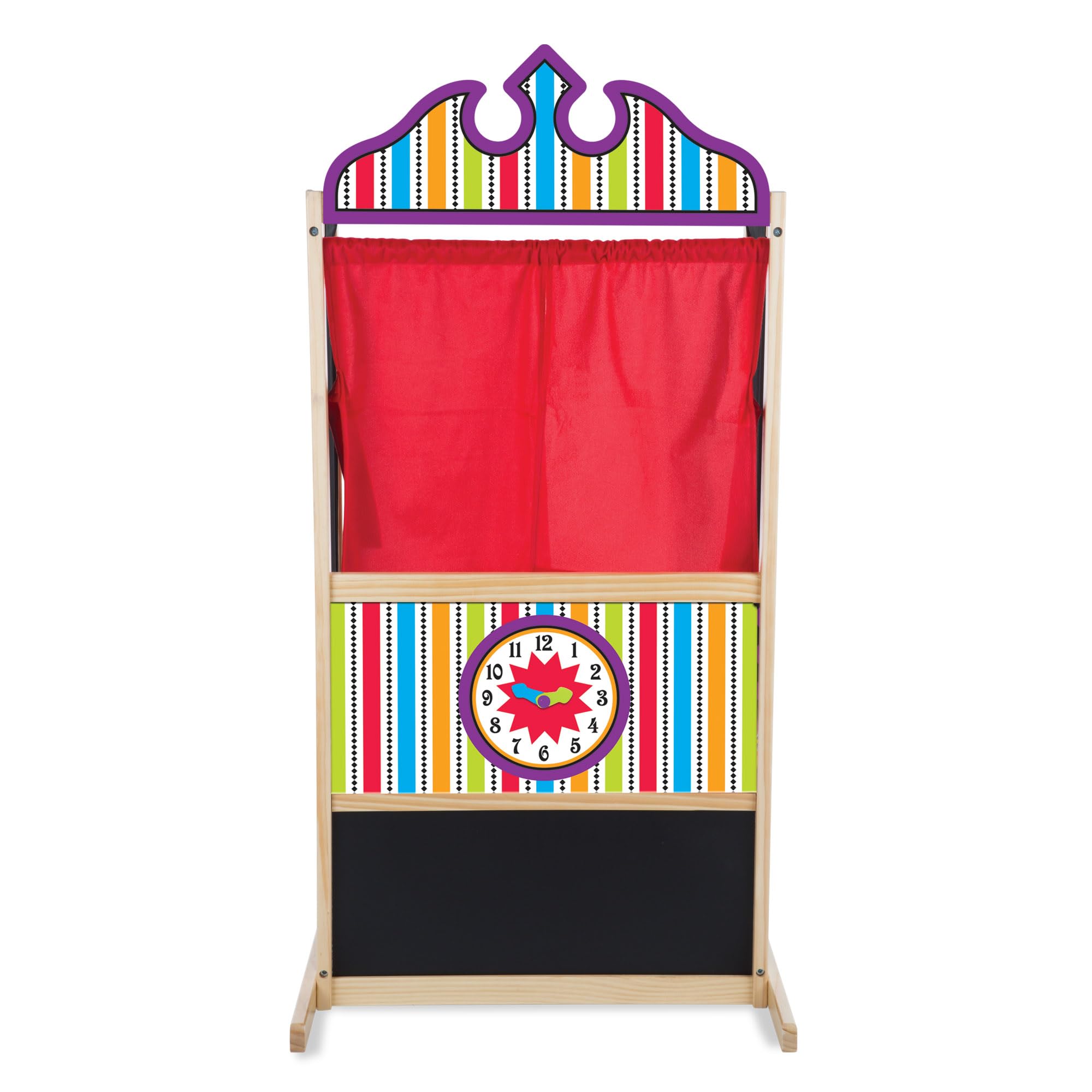


Best for Family Playroom
Melissa & Doug Wooden Puppet Theater
Key Features
- Weight: 12.3 lb
- Materials: Wood and fabric
- Assembled size: 52 x 18 x 24.75 inches
- Recommended age: 3 to 12 years
- Price: Premium
Melissa & Doug’s theater is the tallest wooden stage here at 52 inches, and the only one listed for kids up to 12. That combination is the whole pitch: it is a stage a four-year-old can stand behind, and one a nine-year-old does not feel silly using for a scripted show with tickets.
What earns it the top spot is how little of it you have to worry about. The base is designed not to tip, the frame is solid wood rather than the thin board used at lower prices, and the plush curtains and movable clock make it read as a real theater without a screen or a battery anywhere. It also has the best record in this set for surviving daily play, which is the thing that decides whether a stage is still being used in year two.
Two costs come with it. It does not fold, so it needs a wall or a corner that belongs to it, and assembly is a proper job with panels, screws and hardware rather than a pop-and-go. The box holds the theater itself, so plan on buying two good hand puppets before the first performance.
The detail we keep coming back to is the movable clock beside the chalkboard: kids chalk up a showtime and set the hands to match. That small piece of ceremony is what turns a stage into a production.
Pros
- Solid wood frame with a non-tip base
- Listed for ages 3 to 12, so it lasts
- Curtains, movable clock, and chalkboard
- Best record here for surviving daily play
Cons
- Doesn’t fold, so it needs permanent floor space
- Puppets not included, so budget for them
We recommend it for families with a spare corner and more than one performer: it is the sturdiest, longest-lived stage in this set, and it earns the price.
Best for Preschool Performers
Rundad Wooden Puppet Theater
Key Features
- Assembled size: 24 x 10 x 46 inches
- Recommended age: 36 months to 5 years
- Included puppets: Lion and tiger hand puppets
- Price: Midrange
Two plush hand puppets come in the box, a lion and a tiger, which makes this the wooden stage here you can hand over and play with the same afternoon. It is also shorter than the Melissa & Doug at 46 inches and aimed at ages three to five, so it is a preschool theater rather than a family heirloom.
We rate it the best value among the wooden stages. The anti-tilt support frame that attaches at the base during assembly is the detail that sold us: it widens the footprint and makes the theater much harder to pull over during a big finish. Turn it around and the back becomes a lemonade stand with shelves, so one piece covers shop play and puppet shows, and the price sits below the top pick’s.
The limits are age and height. A tall five-year-old stoops to work the curtain, and by first grade the stage is behind them; if you want something that grows with a child, spend more. Assembly is straightforward but real — panels, screws and the support frame — so clear a floor and find a screwdriver before you start.
The reversibility is what we came back to: a show, then a shift selling pretend lemonade, then another show. Few toys here get a second act out of the same footprint.
Pros
- Two hand puppets in the box
- Anti-tilt frame steadies the base
- Lemonade stand on the reverse side
- Costs less than the top wooden pick
Cons
- Aimed at ages 3 to 5, so it’s outgrown early
Our value pick among the wooden stages — the puppets come in the box, the base resists a four-year-old’s finale, and the price stays below the top pick’s.
Best for Playdates and Travel
Alvantor Puppet Show Theater Tent
Key Features
- Set-up: No tools required
- Weight: 2.1 lb
- Dimensions: 28 x 20 x 41 inches
- Interior capacity: Fits 2-3 kids
- Price: Budget
The cheapest stage here is also the most portable: it folds into a flat bundle you can carry in one hand. It is a polyester tent on labelled poles, 28 by 20 by 41 inches, and it goes up without tools — twist, pop, slot, done.
It is sized for two or three children inside, which matters more than it sounds, because one puppeteer gets lonely and there is room for a second performer or an audience member who insists on being on stage. The sign flips from puppet show to lemonade stand, and the padded front ledge gives kids somewhere to park toys between scenes. It comes apart just as fast and stores in a closet or a car trunk.
The catch is the frame. It is light because it has to travel, and that same lightness is why it bends and tips when two excited kids push against the walls from inside. Keep it for calm shows and indoor floors and it is a bargain; treat it as a fort and the poles will let you know.
Where it earns its place is the house that cannot dedicate a room to a stage: it appears for a playdate, disappears into a bag, and turns up again at a cousin’s birthday.
Pros
- Folds flat and travels in a bag
- Fits two or three kids inside
- No-tool set-up with labeled poles
- Reversible puppet show and lemonade stand
Cons
- Light frame bends and tips in rough play
We point renters and grandparent houses here first: it is the cheapest stage in this guide and one of the few that packs into a bag.
Best for Small Homes
HABA Doorway Puppet Theater
Key Features
- Material: Fabric and metal
- Mounting: Doorway tension rod
- Theater size: 67 x 31 inches
- Recommended age: 3 years and up
- Price: Midrange
This is the one we recommend when floor space is the whole argument. HABA’s theater is a fabric castle scene on a tension rod, 67 inches tall and 31 wide, hung in a door frame and rolled up small enough to lose in a closet. Nothing else here gives a child a stage for the footprint of a curtain.
Standing height is the underrated part. Because the scene hangs from the top of the frame, the opening sits at adult height, so a seven-year-old performs on their feet instead of kneeling, and the puppets disappear above the audience’s eye line. The rod extends for wider frames, the fabric is substantial rather than see-through, and there is a small oval pocket for hand-lettered signage.
The mounting is the weak point. A tension rod holds by pressure, so a solid, square door frame matters, and a child leaning hard on the curtain can bring the whole thing down. Fit it, tug it, and keep it out of the doorway that gets the most traffic.
What you give up is everything a floor theater offers: the chalkboard, the shop counter, the sense of a room within a room. What you get is a stage that is always ready and never in the way.
Pros
- Hangs in a doorway, taking no floor space
- Stage opening sits at standing height
- Rolls up small for closet storage
- Substantial fabric, not a thin curtain
Cons
- Tension rod can slip when kids pull on it
Our space-saver: for small homes and older kids who would rather stand than kneel, nothing else here asks so little of a room.
Best for Tabletop Shows
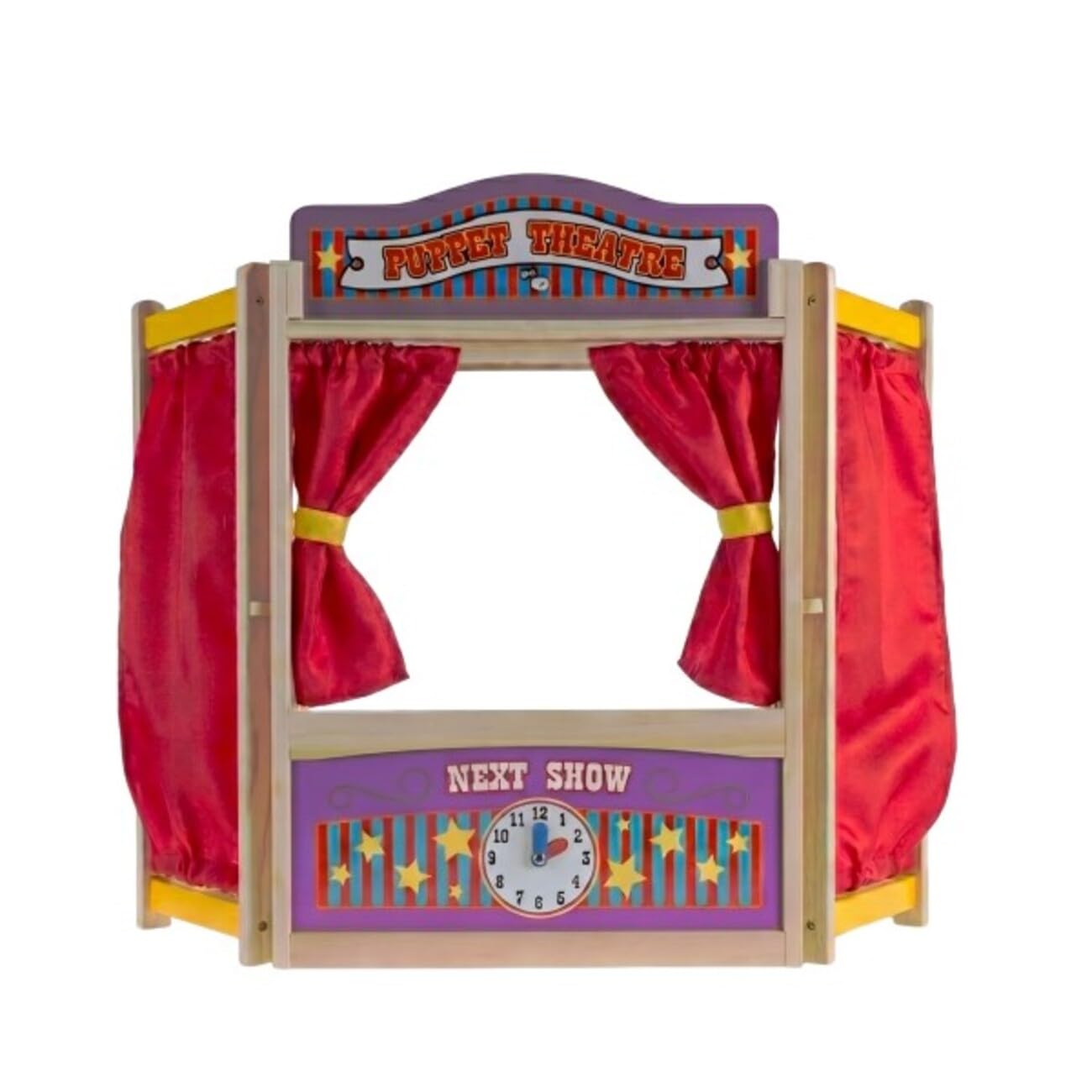
Hey! Play! Tabletop Puppet Theater
Key Features
- Storage: Folds flat
- Materials: Pine wood and MDF
- Stage size: 30 x 26 inches
- Recommended age: 3 to 5 years
- Price: Midrange
A tabletop stage only works if the table is the right one. At 30 inches wide and 26 tall, this wants a low play table or a sturdy coffee table, and it will walk toward the edge the moment a show gets physical.
Set up properly, it is the neatest way to give a small child a real proscenium without clearing a wall. There are plush curtains, a blackboard for show titles, a clock and an interchangeable sign, and the whole thing folds flat so it can live behind a sofa or in a cupboard between performances.
Stability is where this one asks for care. The pine and MDF frame is light for its size, so it needs a surface nobody bumps; a stage that goes over mid-scene takes the performance with it. On a firm table, with a three- or four-year-old who is not leaning over the top, it does what it promises.
Above five, the height starts working against it: a six-year-old has to hunch to reach the curtain, and the sign on top can work loose with handling. It is a first theater, not a last one.
Pros
- Folds flat for cupboard storage
- Curtains, blackboard, clock, and sign
- Gives a small room a real stage
Cons
- Light frame tips on a table that gets knocked
- Suits ages 3 to 5 only
We like it as a first stage for a three- or four-year-old, as long as the table under it is solid and nobody bumps it.
Best for Showpiece Playroom
Le Toy Van Wooden Puppet Theater

Key Features
- Included: Ticket booth, snack counter, winding curtain
- Material: FSC-certified wood
- Assembled size: 27.5 x 16.1 x 48 inches
- Recommended age: 3 to 10 years
- Price: Premium
Buy this one for how it looks in a room, because that is what it is for. Le Toy Van’s theater is red and gold, 48 inches tall, with a curtain that winds up and down on a mechanism instead of a rod, a ticket and show-schedule booth on one side, and a snack-and-menu counter on the other. It is the only stage in this guide that reads as furniture rather than toy storage.
The materials match the finish: FSC-certified wood, water-based paint, nothing plastic. At just under fourteen pounds it stays put when a child works the curtain, which is the practical benefit of buying something heavy — the performance does not wobble.
Two things give us pause. The first is cost: this is the most expensive pick here by a wide margin, and it is a child’s toy. The second is that a 48-inch frame with fixed side booths takes up a wall, and there is no folding it away between shows. Both are fine if the theater is going to be a fixture, and neither is fine for a child who has not asked for a stage yet.
What you are paying for beyond materials is the front of house. Selling tickets and taking snack orders are the parts of theater that keep a six-year-old involved once the puppet show itself is over — and the parts kids show visitors first.
Pros
- FSC wood, water-based paint, no plastic
- Winding curtain and two front-of-house booths
- Heavy enough to stay still during a show
Cons
- The most expensive pick here
- Stands 48 inches tall and needs a wall
We recommend it when the theater will live in the living room and the look matters as much as the show — knowing it is the priciest pick here.
Best for Bluey Fans
Bluey Wooden Puppet Theater

Key Features
- Included: Bluey and Bingo puppets, 2 backdrops
- Material: FSC-certified wood
- Assembled size: 31.89 x 17.32 x 20.08 inches
- Recommended age: 3 years and up
- Price: Budget
If your house runs on Bluey, this is the version that gets played with on day one: Bluey and Bingo hand puppets are in the box, along with two fabric backdrops that swap between scenes.
It is a small theater, 20 inches tall, sized to sit on a table or on the floor in front of a chair, so it suits a three- or four-year-old kneeling at it and not much more. The roll-down curtain is the part that turns a shelf of puppets into a show, and the chalkboard gives kids somewhere to chalk up a title.
The wood is FSC-certified and finished better than most licensed toys — no sharp edges, no sticker graphics, nothing that looks ready to peel. What it is not is a stage for a big production: the opening is sized for one small performer and a couple of puppets, and the backdrops are the whole set design.
We recommend it as a first theater rather than an only theater. It is the one that gets a preschooler hooked, and then gets outgrown the moment a sibling wants a role or the scripts run longer than a minute. That is a good run for the money, as long as you know it is a starter.
Pros
- Bluey and Bingo puppets included
- Two swappable fabric backdrops
- Well-finished FSC wood for a licensed toy
Cons
- Only 20 inches tall, so it’s a preschool stage
For a Bluey fan under five, this is the easiest yes in the guide: we get puppets, backdrops, and a working curtain in one box.
How We Chose and Tested Kids Puppet Theaters
We started by pulling together every kids puppet theater we could find from brands known for playroom furniture, wooden toys, and fabric play tents, then filtered by footprint, price, and material. Anything too wide for a standard doorway or too tall to see over got cut, since a theater that doesn’t fit the room it’s in becomes a closet item. That left 12, which we built and used over eight months.
Each one arrived in a box we opened on the floor with the included hardware and nothing else — no power tools, no second adult. We counted every piece against the parts list before starting and kept notes on missing screws, mislabeled panels, and how quickly a replacement arrived. Then came the real test: a rotating cast of kids ages three to eight putting on shows before school, on rainy Saturdays, and during playdates with four performers fighting over the same curtain.
During those shows we watched how each frame handled a kid leaning over the top bar, sitting on the base, and yanking the curtains open and shut. We nudged every theater on carpet and hardwood to see how far it slid, and checked whether weighted feet or a wide base actually kept it planted when two children leaned in at once. Over the eight months we tracked loose joints, torn curtains, and chipped paint.
Appearance got judged from the sofa, not the playroom — a theater that looked like clutter from across the living room lost ground to one that read as furniture. At the end, we set each price against the puppets, curtains, and storage that came with it, since the cheapest box often needs another thirty dollars of extras.
How to Choose a Kids Puppet Theater
The stage is the easy part; the decision that actually matters is where it can stand, because a theater that has to be packed away every evening gets used far less than one that stays up.
Pick the Spot Before the Stage
The form follows the room. Floor-standing wooden theaters, 46 to 52 inches tall in this group, give the biggest stage and the most theatrical look, and they never move once built. Doorway theaters hang from a tension rod, claim no floor space and store in a closet. Tabletop stages around 20 to 26 inches tall suit three- and four-year-olds on a low table. Pop-up tents are the only ones that travel.
The trap is the word compact, which in a listing usually describes the folded or packaged size rather than the footprint in use. Check the assembled dimensions against the wall you have in mind, not the box.
Match the Stage to the Child’s Height
Height decides how long the toy stays in service. A 20-inch licensed set and a 26-inch tabletop stage are preschool furniture: by six, a child has to hunch to reach the curtain. Floor models at 46 to 52 inches work from about three to eight, and the tallest, listed to age 12, keep going for older kids who want to write a script and cast their friends.
Doorway theaters put the opening at adult height, which is why a tall seven-year-old can perform standing up. Buying for a five- or six-year-old who is already tall? Skip the tabletop versions.
Plan for Assembly and Storage
Wooden theaters arrive as panels, screws and a curtain rod, and assembly is the most consistent frustration in the category — not because it is difficult, but because it is an evening, and it is twice as long alone. Clear a floor, find a screwdriver, and recruit a second adult for the moment the frame goes upright.
Then decide where it lives when nobody is performing. Doorway theaters and folding models disappear into closets; the big wooden stages do not. If there is no wall for it, that is the purchase decision, not the assembly.
Stability Is the Safety Question
Freestanding stages should have a wide base or an anti-tip frame, and two picks here include one; it makes a visible difference when a child leans over the top to work a puppet. Tension rods hold by pressure alone, so they need a solid, square door frame and a firm tug before you trust them. Pop-up frames are light because they have to be, which means calm indoor shows rather than wrestling.
Whatever you choose, keep it out of the main walkway and off a table that gets knocked. Puppet theater is physical play, and the stage takes the weight.
Puppets and the Extras Worth Paying For
Some stages arrive with hand puppets; some arrive with a curtain and nothing else. Puppets are not a trivial add-on, since a pair of good hand puppets can cost as much as a budget pop-up stage, so a theater that ships with a lion and a tiger is better value than its price suggests.
After puppets, the extras that earn their place are a curtain a child can work alone, a chalkboard for showtimes, and a reversible back panel that turns the theater into a shop. Skip anything that lights up or plays music; the play is the point.
Frequently Asked Questions
Can I put a kids puppet theater outside?
The pop-up tents can go out. The Alvantor is a polyester tent over a light frame, and it wipes down with a damp sponge after a garden party. Wooden stages and doorway theaters are indoor toys: the wood is finished for interior use, and a tension rod needs a door frame to press against.
For an outdoor show, a sheet over a clothesline beats dragging a wooden stage onto a patio.
What puppets work with these stages?
Any hand or finger puppets. Nothing here is proprietary; these are open frames with a curtain and an opening, so the puppets your child already owns will work.
The one fit question is size. An adult-sized hand puppet covers most of a 20- or 26-inch tabletop opening, so keep the big puppets for a floor model. Two or three puppets is plenty to start.
How do I clean chalk and fingerprints off?
A dry microfiber cloth takes chalk off the blackboard, and a barely damp one handles sticky prints on painted wood; dry it straight after, because exposed MDF edges swell when they stay wet.
Plush curtains and fabric backdrops spot-clean with a little dish soap on a cloth. Pop-up tents wipe down and air-dry fully before you fold them, or the fabric stores damp.
Final Verdict
For most families, the Melissa & Doug Deluxe Wooden Puppet Theater is the one to buy. It is the sturdiest stage here, tall enough for a standing preschooler, listed for kids up to 12 rather than 5, and the one we expect to still be in a playroom when the first puppeteer starts school.
Two requirements change the answer. If you cannot give up floor space, hang the HABA theater in a doorway instead — it stores in a closet and puts the stage at standing height. And if you want puppets in the box and a lower price, the Rundad is the wooden stage we point to, with the trade that it is aimed at three- to five-year-olds.
