This post contains affiliate links. We may earn a small commission when you buy through our links — at no extra cost to you.
When my daughter was six months old, she grabbed a strip of toast off my plate and missed. That miss — and the mess that followed — is the moment I understood what baby led weaning actually asks of parents: food soft enough to gum, shaped so a baby can grip it, and safe enough that you can breathe while they explore. The right first foods take the panic out of that transition. They hand control to the baby, give you a break from spoon-feeding, and still deliver on taste, texture, and actual nutrition.
Over four months, my team and I worked through 16 first-food products — teething crackers, soft-baked bars, pouch purees for pre-loading spoons, and finger-food meals — with babies six to ten months old. We tasted everything ourselves and watched how each one held up in a fist. Here’s a piece of wisdom that surprised me: the ingredient list matters more than the age label on the front. The picks below are the ones that earned a second reach, not just a first bite.

Best for Starting Solids
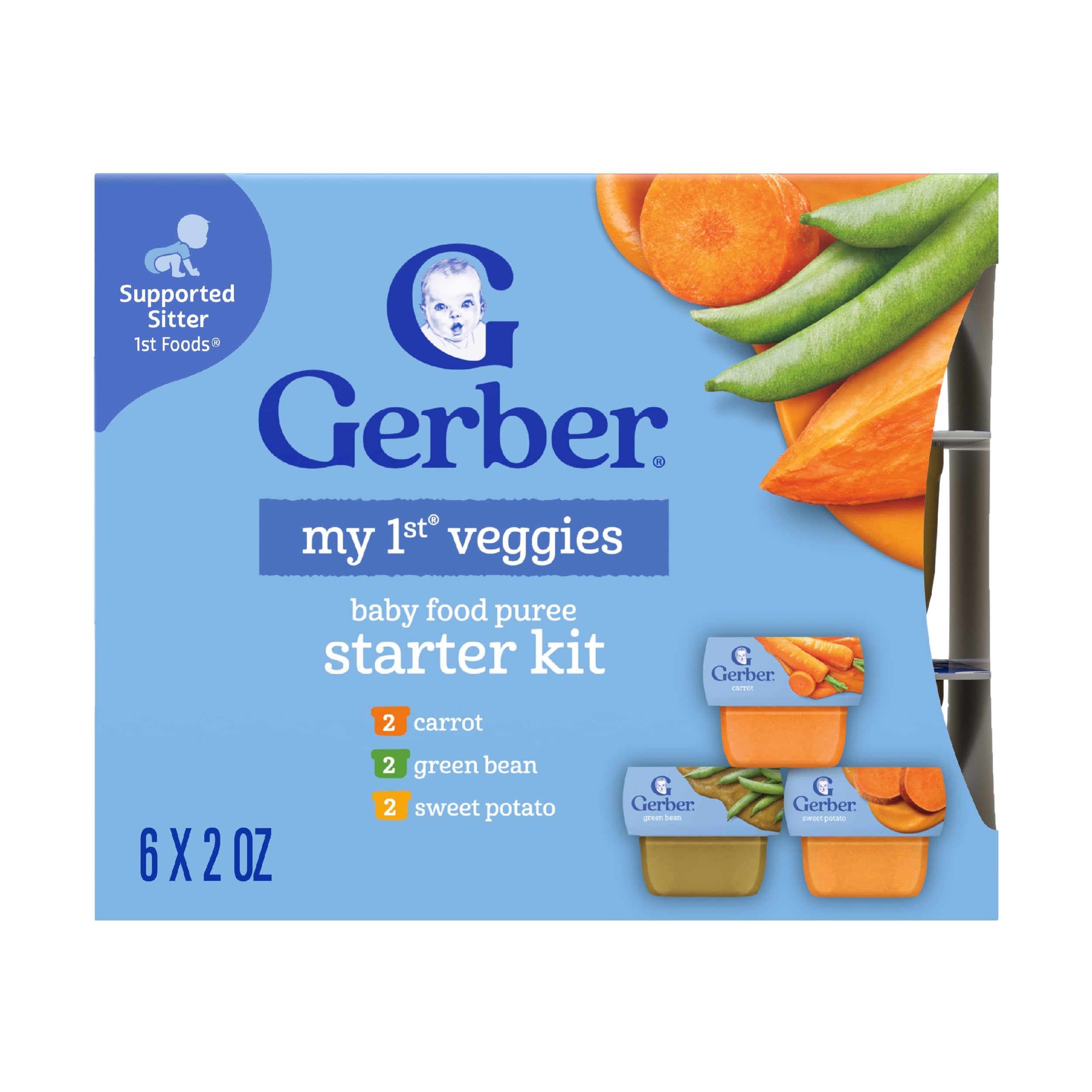
Gerber Stage 1 Veggie Variety Pack
Key Features
- Stage: Stage 1, sits with support
- Label claims: No added salt, artificial colors or flavors
- Package size: 24 oz
- Flavors included: Carrot, green bean, sweet potato
- Price: Budget
Starting solids asks for small amounts of several vegetables, not a cupboard full of one, and Gerber’s variety pack is built around exactly that. The 24 ounces come as individual tubs across carrot, green bean and sweet potato, so you open one at a time and the others stay sealed until you need them. Per ounce it is the cheapest thing in this guide, and it is the only pick that hands you a whole vegetable rotation in a single purchase — a combination that is hard to beat for a family just starting out.
Sweet potato is the tub that empties. It is the sweetest of the three and the one that goes down without negotiation; carrot is close behind; green bean is the flavor that ends up back in the fridge. That is worth knowing before you commit to a 24-ounce pack, because the variety is real but it is not three equal flavors. If your baby turns out to hate green bean, you will be working through a few tubs of it.
The purees run loose, which matters far more on a self-fed spoon than on one a parent controls. Load it to the top and it drips on the way to the mouth. Scoop about half of what looks generous and let the baby take it from there; the sweet potato holds its shape noticeably better than the carrot or the green bean, which is part of why it disappears first.
Nothing in this pack is organic, and that is the one thing that might send you elsewhere — the Happy Baby jar covers that ground. For everyone else, this is where we start.
Pros
- Best value per ounce in this guide
- Three vegetables in one purchase
- Individual tubs stay sealed until opened
- No added salt or artificial colors
Cons
- Loose texture slides off a preloaded spoon
- No organic claim on the label
The pack we point most families to first: three vegetables in sealed tubs, the best value here, and a texture that works from a preloaded spoon.
Best for Fruit First Foods
Beech-Nut Naturals Banana Jar
Key Features
- Stage: Stage 1, around 4 months and up
- Packaging: Glass jar, BPA-free, recyclable
- Label claims: Non-GMO, no added sweeteners
- Package size: 4 oz
There is no organic certification on this jar, and it is better said up front than left for you to find on the back label. What it does offer is the shortest ingredient story in this guide: pureed banana with no added sweeteners, no artificial preservatives, colors or flavors, non-GMO, in a 4-ounce glass jar that is BPA-free and recyclable.
Banana is also the one first food you can mash with a fork in under a minute, so a jar has to justify itself — and we think this one does, on the days when the fruit bowl offers nothing but rock-hard or overripe. The puree is the same consistency every time, it sits sealed in the cupboard until you want it, and it goes into the diaper bag without any planning. That reliability is the whole product, and it is enough.
Glass is the trade-off. It is heavier than a tub in a bag and it can chip, so ours lives in the cupboard rather than the bottom of the stroller. What you get back is a jar you can see through, that does not pick up the smell of last week’s carrot, and that goes in the recycling rather than the bin.
It is one flavor in one size, so treat it as a companion rather than a starter kit. Pair it with a vegetable pack and you have fruit and veg covered for the first couple of weeks; buy it alone and you have a very nice banana and a very narrow diet.
Pros
- Pure banana with nothing added
- Same texture every single time
- Glass jar is BPA-free and recyclable
Cons
- No organic certification
- Glass is heavy and can chip
We keep this for the days when the bananas on the counter aren’t ready: plain, unsweetened, and the same texture every time.
Best for Organic First Tastes
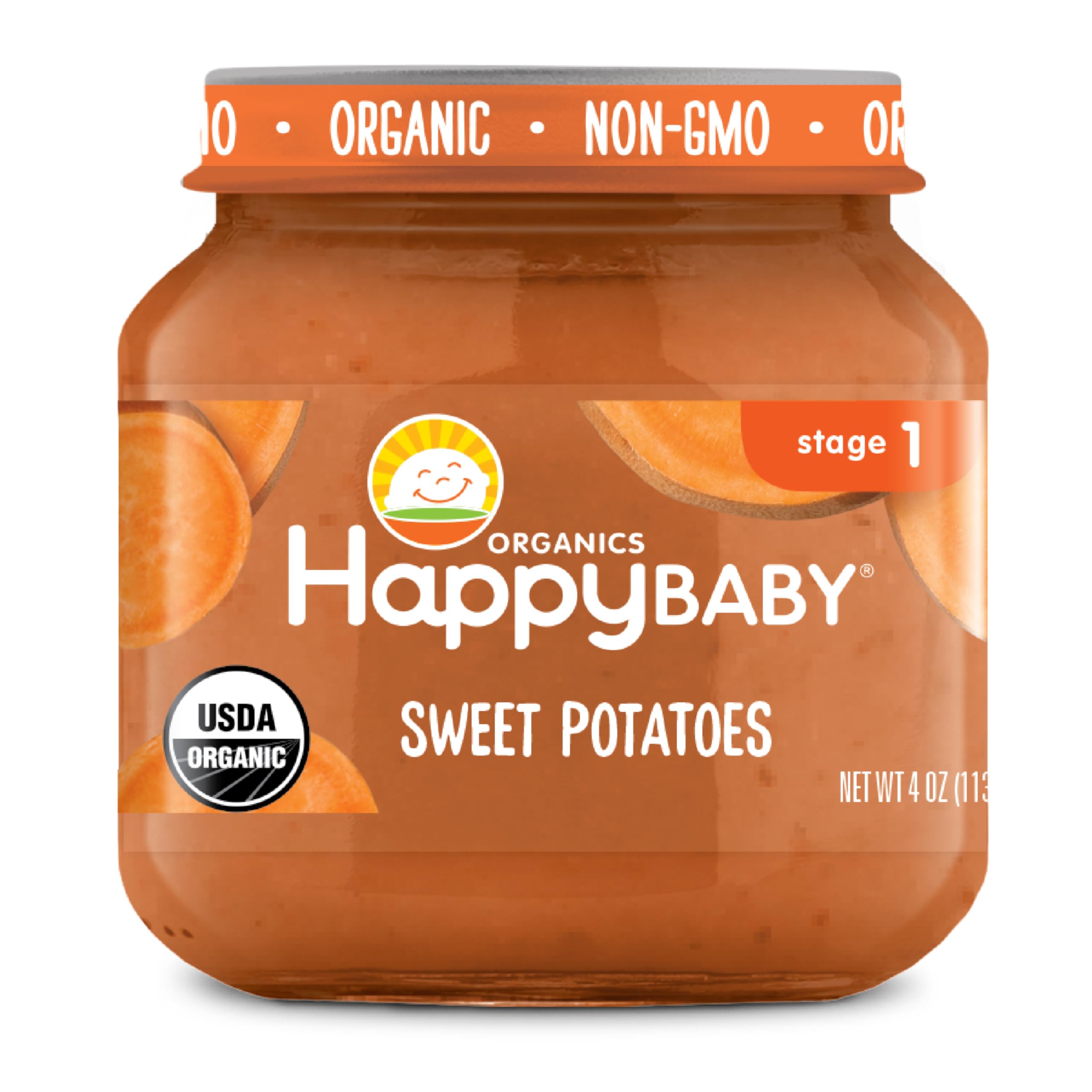
Happy Baby Organic Sweet Potatoes
Key Features
- Ingredients: Organic sweet potato
- Package size: 4 oz
- Package dimensions: 2.64 x 2.17 x 2.17 inches
- Price: Midrange
Gerber’s sweet potato tub and this jar are chasing the same job, so the question is what comes alongside the vegetable. Here it is organic certification and a small, single-serving commitment rather than a box of twelve.
One ingredient is the whole point in the early weeks. When you are adding a new food every three or four days, a jar that contains exactly sweet potato is the easiest thing to trace — if a rash or a bad night follows, you have one suspect rather than a list. The puree itself is smooth and sweet, the sort of thing that gets eaten without a fight, which is not nothing when you are both learning how this works.
For the first fortnight, this is the jar we reach for. It is organic, it is one ingredient, and it does not ask you to commit to a flavor your baby has not met yet. That combination is worth more at the very beginning than a lower price per ounce.
The limit is variety. Sweet potato is all you get, in one size, so this is half of a starter plan rather than the whole thing — expect to pair it with a vegetable pack or a second single-ingredient jar within the week.
Pros
- Certified organic and single-ingredient
- Smooth puree that gets eaten readily
- Easy to trace if a reaction appears
Cons
- One flavor only, in one size
Our pick for the first week of solids, when one ingredient and an organic label matter more than variety or price.
Best for Confident Eaters
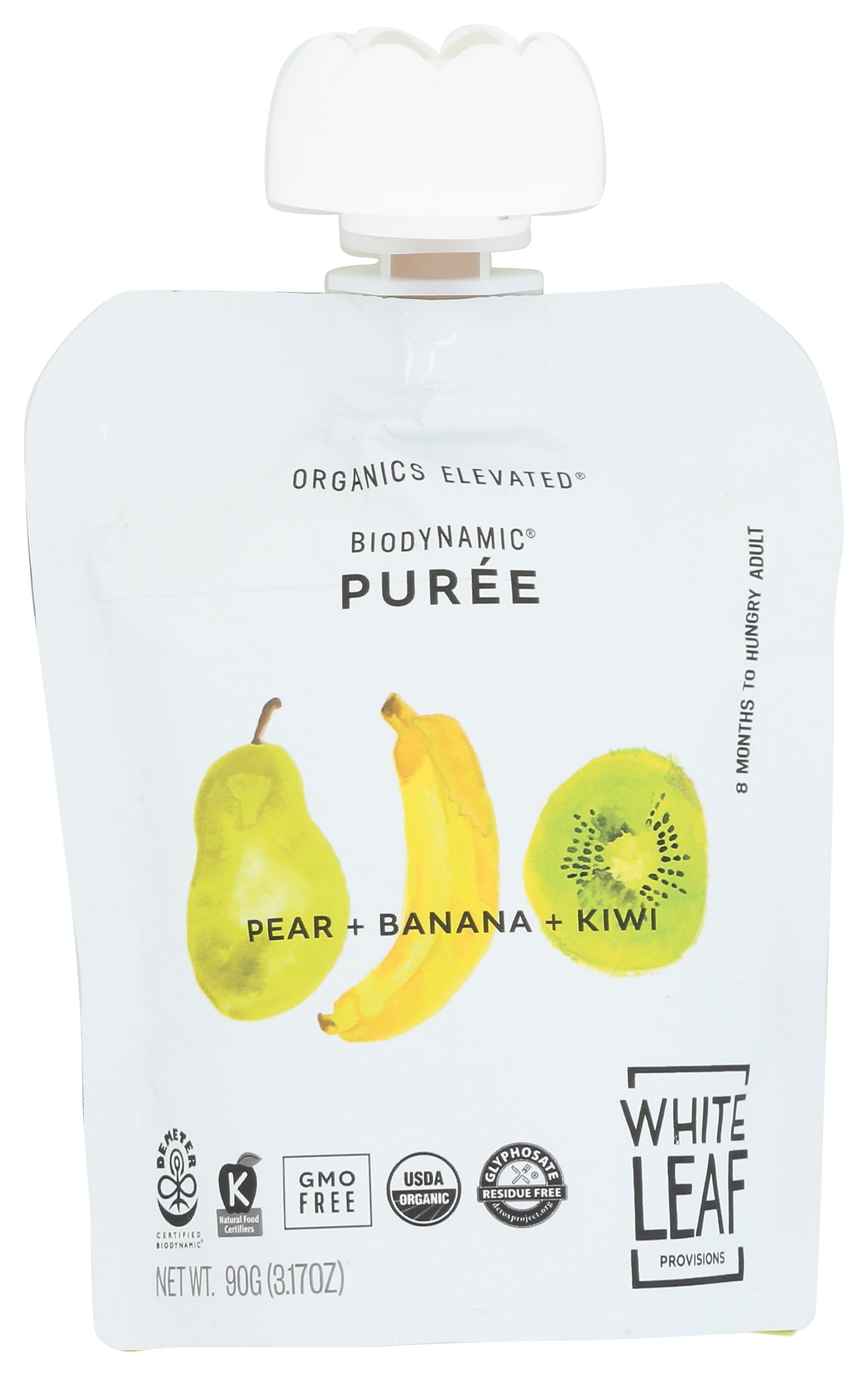
White Leaf Pear Banana Kiwi
Key Features
- Fruits: Pear, banana, kiwi
- Label claims: Organic, kosher, BPA-free
- Package size: 3.17 oz
Pear, banana and kiwi in a 3.17-ounce serving. That is the pitch and it is also the catch, because the thing that makes this one interesting is the thing that makes it a poor place to start.
Once your baby is eating confidently, it is a genuinely nice thing to have in the bag. It is organic and kosher, the packaging is BPA-free, and the pear-kiwi combination tastes like something rather than like the sweet potato and banana the rest of this guide leans on. After a fortnight of orange purees, a baby who has started turning their head away may well lean back in for this.
The problem is timing. Three fruits in one serving runs straight into the one-new-food-at-a-time rule: if a reaction shows up, you have three suspects instead of one. Pear and kiwi are also sweeter and tangier than a first vegetable, which makes this a hard sell as a genuine first food and an easy one two or three weeks in.
At 3.17 ounces it is the smallest serving here, sized for a baby still taking a few spoons at a time and easy to tuck into a bag. Buy it after the single ingredients are established, not before.
Pros
- Distinctive pear-kiwi flavor
- Organic, kosher and BPA-free
- Small 3.17-ounce serving for light appetites
Cons
- Three ingredients at once complicate tracing reactions
We reach for this once a baby is eating well: three fruits make a lively change from orange purees, though they complicate a first introduction.
How We Tested Baby-Led Weaning First Foods
We started by pulling together a shortlist of 40 products sold as first foods or BLW-friendly snacks, then filtered it down by ingredient lists — no added salt or sugar, recognizable whole foods, and clear allergen labeling — plus age suitability and price per serving. That left 16 products to test over four months. We chose a mix of textures and formats on purpose: soft crackers, oat bars, pouch purees, and meal trays, so we could see how babies handled different consistencies.
Testing happened in high chairs at home, during breakfast, lunch, dinner, and the occasional snack on the go. Each product went in front of babies aged six to ten months, with a parent watching for gagging, spit-outs, and whether a baby reached for more. We also tasted every item ourselves and rated flavor, aftertaste, and whether it tasted like actual food rather than a sweetened puff. We squeezed, mashed, and smeared each one to judge consistency — whether it held together in a fist, dissolved cleanly, or turned into a sticky paste.
Portion size got its own check: we weighed what went on the tray, then weighed what came back, so we could see how much was actually eaten and what that meant for value per serving. We rotated flavors and formats across the four months to see which ones stayed interesting and which got refused after a week. Ingredients were read twice — once in the store and once after testing — because a clean label doesn’t help if the texture makes a baby gag. The products that made the list scored well on all of it: taste, flavor variety, consistency, ingredient quality, baby-friendliness, portion size, and value.
How to Choose First Foods for Baby-Led Weaning
The first food that works for a self-feeding baby is not the one with the best ingredients panel; it is the one thick enough to stay on the spoon you hand over.
Readiness, Not the Number on the Label
Stage 1 products in this category carry wildly different ages, and you will see them sitting side by side on the same shelf. The age is not the deciding factor; the baby is. A baby who holds their head steady, sits upright with support, reaches for food and has stopped pushing food back out with their tongue is ready, and that usually lands around six months.
Start with a teaspoon of one ingredient and let appetite lead from there. If your baby is still thrusting food out, wait a week and try again. No pouch or tub fixes an unready baby.
How a Puree Fits Into Baby-Led Weaning
Strict baby-led weaning means finger foods and no spoons, and a tub of puree is plainly not that. What most families actually do is a hybrid: soft strips of food to grab, plus a preloaded spoon. Dip a soft-tipped spoon into the puree and hand it over handle-first, so the baby brings it to their own mouth and controls the pace.
That is still self-feeding, and it is often how a baby learns the mechanics months before they have the grip for a piece of broccoli. If you intend to stay strictly finger-food, skip this category and roast a sweet potato instead.
Thickness Decides Whether It Works
The most useful thing to check before committing to a multipack is texture. Turn a loaded spoon upside down: if the puree slides off in a sheet, it is a spoon-fed texture rather than a self-fed one, and you will spend the meal chasing it. Thicker purees cling to the spoon and let the baby set the pace.
Load less than feels generous. Half a spoon is plenty when the aim is practice rather than volume, and a smaller scoop is the simplest fix for a loose puree that will not stay put.
Single Ingredients First, Blends Later
The case for one-ingredient jars is not purity, it is bookkeeping. Introduce one new food, wait three or four days, then add the next. That way, if a rash or a rough night follows, you know which food to suspect. A three-fruit blend hands you three suspects at once.
The same logic favors a variety pack over a single-flavor multipack early on: you can open a different vegetable every few days without committing to a large supply of the one your baby refuses.
Tubs, Jars and What a Multipack Commits You To
Tubs are light, they stack, and they go in a bag. Glass jars are recyclable and do not hold onto flavors, but they are heavier and they can chip. None of that decides a purchase on its own.
What does decide it is the arithmetic behind a bulk pack: it is only good value if the baby eats every flavor in the box. If you do not yet know what they will take to, buy small across several flavors, find the one that disappears, then buy that one in quantity. An organic seal costs more per ounce; what it buys is how the ingredients were grown, not a thicker puree or an easier eater.
Frequently Asked Questions
Do I need to warm baby food before serving?
Not necessarily. Room temperature is fine, and plenty of babies take a jar or tub straight from the cupboard. If you do warm it, stand the container in a bowl of warm water rather than microwaving it, then stir and test a drop on the inside of your wrist before offering the spoon.
Microwaved puree heats unevenly and can leave a hot pocket that burns a baby’s mouth even when the outside feels cool.
How long does an opened jar or tub keep?
Go by the package rather than by habit. Each brand prints its own use-within window, and it counts from the moment the seal breaks, not from when you first feed from it. Write the date on the lid when you open it.
Spoon out only what you are serving into a clean bowl and refrigerate the rest straight away. Feeding straight from the container puts saliva on the spoon and back into the food, which shortens what is left considerably.
Can I use these if I’m not doing baby-led weaning?
Yes. None of them is specific to self-feeding; they are ordinary Stage 1 purees, and spoon-feeding is exactly what they were made for. The texture rule simply flips, since a looser puree is easier to spoon-feed than to hand over.
The one-new-food-at-a-time approach still applies, whichever way the food reaches your baby.
Final Verdict
Gerber’s veggie variety pack is the one we point to first. Three vegetables in separate sealed tubs, the lowest cost per ounce in this guide, and a texture that behaves when you load a spoon halfway and hand it over.
If organic is the line you will not cross, Happy Baby’s single-ingredient sweet potato jar is the swap, and for a baby’s very first taste its one-ingredient simplicity has real appeal. Save White Leaf’s pear-kiwi blend for a few weeks in, when you want something that is not orange.
