This post contains affiliate links. We may earn a small commission when you buy through our links — at no extra cost to you.
Many parents quickly discover that the biggest challenge with kids probiotics isn’t the science — it’s getting their child to actually take them. Between chewables that taste off, gummies that melt in transit, and powders that clump, the right choice depends on your child’s age, taste tolerance, and your daily routine. This guide matches each product to a specific use-case: from toddler constipation relief to budget-friendly gummies to organic options.
The most important factor is not the CFU count alone — most kid probiotics use 2.5 to 5 billion CFUs, which is plenty for young children. What matters is whether your child will accept the form (chewable, powder, or gummy) and whether the product addresses specific needs like added fiber or organic ingredients. The picks below cover the most common scenarios so you can find the right match for your child’s age and preferences.



Best for Proven Lgg Strain
Culturelle Kids Chewable Probiotic
Key Features
- Probiotic Strain & CFU: 5B LGG
- Form: Chewable tablet
- Age & Allergens: 3+; GF,DF,SF
- Price: Mid-Range
The LGG strain in each chewable is the same one used in over 1,000 clinical studies — that consistency matters when you’re choosing a daily probiotic for a growing child. Parents report fewer stomach complaints and more regular bathroom habits within the first week, backed by 265 positive mentions around digestive health. The berry flavor lands well with most kids: 230 mentions, 83% positive. For the roughly 17% who catch an aftertaste, it’s a minor complaint rather than a refusal trigger — most still finish the tablet.
This pickup works best for families who want a no-mess, no-mix option that fits into a morning routine. The chewable dissolves quickly and doesn’t require refrigeration, making it practical for travel or school lunches. Avoid it if your child is under 3 or refuses any chewable form — the flavorless powder alternative in this lineup hides better in food. For ages 3+ who can chew and tolerate berry, it’s the most straightforward way to get a pediatrician-recommended probiotic into their day.
Pros
- Clinically supported LGG strain linked to regular digestion
- Berry flavor that most kids accept willingly
- Chewable form requires no mixing or refrigeration
Cons
- Some children notice a bitter aftertaste
- Not suitable for toddlers under 3 years
Buy this if you want a convenient, kid-friendly chewable with a well-studied probiotic strain and high success rate for digestion and immunity. Skip it if your child refuses chewable tablets or is under 3.
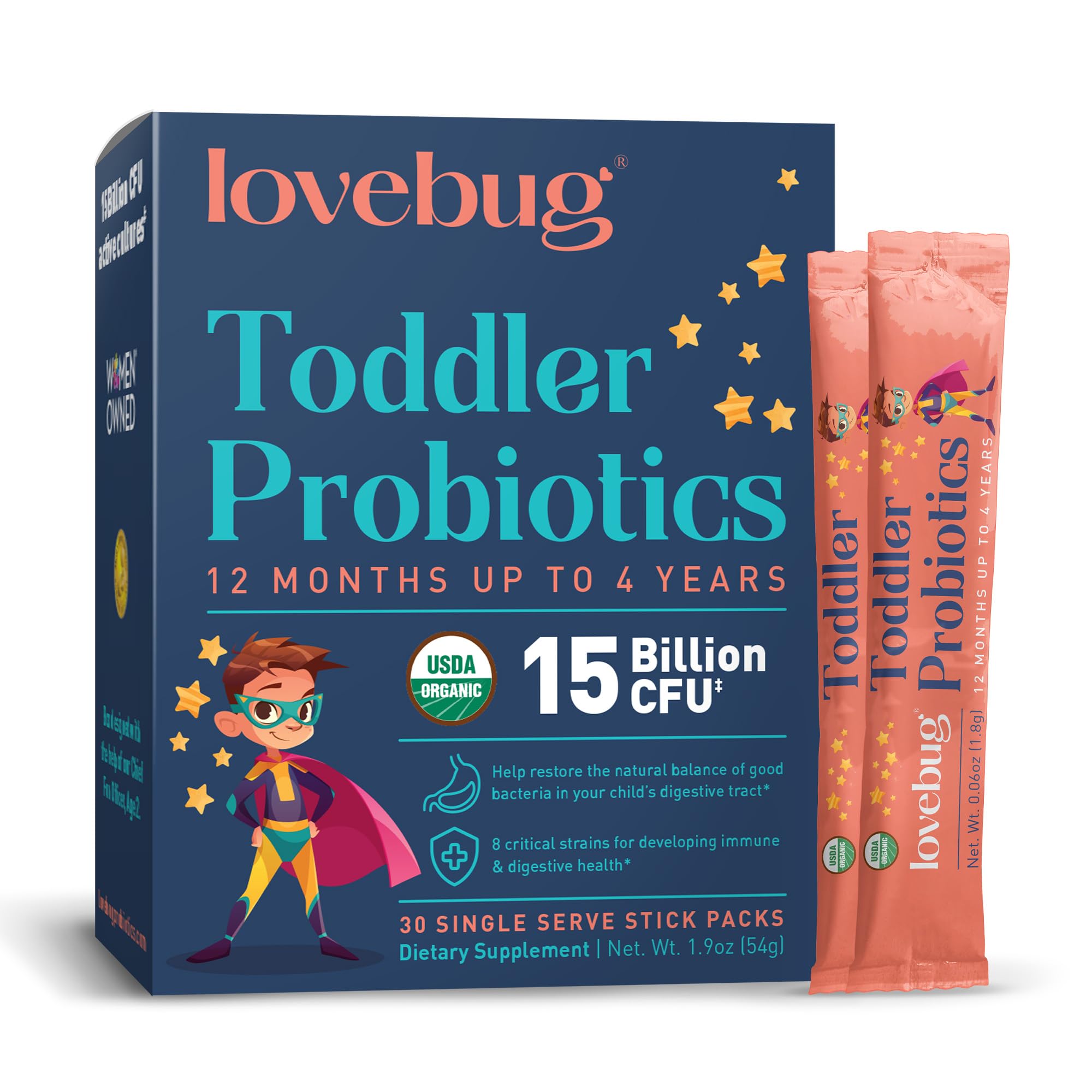
Best for Toddler Constipation
LOVEBUG Toddler Probiotic Powder
Key Features
- Probiotic Strain & CFU: 15B, 8 strains
- Form: Powder packet
- Additives (Fiber/Vitamins): Prebiotic fiber
- Age & Allergens: 1-4; Organic
- Price: Mid-Range
With 15 billion CFU and 8 strains, this powder is built specifically for toddlers ages 1 to 4 – a higher potency than the top-pick chewable. The flavorless formula mixes into almost any drink or soft food without detection, making it ideal for picky eaters. The trade-off: some packets arrive clumpy due to moisture exposure, and the per-serving cost is higher than adult or general kids’ probiotics. Best for families who prioritize organic certification and need a high-CFU solution for constipation and regularity, provided the budget allows for the premium price.
Pros
- High CFU count (15 billion) with multiple strains for comprehensive toddler digestive support
- Flavorless and dissolves quickly – easy to hide in food or drinks
- Extremely effective for constipation relief in toddlers
Cons
- Occasional clumping due to moisture during storage or shipping
- Higher cost per serving compared to many adult probiotics
Buy this if your toddler (1–4 years) needs a high-potency, unflavored probiotic that hides easily in food and targets constipation. Skip it if you’re on a tight budget or need a lower-cost option for older children.
Best for Constipation & Fiber
Culturelle Probiotic + Fiber Packets
Key Features
- Probiotic Strain & CFU: 2.5B LGG
- Form: Powder packet
- Additives (Fiber/Vitamins): 3.5g fiber
- Age & Allergens: 3+; Sugar-free,GF,DF
- Price: Mid-Range
This Culturelle packet combines 2.5 billion CFU of LGG probiotic with 3.5g of fiber — a dual approach missing from the standard chewable option. It targets children struggling with constipation or low-fiber diets and is gentle on even sensitive stomachs. The powder requires thorough mixing into soft foods (like applesauce or yogurt) to limit clumps, and a minority of kids detect a faint taste despite the ‘flavorless’ claim. Parents consistently report effective regularity support without laxatives. At a mid-range price, it simplifies probiotic and fiber intake into one packet, though it’s not for those who want a no-mix chewable or higher CFU.
Pros
- Relieves constipation and promotes regularity for children with digestive issues.
- Adds 3.5g of fiber per packet to support children who need extra dietary fiber.
- Mixes easily into soft foods like applesauce with minimal flavor detection.
Cons
- Powder clumps and doesn’t dissolve fully in liquids; needs thorough stirring.
- Some children detect a mild flavor despite the ‘flavorless’ label.
Buy this if your child has chronic constipation or a low-fiber diet and you want a dual probiotic-fiber packet. Skip it if you need a higher CFU count or a no-mix chewable.
Best for Organic Budget Option
Garden of Life Organic Kids Probiotic
Key Features
- Probiotic Strain & CFU: Multi-strain, 15
- Form: Chewable tablet
- Additives (Fiber/Vitamins): Vitamins C & D
- Age & Allergens: 4+; Organic,Non-GMO
- Price: Budget
The Garden of Life Organic Kids Probiotic is a budget-friendly chewable with 15 strains and added vitamins C and D—a clear advantage over the top pick’s non-organic formulation. Digestive and immune support come from organic ingredients with no artificial additives. The trade-off: the berry-cherry taste is divisive. About one in three children find it unpleasant, so parents of picky eaters should test a small piece first. Best suited for health-conscious families who prioritize organic certifications and don’t mind a mildly tart flavor.
Pros
- USDA Organic and Non-GMO with no artificial additives
- Supports immune health with added vitamins C and D
- Easy for kids to chew and swallow
Cons
- Taste is divisive; many kids dislike the berry-cherry flavor
Buy this if you want an organic, multi-strain probiotic with added vitamins at a low price and your child tolerates a mildly tart flavor.
Best for Organic Gummies
MaryRuth Organics Probiotic Gummies
Key Features
- Probiotic Strain & CFU: 2.5B Bacillus subtilis
- Form: Gummy
- Age & Allergens: 2-13; Organic
- Price: Mid-Range
MaryRuth Organics’ probiotic gummies are USDA Organic and Clean Label Project certified—a distinction the top pick lacks. Kids enjoy the strawberry flavor (96% positive in reviews), and parents appreciate the non-GMO, no-artificial-colors formulation. The 2.5 billion CFU is standard but sufficient for gentle digestive and immune support. However, the per-gummy cost is higher than many competitors, and the CFU count isn’t elevated. This makes it best for families who value organic traceability and clean ingredients over budget or potency.
Pros
- Delicious strawberry taste that kids ask for
- USDA Organic, non-GMO, and free from artificial colors
- Effective for digestive regularity with no reported GI upset
Cons
- Higher per-gummy price compared to other organic options
Buy this if you insist on USDA Organic and Clean Label certification for your child’s probiotic. Skip it if you need a stronger CFU dose or a lower cost per serving.
Best for Budget Gummies
Digestive Advantage Probiotic Gummies
Key Features
- Probiotic Strain & CFU: BC30 Bacillus coagulans
- Form: Gummy
- Age & Allergens: Children; —
- Price: Budget
This 80-count gummy probiotic costs less per serving than any other option in our review, and children consistently enjoy the fruit flavors. Digestive issues like bloating and irregularity often improve with daily use. However, the gummies are coated with added sugar and frequently arrive melted in warm weather – a real concern for buyers in hot climates or during summer. Best suited for budget-focused families whose kids love sweet gummies and who can store the bottle in a cool place.
Pros
- Tastes like candy – kids ask for these gummies and take them without fuss.
- Excellent value – 80 gummies per bottle at the lowest cost per serving.
- Effective for digestive discomfort – reduces bloating and irregularity in many children.
Cons
- Frequently arrive melted in warm weather, forming a single clump.
- Coated with sugar sprinkles – not ideal for low-sugar or cavity-conscious families.
Buy this if your kids need an affordable, great-tasting gummy probiotic and you live in a cool climate or can store the bottle away from heat.
How to Choose
For kids, a probiotic’s CFU count matters less than whether your child will actually take it consistently.
Probiotic Strain and CFU Count
Most effective kid probiotics use Lactobacillus rhamnosus GG (LGG) at 2.5–5 billion CFU, which is sufficient for young children. Higher CFU counts (e.g., 15 billion) are not necessary unless recommended by a pediatrician for specific conditions. Focus on the strain’s clinical backing rather than raw numbers.
Form: Chewable, Powder, or Gummy
Chewable tablets are convenient and portable but may have a chalky taste. Powders are flavorless and mix easily into food, though they can clump if not stirred thoroughly. Gummies are kid-friendly but often contain added sugar and may melt in warm weather. Choose based on your child’s tolerance and your daily routine.
Additional Ingredients
Many probiotics include added fiber, prebiotics, or vitamins like C and D. Fiber aids regularity, while vitamins support the immune system. If your child already takes a multivitamin, avoid overlapping doses. Prebiotic-fiber combos can be helpful for constipation but check the fiber amount per serving.
Age Suitability and Allergens
Always check the age recommendation on the label — some probiotics are formulated for toddlers (1–4 years) while others start at age 3 or 4. Look for allergen labels like gluten-free, dairy-free, or organic if your child has sensitivities. Organic certifications ensure no synthetic pesticides or GMOs.
FAQ
Can kids probiotics cause stomach upset or diarrhea?
For most children, probiotics are gentle, but some may experience mild gas or bloating during the first few days. Starting with half the recommended dose and gradually increasing can help the digestive system adjust. If diarrhea persists for more than a week, consult your pediatrician.
How should I store probiotic gummies to prevent melting in summer?
Keep gummies in a cool, dry place below 77°F (25°C). During hot months, store them in the refrigerator. Avoid leaving them in a hot car or direct sunlight, as heat can cause them to stick together or lose potency.
What’s the difference between chewable and powder probiotics for kids?
Chewable tablets are portable and don’t require mixing, but some children dislike the taste or texture. Powders are flavorless and can be hidden in food or drinks, making them ideal for picky eaters. However, powders need to be stirred thoroughly to avoid clumping and may leave a slight residue.
Do kids probiotics really help with constipation?
Yes, many parents report significant improvement in regularity, especially with strains like L. rhamnosus GG and products that include fiber. The effect is most noticeable in children with chronic constipation or low-fiber diets. For best results, pair the probiotic with increased water and fiber intake.