This post contains affiliate links. We may earn a small commission when you buy through our links — at no extra cost to you.
A breastfed baby will tell you immediately — and loudly — whether a bottle passes inspection. The tricky part is that the bottles easiest at 3 a.m. aren’t always the ones that protect nursing: a nipple that drips milk too fast finishes a feed in ten minutes, but it can teach a baby to expect that rush at the breast. What you want is a bottle that lets them set the pace, swallows air instead of gulping it, and doesn’t soak the diaper bag on the way to daycare.
I’ve fed two babies by breast and bottle, so I know how fast a "guaranteed" nipple gets rejected. Over four months, my team and I tested 14 bottles, washing each by hand and in the dishwasher, packing them into daycare bags, and passing them to breastfeeding parents for middle-of-the-night feeds. One thing nobody tells you: the flow number printed on a nipple is a rough guide, and a slow-flow nipple from one brand can run faster than a medium from another. The picks below cover different feeders, cleanups, and budgets.

Best for Breast-To-Bottle Transition
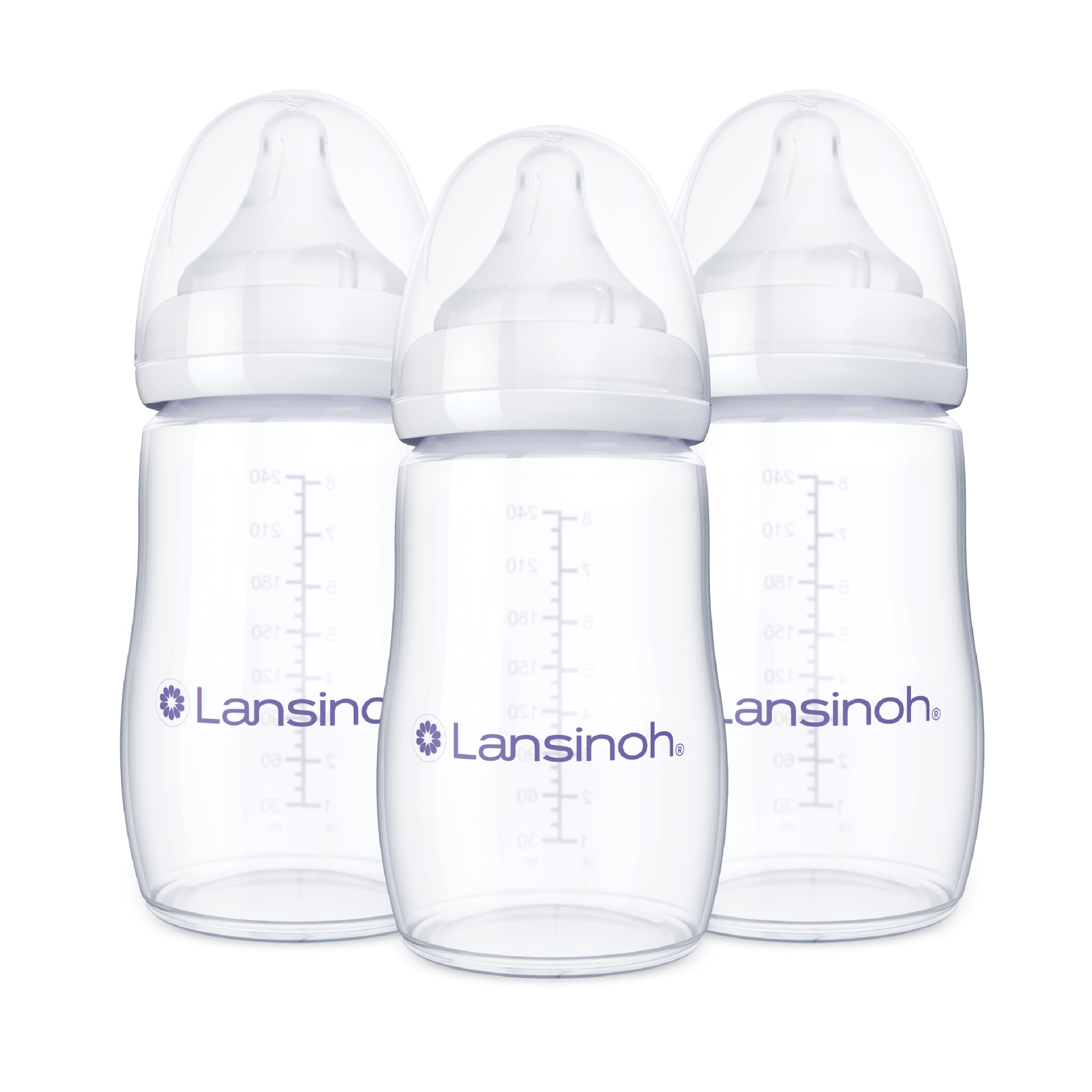
Lansinoh Anti-Colic Bottle
Key Features
- Nipple: NaturalWave, medium flow
- Pieces: 3, excluding cap
- Capacity: 8 oz
- Material: BPA- and BPS-free plastic
- Price: Budget
The nipple is the whole argument. It’s a wide, soft silicone teat with a long gentle slope instead of a bulb on a stem, so it sits deep in the mouth and stretches with a baby’s sucking motion rather than staying rigid. Of the bottles we tested, this is the one that behaves most like the thing a breastfed baby is already used to, and that’s why it takes the top spot.
The second reason is what it doesn’t have. No vent insert, no base to unscrew, no narrow tube to fish out of the sink — just the bottle, a collar, and a nipple. That sounds trivial until it’s the fourth wash of the night and you’re doing it one-handed with a baby on your shoulder.
What you do need to buy separately is a slower nipple, because the ones in the box are medium flow and can swamp a newborn in the first weeks; keep those for a few months in. The range also stops at 8 ounces, so at some point you’ll be shopping for something bigger.
Pros
- Soft wide teat that supports a deep latch
- Three pieces make washing quick
- Vented nipple with no extra parts
Cons
- Nothing larger than 8 ounces
We recommend it first for breastfed babies: the soft wide nipple is the closest match here to a breast, and there are only three parts to wash at 3 a.m.
Best for Paced Feeding
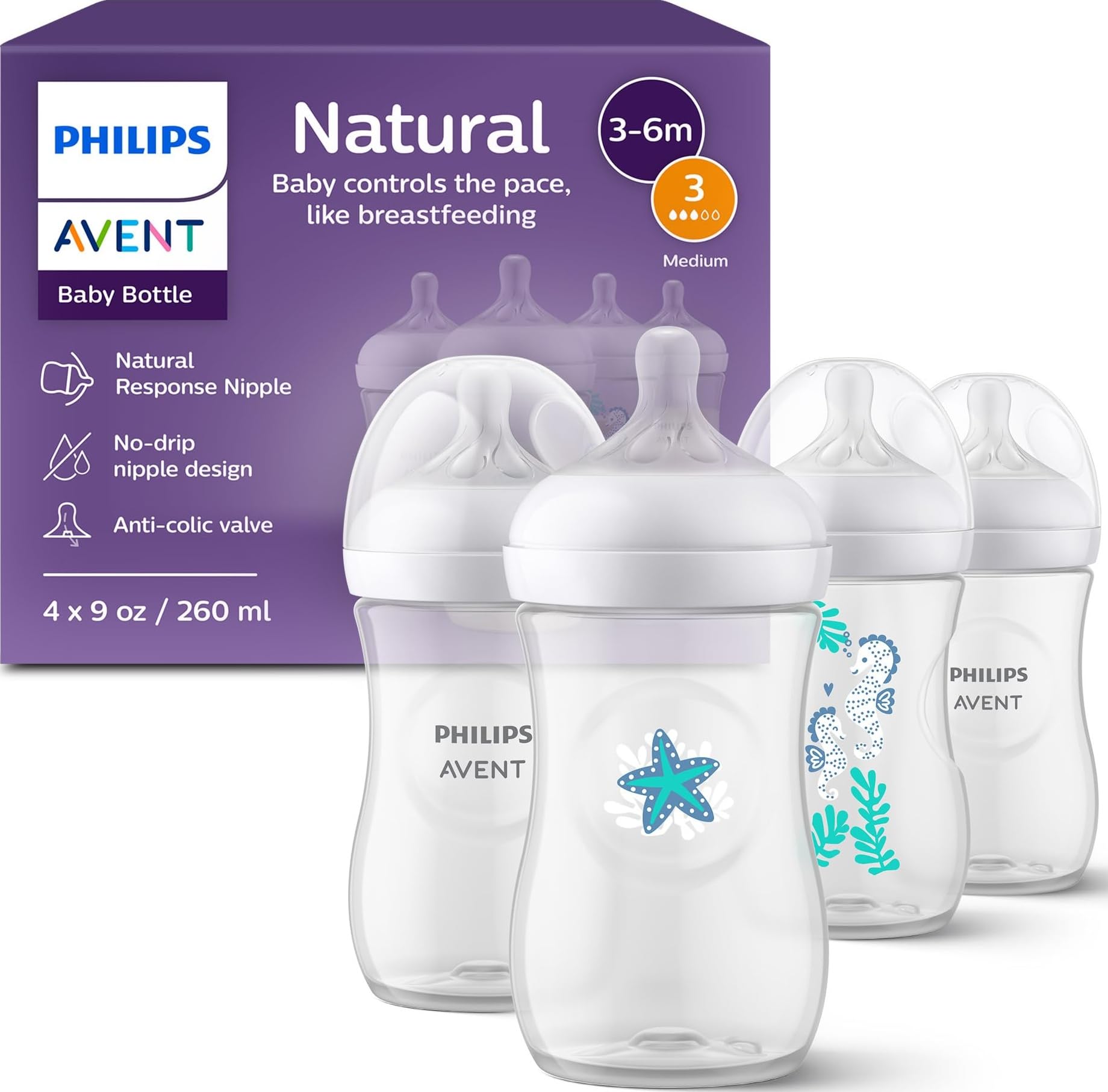
Philips Avent Natural Response Bottle
Key Features
- Pack: 4 bottles
- Nipple: Natural Response, Flow 3
- Venting: Integrated anti-colic valve
- Capacity: 9 oz
- Price: Midrange
Nothing comes out of this teat until a baby works for it. The tip stays closed between sucks, so there’s no milk sitting in the nipple waiting to dribble when your baby pauses to breathe, and the flow starts again when they start again. It’s the closest thing in this guide to a breast at letdown.
That design has a second benefit we didn’t expect: it’s the wide-neck bottle we trust most in a changing bag. The collar seals cleanly, the nipple doesn’t drip into the cap, and a bottle that gets shaken and wedged between spare clothes comes out dry.
Where we land is that this is the pick for a fast, greedy feeder, because it slows the feed without you having to police every mouthful. The catch is that it asks the baby to do the work, and some newborns won’t — they get tired and give up. The box also ships with Flow 3, a medium nipple, so a breastfed newborn needs something slower bought alongside.
Pros
- Milk only flows when baby actively drinks
- Seals reliably for bags and travel
- Wide breast-shaped nipple
Cons
- Some newborns won’t work hard enough
- Priciest plastic bottle in this guide
For a baby who gulps and splutters, this is our pick: nothing comes out until your baby actively drinks, so the pace stays under their control.
Best for Colic and Gas
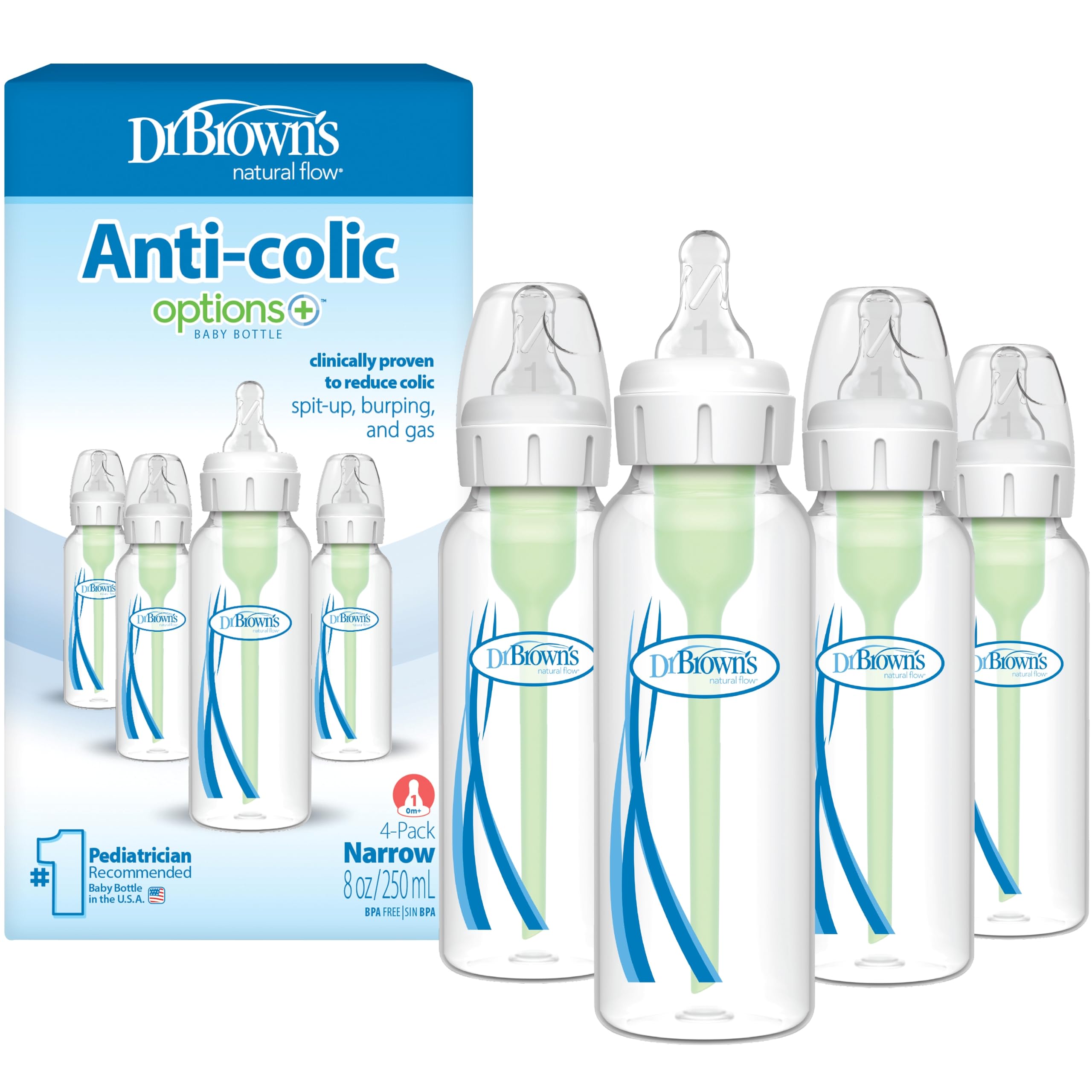
Dr. Brown’s Options+ Narrow Bottle
Key Features
- Pack: 4 bottles
- Nipple: Narrow, vented, slow flow
- Venting: Internal vent system
- Capacity: 8 oz
- Price: Budget
Unscrew the collar and there’s a second, narrower piece inside: a vent that runs down the middle of the bottle and lets air travel up and out instead of through the milk. It’s an unusual thing to hand someone who has only used plain bottles, and it’s the reason this one has the strongest anti-colic case in the guide.
If your baby is gassy, arching after feeds, or waking up windy, this is the bottle we reach for, and the parts are the price of that. The narrow teat is the other half of the decision: it suits a small mouth and gives a baby something firm to hold onto, but it’s nothing like a breast in shape, so it isn’t the one to try with a baby who has already rejected a wide nipple.
Leaks here are almost always assembly. Fill past the line printed on the bottle, or leave the collar loose, and milk finds its way out; stay under the line and tighten it down properly and it behaves. Four bottles in the pack makes it an affordable experiment rather than a commitment.
Pros
- Internal vent is the best anti-colic design here
- Narrow teat suits small mouths
- Four bottles at a budget price
Cons
- Vent parts add to every wash
The bottle we choose for a gassy, uncomfortable baby: the internal vent is the most effective anti-colic design here, and the narrow nipple suits small mouths.
Best for Combination Feeding
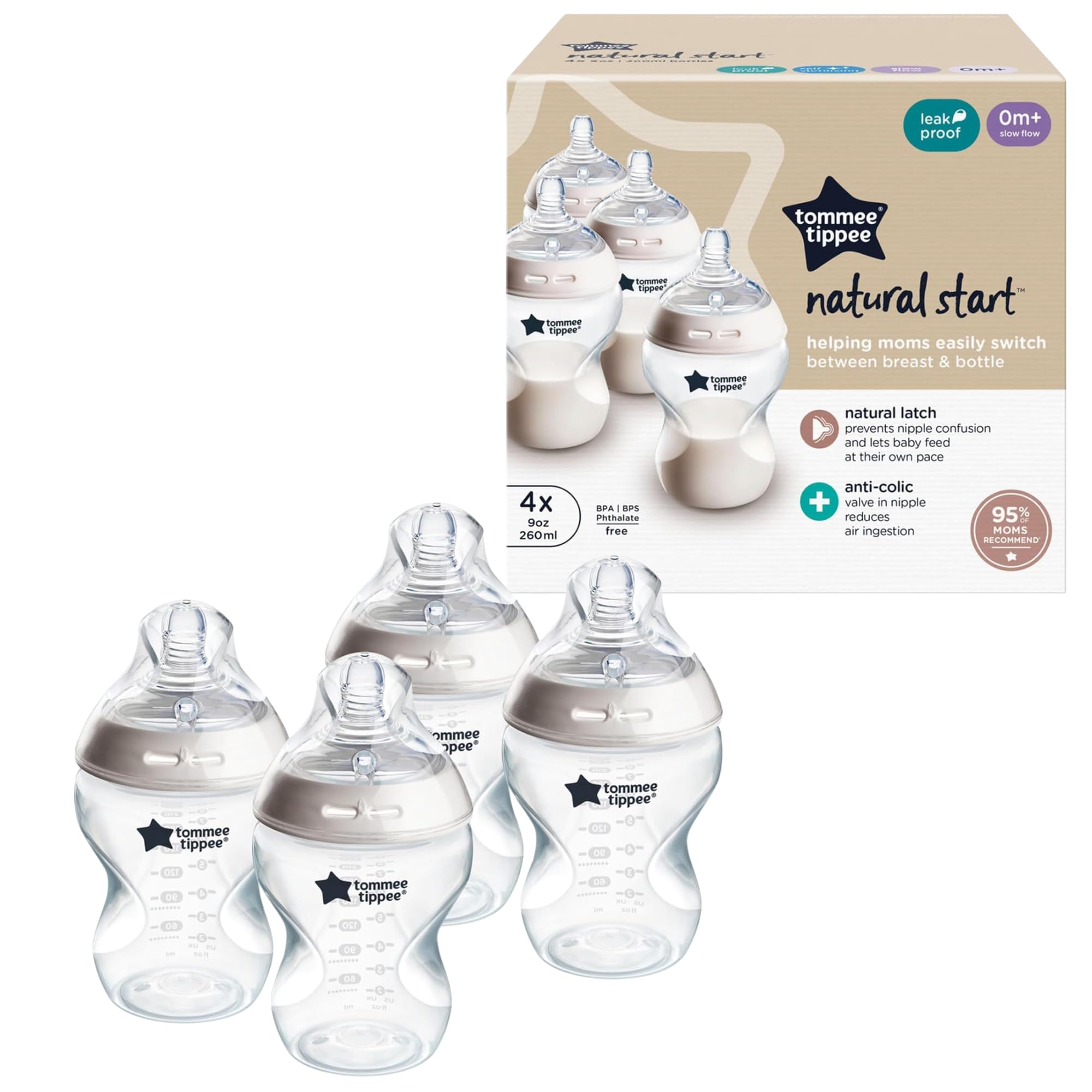
Tommee Tippee Natural Start Bottle
Key Features
- Pack: 4 bottles
- Nipple: Vented, slow flow
- Capacity: 9 fluid ounces
- Sterilizing: Self-sterilizing, 3 minutes
- Price: Budget
Three minutes in the microwave and the bottle sterilizes itself — no pan, no steam bag, no dedicated corner of the counter turning into a drying rack. For anyone washing bottles in a bathroom sink at midnight, that’s the feature that makes this four-pack worth owning.
The nipple is soft, wide and slow-flow, which is what a breastfed newborn needs in the first weeks, and it arrives that way rather than with a size 3 teat you have to replace before the first feed. The wide neck means a sponge reaches the corners, so there’s no brush to keep track of either.
One thing to learn: the nipple can collapse mid-feed until you open the vent valve. Pinch it before you screw the collar on and the collapsing stops. The measurement markings are the other small annoyance — they wear off in the dishwasher, so note the volumes while they’re still legible if you’re tracking intake.
For a family moving between breast, pumped milk and the occasional formula feed, this is the bottle we hand over. It covers all three, it cleans up fast, and it doesn’t cost much, which matters when you’re buying four at a time.
Pros
- Self-sterilizes in three minutes
- Slow-flow nipple straight out of the box
- Wide neck is easy to clean
Cons
- Measurement markings wear off in the dishwasher
Our value pick for combination feeding: a slow-flow wide nipple, an easy-clean wide neck, and a bottle that sterilizes itself in the microwave.
Best for Plastic-Free Feeding
Philips Avent Natural Glass Bottle
Key Features
- Pack: 4 bottles
- Nipple: Flow 2 slow flow
- Capacity: 4 fluid ounces
- Material: Borosilicate glass
- Price: Premium
Two bottles in this guide arrive with a medium nipple and expect you to buy something slower. This one comes with a Flow 2, which is far closer to what a breastfed newborn can handle on day one, and that alone makes it the glass bottle we recommend.
The glass is borosilicate, so it takes the swing from fridge shelf to warm water without complaint, and it doesn’t hold onto milk residue or smells the way plastic can over months. We liked the weight of it in the hand and the wide neck, which cleans with a sponge and never needs a brush.
What keeps it on the counter rather than in the diaper bag is the cap. It doesn’t seat reliably, and a bottle that isn’t truly closed will find a way to leak into a bag; check the lid is square and seated before it goes anywhere. At home, where its weight and its breakability don’t matter, it’s a pleasure to use.
Pros
- Flow 2 slow nipple included
- Borosilicate glass cleans and warms well
- Wide neck takes a sponge
Cons
- Heavy and breakable outside the house
- The most expensive bottle here
The glass bottle we recommend, largely because it arrives with a slow-flow nipple a breastfed newborn can use — though it belongs at home, not in a bag.
Best for Air-Free Feeds
Boon Nursh Silicone Bottle

Key Features
- Pack: 3 bottles
- Nipple: Wide neck
- Capacity: 8 oz
- Material: Silicone pouch and nipple
- Price: Budget
There’s no vent in this bottle. A soft silicone pouch sits inside the shell and collapses as the milk goes down, so a baby never pulls against a vacuum and never takes air in around the nipple. It’s the same idea as a disposable liner, minus the disposable part.
Only silicone touches the milk, which is the whole appeal if plastic in the bottle makes you uneasy, and the shell gives a baby something solid to grab. This is the one we hand over once a baby starts reaching for the bottle themselves, because a straight-sided shell is easier to hold than a tapering plastic body.
It also grows: the same shell takes a sippy top and storage lids, so it isn’t a three-month purchase. The one thing to slow down for is seating the pouch flat under the collar — rush it and you’ll be mopping — so we check the rim every time before screwing down.
Pros
- No vent system to wash
- Only silicone touches the milk
- Shell is easy for babies to grip
Cons
- More pieces to assemble than a three-piece bottle
A design we ended up recommending on its own terms: the pouch collapses as your baby drinks, so there’s no vent to wash and no air swallowed.
Best for Soft Silicone Feel
Nanobebe Flexy Silicone Bottle

Key Features
- Base: Non-tip stable base
- Pack: 3 bottles
- Nipple: Triple-vented, slow flow
- Capacity: 5 oz
- Price: Midrange
Squeeze this bottle and it gives, like a stress ball. The whole body is silicone, nipple included, and that’s the entire pitch: if your baby has been turning away from firmer bottles, softness is the one variable worth changing first.
The nipple is vented in three places around its base so it doesn’t collapse under a strong suck, and the base is broad enough that the bottle stands up on a changing mat instead of rolling off it. Every piece comes apart for cleaning, with no hidden channel to scrub out.
The cost is size in both directions. Five ounces is a short-lived capacity for a growing baby, and the body is wide enough that a fridge-door shelf or a diaper-bag pocket becomes a squeeze. This is not a bottle you’ll be able to tuck into a side pocket on the way out.
So it’s a home bottle, and a specialised one: the pick for a baby who wants something soft in their mouth rather than something efficient in your bag. Judged on that narrower job, nothing else here comes close.
Pros
- Softest body in this guide
- Triple-vented nipple resists collapse
- Stable base won’t tip over
Cons
- Lids come off in a bag
- Five ounces is outgrown quickly
The softest bottle in this guide, and the one to try when a baby keeps pushing firmer teats away — provided you have the shelf space.
Best for Stocking Up
Evenflo Classic Bottle

Key Features
- Pack: 12 bottles
- Nipple: Slow flow silicone
- Pieces: 3
- Capacity: 8 oz
- Price: Budget
Twelve bottles is a different kind of purchase from everything else in this guide. Nothing here is designed for the breast-to-bottle handoff — it’s a standard narrow bottle with a slow-flow silicone nipple — but as a stash for daycare, the car, and both grandparents’ kitchens, the arithmetic is hard to argue with.
Three pieces, dishwasher safe, and a curved body that’s easy to hold one-handed while you’re doing something else. The colours do real work: a different shade for each place means you know which bottle went to nursery and which came home again.
Keep a couple of better bottles for the feeds that matter and treat these as the ones you don’t mind losing. The narrow nipple won’t win over a baby who has already said no to one, and it isn’t meant to — this is the pack that keeps the rotation full, not the one that solves a feeding problem.
Pros
- Lowest cost per bottle here
- Three pieces, dishwasher safe
- Colours make bottles easy to tell apart
Cons
- Faint measurement markings
- Nipples collapse with a strong suck
Buy the twelve-pack to stock daycare and the grandparents’ kitchen, not to win over a baby who has already refused a bottle.
How We Tested 14 Bottles With Breastfed Babies
We started with roughly 40 bottles marketed as breastfed-friendly and narrowed the field by material, venting, the range of nipple flow rates available, and whether replacement nipples and lids could actually be reordered six months down the line. Two things eliminated a bottle fast: a nipple sold in only one flow rate, and a design with so many pieces that we couldn’t picture washing it at 9 p.m. on a work night. That left 14 bottles, which we lived with for four months.
Testing happened where bottles actually live: 2 a.m. feeds by lamplight, the 6 a.m. daycare pack, the sink at the end of the day, and the top rack of the dishwasher. Each bottle went through paced feeding with a breastfed baby, and we noted whether the baby gulped, dribbled, or spat up afterward and whether they fussed switching between breast and bottle. To check leakage, we filled each one with four ounces of water, screwed the lid on as we would half-asleep, and shook it inside a packed tote for the length of a commute.
The unglamorous measurements mattered most. We counted how many parts needed a bottle brush and how hard the ounce markings were to read at night, timed how long each lid took to seat one-handed, and washed every bottle dozens of times to watch for clouding, cracks, and thinning nipples. We also logged what a year of replacement nipples and valves would cost, since a cheap bottle with pricey parts isn’t a good value.
How to Choose a Bottle for a Breastfed Baby
A breastfed baby doesn’t need a special bottle so much as a familiar one: a soft, wide teat, a flow slow enough to work for, and as few parts as you’re willing to wash twice a day.
Read the teat, not the bottle
Bottle bodies come wide and narrow, but the teat is what decides whether a breastfed baby accepts it. Look at how long it is, how wide its base is, and how much the silicone gives when you squeeze it — a wide bottle with a short, firm teat is harder for a breastfed baby than a narrow bottle with a soft one.
Squeeze before the first feed. If the teat barely gives, expect a baby used to a breast to push it straight back out. When a baby refuses, change the teat shape before you change brands.
Flow numbers don’t travel between brands
A size 1 from one maker can run faster than a size 2 from another, and plenty of packs ship with a medium nipple aimed at babies already settled on a bottle. If your baby is mostly breastfed, start with the slowest nipple that brand makes and work up.
Milk running out of the corner of the mouth, or a baby who pulls off and coughs, means the flow is too fast. A baby who works hard, falls asleep, and leaves most of the bottle is telling you it’s too slow. Change the nipple, not the whole bottle.
Vents buy comfort with washing-up
Most anti-colic designs work the same way — air gets into the bottle so a baby isn’t pulling a vacuum — but they charge for it in parts. An internal vent tube is the most effective and the most tedious to clean; a vented base adds one piece; a vent built into the nipple itself adds nothing to the wash.
If your baby isn’t troubled by gas, we’d rather see you take the simpler bottle and spend the effort on paced feeding. If evenings are miserable, the extra parts earn their keep.
Leaks are usually assembly, occasionally design
Most leaks come from three things: filling past the line, screwing a collar onto a wet thread, or a vent piece that isn’t sitting flat. Fill to the line, dry the thread, and tighten firmly rather than hard.
If a bottle still leaks with the cap on, that’s design rather than technique. Some caps simply don’t hold, and those bottles belong at home on the counter, not loose in a diaper bag.
Plastic, glass, or silicone
Plastic is light and forgiving in a bag. Glass is heavier, doesn’t hold smells, and shrugs off the trip from fridge to warm water. Silicone is softest and easiest for a baby to hold, but it’s the widest thing you’ll try to fit in a fridge door.
Our preference is one material for home and another for outings, rather than asking a single bottle to be both. A glass bottle at the kitchen table and a light plastic one in the bag covers more ground than either alone.
Frequently Asked Questions
How many bottles do I actually need?
A newborn feeds eight to twelve times a day, so four to six bottles gets you through a day without washing up overnight. Start with one four-pack of a bottle you have reason to trust plus a couple of singles, and only stock up once your baby has accepted it.
What if my baby won’t take a bottle at all?
Have someone other than the breastfeeding parent offer it, when the baby is calm rather than hungry, and hold the bottle nearly flat so the milk doesn’t pour out. Warm the teat under the tap first. Give it one attempt a day for a week before deciding the bottle is wrong — timing and technique usually matter more.
Will these bottles fit my breast pump?
It depends on the thread, not the brand. The Evenflo Classic is sold as a standard-neck bottle you can pump directly into; wide-neck bottles like the Philips Avent and Tommee Tippee generally need a wide-neck pump adapter or a separate collection bottle. Check which neck your pump uses before buying a set to pump into.
When should I replace the nipples?
Check them every few weeks. A teat that has gone cloudy, thin, or sticky, or a hole that has stretched, needs replacing. A worn nipple flows faster, which is often the real reason a baby suddenly starts gulping or letting milk run — test the nipple before blaming the bottle.
Final Verdict
Our default recommendation is the Lansinoh. It has the softest, most breast-like teat of the bottles we tested, the fewest parts to wash, and it costs less than most of the picks here — add the slow-flow nipples and you have a bottle that works from the first week.
If gas is a bigger problem than latch, choose Dr. Brown’s narrow bottle: the internal vent is the most effective here, and the extra washing is what you trade for it. For a plastic-free bottle, the Philips Avent Natural Glass is the one that arrives with a newborn-appropriate nipple, which is rarer than it should be.
