This post contains affiliate links. We may earn a small commission when you buy through our links — at no extra cost to you.
Jarred baby food is a small convenience with a big job: it has to be quick enough for a screaming baby, varied enough that you don’t serve the same orange puree for a week, and made from ingredients you can pronounce. The catch is you can’t know any of that from the label—a jar can look wholesome and still taste flat or leave half its contents on the spoon. I’ve spooned plenty of rejects into the sink, and I’ve found a few jars worth keeping in the diaper bag.
For three months, we put 16 jars through meals: breakfast in the high chair, lunch at my mother’s table, dinner from the bag on a late errand. We tasted every one, watched how babies reacted to texture and flavor, and read the ingredient lists line by line. We noted if a jar was one meal or two, checked best-by dates, and tracked how each one sat the next day. The jars that earned a spot weren’t always the cheapest or smoothest; they disappeared from the bowl and got bought again.


Best for Everyday Full Portions
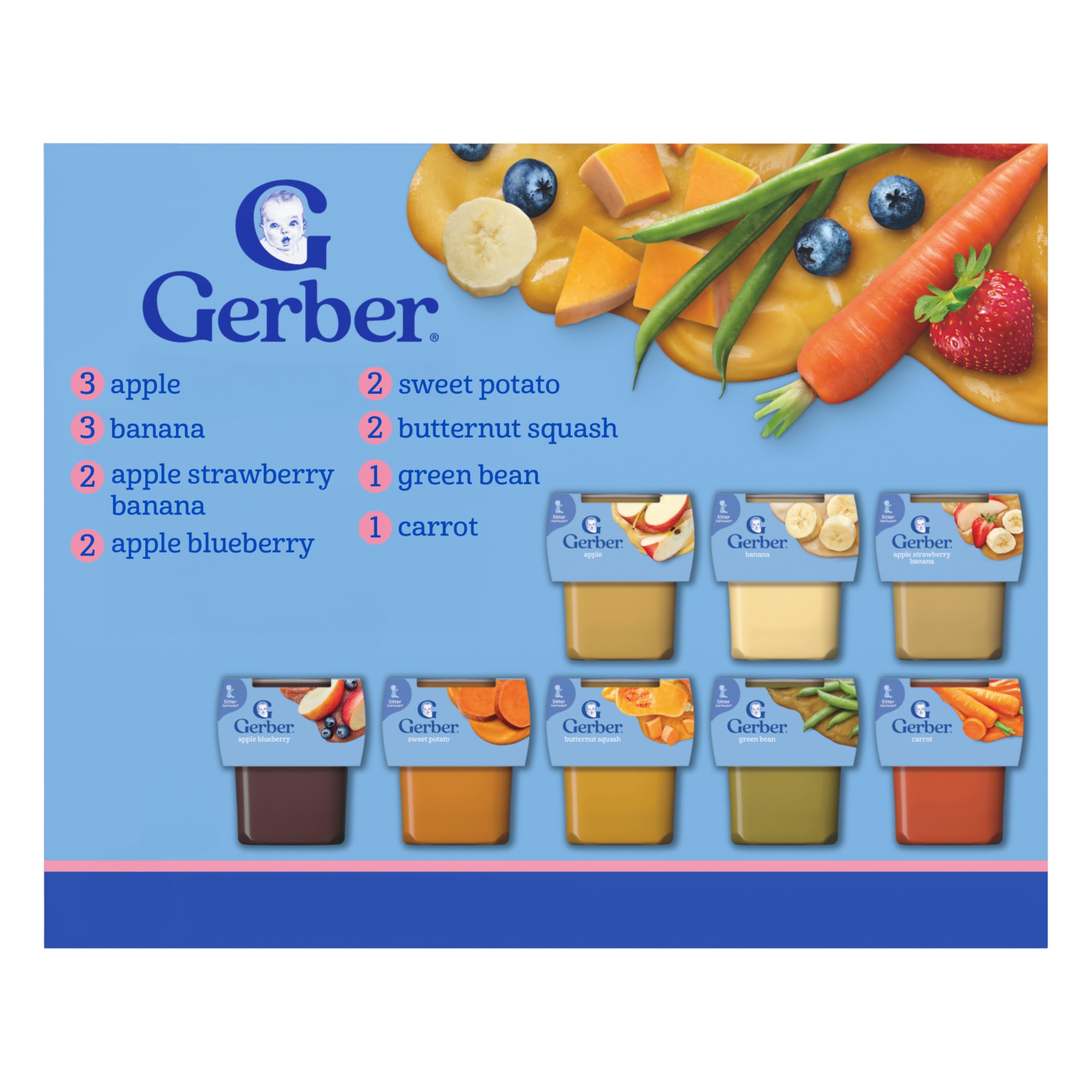
Gerber Stage 2 Variety Pack
Key Features
- Stage: Stage 2
- Flavors: 8 varieties
- Serving size: 4 oz
- Tubs per box: 32
- Price: Budget
Thirty-two tubs, eight flavors, and the lowest price tier in this group: that’s the case for making this box your default once your baby is eating full portions. Each tub holds 4 ounces, which is a meal rather than a taste, and the range runs from plain apple and banana through apple blueberry and apple strawberry banana to sweet potato. The pack size is the underrated part — you find out which flavors your baby actually finishes without committing to a case of one.
Stage 2 is the other half of the pitch. The puree is smooth without being watery, built for a baby who has already handled thin single-ingredient food and is ready for blends. The tubs stack in a cupboard and need no refrigeration until they’re open, which matters when the fridge is already full of milk. We spoon out what’s being eaten and decant the rest into a small lidded container, because these arrive with a single-use foil seal and no plastic lid. Not a dealbreaker, but plan for it on day one if your baby rarely finishes four ounces in one go.
What keeps it from being perfect is the blend list. Apple appears in three of the eight, and the vegetable side is thin — sweet potato carries most of it while the rest leans fruit. If you’re working on greens, this box won’t do that job on its own; pair it with a spinach or green-vegetable pouch and the week is covered. For plain usefulness across a week of meals, nothing here beats it.
Pros
- Eight flavors in a single box
- 4-ounce tubs suit a full meal
- Lowest price tier of the picks here
- Smooth stage 2 texture for blend-ready eaters
Cons
- Fruit-heavy mix; thin on vegetable blends
We recommend this box for babies eating full portions: eight flavors, 4-ounce tubs, and the lowest price tier here make it our everyday default.
Best for First Solids
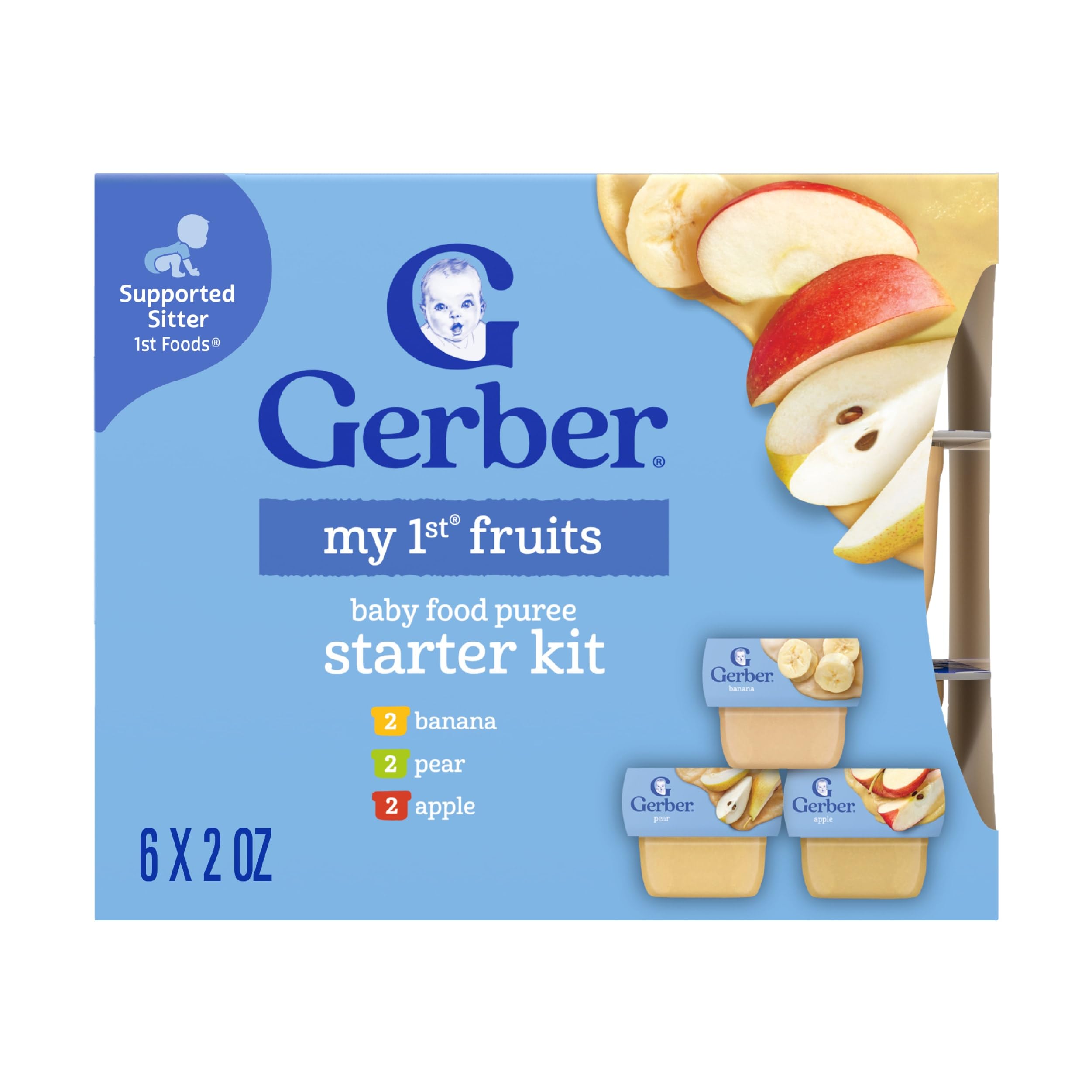
Gerber Stage 1 My 1st Fruits
Key Features
- Stage: Stage 1
- Fruits: Banana, pear, apple
- Serving size: 2 oz
- Tubs per box: 12
- Price: Budget
The first weeks of solids are mostly ceremony: three spoons of puree, a grimace, a decision. A 2-ounce tub is built exactly for that, and this box gives you twelve across banana, pear, and apple — three single fruits, so if something disagrees with your baby you know precisely which one it was.
We reach for this pack at the start, and the texture is the reason. It’s thin, closer to applesauce than to the denser stage 2 blends, which is what a baby still learning to move food off a spoon can actually handle. Keeping each flavor single also turns the box into an elimination test: introduce one, wait a few days, move on. And because the tubs are small, a rejected flavor costs you two ounces instead of four.
The arithmetic changes fast. By the time your baby is finishing a tub and looking for more, you’re opening two or three at a sitting and this box stops making sense beside the 4-ounce packs. That’s the nature of a stage 1 product rather than a fault, and twelve tubs is about the right amount for the window. Buy it for the beginning, then move up a stage.
Pros
- Single-fruit tubs make reactions easy to trace
- Thin, applesauce-like texture for first spoons
- Small tubs limit how much is wasted
Cons
- Stops fitting once portions grow
If your baby is sitting with help and tasting solids for the first time, we hand you this box: three single fruits, 2-ounce tubs, nothing wasted.
Best for Organic Pouches
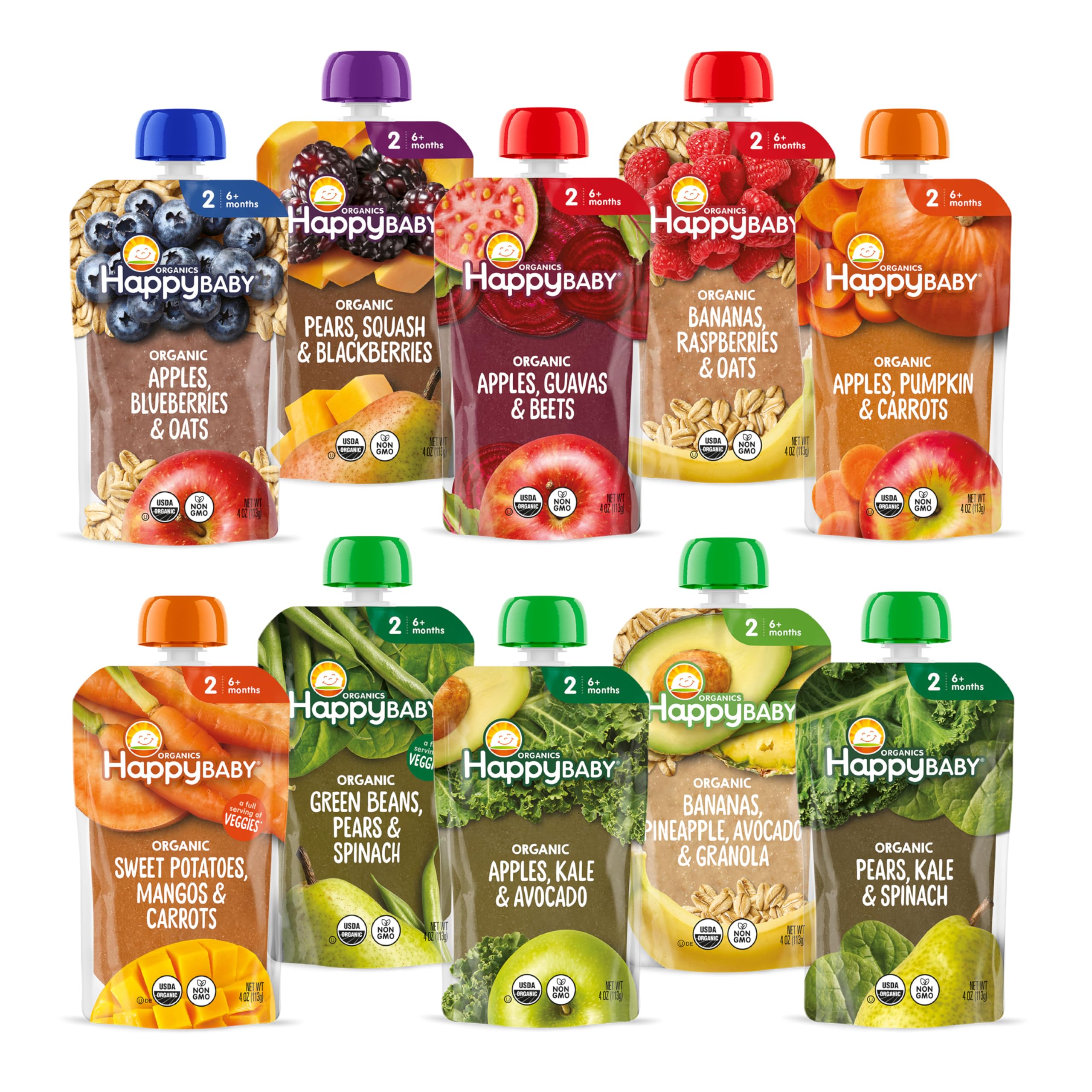
Happy Baby Clearly Crafted Pouches
Key Features
- Stage: Stage 2
- Serving size: 4 oz
- Certification: USDA Organic
- Pouches per box: 10
- Price: Premium
You can see the puree through the film on these pouches, and that transparency is the whole idea: no guessing what’s inside. Happy Baby certifies the line USDA organic and makes it with non-GMO ingredients, and the blends stay short — fruit and vegetables in simple balances rather than a long ingredient paragraph. For a parent reading every label for the first time, the pack answers the question before you turn it over.
The pouch format earns its place in the diaper bag rather than at the high chair. Screw cap, no spoon, one hand — a baby who can hold it feeds themselves in a stroller, and there’s nothing to spill when it gets dropped. We keep a couple in the car for the days when a meal happens somewhere unexpected, and the clear window means we can see whether the texture is right for the baby before opening it.
The trade is cost, and it’s the steepest format here. You’re paying for organic certification and the packaging rather than volume, and ten 4-ounce pouches disappear quickly in a household that actually uses them. Buy them for travel and for the organic requirement; buy tubs for the meals at home and keep a couple of these for the bag.
Pros
- Certified USDA organic, non-GMO ingredients
- Clear packaging shows the puree
- Screw cap survives the diaper bag
- Simple fruit-and-vegetable blends
Cons
- Premium price for the format
- Spout is hard work for younger babies
For organic-only shopping and a pouch that lives in the diaper bag, these earn their premium: certified organic, see-through, and capped.
Best for Protein and Savory
Serenity Kids Organic Pouches
Key Features
- Protein: 5 g per pouch
- Serving size: 3.5 oz
- Certification: USDA Organic
- Pouches per box: 8
- Price: Premium
Five grams of protein in a 3.5-ounce pouch is the number that separates this one. Most of the purees here are fruit and vegetables; Serenity Kids puts grass-fed beef or wild-caught salmon in the blend and pairs it with sweet potato, spinach, or butternut squash. Nothing is sweetened, so the flavor is savory by design — the point is a palate that doesn’t expect everything to taste like apple.
Babies divide on them. The beef and vegetable blends go down more easily than the salmon, which is the one likely to come back at you on the first spoon. Our approach with a refusal is to keep offering it alongside something familiar rather than writing it off, because the savory flavors are the ones worth the persistence. One warning from the high chair: the orange vegetable base stains, and it leaves cloth bibs yellow.
Where that leaves this pouch is as a complement rather than the whole diet. We treat it as the protein slot in a day otherwise built on fruit and vegetable purees, one pouch alongside the usual food rather than a case of it. If your baby is past six months and eating mostly fruit, this is the most direct fix on the list, and you pay accordingly.
Pros
- 5 g of protein in every pouch
- Organic with no added sweeteners
- Savory blends widen a fruit-heavy diet
Cons
- Highest cost per pouch here
- Orange vegetable blends stain cloth
We keep these for the protein: 5 grams a pouch from beef or salmon, organic, and savory enough to keep a fruit habit from taking over.
Best for Toddler Self-Feeding
Beech-Nut Stage 4 Pouches
Key Features
- Stage: Stage 4
- Serving size: 3.5 oz
- Certification: Non-GMO
- Pouches per box: 18
- Price: Midrange
Somewhere around the first birthday, eating stops being something you do to a baby and becomes something a toddler does while walking. These 3.5-ounce pouches are built for that stage: squeezable, easy for small hands, and blended thick enough that they don’t pour out when waved. The 18-pack splits into three blends, including one with apple, yogurt, raspberry, purple carrot, and oat, and one with apple, blueberry, and spinach.
What we like is that these carry more than fruit. Yogurt, oats, spinach, and purple carrot show up in the ingredient list, and the box is built around protein and fiber, iron and zinc, which is more than most toddler snack packs promise. For a toddler who has decided vegetables are a conspiracy, a pouch that slips spinach and oats in at snack time is doing quiet work. No food dyes, non-GMO, and free of nuts and soy — the last matters if you’re reading labels for an allergy.
The yogurt blend is the one to introduce carefully: it tastes noticeably tangier than the apple and blueberry packs, and a toddler expecting sweetness may hand it back. Offer it first, before the sweeter blends have set expectations, and it usually lands. After that this is the pouch we pass over without a second thought.
Pros
- Built around protein, fiber, iron, and zinc
- Yogurt, oats, and spinach in the blends
- No food dyes; free of nuts and soy
- Squeezable pack a toddler can hold
Cons
- Only three blends across 18 pouches
Once your toddler wants to hold the pouch themselves, this is the box we buy: three blends with yogurt, oats, and spinach, and no food dyes.
Best for Single-Ingredient Trials
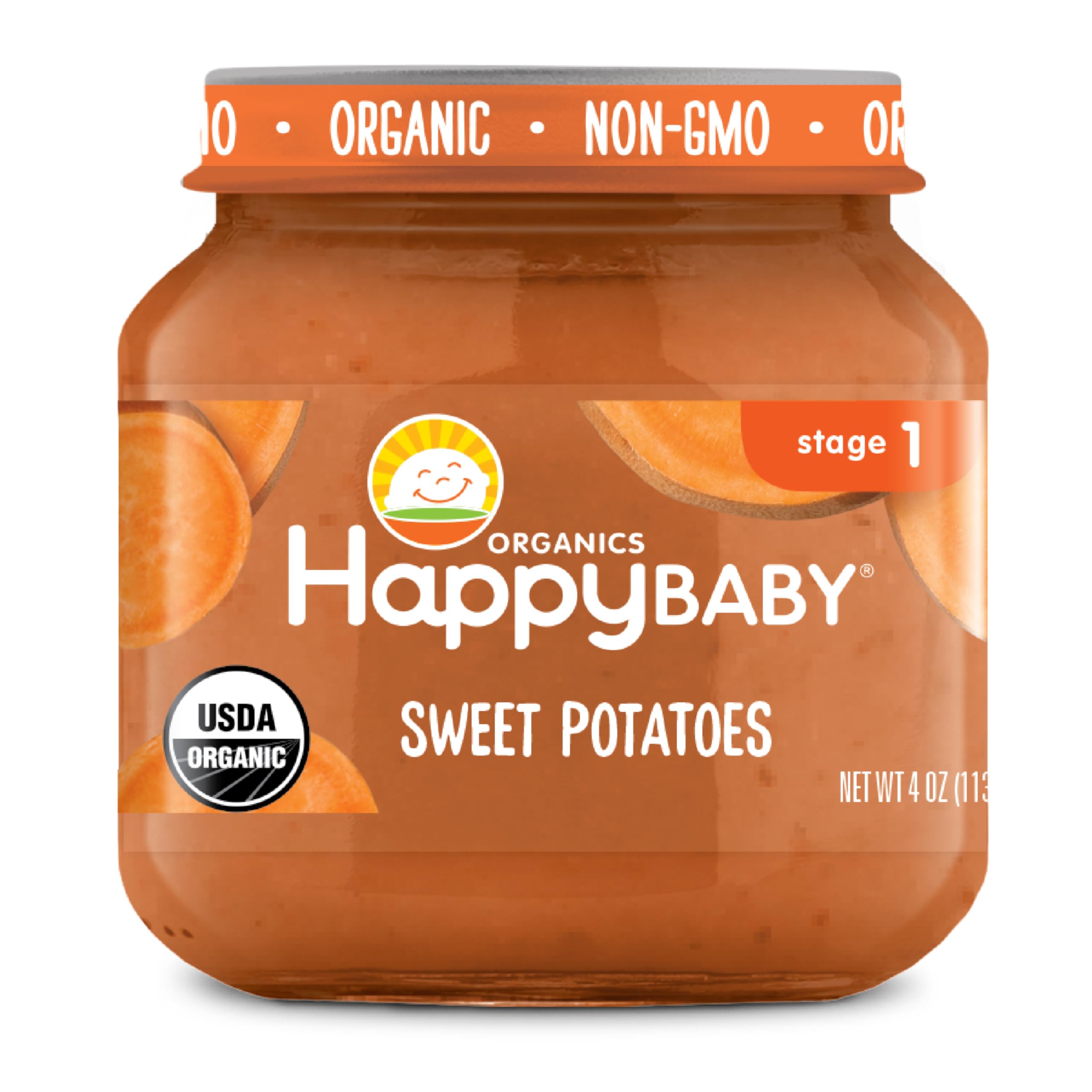
Happy Baby Organic Sweet Potatoes
Key Features
- Pack: Single jar
- Stage: Stage 1
- Serving size: 4 oz
- Certification: Organic
- Price: Midrange
One jar, one ingredient, 4 ounces: that’s the whole proposition. If you want to introduce sweet potato and find out whether your baby reacts to it, buying a single organic jar beats committing to twelve, and it beats standing at the stove to make a portion the size of your thumb.
Sweet potato is also the friendliest first vegetable for most babies — naturally sweet, smooth, and easy to loosen with breast milk or formula if it comes out thicker than your baby likes. Happy Baby’s version is certified organic and the ingredient list stops at the vegetable, which is exactly what you want when you’re reading labels for the first time.
Where it stops being useful is as a pantry item. One jar is one meal, so a baby who loves sweet potato means a reorder every week, and you’re paying single-jar money instead of case money. We treat it as the trial run — one vegetable, one jar, no commitment — and switch to the case packs once we know it’s a favorite.
Pros
- One ingredient, easy to trace a reaction
- Certified organic
- Buy a single jar instead of a case
Cons
- Costly as a staple; one jar at a time
For a first taste of sweet potato or a reaction check, this single organic jar is the sensible buy; as a pantry staple it costs too much.
How We Tested Jarred Baby Food
We started by scanning store shelves and online listings, then narrowed the field to 16 jars that covered single-ingredient purees, mixed vegetable and fruit blends, and heartier meat-and-vegetable combinations. We filtered out anything with added sugar or salt and made sure the shortlist spanned a range of jar sizes and price per ounce, since a tiny stage-one jar and a larger stage-two jar solve different feeding problems. Testing ran for three months, with jars rotating through breakfast at the high chair, lunch at my mother’s table, and dinner from the diaper bag on late errands.
At the high chair, we spooned each jar into a bowl, tasted a bite ourselves at room temperature, then watched for the first reaction: a lunge for the spoon, a grimace, or the telltale tongue push. We noted whether the texture was silky or gluey, whether the flavor tasted like the vegetable on the label or just sweet, and whether the color and smell matched what we expected. We also read every ingredient list and compared the first three ingredients, because a jar that leads with apple puree tastes different from one that leads with carrot.
We tracked practical things, too: a kitchen scale gave us price per ounce, and we counted how many spoonfuls a jar yielded at a typical feeding—some were a full meal, others barely a snack. Opened jars went into the fridge for two days to see how they held up, and unopened jars sat in the pantry so we could check best-by dates and packaging. We kept a diaper log for the next day to see whether anything seemed to sit heavily or cause a change in routine. At the end, we asked whether we’d buy it again with our own money, which is the test most jars fail.
How to Choose Jarred Baby Food
The right jar comes down to less than the shelf suggests: the stage your baby is ready for, how much of a container gets eaten at one sitting, and whether you need a spoon or a spout.
Match the stage to the mouth, not the birthday
Stage numbers describe texture and experience rather than a precise age. Stage 1 is thin, single-ingredient puree for a baby who can sit with help and is just learning to swallow. Stage 2 is smooth blends for a baby who has that down. Stage 4, the toddler pouches, is thicker food designed to be self-fed. A baby who has never taken a spoon will struggle with a thick blend, and a nine-month-old will be bored by two ounces of single pear.
Our advice is to buy small at each transition. The 2-ounce Gerber tubs make sense for the first month and stop making sense almost immediately after that; the 4-ounce stage 2 tubs become the workhorse the moment a full portion is realistic.
Tub, jar, or pouch
A tub means a spoon, and a spoon means you control the amount, see the texture, and can tell when your baby has had enough. A pouch means a spout, which is faster, cleaner in a stroller, and lets a baby feed themselves. Neither is better; they answer different parts of the day, and most households end up with both.
The trap is resealability. The tubs here arrive with a one-time foil seal and no lid, so a half-eaten tub needs decanting into your own container or a compatible lid you buy separately. Pouches reclose with a cap and can live in a bag for weeks. If your baby rarely finishes a tub, keep pouches for outings and decant tubs at home.
Portion size decides more than you think
Purees here run from 2 ounces to 4 ounces, and that gap matters more than it sounds. A beginner eats a few spoons; a baby well into stage 2 can finish 4 ounces and look for more. Buy the big tubs too early and you throw food away; buy the small ones too late and you’re opening three at a meal.
Size the pack against your baby’s appetite rather than the case price. The cheapest way to buy food that ends up scraped into the bin is not cheap at all.
Read the ingredient line, then the claims
Single-ingredient jars do one job well: they let you introduce one food and watch for a reaction. Blends are for babies who have already met the individual ingredients. Beyond that, the useful distinctions are whether the pack carries added sweeteners or salt, and whether the vegetable content is real, because an apple-first vegetable blend is mostly apple.
Organic certification is worth paying for if it matters to you, but it isn’t a nutrition claim on its own. A mid-priced pouch with yogurt, oats, and spinach can deliver more useful variety than a premium organic fruit puree.
Check dates and seals when the box lands
Shelf-stable isn’t the same as indefinitely good. Case packs can sit in a warehouse before they reach your door, so the date stamp on the tub is the one worth reading the day the box arrives, while you still have the whole return window in front of you.
Check seals at the same time. A foil lid that has lifted, a dented rim, or a pouch that looks swollen is a container to throw out rather than feed. That’s the one thing about case packs worth a minute of your attention.
Frequently Asked Questions
Do I need to refrigerate jarred baby food?
Not before it’s opened. Sealed jars, tubs, and pouches are shelf-stable and belong in the cupboard, where they keep until the date on the pack. Once a container is open, refrigerate what’s left and use it within a day or two, with your pack’s label as the authority because brands differ.
If you decant into your own container, write the date on it. And don’t put a jar back in the fridge after your baby has eaten straight from it.
Can my baby eat straight from the pouch?
Yes, and that’s exactly why pouches earn their place on the go. The catch is saliva: once your baby’s mouth has been on the spout, the rest shouldn’t be saved for later.
If you’re not confident a pouch will be finished in one sitting, squeeze it onto a spoon and keep the straight-from-pouch method for snacks you know will disappear.
Is jarred baby food as nutritious as homemade?
Close enough that convenience usually wins. Commercial purees are cooked and heat-processed so they can sit on a shelf, which costs some heat-sensitive vitamins, but the bigger variables are what’s in the container: no added salt or sugar, real vegetables rather than mostly juice, and enough iron for a baby past six months.
A fruit puree on its own is thin on iron, which is why a savory meat-and-vegetable pouch is worth working into the rotation.
Final Verdict
For most families the box to buy is Gerber’s stage 2 variety pack: 4-ounce tubs, eight flavors, and the lowest price tier here. It covers everyday meals without waste and gives a baby enough choice to develop a preference.
Change the answer in two cases. If your baby is only now starting solids, the 2-ounce stage 1 tubs will waste less and cost less while you learn how much gets eaten. And if organic certification or a pouch that survives a diaper bag is the requirement, Happy Baby’s Clearly Crafted pack is where the extra money goes.
