This post contains affiliate links. We may earn a small commission when you buy through our links — at no extra cost to you.
A baby in a pool float looks easy until you try it. The ring that tips forward the second your baby lunges for a toy, the canopy that shades the back of their head and nothing else, the seams that give up by mid-July — a lot of what’s sold for babies in water is sold on cuteness rather than on how it behaves once it’s wet. What a good float actually fixes is simple: it holds your baby upright, steady, and shaded, so you can both relax and play instead of you hovering with one hand under their arms the entire time. Everything past that is decoration.
I spent the start of last summer wrestling a cheap inflatable back into the car while it quietly lost air, which is roughly when I stopped trusting the packaging. My team and I put 14 floats to work over one full summer, and the pattern was clear by August: the ones that held up had deep seats, two air chambers, and canopies that reach forward over a baby’s face instead of straight up. The rest photographed better than they floated; the picks below lean plain and sturdy, which is exactly right here.


Best for Everyday Pool Use
SwimWays Baby Spring Float
Key Features
- Included: Carry tote
- Age range: 9 to 24 months
- Sun canopy: Removable, UPF 50+
- Weight limit: 22 lb
- Price: Midrange
The seat is what earns this float the top spot. Rather than perching a baby on top of an air ring, the Spring Float lowers them into a soft mesh seat with two leg holes, so their legs hang free in the water while their head and shoulders stay clear. Feeling the pool seems to settle a nervous baby faster than being held above it, and the mesh keeps them visible from the deck. A spring is sewn into the outermost chamber, which lets the ring flex with the water instead of riding like a rigid hoop.
The canopy is removable and rated UPF 50+, with mesh panels at the sides so you keep eye contact while the sun stays off their face. Underneath, two separate air chambers and child safety valves mean one slow leak does not put the whole float down mid-session.
At 1.7 pounds and 34 inches long it carries one-handed, and it folds into three flat rings that go back into the included tote. The seat is rated for 9 to 24 months and up to 22 pounds, which is the real boundary: a big one-year-old pushes that ceiling by their second summer, so plan on a replacement if your baby runs heavy.
The trade against the LAYCOL below is the start date. This one waits until your baby can hold their head and sit with a little support, where the LAYCOL straps in a three-month-old. For the months after that, the open seat lets them do the thing a pool is for.
Pros
- Mesh seat lets a baby kick in the water
- UPF 50+ canopy with see-through mesh sides
- Two chambers and child safety valves
- Packs into its own tote at 1.7 lb
Cons
- Fiddly to deflate fully and refit into the tote
For most babies from about nine months to two years, this is the float we point to: the mesh seat keeps them in the water and the canopy shades them without hiding them.
Best for Young Babies
LAYCOL Baby Float with Canopy
Key Features
- Included: Manual pump
- Age range: 3 to 36 months
- Sun canopy: Removable, UPF 50+
- Weight limit: 48 lb
- Price: Midrange
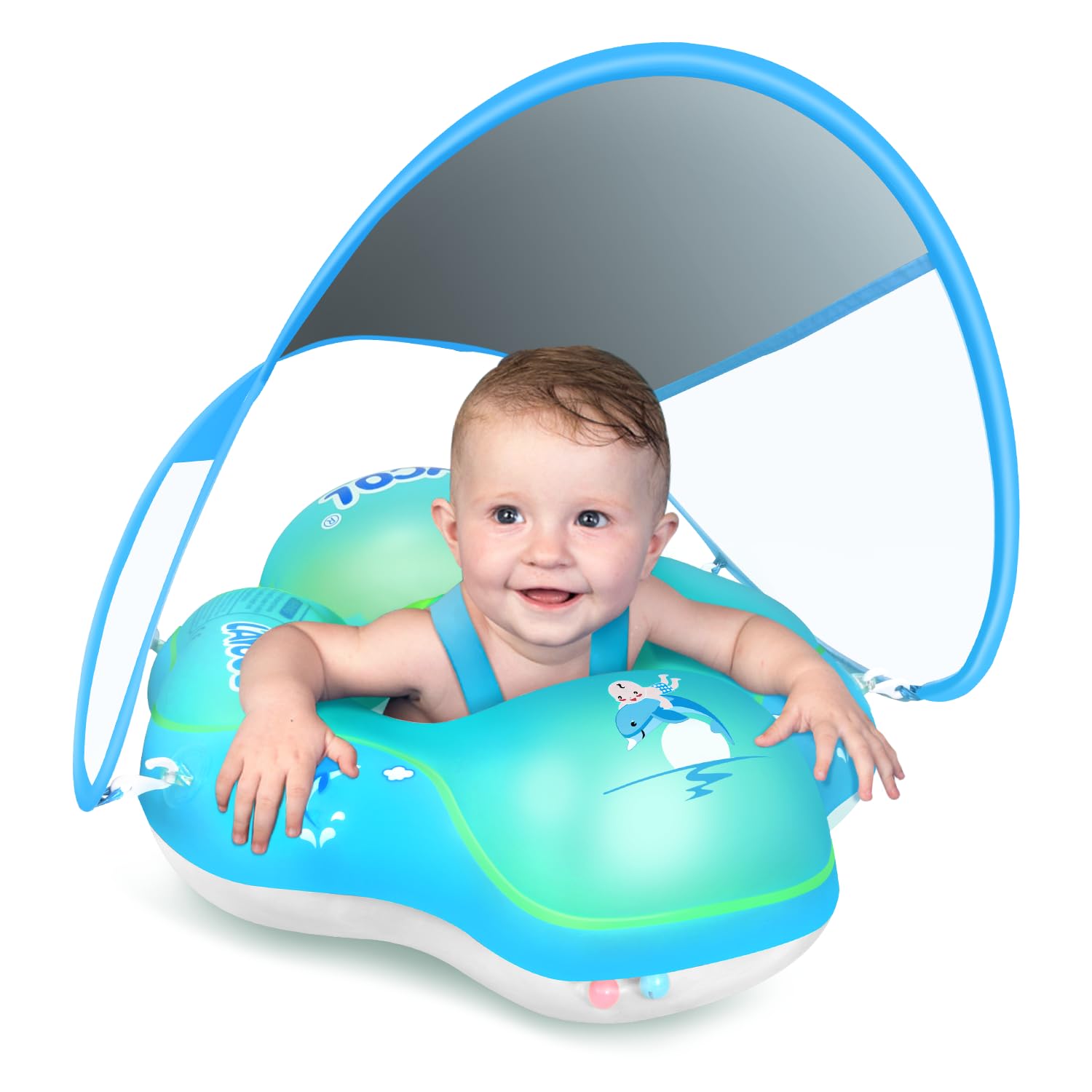
Most floats here assume a baby who can sit. The LAYCOL is built for the ones who cannot yet: a five-point buckle, two shoulder straps, a crotch strap and an abdomen support hold a three-month-old upright, and the raised front and widened sides are shaped to stop them pitching forward when they lean.
That makes it the most secure seat in this group for a very young baby, and it is why the float earns a place despite a couple of things we do not love. The two carry positions are genuinely useful: buckle them facing the water and they kick, switch the method and they lie back with their head cushioned. A manual pump comes in the box, which saves the arrival-day scramble for a nozzle.
The rest is sensible. The UPF 50+ canopy clips off in a second, the body is a compact 30 by 18 inches for a bucket seat, and the range runs to 36 months and 48 pounds, so it keeps fitting long past the baby stage in a way most of the floats here do not. Given how short the useful life of a baby float usually is, that range is doing real work.
Pros
- Five-point harness with shoulder and crotch straps
- Two carry positions, front and back
- Rated 3 to 36 months and 48 lb
- Manual pump included
Cons
- PVC seams can leak after a season or two
We send parents of newborns and young babies here, because the five-point harness holds a baby who cannot sit yet and the fit runs to 36 months.
Best for Busy Hands
EZIGO Baby Pool Float with Canopy
Key Features
- Seat: Adjustable safety seat
- Age range: 6 to 36 months
- Sun canopy: 0 to 120 degrees, UPF 50+
- Weight limit: 15 kg (33 lb)
- Price: Midrange
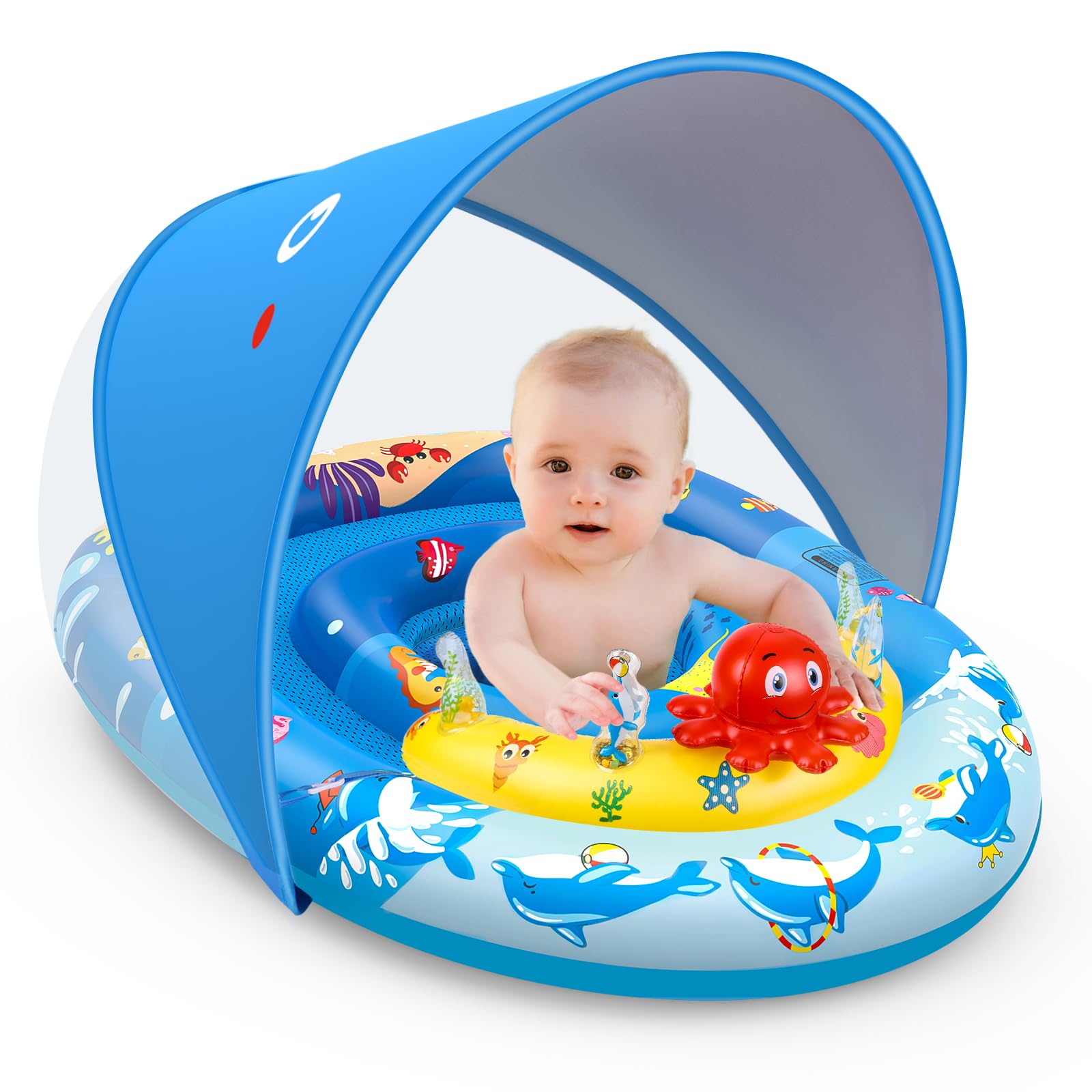
The SwimWays gives a baby water to kick in; the EZIGO gives them something to do with their hands. A squeaking octopus, two sequined dolphins and a pair of bells sit on a console in front of the seat, and that is the difference between a float that gets twenty minutes and one that gets an afternoon. That console is why this sits in the runner-up slot rather than reading as a gimmick: a baby with something to grab stays put far longer.
The rest is well judged. The seat adjusts underneath with a strap that stops a small rider sliding forward, the dual chambers and widened sides give it the same broad footprint as the other bucket floats, and the canopy swings through 120 degrees, so you drop it low for a late-afternoon sun or lay it back when the pool is in shade.
Inflated at 34 by 27 inches, it takes a real bite out of a beach bag, and the toys on the console are the first thing a teething baby will go for. Neither is a reason to skip it; both are things worth knowing before you pack the car.
Pros
- Squeaky toy console keeps a baby occupied
- Canopy tilts through 120 degrees
- Adjustable seat strap underneath
- Dual air chambers with widened sides
Cons
- 15 kg (33 lb) limit is mid-pack
- Bulky 34 by 27 inch footprint
If your baby needs entertaining to stay in the water, this is our pick: the toy console earns its place and the canopy follows the sun.
Best for Travel and Comfort
Mambobaby Float with Canopy
Key Features
- Age range: 3 to 24 months
- Sun canopy: UPF 50+
- Construction: Foam with fabric cover
- Weight limit: 40 lb
- Price: Premium
The most expensive float in this group is the one that never needs inflating. The Mambobaby is a foam core under a fabric cover: no valves, no hand pump on a hotel floor, and nothing to deflate at the end of the day. It compresses down small enough to travel in a suitcase and weighs under two pounds.
The cover is where the money goes. Fabric is soft against bare legs in a way PVC is not, and it is not slippery when wet, so a wriggling baby has something to grip against. The five-point buckle and the 40-degree seat angle hold them in a supported semi-recline, and the canopy wraps further around the sides than the others here, which matters when the sun is not straight overhead.
Two things to know first. The harness snaps are the part to watch, because a determined baby arching backwards can pop one, so give each a tug before you put them in. And the 3-to-24-month range with a 40-pound ceiling is a shorter run than the LAYCOL offers. Neither undoes the case; both are worth knowing before you commit.
Pros
- Foam core means no pump and no valves
- Fabric cover is soft against wet skin
- Five-point buckle with a 40-degree recline
- Folds flat for a suitcase
Cons
- Premium price tier for a float outgrown in two summers
We keep the Mambobaby for parents who dread inflatables: no pump, a soft fabric seat, and a body that folds into a suitcase.
Best for Sitting and Splashing
SwimSchool Infant Baby Pool Float

Key Features
- Age range: 6 to 24 months
- Sun canopy: Multi-position, UPF 50+
- Weight limit: 30 lb
- Inflated size: 36 in
- Price: Midrange
Thirty-six inches across is a lot of float, and the SwimSchool uses the space deliberately: the seat sits in the middle of an open mesh play area, so a baby who drops a toy can reach down and find it again. Among the floats here it is one of the widest, and width is what keeps a leaning baby from going over.
The canopy runs on a plastic hinge with a 120-degree range, which holds its angle instead of drooping after an hour in the sun. Dual air chambers and child safety valves are here for the same reason as everywhere else in this category: a single puncture should not end the day. The multi-point seat straps adjust as they grow, and the whole thing weighs 1.6 pounds.
What keeps it out of the top tier is the window. Six to 24 months and 30 pounds is a shorter run than the LAYCOL or the HINZER give you, and a float this size will feel crowded in a small plunge pool. As a stable platform for a baby who wants to sit up and slap the water, the shape is one of the better ones here.
Pros
- Wide base resists a leaning baby
- Multi-position canopy holds its angle
- Open mesh play area with toys
- Dual chambers and safety valves
Cons
- Rated only to 24 months and 30 lb
- 36-inch ring needs a decent-size pool
Our pick for a baby who wants to sit up and play: the wide ring is steady and the hinged canopy stays where you angle it.
Best for Toy-Loving Babies
GLOPUS Baby Pool Float with Canopy
Key Features
- Age range: 6 to 36 months
- Sun canopy: Removable, UPF 50+
- Toy console: Squeaky starfish and submarines
- Weight limit: 15 kg (33 lb)
- Price: Midrange
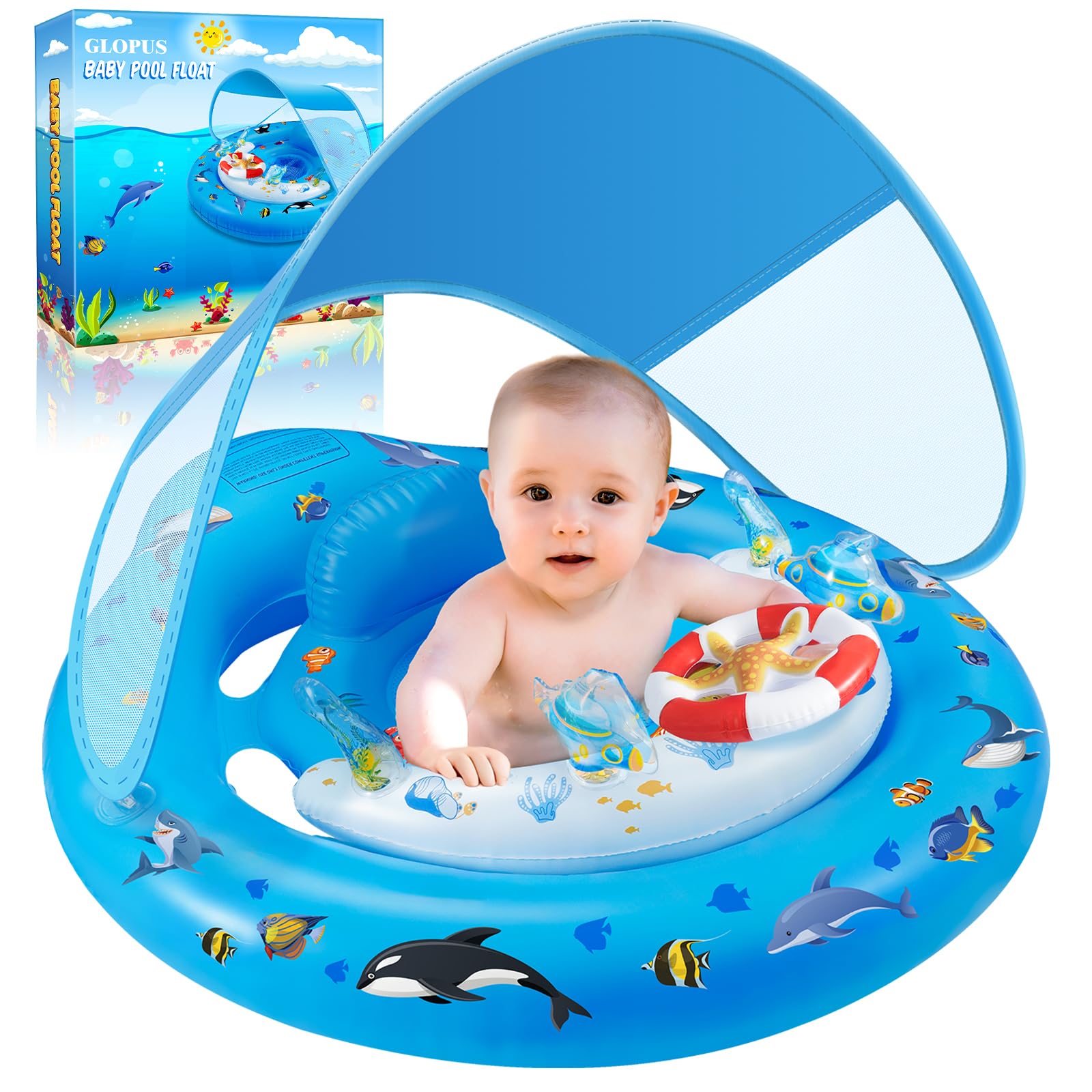
The GLOPUS is the EZIGO’s twin with different toys: the same bucket seat ringed by air chambers, the same console across the front, the same removable canopy. Where the EZIGO has an octopus and two dolphins, this one has a squeaky starfish, two submarines with sequined hulls and a pair of bells.
Nothing about the layout suffers for it. A strap under the seat stops a baby sliding forward, the dual chambers and widened sides supply buoyancy at the edges, and the canopy comes off when you want the sun. At two pounds it is light enough to carry down to the pool with a bag on the other shoulder.
We put it a step behind the EZIGO on fit rather than design: the 15 kg ceiling is the same, but the six-month start skips the newborn months the LAYCOL covers. The canopy hooks are the fiddly part and work loose when you carry the float by the shade, so lift it by the ring.
Pros
- Toy console with a starfish and submarines
- Adjustable seat strap underneath
- Removable UPF 50+ canopy
- Dual chambers and widened sides
Cons
- 15 kg (33 lb) weight limit
- Canopy hooks work loose when carried
For a baby who grabs at everything, we point to the GLOPUS: it matches our EZIGO runner-up in the water with a different toy set.
Best for Growing Toddlers
HINZER Baby Pool Float with Canopy
Key Features
- Age range: 6 to 36 months
- Sun canopy: Removable, UPF 50+
- Weight limit: 22.68 kg (50 lb)
- Inflated size: 31 in square
- Price: Midrange
Fifty pounds is the highest weight limit here, and that is the reason to open with the HINZER if you are shopping for a toddler rather than a baby. The 6-to-36-month range plus that ceiling mean it still fits a three-year-old, where most of the floats on this page stop at two.
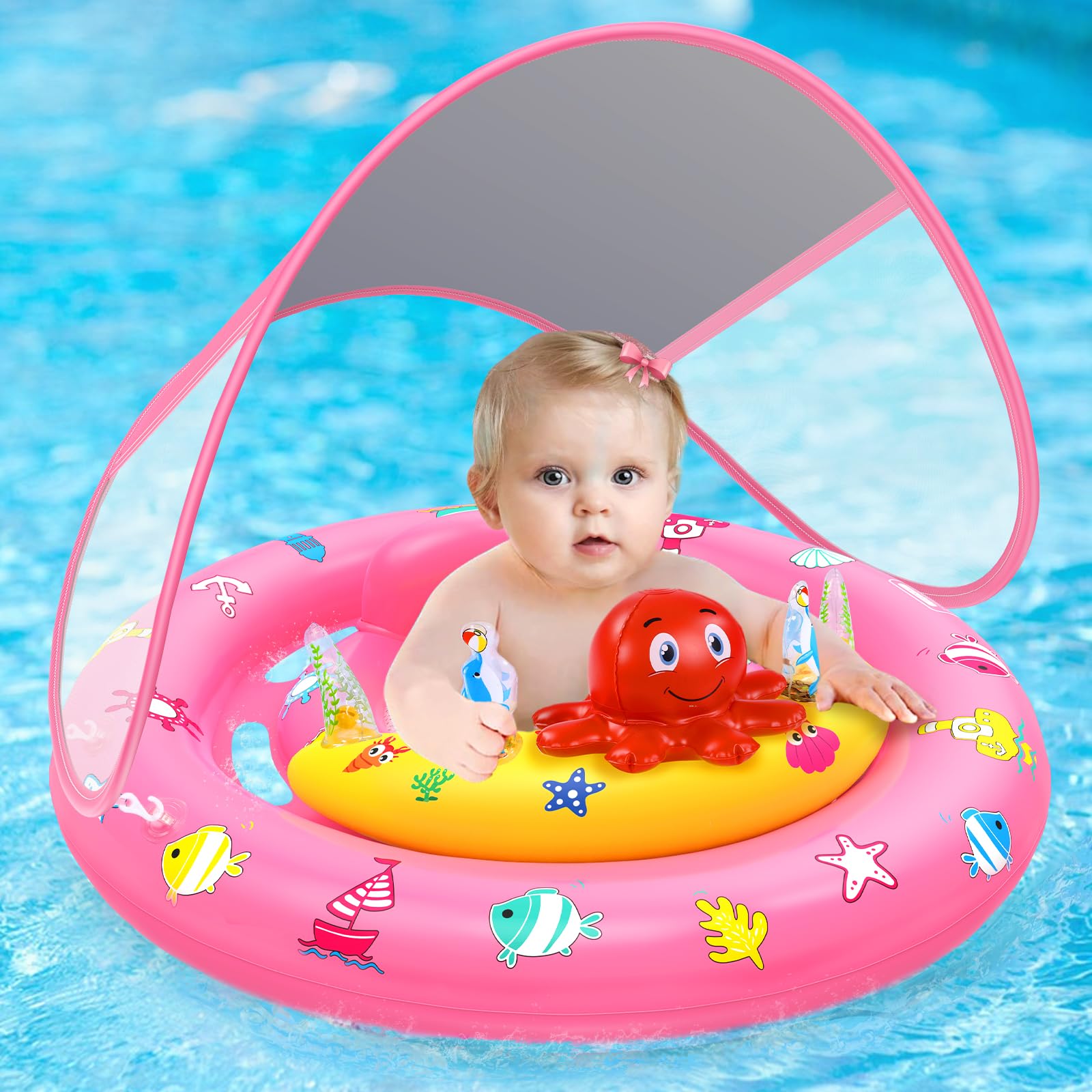
The shape is a 31-inch square rather than a circle, with a hollowed console of toys set in front of the seat: a squeaky octopus, a sparkly dolphin and a pair of bells. Sitting up with something to reach for suits an older baby, and the adjustable seat underneath means the harness grows with them instead of being retired at the first growth spurt.
The canopy is removable and rated UPF 50+, with mesh sides so you can see them, and the float weighs 0.9 kg, light enough to tuck under an arm. The PVC build is the same as the rest of the inflatables here: nothing about it is premium except the range.
That makes it the sleeper of the group. Nothing about it is novel; it simply covers the two things that end a pool session early, a child who has outgrown the seat and a child who has nothing to do in it. For a second summer with a walking toddler, that is most of what you need.
Pros
- 50 lb limit, the highest in this set
- Adjustable seat with a toy console
- Removable UPF 50+ canopy with mesh sides
- Light 0.9 kg carry
Cons
- Only comes in pink
We hand the HINZER to parents of toddlers, because its 50-pound limit is the highest here and the seat adjusts as they grow.
Best for First Summer
GBD Flamingo Baby Float

Key Features
- Included: Manual inflator
- Age range: 8 to 36 months
- Sun canopy: Removable, UPF 50+
- Weight limit: 18 lb
- Price: Budget
The Flamingo is the least expensive float here that comes with a canopy, and it looks the part: a pink bird with a shaped head, wings either side and a shade clipped over the top. For a first summer and a lot of photographs, that counts for something.
Eighteen pounds is the catch, and it changes who this is for. That is an average nine-month-old or a small one-year-old, and plenty of babies sail past it before their first birthday. The 8-to-36-month range on the box reads generously, but the weight limit is what actually decides when this float stops being usable, and it is the lowest ceiling here by a wide margin.
Inside that window it is decent. The seat cushion is thicker than most at this price tier, the canopy clips on and off without a fight, and a manual inflator comes in the box so it works the day it arrives. The vinyl is thin, and the seams are the part to keep an eye on.
So think of it as a first-summer float rather than a family one: buy it for a baby comfortably under eighteen pounds, use it hard for a few months, and do not plan on it seeing a second child through. Check the weight on the scale at home, not the age on the box, before you order.
Pros
- Cheapest shaded float in this group
- Thicker seat cushion than most at this tier
- Manual inflator included
- Canopy clips on and off easily
Cons
- 18 lb ceiling retires it before many first birthdays
- Thin vinyl can split at the seams
We recommend the Flamingo only for a baby still under eighteen pounds: it is the least expensive shaded float here, and that limit retires it.
How We Tested the Baby Pool Floats
We started with around 40 floats — plain rings, seated floats, dual-chamber inflatables, fabric-covered styles, and a handful with canopies — and cut the list by reading specs and safety documentation: age and weight ratings, chamber count, valve type, canopy dimensions, and whether the maker followed the ASTM standard for infant flotation aids. Price wasn’t much of a filter, since most of these land in the same range. That left 14 models, which we inflated with both a hand pump and a car pump to see which ones could be filled one-handed with a baby on your hip.
Testing ran four months, May through August, with three families and babies from 3 to 18 months. Floats came to backyard pools, the shallow end of a public pool, a lake dock, and the bathtub, which is where the unglamorous work happened. We left each float fully inflated on a sunny deck for a week and checked it every morning to see how much air it had lost and whether the seams were still tight. On the water, we watched the moment a baby lunged for a toy and whether the float tipped forward with them, and we checked whether losing one chamber still kept a baby’s head clear. Fit got the closest attention — whether a baby slid forward in the seat, whether the leg holes rubbed, and whether a wriggly 6-month-old could work toward the edge of the opening.
Sun protection was measured at noon rather than eyeballed: we noted where the shadow actually landed on a baby’s face and shoulders when the sun came in at an angle. Ease of use meant getting a wet, slippery float back into a beach bag, drying it on a towel rack, and deflating it in a driveway without a wrestling match. Quality came down to squeezing seams and checking stitching and zippers on the fabric covers. For value, we kept a tally of which floats still looked new in August and which had cloudy vinyl or a canopy that wouldn’t stay up.
How to Choose a Baby Pool Float
The most useful number on any of these boxes is the weight limit, because it decides how long the float lasts far more than the age range printed beside it.
Start With Weight, Not Age
The age ranges on these floats are optimistic. The GBD Flamingo is sold as 8 to 36 months but tops out at 18 pounds, which plenty of babies reach before their first birthday; the HINZER, rated to 50 pounds, still fits a three-year-old. Weigh your baby, add the couple of pounds they will gain over the summer you plan to use the float, and buy against that number rather than the age on the box.
Headroom is worth more than a long age range with a low ceiling, especially if the float will be shared between siblings or handed down.
Match the Seat to the Baby
Two seat designs cover this category, and they suit different stages. A bucket seat with a multi-point buckle, like the LAYCOL, the EZIGO or the Mambobaby, straps a baby in at the shoulders and between the legs, which is what a baby who cannot yet sit upright needs. A mesh seat with leg holes, like the SwimWays, assumes a baby who can hold their head and sit with support, and rewards them by letting their legs hang in the water so they can kick.
The trap is buying ahead. A harness that swallows a five-month-old leaves them slumped, and an open seat bought too early gives you nothing to strap them into. Buy for the stage your baby is in now.
What a Canopy Can and Cannot Do
Every shaded float here claims UPF 50+, so the rating will not separate them; how the canopy moves will. A hinged canopy with a range of positions, like the ones on the EZIGO and the SwimSchool, stays where you set it and can be dropped low when the sun sits near the horizon. A shade with one fixed angle only works when the sun is directly overhead.
Check what the shade actually covers. A canopy sized to keep the face out of the sun leaves shoulders and legs in the open, so pair it with a hat and a long-sleeve swim shirt rather than treating it as full cover.
Inflatables, Foam, and What Wears Out First
Almost everything in this group is PVC inflated through a valve, and the seams are where they fail, usually not in the first week but over a summer or two of sun and chlorine. That is the argument for the foam Mambobaby: no seams and no valves to patch, at roughly twice the price and with a shorter fit range.
Whatever you buy, rinse it in fresh water, dry it fully before folding, and store it out of direct sun. A float that lives on a hot patio ages far faster than one that goes back in a bag.
Supervision Is the Flotation Device
None of these is a lifesaving device, and none replaces a life vest, swim lessons or your hands. A pool float holds a baby at the surface in calm water while an adult is within arm’s reach; it will not right a child who ends up face down.
Before each session, squeeze the chambers to check for softness, look along the seams, and tug the harness snaps if the seat has them. A float that has lost air between uses is a float to retire, not to top up and hope.
Frequently Asked Questions
Can I use a baby pool float in the ocean or a lake?
A pool float is built for still water. In surf, a current or a boat wake, the float can be pushed over or carried, and none of these designs is made to keep a face up.
Keep it for pools and calm, shallow water you can stand in. For a boat or open water, a life vest sized to your child’s weight is the right gear, and a flotation aid like these is not a replacement.
Will these floats fit in a bathtub?
No. The smallest float here is 27 inches across and the widest is 36, which is more than the interior width of a standard tub, so it will wedge and tilt instead of floating level.
If you want water confidence before the pool, use a bath seat made for a tub, and save the float for a pool you can stand in.
How much air should I put in?
Not all of it. Most of these inflatables are meant to be filled to roughly 80 to 90 percent, with the seams still slightly soft, because a rock-hard ring is stiffer and rolls more easily than one with a little give.
Fill each chamber in turn, seat every valve firmly, and top up between sessions — a float that has gone soft in a hot car is telling you something.
Can two children share one float?
No. Every float here is single-occupancy and rated for one child’s weight, so a second child adds load the chambers were not designed for and shifts the balance.
With two children in the pool, buy two floats or take turns. A toddler leaning over the side to reach a sibling is exactly the kind of uneven weight that rolls one of these over.
Final Verdict
Buy the SwimWays Spring Float if your baby is between about nine months and two years. The mesh seat is the reason: it puts them in the water rather than on top of it, so they can kick and splash while the canopy keeps the sun off without cutting them off from you.
If your baby is still an infant, the LAYCOL’s five-point harness is the safer place to start. If you are shopping for a toddler who has already outgrown one float, the HINZER’s 50-pound limit is the one to beat.
