This post contains affiliate links. We may earn a small commission when you buy through our links — at no extra cost to you.
The couch cushions had become a launchpad and the hallway a sprint track, and it was only 4 p.m. on a rainy Sunday. What those kids needed wasn’t another screen — it was something they were allowed to hit. A kids punching bag gives all that restless energy somewhere legitimate to land, and it builds hand-eye coordination and no small amount of confidence along the way. The trouble is you don’t find out until the box is open whether the base stays put or skids across the carpet.
Over the past six months, my team and I put 11 of these through daily use with kids from toddlers to tweens — in basements, garages, and one long-suffering playroom. Two things separated the good ones from the disappointments: a height that actually matched the kid, and a base stable enough to stay planted after a hundred hooks. Assembly varied wildly too, from a ten-minute snap-together to two adults and a hand pump. The picks below earned their floor space.



Best for Ages 4-12
HopeRock Kids Set
Key Features
- Height: 60 in
- Includes: Gloves
- Age range: 4-12
- Game modes: 4
- Price: Premium
The HopeRock is the only bag here that turns a practice session into a game. Lights flash, music plays, and the built-in scorer counts hits across four modes, from a simple hit-and-light round to a memory challenge. We noticed how quickly that feedback pulled a kid back for another round; it is the difference between a bag that gets used twice and one that becomes part of the after-school routine.
The 60-inch height gives it room for a 4-year-old to grow into and an 11-year-old to still use, and the PVC is noticeably thicker than the budget inflatables we handled. The base needs to be filled and the bag inflated properly; once it is, it takes punches without wandering across the floor. We also appreciate that it is freestanding, so there is no ceiling mount to argue about.
Air retention is the question mark. Some units hold pressure well; others need topping up, and a soft bag changes the rebound. Check the valve and seam before you fill the base, and keep the pump handy for the first week. The HopeRock also costs more than a plain inflatable, and the lights and music are the reason. If your kid is motivated by targets and scores, that premium buys engagement. If they just want to hit something, a simpler bag does the job.
Pros
- Scoring, lights, and music drive engagement
- Thicker PVC than budget inflatables
- Height suits a wide 4-12 age range
- Freestanding with no ceiling mount
Cons
- Air retention varies between units
- Premium price for the interactive features
We recommend the HopeRock for ages 4 to 12 when you want a freestanding bag that keeps a kid engaged; the lights and scoring earn their keep, as long as you check the valve.
Best for Ages 3-6
QPAU Inflatable Bag
Key Features
- Shell: 0.5 mm PVC
- Height: 48 in
- Includes: Gloves
- Age range: 3-6
- Price: Midrange
If there is a five-year-old in the house, the QPAU is the bag we hand over first. The 48-inch height puts the target at chest level for a preschooler, and the wide base is meant to be filled with water or sand before the first punch. That combination makes it feel less like a novelty and more like a starter piece of kit.
Set-up is straightforward: inflate the bag, fill the base, and check that the valve is seated. We like that the PVC is 0.5 mm thick and that a pair of gloves comes in the box, because small hands need a glove that fits rather than an adult pair rolled over twice. The bag bounces back after a hit, which is the point for a child this age; it rewards timing without giving them a hard surface to punish their knuckles.
The 48-inch height is also the limit. A seven- or eight-year-old will overshoot it, and the bag will start to feel like a toy. For a younger child who is just starting, though, the QPAU is simple, stable, and easy to live with. Check the valve and seams before each session; that is the first place a slow leak shows up, and a leaning bag is usually a base problem rather than a punching problem.
Pros
- Sized right for ages 3-6
- Stable water- or sand-filled base
- Gloves included for small hands
- Simple setup
Cons
- Heavy once the base is filled
For a child aged 3 to 6, the QPAU is the simple, stable starter we recommend; older kids will outgrow its 48-inch height, but younger ones can grow into it.
Best for Serious Youth Training
Ringside Youth Heavy Bag
Key Features
- Length: 34 in
- Weight: 40 lb
- Includes: Gloves, wraps, mount
- Age range: 5-13
- Price: Premium
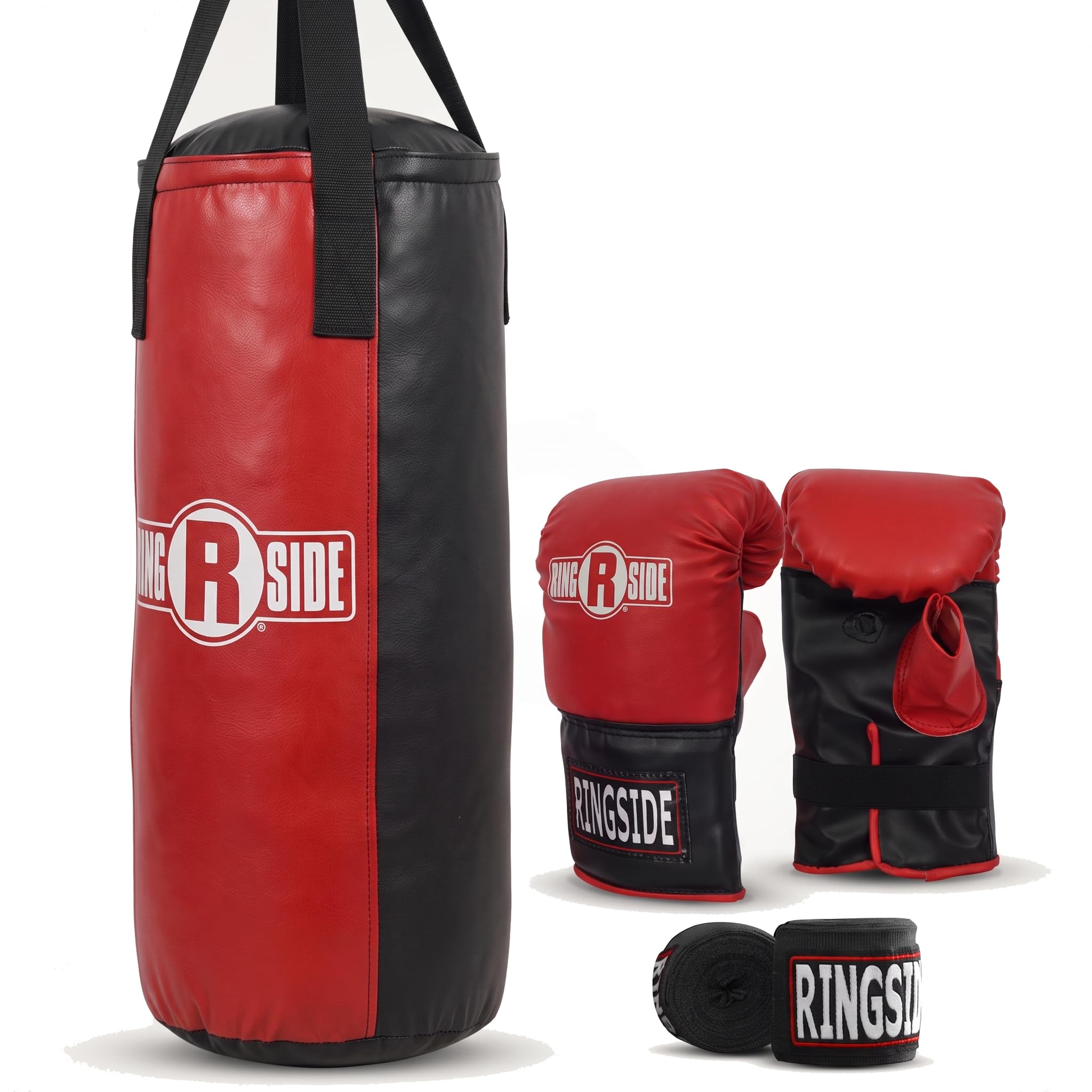
A 40-pound bag is not a toy, and that is exactly the point of the Ringside kit. It is the one pick here that feels like real gym equipment scaled for a young athlete: a 34-inch vinyl heavy bag, a pair of youth gloves, handwraps, and the mounting hardware in one box.
For a child who is actually taking classes, the weight is the advantage. It does not bounce away from a straight punch or slide across the floor, so they learn to sit down on their shots and keep their guard up. The trade-off is installation: this hangs from a ceiling mount, and you need a structural beam and the right hardware before anyone throws a punch. A drywall anchor or a doorframe bar is not enough for 40 pounds of swinging bag.
The vinyl shell is easy to wipe down, and the kit covers the basics without sending you shopping for gloves separately. The gloves are youth-sized, so check the fit; a child with larger hands may need a different pair. It also costs more than the inflatables here, which is fair for a bag that is meant to be hit hard for years rather than replaced after a growth spurt. If you have a beam and a kid who is serious, this is the one that will still feel useful when they are 12.
Pros
- Real 40-pound heavy bag
- Includes gloves, handwraps, and mount
- Stable under hard punches
- Vinyl shell wipes clean
Cons
We recommend the Ringside kit for a 5- to 13-year-old who is serious about boxing or martial arts; it is the most durable-feeling bag here, provided you can hang 40 pounds from a secure beam.
Best for First Hanging Bag
Mesetast Hanging Bag
Key Features
- Fill: Unfilled
- Mount: Hanging
- Gloves: 8 oz
- Height: 2.7 ft
- Price: Midrange
The Mesetast arrives as an empty shell, which is either the smartest part of the kit or the most annoying, depending on how much filler you have in the garage. You hang it, then stuff it with old clothes, sand, sawdust, or a mix, staying under the 50-pound limit. That lets you tune the firmness for a smaller child instead of handing them a bag that swings like a wrecking ball.
At 2.7 feet, it is sized for beginners under 10. The 8-ounce gloves and hand wraps are a nice touch at this level, and the reflex ball adds a warm-up that does not require the bag. We like that the mounting accessories are included, because a cheap bag with no way to hang it is not a bargain. The shell is Oxford cloth and PU, so it is softer than a vinyl heavy bag but still takes a purposeful punch.
It comes unfilled, so you choose the filler: old clothes for a softer bag, sand for a firmer one, staying under the limit. It hangs from a secure beam, and the included hardware gives you a start. For a first hanging bag, that is a fair trade: the Mesetast lets a young beginner learn distance and rhythm without a 40-pound bag overpowering them. Just leave enough clearance for the swing and check the mount before every session.
Pros
- Tunable fill for a softer or firmer bag
- Includes 8 oz gloves and hand wraps
- Sized for beginners under 10
- Mounting hardware included
Cons
- Unfilled; you supply the stuffing
We recommend the Mesetast for a first hanging bag under 10, because the fill-it-yourself shell lets you soften the punch and the included gloves fit the age group.
Best for Ages 3-8
Qoosea Dinosaur Bag
Key Features
- Design: Dinosaur
- Height: 48 in
- Includes: Gloves and pump
- Age range: 3-8
- Price: Budget
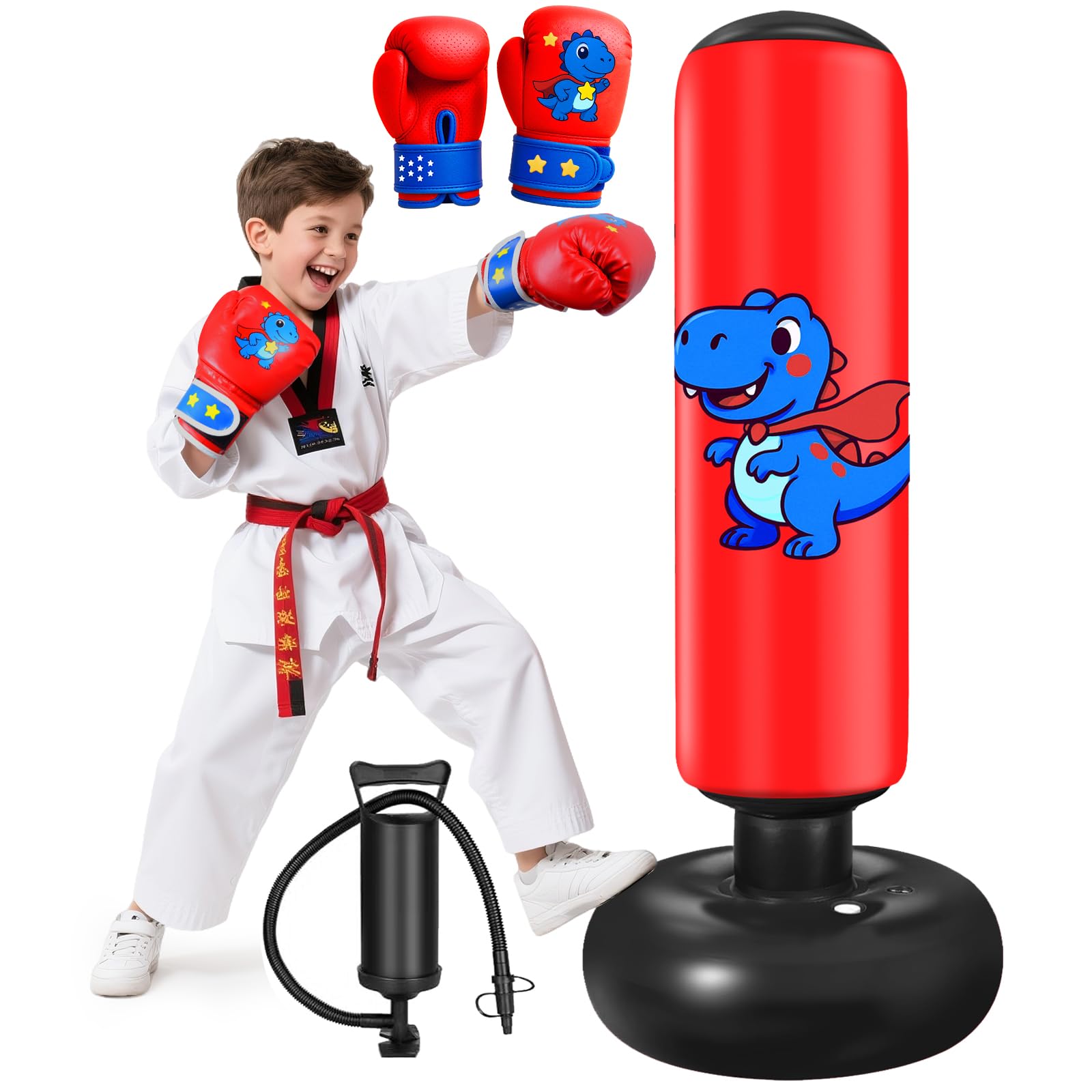
The Qoosea is the least complicated bag in this group, and the dinosaur print tells you who it is for. It stands 48 inches tall, comes with a pair of gloves and a pump, and fills at the base with water or sand. For a four- or five-year-old who has never worn a glove, that is enough.
We like the low fuss here. There is no ceiling mount, no electronic module, and no app; you inflate it, fill the base, and let them hit. The wide base keeps it upright for straight punches and kicks, and the bounce-back action is gentle enough for a small child. The PVC is on the lighter side, so keep it away from sharp toys and check the seams after the first few sessions.
The 3-to-8 age range is the real boundary. A taller 8-year-old will want a bigger target, and an older kid will overpower it. The included pump is basic, but it works; just set aside a few minutes for the first inflation. For a family that wants a first bag without a project, that simplicity is the feature. If you want a cheerful, inexpensive first bag that does not try to be a training system, the Qoosea is an easy yes.
Pros
- Simple, no-tool setup
- Gloves and pump included
- Gentle bounce-back for young kids
- Budget-friendly
Cons
- Only suits ages 3-8
- Base gets heavy once filled
We recommend the Qoosea as a first bag for ages 3 to 8, when you want something cheerful and simple without a ceiling mount or a learning curve.
Best for Small Indoor Spaces
NATGGZ Punching Set

Key Features
- Set: 7 pieces
- Stand: Adjustable
- Weight: 3.04 lb
- Age range: 3-8+
- Price: Midrange
If the playroom is also the living room, the NATGGZ spring stand is the least intrusive way to give a kid a target. It is a freestanding set with an adjustable stand, a spring-loaded punching ball, gloves, a pump, and a base, so it does not need a ceiling beam or a permanent corner.
The height adjustment is the useful part: you can bring the target down for a 4-year-old and raise it as they grow. The spring returns the ball after each shot, which keeps the rhythm going and teaches hand-eye coordination without a heavy bag swinging back. We found the seven-piece kit covers the basics, and the small footprint makes it easy to move from room to room. The gloves are a welcome extra for a set this size, and the pump means you can adjust the ball without hunting for a bicycle pump.
It is not a heavy bag, and it does not pretend to be. The target is small for older kids, and a hard hitter can knock the stand around or loosen the center pipe over time. Check the bolts before use and keep the base weighted. For ages 3 to 8 in a tight space, though, it is a clever compromise: enough resistance to be fun, not enough to rearrange the furniture.
Pros
- Adjustable height grows with kids
- Small footprint for tight rooms
- Spring return builds rhythm
- Seven-piece set includes gloves and pump
Cons
- Small target for older kids
- Stand can loosen with hard use
We recommend the NATGGZ for ages 3 to 8 in a tight indoor space, where its adjustable spring target is easier to live with than a full bag.
Best for Tall Older Kids
RORALA Inflatable Bag

Key Features
- Base: Water-fill
- Height: 63 in
- Includes: Gloves and pump
- Age range: 3-12
- Price: Budget
At 63 inches, the RORALA is the tallest inflatable here, and that is its reason to exist. A tall 9- or 10-year-old who has outgrown a 48-inch bag can still work high targets without switching to a hanging bag. The kit includes gloves and a hand pump, and the base takes several gallons of water.
The extra height changes the way a kid uses it: there is more bag to circle, and the target sits closer to shoulder height for an older child. The PVC shell is sturdy enough for repeated punches and kicks, and the bounce-back is lively. We like that it is freestanding and easy to move once the base is empty, which makes it a better fit for a garage or a basement than a permanent mount.
The base is the whole story with this one. It needs to be filled fully, and several gallons of water make it heavy to move and messy to drain. Stability is the weak spot: a full base keeps it upright for most kids, but a hard kick can still send it leaning.
We think that makes the RORALA a tall-kid specialist rather than the default. If your 9- or 10-year-old has outgrown a 48-inch bag and you have a spot where a heavy water base can live, it solves a real problem. If you want one bag for the whole family, start with a more broadly sized pick.
Pros
- Tall 63-inch target for older kids
- Includes gloves and pump
- Freestanding and movable when empty
- Lively bounce-back
Cons
- Heavy, messy base to drain
- Stability can vary with fill
We recommend the RORALA for a tall 9- or 10-year-old who has outgrown a 48-inch inflatable, as long as you will fill and drain a heavy water base.
How We Tested 11 Kids Punching Bags
We started with every kids punching bag we could find that was genuinely sized for children rather than a scaled-down adult bag, then filtered by height range, base type, fill requirements, and price. From that pool we bought 11 bags outright and handed them to families with kids ages 3 to 12 for six months — after school, before dinner, during homework breaks, and on rainy Saturdays.
Assembly got a stopwatch and a single adult, and we noted whether a bag needed a pump, tools, or a second set of hands. Right out of the box we smelled each one and logged whether that vinyl-and-glue odor faded in a day or was still hanging around the playroom a week later. Inflatables were filled to the maker’s spec and checked again on days two, seven, and thirty for soft spots, seam leakage, and air retention; a few needed topping up before nearly every session.
Then came the part that mattered. Kids hit them. We watched ten straight minutes of hooks and kicks and recorded whether the base walked, tipped, or stayed planted — bags filled with water or sand held far better than the ones we left empty. We measured each bag’s striking height against each kid’s shoulder and chin to see who it was genuinely built for, and over the following weeks checked seams, stitching, and base covers for splitting. Parents were asked which bags their kids returned to without being nudged; the answer rarely matched what the adults expected.
Value came last but not lightly. We weighed what each bag cost against how much use it actually got, and a bargain that sagged by week three scored worse than a pricier one that survived all six months.
How to Choose a Kids Punching Bag
The right kids punching bag is the one that stays upright after a real hit and still fits the child you have now, not the one in the catalog photo.
Start With the Format, Not the Character
Freestanding inflatables are the easiest first bag: no ceiling mount, no tools, and they can move from room to room. A spring-loaded stand takes up even less space and is gentler on the hands, but it is a target trainer rather than a heavy bag. A hanging heavy bag is the most serious option, and the only one that teaches a child to sit down on a punch; it also needs a structural beam and enough clearance. Pick the format your room can support before you fall for a print or a light show.
Stability Comes From the Base
An inflatable bag is only as steady as its base. Water is easy to pour and easy to drain; sand is heavier and stays put, but it is messier to change. Either way, fill to the listed level, not halfway, and set the bag on a flat, hard floor. A partially filled base is the usual reason a bag leans after a few punches. If the bag will live on a rug, put a rubber mat or a tray underneath, especially with a water fill.
Match Height and Age, and Leave Room to Grow
A 48-inch bag is right for a preschooler and early elementary kid; a 60-inch inflatable or a 34-inch hanging bag suits older children. Adjustable stands and height-adjustable bags are worth it if two kids will share, but check the top height before you buy. The common mistake is buying an adult heavy bag because it will last; a 40-pound bag that is too long for a child teaches poor form. Size the bag to the child, then size the mount to the bag.
Inspect the Seams, Valve, and Kit
Inflatables fail at the seams and the valve more often than anywhere else. Before the first fill, check that the valve seats firmly and the base seam is even; keep the repair patches in a drawer. A pump, a pair of gloves that actually fit, and a base cover are not extras if they keep the bag usable. For a hanging bag, confirm that the filler is included or decide what you will use, and check the weight limit before you stuff it.
Safety and Supervision
Any bag that hangs or holds water needs an adult install. Hang a heavy bag from a structural beam with rated hardware, not a drywall anchor or a doorframe. Keep the base within its fill limit, and have kids wear the gloves rather than bare knuckles. Supervise the first sessions, especially with a spring return or a bag that swings, and teach them to hit with control rather than try to knock it over.
Frequently Asked Questions
Can I hang a youth punching bag from a wall instead of the ceiling?
Only if the bag’s maker supports a wall mount and you use a bracket rated for the full bag weight, fixed into studs or a structural beam. Most youth heavy-bag kits are designed for a ceiling mount, and a drywall anchor will not hold a swinging 40-pound bag. If you rent or cannot find a beam, choose a freestanding inflatable instead.
Can adults use a kids punching bag?
For light technique work, yes, but not for hard punching. An inflatable sized for a 6-year-old will tip or wear out under adult power, and a 40-pound youth bag is still lighter than most adult bags. If an adult wants to train, use the kids’ bag for footwork and accuracy only, and leave the power shots for equipment rated for adult use.
How do I clean and store an inflatable punching bag?
Wipe the PVC with a damp cloth and mild soap, then dry it fully before storage. Empty the base, deflate the bag, and keep it out of direct sun and away from sharp toys; heat and UV are hard on seams. Store it loosely folded rather than compressed in a hot garage, and check the valve before the next inflation.
Final Verdict
For most families, we recommend the HopeRock: the scoring and lights keep a 4- to 12-year-old engaged, and the freestanding design avoids a ceiling project. If your child is 6 or younger and you want the simplest stable starter, the QPAU is the better fit. If they are already training seriously, the Ringside 40-pound kit earns the installation.
