This post contains affiliate links. We may earn a small commission when you buy through our links — at no extra cost to you.
A stacking toy looks simple until you watch a baby try to destroy one. The good ones survive the chew, the drop, and the gleeful swipe; the bad ones split at a seam or frustrate a 9-month-old before the tower is half built. I’ve watched my niece go mouth-first and hands-second, which is why I care less about shelf appeal and more about real baby handling. What you’re really buying is a first lesson in cause and effect—plus a toy that gives little hands something to grab, stack, knock down, and try again.
We’ve spent the past four months with 16 stacking toys, judging quality and durability after repeated drops and washes, watching for genuine enjoyment and playfulness, and checking age-appropriateness from sitters to early walkers. Value came down to how many pieces actually got played with, and size mattered more than I expected—some sets hog the toy shelf, while others are awkward for small hands. The picks below earned their place on the floor.


Best for First Stacking Toy
The First Years Stack & Count Cups
Key Features
- Cups: 8
- Material: BPA-free plastic
- Water play: Holes in every cup base
- Recommended age: 6 months – 2 years
- Price: Budget
Turn any of the eight cups over and there is a big number molded into the base. It is a detail that costs the manufacturer nothing, and it is the reason this set keeps earning its place: at nine months it is a cup to bang on the floor, at eighteen months it is a tower, and somewhere around two it becomes a counting game where the order has to be right. The toy grows instead of being outgrown, which is rare enough in this category to be worth saying plainly.
The holes in the bottom of each cup are the other thing we appreciate. They turn the set into a bath toy, with water pouring through in little streams, and they let the cups drain instead of sitting full of stale water in the toy bin. The plastic is BPA-free, the whole set weighs under five ounces, and the cups nest into one small stack that disappears into a diaper bag.
The honest boundary is age. This is a baby-and-toddler toy, and a three-year-old who wants to build something taller needs blocks. Up to that point, the lack of anything to line up is a feature: a nine-month-old gets one cup on another without help, and the same eight cups do bath duty, sand duty and hiding-place duty long after the stacking phase ends.
Pros
- Eight cups that stack, nest and pour
- Numbers in the base for counting later
- Drains and plays in the bath
- Nests into one bag-sized stack
Cons
- No post or base, so towers topple easily
We recommend these eight cups before anything else here: they work at six months, at two years, and in the bath in between.
Best for Ring Stacking Practice
Sassy Stacks of Circles
Key Features
- Height: 8 inches
- Pieces: 9
- Ring textures: A different texture on each ring
- Recommended age: 6 months – 2 years
- Price: Budget
One ring in this set is clear plastic with beads sealed inside, so shaking the stacker makes a noise and a baby can see exactly what is making it. It is the kind of detail that suggests someone watched a six-month-old for an afternoon before designing the thing, and it is the piece children go back to.
The other rings are textured and weighted differently from one another, which matters less for stacking than for the stage before it: most of the early play with a stacker is grabbing, turning it over and chewing an edge. The chunky rings are easy to close a fist around, they are safe to mouth on, and the straight post accepts them in any order, so a baby gets the click of success long before they work out that the wide ones belong at the bottom.
Of the ring stackers here, this is the one we trust to hold a baby past the first week, because there are three separate challenges inside it, grip and release and order, and they arrive in that sequence. The beads are the reward at the end of it: a child who finally gets the clear ring over the post has made a rattle, not just a tower.
Pros
- A different texture on every ring
- Clear ring with beads that rattles
- Post takes rings in any order
- Chunky rings double as teethers
Cons
- Rings run small for older toddlers
For a ring stacker rather than a cup set, this is our pick: textured, rattly, and forgiving enough for a baby still learning to let go.
Best for Living-Room Looks
mushie Stacking Cups
Key Features
- Cups: 8
- Made in: Denmark
- Material: BPA-free polypropylene
- Recommended age: 0 months and up
- Price: Midrange
These are the stacking cups you leave out. The colors are muted rather than primary, the cut-out shapes in the bases are genuinely charming, and a finished tower looks like it belongs in a nursery rather than a playroom. That is most of the reason to spend more on them than on a basic cup set, and we think it is a fair reason.
The rest of the case is solid rather than spectacular: eight BPA-free polypropylene cups, designed and made in Denmark, nesting down to a small stack that fits on a shelf. The cut-outs behave the way cut-outs should, draining in the bath, dribbling when a baby pours, and letting a toddler peer through the bottom of a cup at you.
What we did not expect was how much the looks change the toy’s life. A set that is pleasant to look at stays in the living room instead of being tidied into the toy bin, and a set that stays out gets picked up twenty times a day. Ours has been handled far more than the brighter cups we tested, and not because it stacks any better.
Pros
- Muted colors that suit a living room
- Shape cut-outs drain and pour
- Made in Denmark from BPA-free plastic
- Nests into one small stack
Cons
- Pricier than the other cup sets here
Buy these if the toy is going to live in your living room: eight well-made cups that look like decor and still stack, pour and nest.
Best for Teething Babies
Moonkie Silicone Stacking Cups
Key Features
- Care: Machine or hand wash
- Cups: 7
- Material: Food-grade silicone
- Recommended age: 6 months and up
- Price: Midrange
Seven cups of food-grade silicone, and the first thing most babies do with them is not stacking, it is chewing. The rims are soft, the outsides carry raised patterns clearly meant for gums, and the set is quiet in a way no plastic cup set manages: the tower goes over with a thud rather than a clatter.
That softness is why we put this set above the other cups for a young baby. A six-month-old with teeth coming through gets a proper teether in seven shapes, and you get a toy that is machine washable rather than wiped down by hand. The cups still stack and nest, and because they are silicone, a stack that falls over does not take a chunk out of the floor or a sibling.
They are also the easiest set here to carry. The seven cups nest into a stack about the size of a mug, the holes in the bases make them bath toys, and silicone does not rattle against everything else in a bag the way hard plastic does. Ours lives in the diaper bag rather than the toy bin.
Pros
- Soft silicone that works as a teether
- Machine washable rather than wipe-only
- Quiet when the tower goes over
- Nests to about the size of a mug
Cons
- Silicone flexes, so tall towers wobble
For a baby who puts everything in their mouth, these soft washable cups are the ones we hand over first.
Best for Bath and Sandbox
Battat Stack Up Cups
Key Features
- Pieces: 9 cups plus carry bucket
- Carry handle: On the largest cup
- Cup markings: Embossed numbers
- Recommended age: 18 months and up
- Price: Budget
The piece that makes this set is the biggest one: a bucket with a molded handle, wide enough to hold all nine cups. That turns a toy that normally lives as scattered floor debris into a single object you can carry by a handle, and it is the difference between a set that goes to the beach and a set that stays home.
We found that handle changes where the set goes. The cups are thick, sturdy plastic in bright, distinct colors, and the whole thing is light enough for a toddler to lug to the sandbox themselves. The nine cups also build a genuinely tall tower, one that comes up around toddler height, so a child gets something that feels like an achievement rather than a small pile.
Numbers are embossed into the cups, so counting practice comes free once the stacking is sorted, and the smooth interiors wipe out easily after a morning in the sand. It is also the set here that is easiest to put away, which sounds dull until you have stepped on the alternative.
Pros
- Bucket with a handle stores all nine cups
- Thick, bright cups build a tall tower
- Embossed numbers for counting
Cons
- Rated 18 months and up, the latest here
The set we take out of the house: nine cups and a handled bucket that packs itself up and works as beach kit.
Best for One-Box Gift
Fisher-Price Blocks & Rock-a-Stack
Key Features
- Bucket: Storage with shape-sorter lid
- Set includes: 5 rings, 10 blocks, bucket
- Recommended age: 6 months and up
- Price: Midrange
Two toys in one box: the five-ring Rock-a-Stack on its wobbly base, and the ten-block bucket with a shape-sorter lid. As a present for a child whose household you do not know, it is the safest thing here, because it covers the two things a baby does between six months and two years, which are putting rings on a post and pushing blocks through holes.
The Rock-a-Stack half is the gentler introduction. The rings are wide and easy to grab, the base rocks when it is hit so a baby gets a reaction without needing any skill, and the top piece rattles. It is not as textured or as chewable as the Sassy rings, but a baby who cannot yet stack can still knock it flat and feel like a cause.
The blocks half is what earns the set its keep later. Ten blocks, a shape-sorter lid and a bucket that holds everything, which is the underrated part: blocks without a container are just floor.
Where this loses to the dedicated picks is focus. Five rings is fewer than any other stacker here, and the shape sorter is a sideline rather than a proper puzzle, so a child who takes to one half will outgrow it faster than they outgrow a single-purpose set. What you get in exchange is variety in one purchase and a bucket that tidies itself.
Pros
- Two classic toys in one box
- Wide rings and a base that rocks
- Ten blocks plus a shape-sorting bucket
Cons
- Only five rings on the stacker
The safest gift on this list: two classic Fisher-Price toys covering stacking and shape sorting from six months.
Best for Big Builds
iPlay, iLearn Stacking Cup Castle
Key Features
- Pieces: 18
- Storage: Base flips into a box
- Recommended age: 12 months – 6 years
- Assembled height: 23 inches
- Price: Premium
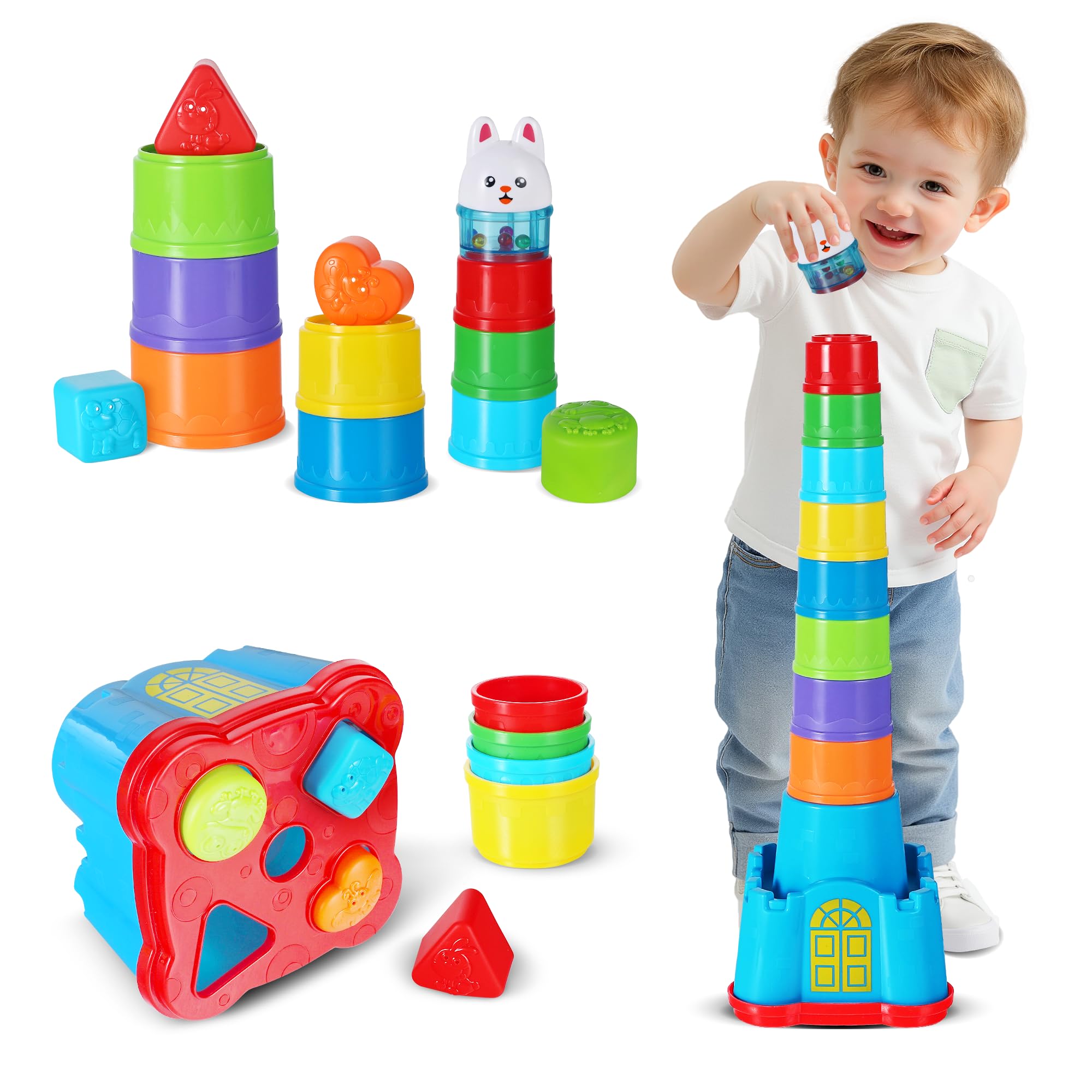
Eighteen pieces build a castle over 23 inches tall, and the height is the point. A tower a child has to stand up and reach to finish is a different kind of project from a cup stack at floor level, and it is the first stack we have seen a toddler walk around afterward to admire.
The set does more than stack. The cups nest inside one another, the base flips over to become a storage box, and a shape-sorting element runs alongside the stacking, so a child who is bored of towers can sort shapes for ten minutes and come back with fresh interest.
We rate it for the child who already stacks and wants more, not for a first birthday. At 18 pieces it is a set you will be picking up, and it is the priciest thing on this page, so it earns its place only if the tower is going to be built and rebuilt. One thing to know: the shape-sorting base does not grip the cups firmly, so it works better as a separate puzzle than as the foundation of the castle.
Pros
- Builds a castle over 23 inches tall
- Nests, stacks and sorts shapes
- Base flips into a storage box
Cons
- 18 pieces to gather up afterward
For a child who stacks to build, this 18-piece castle beats every cup set here on scale and on play modes.
Best for Cause and Effect
JUXUE Spinning Stacking Toy

Key Features
- Action: Discs spiral down the pole
- Height: 14 inches
- Material: ABS plastic
- Recommended age: 12 months – 3 years
- Price: Midrange
Pull the pole out of the base and the rainbow discs spiral down it instead of dropping straight. It is a small mechanical difference that turns the last two seconds of stacking into the best two seconds, and it is the reason this toy gets rebuilt rather than abandoned.
The discs are chunky ABS, sized to be stacked by color, by size or at random, and the finished tower stands 14 inches. Stacking is only half of it: the spiral is the payoff, and cause and effect is precisely the thing a one-year-old is working out.
Alignment is both the appeal and the catch. A disc has to sit square on the spiral before it will twirl, which is beyond most one-year-olds at first and genuinely satisfying around eighteen months, so the toy has a longer runway than it looks, as long as nobody expects a toddler to nail it on day one.
There is a social side to it as well. A toy with a mechanism is a toy a child wants someone else to watch, and that is what lifts this above the passive stackers here: it is the pick for a household where a toddler’s main audience is a sibling or a parent on the floor.
Pros
- Discs spiral down the pole
- Stack by size, color or at random
- Chunky discs are easy to grab
- Pole comes apart for storage
Cons
- Base is light and topples when nudged
A stacking toy for the child who has worked out cause and effect: stack the discs, pull the pole, watch them spiral.
How We Tested the Best Stacking Toys for Babies
We started by pulling together the stacking toys that show up most often in baby registries and parent forums, then narrowed the shortlist by age range, piece count, materials, footprint, and price. From that group, we tested 16 sets over four months.
The testing happened where the toys actually live: living room floors, high chairs, diaper bags, and the shelf beside the books. We handed each set to babies at different stages—sitters, crawlers, and early walkers—and watched what they did first: grab, mouth, stack, swipe, or ignore. We noted which pieces were easy to pick up and which were too bulky for small hands, and we measured how much shelf or floor space each set claimed after cleanup.
Durability got a separate workout. We dropped pieces from high-chair height, wiped and washed them the way a caregiver would, and checked seams, edges, and painted surfaces after each round. Quality showed up in small things—whether pieces stacked without wobbling, whether edges felt smooth, whether the set still looked intact after a week of hard play. For enjoyment and value, we tracked which sets babies came back to without prompting and whether extra pieces added play or just clutter.
How to Choose Stacking Toys for Babies
The right stacking toy is the one still being played with at two, so the question isn’t which set stacks best but which set has something left to offer once stacking is mastered.
Cups, rings or blocks: decide the play pattern first
Nesting cups teach volume and order, because a cup goes inside a bigger cup. Rings on a post teach sequence, because the wide ones have to sit at the bottom for the tower to look right. Blocks and shape sorters add matching, which arrives later than either.
Our advice for one set bought before the first birthday: buy cups. They double as bath toys, sand toys and containers for other toys, and a baby can succeed with them before they can aim. Add a ring stacker around the first birthday if the post-and-hole idea appeals. Buying both at once usually means one sits untouched for months.
Take the minimum age seriously, and ignore the maximum
Almost every set here starts at six months, and at six months the play is grabbing, mouthing and knocking things down rather than stacking. Real stacking tends to arrive somewhere between nine and fifteen months, two cups at a time.
The number worth respecting is the minimum age, since it reflects the maker’s judgement about the smallest piece and the design. The upper number is marketing: a four-year-old with a cup set is a four-year-old with a drum kit, and that is fine.
Check the smallest piece, and any fixed rod
What actually matters for a baby is the smallest object in the box. If a ring or a block passes through a toilet-paper tube, it is too small to leave with a child who mouths everything. The second thing to check is a fixed rod or post: on a stacker with an exposed dowel, a child who falls onto it or works the topper off is meeting a hard, narrow object.
That is why cups with no post are the safer shape for the under-ones, and why rings on a post suit a toddler who has stopped putting everything in their mouth.
Plan for water, sand and the trip out of the house
Holes in the base of a cup are what turn a stacking set into a bath toy, and they stop water sitting inside it between baths. A bucket, a handle or a nesting stack is what makes the set leave the house at all.
If you want one set that does the tub, the beach and the diaper bag, buy cups with drainage holes where the largest piece doubles as a container. If the set is staying home, this matters much less than how it stacks.
Think about where it will live
A set that nests into one object gets kept within reach. A set that scatters into nine pieces ends up in the toy bin, and the toy bin is where toys go to be forgotten. We weight storage and looks more heavily than a spec sheet suggests, because a set that is pleasant to leave on a shelf is a set that gets picked up twenty times a day.
If your living room is the playroom, muted colors and a tidy nested stack are worth a little more. If you have a dedicated playroom, buy for play value and let the colors be loud.
Frequently Asked Questions
How many stacking toys does a baby actually need?
One good cup set covers the first year by itself, and it is the set that does bath duty, sand duty and the diaper bag. If you add a second, make it a different format, such as a ring stacker alongside nesting cups, rather than another set of cups that is the same toy twice.
Two sets is plenty until a child starts building with blocks, and at that point the cups become containers rather than towers.
Can stacking toys go in the dishwasher?
It depends on the material, and it is worth knowing before the first wash. Silicone sets are commonly sold as machine washable, and most rigid plastic cups survive a top rack. Wooden stackers should be wiped with a damp cloth and dried straight away, because soaking lifts paint and swells the wood.
The simplest test is to squeeze a cup: if it gives under your thumb, it is silicone and will take the heat.
Why does my baby only knock the tower down?
Because flattening a tower is the stage before building one, and it is doing real work: the child is learning that their hand causes an effect. Keep building two-cup towers for them to knock over, and say the words as it happens, up and down and again.
When they start reaching to place a cup rather than sweep it, move to three. A set with no post is easier to start on, because nothing has to be lined up first.
Final Verdict
For most babies, the eight cups from The First Years are the whole answer. They are the least expensive way into stacking here, they work from the sitting-up months through the counting years, and they keep a job in the bath long after the novelty of towers wears off.
Add the Sassy rings if you want a post-and-ring challenge in the same house, or take the mushie cups instead if the toy is going to sit in your living room. Past that, the decision is about age rather than quality: the 18-month sets on this page are excellent toys that a six-month-old simply cannot use yet.
