This post contains affiliate links. We may earn a small commission when you buy through our links — at no extra cost to you.
The promise of a ride-on electric car is a kid grinning behind the wheel; the worry is a battery that dies mid-block, a remote that lags a second behind the steering, and a box of parts that never quite goes together. A good one solves all three: it holds a charge long enough for real play, responds the instant you tap the remote, and goes together without a fight. I’ve watched too many driveway test runs end in a parent chasing a stalled car, and the difference almost always comes down to those basics.
Over the past eight months, my family and I have tested eight models with kids ages three to seven, from budget-friendly rides to larger two-seaters. We logged every assembly step, every charge cycle, and every bumpy lawn crossing—and the pattern is clear: the best cars feel planted on turns, fit a garage without swallowing it, and still look presentable after a season of scuffs. The picks below are the ones that earned their space, not just the ones that looked good in the box.



Best for Everyday Family Use
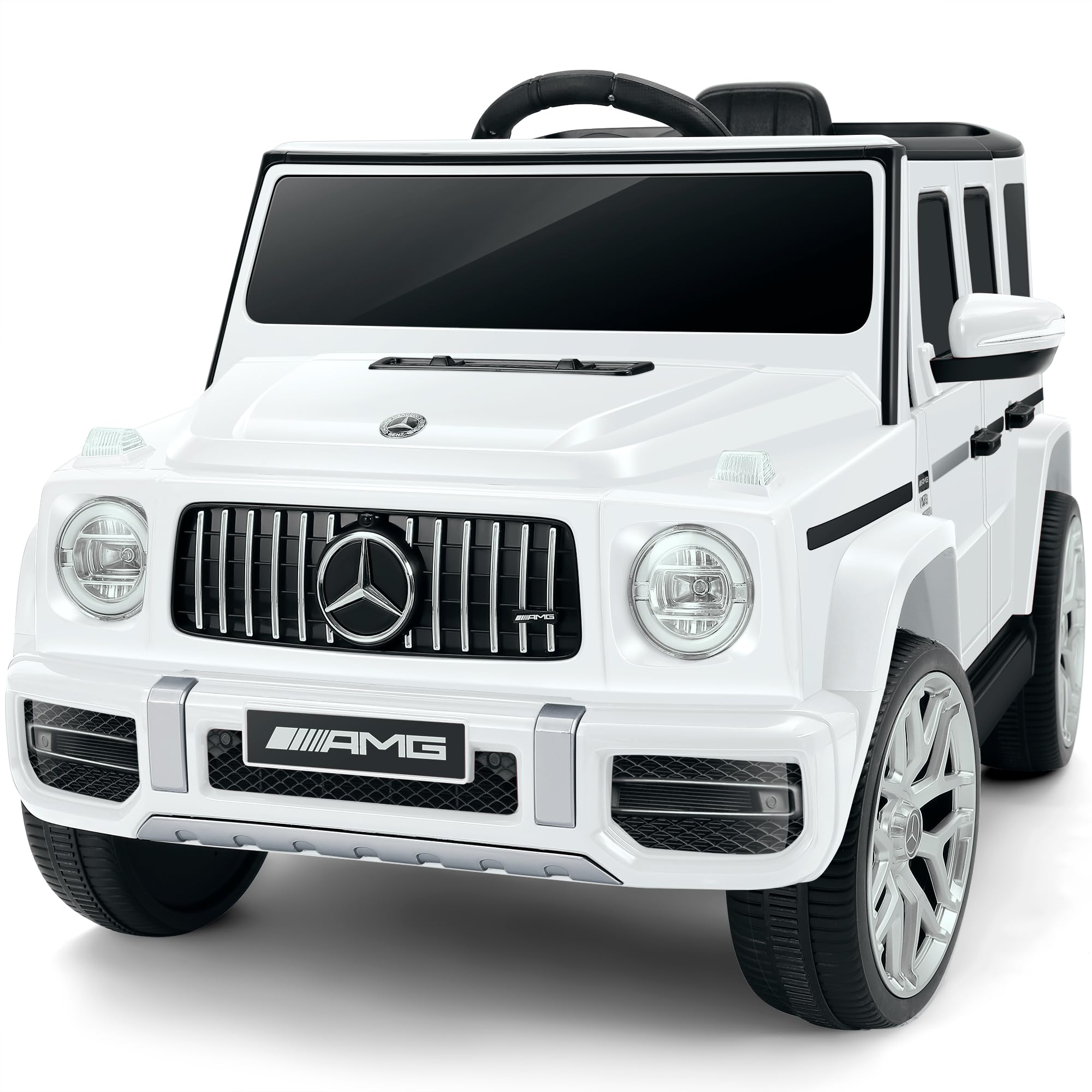
ELEMARA AMG G63
Key Features
- Footprint: 40.7 x 24.4 x 20.5 inches
- Stated run time: 2 hours
- Weight capacity: 66 lb
- Battery and motors: 12V, dual 35W
- Price: Midrange
Two licensed G-Wagens came through our testing, and the cheaper one is the one we keep recommending. The reason is not the badge. It is that every part which decides whether a ride-on is still fun three months in, meaning the pack, the drivetrain, the remote, and the way it rides over a cracked path, holds up here without the asterisks the other G63 carries.
The number that changes your afternoons is two hours of stated run time, the longest in this group, with dual 35W motors behind it. That is the difference between circling the driveway and walking to the end of the street and back. A 66-pound capacity covers a tall six-year-old, and at 34 pounds the car itself is light enough that one adult can haul it into the garage.
Two things to plan for. At 40.7 inches long it wants a wall rather than a corner of the playroom. And speeds come as a range rather than a single top figure, so start on the remote’s low step and work up. The low-battery prompt is a small feature we ended up caring about more than the lights and music, because it warns you before the walk home rather than after it.
Pros
- Longest stated run time here at two hours
- Clean record on battery, build, and ride
- 66-pound capacity fits a tall six-year-old
- Costs less than the other G-Wagen here
Cons
- 40.7 inches long; needs wall space
Start here: the cleanest record on battery, build, and ride of anything we tested, and it costs less than the other G-Wagen.
Best for Two Riders
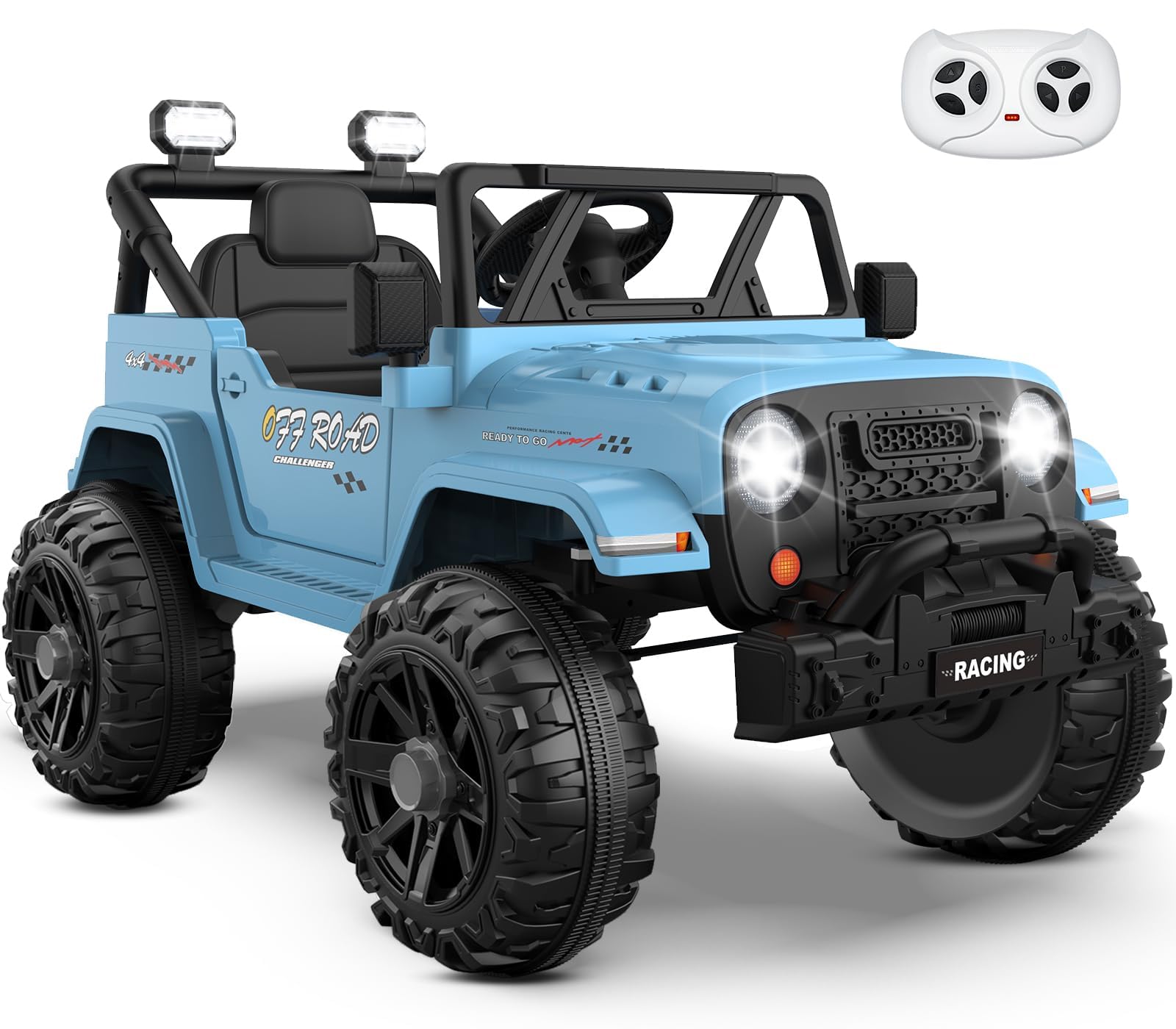
First Ride On Bronco 24V
Key Features
- Seats: Two, 21-inch bench
- Top speed: 2.0, 2.7, and 4.3 mph
- Weight capacity: 132 lb
- Battery and drive: 24V, dual drive
- Price: Premium
The second-child problem does not have many answers. This one solves it the obvious way: a 21-inch bench, two separate three-point belts, and a 132-pound capacity, so a five-year-old and a two-year-old ride at the same time instead of taking turns. Add 24 volts, dual drive, and four-wheel suspension and it is the only car here that behaves like a small vehicle rather than a toy.
Speed is quoted as three steps, 2.0, 2.7, and 4.3 mph, and the top one deserves some thought. That is faster than an adult walks, which is exactly what you want when a four-year-old is driving and exactly what you do not want where the pavement meets a road. We kept to the remote’s low step while the younger one was aboard, and the two coexisted fine.
It is the most expensive car here, and it is the one to choose for two riders or a sloping yard. A 132-pound limit means it stays in service long after a 12V single-seater has been outgrown. What you accept is size: 44 inches long, 56 pounds, and a folded seat in the car if it travels. Watch the rear wheels for play in the first week, since drivetrain trouble starts there.
Pros
- Two seats with two three-point belts
- 132-pound capacity outlasts a 12V single-seater
- 24V dual drive takes grass and slopes
- 4.3 mph keeps up with a walking adult
Cons
- 56 pounds and 44 inches long
- Hard plastic wheels are loud on pavement
For two children riding at once, this is the only real answer in the guide: a 24V two-seater with 132 pounds of capacity.
Best for Long Sessions
ANPABO Mercedes G63
Key Features
- Motors: Dual 35W
- Battery: 12V 7AH
- Footprint: 44 x 23 x 28 inches
- Weight capacity: 66 lb
- Price: Midrange
A 7AH battery is a large pack for a 12V ride-on. Capacity, not voltage, decides how long a child is out before the charger comes off the shelf again, and ANPABO put the money there rather than into stickers. Two 35W motors move it, the same pairing the other G-Wagen uses, so the pack is the real difference between them.
That pack is why it is our long-session pick, and the rest is standard-issue good. A 66-pound capacity takes a big six-year-old, the finish photographs like the real thing, and assembly goes together with the tools in the box. At 36 pounds it is heavy enough to want two hands when you move it, which is the honest cost of the bigger battery.
Two things to know before ordering. At 44 inches it is one of the longest 12V cars here and wants a wall rather than a corner. And the battery and charger are the parts that end a 12V car’s life, this one included, so note whether the charger light turns green in the first month and you will know where you stand.
Pros
- 7AH pack is the largest 12V battery here
- 66-pound capacity takes an older child
- Looks like the real G-Wagen
- Assembles with tools in the box
Cons
- 36 pounds, so it is a two-hand lift
- 44 inches long; needs garage wall space
The biggest 12V battery here, in a body that looks the part; our pick when afternoon range matters more than price.
Best for First Car
ARBELI 12V Toddler Car
Key Features
- Certification: ASTM F963, CPSIA
- Stated playtime: 1-2 hours
- Weight capacity: 50 lb
- Battery and motors: 12V, dual 35W
- Price: Budget
At the bottom of the price range, the two things that usually get cut are the soft start and the certification. ARBELI kept both. The car ramps up speed instead of lurching off the line, which matters with a two-year-old who is not holding on, and the build is certified to ASTM F963 and CPSIA.
The hardware is a 12V pack and dual 35W motors with a stated one to two hours of playtime, more than the money suggests. At 39 inches long and 30 pounds it goes into a shed without a fight and comes out without a second person, which is the sort of thing you notice every single weekend.
The limit is the rider. A 50-pound capacity is the lowest in this group, so a tall five-year-old is the end of the road and this is really a car for a two- to four-year-old. The seatbelt is also cut long for a small toddler; buckle it, lift the child’s shoulders, and check that it holds before the first ride rather than after.
We point buyers here when the goal is a first car that a toddler rides on the remote and a four-year-old drives around the patio. The steering wants more room than the footprint suggests, so give it a wide berth in a tight yard, and keep it on pavement, because this is not the car for a lawn.
Pros
- Soft start avoids the launch jolt
- Certified to ASTM F963 and CPSIA
- One to two hours of stated playtime
- 30 pounds and 39 inches, easy to store
Cons
- 50-pound capacity is the lowest here
- Seatbelt runs long on a small toddler
Our value pick for a first car: soft start, real certification, and dual 35W motors at the bottom of the price range.
Best for Small Riders
BTMWAY Lamborghini 12V
Key Features
- Battery: 12V 7A
- Seat size: 14.2 x 7.9 inches
- Top speed: 2.5 mph
- Rider limits: 55 pounds, 33 inches
- Price: Budget
Almost no ride-on tells you what size child it fits. This one does: a 33-inch height limit, a 55-pound weight limit, and a seat 14.2 inches wide by 7.9 inches deep. Measure your child against those three numbers before you order and you have your answer, which is more than most of these cars tell you.
The car underneath suits that small rider. Top speed is 2.5 mph, the slowest here, and we count that as a feature rather than a shortfall: at that pace a two-year-old on the remote is a passenger, not a projectile. Lockable doors, spring suspension, LEDs and music round it out, and the 12V 7A pack charges in 8 to 12 hours for one to two hours of running.
What you give up is growth. A child who clears 33 inches is looking at the seat rather than sitting in it, and the 55-pound limit closes the door a year or two before the bigger cars do. If you want one purchase to carry a child from nursery to school, this is not it. As a first car for a small rider, it is the easiest one here to buy with confidence.
Pros
- Publishes a height limit and seat size
- 2.5 mph is the calmest top speed here
- Lockable doors and spring suspension
- One to two hours per charge
Cons
- 33-inch height limit caps its useful life
- 55-pound capacity is on the low side
A slow, sweet-natured first car for a rider under 33 inches; the published limits mean you can buy it without guessing.
Best for Narrow Paths
Winado Chevrolet Colorado

Key Features
- Footprint: 40.15 x 21.65 x 22.83 inches
- Certification: ASTM and CPSIA
- Weight capacity: 66 lb
- Battery and motors: 12V, 2 x 25W
- Price: Budget
A pickup rather than a sports car, at a price that sits with the budget cars. The Colorado body is 40.15 inches long and, more usefully, 21.65 inches wide. That makes it the narrowest full-size car here, which is the difference between squeezing down the gap beside the house and carrying it through the front door every time.
Underneath there is 12V, two 25W motors, a 66-pound capacity, a three-speed remote, soft start, lockable double doors, and a stated ASTM and CPSIA certification. The 25W motors are the honest limitation: on grass the car slows where the 35W cars keep going, so treat pavement and short turf as home ground.
We rate it the best of the budget 12V cars. It is certified, it takes a big six-year-old, and it asks for less width than anything else in the group. The parts to watch are the usual ones: how the charger behaves in month one, and a battery that ultimately decides how many summers the car gets.
Pros
- 21.65 inches wide, the narrowest here
- Stated ASTM and CPSIA certification
- 66-pound capacity at a budget price
- Three-speed parental remote
Cons
- 25W motors slow noticeably on grass
The budget 12V we recommend: certified, narrow enough for a side path, and rated to 66 pounds.
Best for Flat Pavement
Miniature Motors 12V Truck

Key Features
- Top speed: 3.5 mph
- Stated run time: 50 minutes
- Weight capacity: 66 lb
- Battery and motors: 12V, twin 35W
- Price: Budget
The steering is the first thing we noticed: this truck wants more room to turn than 39 inches of car should need, and the back end gets light on any kind of slope. Keep it on level pavement and that stops mattering, and on level pavement it is the quickest route to a driving kid for as little money as anything here. Twin 35W motors push it to 3.5 mph, fast enough for a four-year-old to feel it.
There is a lot to like at this size. At 26.4 pounds it is light enough for one adult to lift into a shed or a trunk, the four-wheel suspension softens a brick path, and the seat takes a 66-pound rider. Assembly goes quickly with the spanners in the box, though the steel wheel needs a firm press before it locks in, and that is the step that catches people out.
The number to think hardest about is 50 minutes, the stated run time and the shortest here. That is a loop of the block with play at each end rather than an afternoon at the park, so plan on the charger coming out between outings instead of after a week of them.
Pros
- 26.4 pounds is the easiest lift here
- Twin 35W motors reach 3.5 mph
- Four-wheel suspension and 66-pound seat
Cons
- Turns wide and feels light on slopes
- 50-minute stated run time is the shortest here
Quick, light and cheap, and happiest on flat pavement; buy it for a driveway, not a sloping yard.
Best for Tight Storage
Fillfulfun CLS 350

Key Features
- Footprint: 35.43 x 23.62 x 15.75 inches
- Product weight: 19 lb
- Weight capacity: 66.1 lb
- Battery and motors: 12V, dual 25W
- Price: Budget
At 35.43 inches long, 15.75 inches tall, and 19 pounds, this is the smallest car in the group by a clear margin, and the only one that goes on a shelf in the garage rather than taking a wall. The seat also sits low enough that a toddler climbs in without being lifted, which you will appreciate about forty times a week.
The rest of the specification is more generous than the size suggests: a 66.1-pound capacity, 12V and dual 25W motors, spring suspension, a parent remote, Bluetooth, LEDs and music. It is rated 3 to 6 years, but the shape tells the truth: the seat is a small bucket and the legroom runs out early.
Practically, treat the 66-pound rating as generous. Height and legroom will retire this car long before weight does, and the 25W motors are happiest on paving and short grass rather than a long lawn.
We keep it on the list for one reason: storage. If the choice is between a ride-on that lives in the hall cupboard and no ride-on at all, this is the one that fits the cupboard. For a big yard, the 12V cars with 35W motors and longer bodies are the better buy.
Pros
- Smallest and lightest car here
- 66.1-pound capacity in a tiny body
- Low seat a toddler can climb into
- Spring suspension and parent remote
Cons
- Legroom runs out early
The one to buy when storage is the constraint: smallest and lightest here, and still rated to 66 pounds.
How We Chose and Tested the Best Electric Cars for Kids
To build our shortlist, we read through owner reviews and spec sheets for dozens of ride-on cars, then narrowed the field to eight models that covered the most common sizes, seat configurations, and price bands. We assembled each car ourselves with a stopwatch running, noting missing hardware, vague diagrams, and whether body panels needed force. Kids ages three to seven then drove them on a concrete driveway, a sloped sidewalk, a grassy backyard, and a paved park loop over eight months.
At each session, we timed how long a full charge lasted and how long recharging took, and we watched for the telltale slowdown before a battery quit. Remote control got its own test: we walked to the far end of the driveway, tapped the controls, and noted any lag, then used the override to stop a car aimed at a flower bed. We also cycled through forward, reverse, speed modes, and brakes, and checked whether lights and sounds still worked after a few weeks of use.
To judge durability and stability, we sent the cars over curbs, grass, and gravel, then inspected wheels, axles, and body panels for cracks or wobble. We took turns at speed on pavement and lawn to see which cars felt planted and which lifted a wheel. Size mattered too: we measured each footprint against a garage bay and a garden gate, and checked seat height and legroom for different kids. Finishes were checked after scuffs and a hose-down, and we tracked which cars the kids returned to after the first week—the simplest read on enjoyment. Finally, we compared what came in the box, from chargers to remote systems, against the going rate for similar cars.
How to Choose an Electric Car for Kids
The car that gets used is not the one with the best badge on the grille; it is the one whose seat fits your child, whose battery survives your charging routine, and whose speed suits the ground you actually have.
Fit comes before everything else
Age ratings on these cars are loose. Nearly all of them say 3 and up, and plenty of two-year-olds ride them on the remote. What decides whether the car gets used is height and seat size: a 33-inch height limit with a 14-inch-wide seat is a very different proposition from a 132-pound limit with a 21-inch bench.
Put your child’s measurements against those numbers rather than the age on the box. A car with a small bucket seat will be outgrown long before its weight limit is reached, which is why the listings that publish a height or a seat measurement are worth more than the ones that publish a bigger battery.
12V or 24V, and what a top speed feels like
Voltage tells you how much car the motors are moving, not how fast it goes. The 12V cars here run from 2.5 to 3.5 mph: 2.5 is a brisk adult walk, 3.5 is a jog, and both are easy to manage with a remote in your hand. The single 24V car reaches 4.3 mph and carries two children, which is the point of it.
Buy 24V for a second rider or a slope, not for speed. At 4.3 mph the car outruns a walking adult, so the remote’s low step becomes the setting you live in for the first season anyway.
Battery capacity buys you an afternoon
A 12V pack is sold by capacity. 4.5AH is the common budget size, 7AH is the bigger one, and the stated run times in this group stretch from 50 minutes to two hours. Charging takes 8 to 12 hours, which is why capacity matters more than it looks: a bigger pack means one charge covers the afternoon rather than half of it.
Quoted run times assume a light rider on flat ground, and grass, a heavier child, and a slope all shorten them. The pack is also the part that eventually ends a ride-on’s life, so note whether the charger light turns green in the first month and you will know early.
The remote matters more than the lights
Every car here has a parent remote, and they do not all behave the same. What you want is a remote that takes over from the pedal instantly, with three speed steps and a stop that works at the far end of the driveway. The trap is the remote that pairs and steers but never quite overrides a child standing on the pedal.
Test the stop button at arm’s length before the first real ride, and test the range where you will actually use it. A garden with a hedge and a fence is not the same as an open parking lot.
Match the car to the ground
Plastic wheels and 25W motors are fine on pavement and short turf, and they struggle in longer grass and on slopes. If your yard is a lawn, buy power: 35W motors and four-wheel suspension are the difference between a car that crosses the grass and one that sulks at the edge of it.
If your driving is a driveway and a patio, a lighter, slower car is easier to live with, and far easier to move out of the way when the mower comes out.
Frequently Asked Questions
Can my 2-year-old use one of these cars?
Yes, as a passenger with the remote in your hand. Most of these are rated 3 and up, and a two-year-old rides with a parent steering rather than driving.
The thing to check is the harness. Buckle the child in and see whether the belt holds the shoulders or slides off them, because a belt cut for a five-year-old will not hold a small toddler.
How long does assembly take?
Plan on half an hour to an hour with one adult, and have a second person for the wheels and axle. Tools are usually in the box.
Do the steering check before the first charge: turn the wheel lock to lock and watch whether the front wheels match it. A car that pulls to one side is usually an alignment problem, not a motor problem.
Will it fit in my car to take to the park?
Check length and weight, not trunk volume. The smallest car here is 35.4 inches long and 19 pounds, which goes into a hatchback with the seats up. The largest is 44 inches and 56 pounds and wants a folded seat or a truck bed.
Measure the opening you would actually lift it through, and remember that swinging 56 pounds over a sill is a two-person job.
Can two children ride at once?
Only in a car built for it. Adding two children’s weights against a 66-pound capacity is not the test, because a single bucket seat with one belt is a one-rider car however the numbers add up.
The two-seater here is the 24V Ford Bronco, with a 21-inch bench, two three-point belts, and a 132-pound limit. Everything else in this guide is one child at a time.
Final Verdict
The ELEMARA G63 is the car we point most families at. It has the longest stated run time in this group, a 66-pound capacity that covers a tall six-year-old, and the cleanest record on the parts that actually fail, which is why it edges out the larger G-Wagen that costs more.
If two children need to ride together, the 24V Bronco is the only car here that does it. If you want the largest 12V pack on the page for long afternoons, take the ANPABO instead.
