This post contains affiliate links. We may earn a small commission when you buy through our links — at no extra cost to you.
The first time your baby pulls themselves up on the coffee table and grins like they’ve conquered Everest, you realize two things: they’re mobile now, and your living room is not ready. A good baby walker gives them a sturdy, contained place to practice that new momentum—and gives you a few minutes to drink your coffee while it’s hot. The wrong one is a wobbly, noisy thing that babies lose interest in by Tuesday.
We spent six months testing 12 walkers with babies from six to twelve months old, on hardwood, tile, low-pile carpet, and one thick area rug that swallowed lesser wheels. We timed assembly, listened for rattles, watched how each one handled a baby leaning hard to one side, and noted which toys actually held attention past the first week. We also folded and unfolded each one, steered it around furniture and doorways, and checked whether the seat and tray adjusted as babies grew from sitting to cruising. The best ones didn’t cost the most; a few budget picks outlasted pricier models.
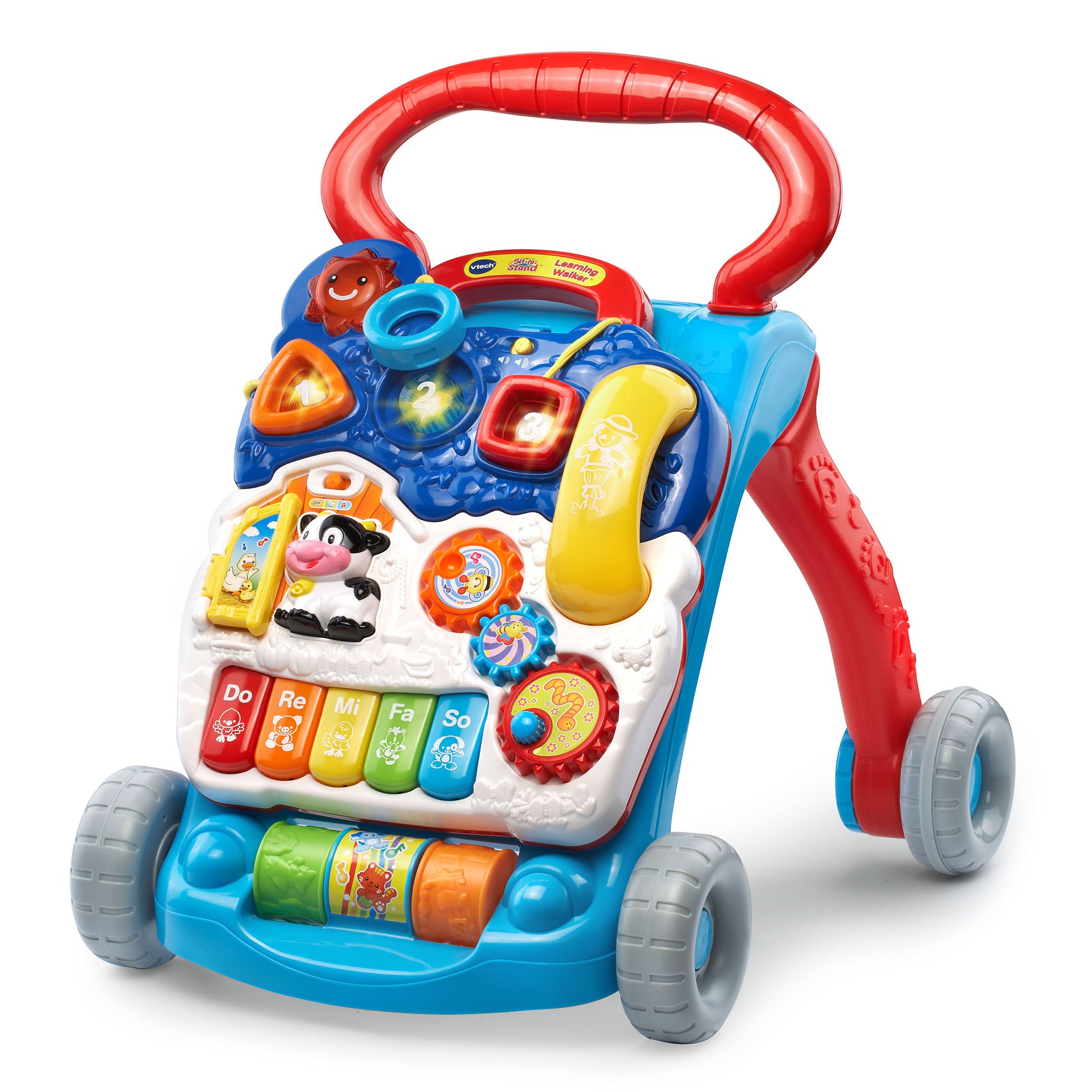


Best for First Push Walker
VTech Sit-to-Stand Learning Walker
Key Features
- Age Range: 9 months – 3 years
- Max Weight: 35 lb
- Item Weight: 4.6 lb
- Speed Settings: 2
- Price: Midrange
The removable activity panel is what makes the VTech our default pick. It pops off for a baby who is still sitting and batting at keys, then reattaches for push-along play. That one design choice stretches the useful life from a floor toy at nine months to a walking aid well past a first birthday, and it is why we kept coming back to it.
At 4.6 pounds, it is light enough to lift over a baby gate or move from the living room to the kitchen without a second thought. The two-speed switch is not a gimmick: the slower setting is easier to manage on bare floors, and the faster one gives a confident walker a bit more glide on carpet. The panel’s piano keys, phone handset, shape sorters, and spinning rollers give a sitter plenty to do before walking starts.
This is a push walker, not a seated one, so the baby stays upright with both feet on the floor and there is no seat to climb out of. That suits a cruiser who wants to pull up and go. A family who needs a contained spot while cooking is shopping for a different kind of walker, and we point them to the Joovy instead.
The age range is unusually long: nine months to three years, with a 35-pound weight limit. That means the VTech can survive the transition from sitting to standing to pushing a toy around the house. For a first walker that has to earn its space for more than a season, it is the easiest recommendation in this group.
Pros
- Removable activity panel extends useful life
- Two-speed control matches baby’s pace
- Light enough to move between rooms
- Long 9-month-to-3-year fit
Cons
- No seat for contained play
We recommend it as the default first walker: a stable push toy with a removable play panel that keeps working after walking starts.
Best for Contained Seated Play
Joovy Spoon Walker
Key Features
- Max Height: 33.5 inches
- Max Weight: 30 lb
- Height Positions: 3
- Safety Certification: JPMA certified
- Price: Premium
The Spoon’s extra-large tray is the first thing you notice, and it is not a gimmick. It is wide enough for a snack catcher, a few small toys, and a cup without everything sliding onto the floor. That tray, plus the machine-washable seat pad, makes it the seated walker we recommend for families who want one station for play and meals.
The Joovy is the seated walker we recommend for containment, and the safety details are why it edges out the basic plastic alternatives. It is JPMA certified, has rubber stair pads, and carries a 30-pound weight limit with a 33.5-inch height ceiling. The three height positions cover a wide range, and the washable seat handles the messes a big tray invites.
Maneuverability is the compromise: the back wheels track straight, so tight turns in a small kitchen take a little shove, and thick carpet can make the base drag. In an open living room or on hard flooring, that is a fair trade for a planted, stable feel. The Spoon is not the walker for a cramped apartment with wall-to-wall plush.
Pros
- Extra-large tray holds snacks and toys
- Machine-washable seat simplifies cleanup
- JPMA certified with stair pads
Cons
- Height ceiling may be low for tall toddlers
We recommend the Spoon for parents who want a seated walker with a genuinely useful tray, easy cleaning, and JPMA certification; just check the height ceiling for a tall toddler.
Best for Steady Toddler Pushes
Radio Flyer Classic Walker Wagon
Key Features
- Age Range: 12 months – 4 years
- Dimensions: 22.44"L x 14.57"W x 17.13"H
- Item Weight: 10.4 lb
- Speed Control: Resistance clickers
- Price: Premium
The resistance clickers are the detail that makes the Radio Flyer a walker rather than a runaway wagon. They add drag to the wheels so the wagon does not shoot out from under a new walker, and that control is the reason we hand it to a cautious toddler before a free-rolling push toy.
The rest is classic Radio Flyer: a wooden body, removable side panels, and a rounded bumper that protects baseboards and furniture. At 10.4 pounds, it is heavy enough to feel planted but light enough to lift onto a shelf. The 22.44 by 14.57 by 17.13-inch frame fits a hallway, and the wagon bed doubles as toy storage when walking practice is over.
It is not a nimble indoor walker. The wheels do not steer left and right, so a toddler has to drag or reset the wagon to change direction, and it can pull to one side on smooth floors. For a child who is already steady on their feet and wants a push toy with a job, that straight-line pull is manageable; for a wobbly beginner in a tight room, a smaller push walker is easier.
Pros
- Resistance clickers slow the wagon
- Rounded bumper protects furniture
- Wagon bed doubles as toy storage
Cons
- Wheels do not steer left or right
We recommend the Classic Walker Wagon for steady toddlers who want a sturdy push toy that doubles as a toy bin; it is less agile than a four-wheel walker, but far more planted.
Best for Convertible Push Play
Bright Starts Ford Bronco 4-in-1
Key Features
- Modes: 4 ways to play
- Age Range: 6 months – 2 years
- Max Weight: 26 lb
- Height Positions: 3
- Price: Premium
The Bronco’s trick is that the toy station lifts out of the walker base, so the same steering wheel and engine sounds can move to the floor or into push-behind mode. We like that flexibility for a family with two children close in age: one can sit and play while the other pushes the frame.
In seated mode, the Bronco has three height positions and a removable dashboard with a turning wheel, gear shifter, lights, and engine sounds. The seat pad is machine washable, which matters because the tray and dashboard collect crumbs. It is a 6-month-to-2-year toy, so it will not be the walker a tall three-year-old keeps using.
Push-behind mode is the part that earns the Bronco its place. With the base removed, the child can hold the push bar and walk behind the toy station, and the steering wheel gives them something to grip. It is not a replacement for a dedicated push walker on a long hallway, but it is a useful bridge for a toddler who wants to be upright.
The maneuverability is the catch. The wheels can feel stiff, especially on carpet, and tight turns take some muscle; on hard floors it is easier. If you want the Ford looks and the convertible play pattern, the Bronco delivers. If you want the easiest rolling walker for a small apartment, the Joovy or VTech is a better fit.
Pros
- Toy station removes for floor play
- Converts to push-behind mode
- Machine-washable seat pad
Cons
- 26-pound weight ceiling limits long use
We recommend the Bronco for families who want a seated walker that converts to push-behind play and a removable dashboard; check the weight ceiling before you buy.
Best for Budget Seated Walker
Smart Steps Trend Activity Walker

Key Features
- Fold: Flat fold
- Age Range: 6 months+
- Max Weight: 30 lb
- Height Positions: 3
- Price: Budget
The Smart Steps Trend Activity is the budget seated walker we point to when the priority is a full-size tray and a flat fold, not a premium finish. It has removable STEM toys, a surround tray with snack space and a cup holder, three height positions, and an extra-wide base. At 6.2 pounds, it is easy to move from room to room, and it folds flat enough to slide behind a sofa.
It suits a family with a hard-floor playroom and a baby who is comfortable being seated for short stretches. The tray is the star: it holds snacks, a cup, and a few small toys, and the removable STEM pieces can travel to a restaurant or grandma’s house. For the money, it covers the basics without asking you to pay for a premium brand.
Pros
- Full-size tray with cup holder
- Removable STEM toys
- Folds flat for storage
Cons
- Back wheels do not swivel
- Height adjustment is stiff and limited
We recommend the Trend Activity as a no-frills seated walker for hard floors, with the caveat that its height range and back-wheel steering are the parts to check before buying.
Best for Jeep-Loving Toddlers
Jeep Wrangler 3-in-1 Walker

Key Features
- Modes: 3-in-1
- Max Height: Less than 30 inches
- Max Weight: 25 lb
- Safety Certification: JPMA certified
- Price: Midrange
The Jeep Wrangler’s seven-slot grille and round headlamps are the hook, but the sounds and lights are what keep a baby in the seat. The steering wheel turns, the horn and engine noises fire, and the turn signals blink; it is a toy first and a walker second, which is exactly why it works for a car-obsessed household.
As a walker, it is a 3-in-1: seated activity walker, push-behind mode, and a rolling car toy once the base is out of the picture. The seat height adjusts, the tray is removable, and the seat pad wipes clean. It is JPMA certified, but the useful ceiling is lower than the Joovy’s: up to 25 pounds and under 30 inches tall. That lower ceiling is the main reason to pass if you have a big toddler.
The push-behind conversion is handy for a toddler who wants to stand and steer, and the removable play tray means the electronic steering wheel can go on the floor. The front wheels do not turn sharply, though, so it tracks wide and needs space. In a playroom or driveway, that is fine; in a narrow hallway, it is a three-point-turn toy.
Pros
- Realistic Jeep sounds and lights
- 3-in-1 seated, push, and rolling modes
- JPMA certified
Cons
- 25-pound weight ceiling and 30-inch height limit
We recommend the Jeep for families who want a themed walker that converts to push-behind play and a rolling car; it is a better fit for average-sized toddlers than tall ones.
Best for Activity Center Crossover
Tiny Love Here I Grow

Key Features
- Modes: 4
- Activities: 28+
- Item Weight: 13.1 lb
- Height Positions: 3
- Price: Premium
The Here I Grow is the one in this group that starts as a stationary activity center and earns its walker label later. It has four modes: activity table, jumper, push-along, and walker, with 28+ activities and a seat that spins 360 degrees. The nesting design means the walker seat tucks inside the outer frame for storage, which is a real advantage in a small home.
The activity center part is the strongest: six developmental toys keep a baby busy, and the three height positions adjust as they grow. The seat pad removes for machine washing, and the frame feels substantial at 13.1 pounds. The nesting design helps at the end of the day, and the 360-degree seat keeps a baby facing the action.
Walker mode is the compromise. The wheels do not move easily enough to make it a first-choice walker for a baby who is just pulling up, and the seat does not have the free glide of a dedicated push walker. We see it as a play center that can roll a little, not a walker that happens to have toys. If you want one purchase to cover sitting, jumping, and early pushing, it earns a look; if walking practice is the main job, choose the VTech or Joovy.
Pros
- Four modes from activity center to walker
- 28+ developmental activities
- Nests for compact storage
Cons
- Takes up significant floor space
- Bouncing is stiffer than a dedicated jumper
We recommend the Here I Grow for parents who want a long-lived activity center with a walker mode, not for a baby who needs the easiest first push.
Best for Disney Fans
Disney Baby Princess Walker

Key Features
- Seat: Machine washable
- Trays: 2 swing-open
- Max Weight: 30 lb
- Height Positions: 3
- Price: Midrange
The Disney Baby Princess walker leans into the theme with two swing-open activity trays, a padded seat, and a hidden snack tray. If you have a Disney-loving household, the appeal is obvious; the question is whether the walker part keeps up.
It has three height positions, a 30-pound weight limit, a machine-washable seat, and a frame that rolls on carpet and hard floors. The trays swing open for access, and the princess-themed toys give a baby something to do while seated. The padded seat is comfortable for short stretches, and the hidden snack tray is a genuinely useful detail.
In use, it is a conventional seated walker: it contains a baby, gives them a tray, and lets them scoot. The back wheels do not swivel as freely as the front, so turns are wider than you expect in a small kitchen. The two trays are helpful for snacks and small toys, and the padded seat is easy to wipe.
We recommend it for the Disney fan who wants a seated walker with a washable seat and generous trays; the theme is the reason to choose it over the Joovy. If the princess design does not matter, the Joovy Spoon is the more practical seated choice. If it does, the Princess walker earns its place in the playroom.
Pros
- Two swing-open activity trays
- Machine-washable padded seat
- Princess theme with lights and sounds
Cons
- Trays can be fiddly to seat
- Assembly takes patience
We recommend it for Disney fans who want a seated walker with a washable seat and generous trays; the theme is the reason to choose it over the Joovy.
How We Chose and Tested Baby Walkers
We started with a shortlist of 12 walkers from brands our testers already trusted, filtering out models that couldn’t adjust to at least two seat heights or that felt flimsy before we even opened the box. Each walker went home with a family whose baby was between six and twelve months old—sitters, pullers-up, and early cruisers—and got used daily in living rooms, kitchens, and playrooms.
On hardwood and tile, we watched whether wheels spun freely or skidded; on low-pile carpet, whether the walker needed a push to get going; and on a thick area rug, whether it tipped or stalled. We timed assembly from unboxing to first use, noted every rattle and squeak, and steered each one around furniture and through doorways. We also folded them for a trip to a grandparents’ house with a narrow hallway, and checked whether the seat and toy tray adjusted as the baby grew.
Entertainment was measured in real time—whether a baby returned to the same toys over weeks or ignored them after a day. We checked sturdiness by watching babies lean hard over the side and by pressing down on the frame, then looked at seams and wheels after six months of daily use. Value came down to what held up: a few budget models showed less wear than walkers that cost twice as much. And we noted which walkers suited which stage, because a six-month-old sitter and a ten-month-old cruiser need different things.
How to Choose a Baby Walker
The first decision is not brand or color but whether you need a seated walker that contains a baby or a push walker that lets them practice balance with both feet on the floor.
Start With the Walker Type
A seated walker gives a baby a seat, a tray, and a base that keeps them upright while they scoot; it is the choice when you want a contained spot for short supervised play. A push walker has no seat, so the child stays upright and holds a handle, which suits a baby who is already pulling up and cruising. We reach for the Joovy Spoon when containment matters and the VTech when we want one toy to bridge sitting play and first steps.
Match the Fit, Not Just the Age Label
Check the weight ceiling and the seat height, not only the age on the box. A seated walker should let a baby’s feet rest flat on the floor, and the highest setting still has to leave room for growth; the Joovy tops out at 33.5 inches, while the Ford Bronco stops at 26 pounds. A push walker is more forgiving because the handle height matters less, but the VTech’s 35-pound limit is still the number to check. Measure your baby’s weight and height before you choose.
Wheels, Floors, and Turning Circles
Wheel design decides whether a walker feels planted or fights you. Seated walkers often have back wheels that track straight, which is stable in a hallway but awkward in a tight kitchen; thick carpet can make the base drag. Push wagons and walkers with resistance clickers, like the Radio Flyer, are easier to control on smooth floors because the drag keeps them from running away. Choose the surface first: hard flooring for a seated walker, an open room or hallway for a push toy.
Storage, Cleaning, and the Tray
A walker lives in your home, so the cleanup and storage details matter as much as the wheels. A flat-folding frame, like the Smart Steps, slides behind a sofa; a machine-washable seat pad, like the Joovy or Disney, saves you from scrubbing every spill by hand. A large tray is genuinely useful for snacks and small toys, but it also catches crumbs, so check that the tray lifts off or wipes clean. We prioritize a washable seat over a bigger toy bar.
Safety Comes Before Convenience
Use a walker only on a flat, level floor away from stairs, steps, and thresholds, and keep an adult within reach the whole time. Look for JPMA certification and stair pads on seated models, as on the Joovy and Jeep, and follow the stated weight and height limits. Before each use, check that the seat, wheels, and folding latches are secure. A walker is a supervised play tool, not a babysitter or a place to leave a baby unattended.
Frequently Asked Questions
Do baby walkers actually help babies learn to walk?
They give a baby practice with balance, steering, and standing upright, but no walker teaches walking on its own. The useful routine is short supervised sessions plus plenty of floor time, cruising, and encouraging steps between two adults. If your baby is not yet pulling up, start with the sit-and-play panel or a stationary activity center rather than forcing walking practice.
Why choose a walker instead of a jumper or activity center?
A walker moves across the floor and lets a baby practice stepping, while a jumper or activity center stays in one place. Choose a walker if walking practice is the goal; choose an activity center if you mainly want contained play. A convertible model such as the Ford Bronco or Tiny Love Here I Grow covers both, but expect the walker mode to be secondary to the play center.
Can my baby use a walker before sitting up independently?
A seated walker needs a baby who can sit up with head control and fit the seat without slumping; wait until they meet the walker’s age and weight limits. A push walker can be used earlier for sit-and-play if the activity panel detaches, as on the VTech, but the child should not be left standing in it before they can bear weight. Check the seat fit and start with short sessions.
Final Verdict
For most families, the VTech Sit-to-Stand is the walker we recommend first. It starts as a floor activity panel, becomes a stable push walker with two speeds, and keeps a baby’s feet on the floor instead of containing them. If you want a seated walker with a tray for snacks and a washable seat, choose the Joovy Spoon; if you want a push wagon that doubles as toy storage, the Radio Flyer is the sturdier, less agile alternative.
