This post contains affiliate links. We may earn a small commission when you buy through our links — at no extra cost to you.
Foam play blocks are the rare toy that earns its floor space: soft enough that a toddler can face-plant onto them, firm enough to build a fort a five-year-old will defend. The catch is that softness cuts both ways. Cheap foam dents under a knee, sheds crumbs along the seams, and slides apart the second a tower gets ambitious — so what you’re actually shopping for is density, and a shape that stacks honestly.
I’ve watched plenty of toys get abandoned by Tuesday, but these get played with daily when they’re right. Over the past six months, my team and I have lived with 10 sets in playrooms, living rooms, and one very crowded basement, and the ones that held up shared three things: dense foam, clean seams, and color that didn’t wash out after a wipe-down. One thing nobody tells first-time buyers — bigger blocks suit younger kids, not older ones, since small hands need a piece that won’t tip the whole tower. Ahead are the sets worth clearing a corner for.


Best for Toddlers Building Big
LOLO TOYS Large Foam Blocks
Key Features
- Pieces: 30
- Storage: Clear storage bag
- Material: EVA foam
- Recommended age: 36 months to 12 years
- Price: Midrange
Large is the whole point, and LOLO gets the scale right: these are pieces a preschooler carries in one hand and stacks with two, not the finger-sized bricks that end up in the vacuum. Thirty blocks in six colors arrive with a clear storage bag, and the EVA foam is dense enough that a tower holds its line instead of bowing.
That density is why we put this set at the top. Soft blocks that collapse under their own weight teach a child that building does not work, and these stay put through a wobbly third or fourth layer, which is about where a three-year-old’s ambition runs out. They also wipe clean in seconds and float, so a few can migrate to the bath without any fuss.
Blocks get thrown, sat on and chewed, and this foam takes all three: corners survive a mouthful and the pile still looks intact after a playdate. The bag is the quiet hero of the set — thirty loose blocks on a hardwood floor at bedtime is a different evening from thirty blocks in a bag by the door.
The catch is the age floor. LOLO lists 36 months and up, and that fits a set built for stacking rather than mouthing. In a mixed-age house this is the older child’s set; the baby needs something squishier, and the two can share a shelf without either being a compromise.
Pros
- Chunky blocks a preschooler can grip and stack
- Dense EVA keeps towers standing
- Wipes clean and floats for bath play
- Storage bag keeps all 30 pieces together
Cons
- Stated age starts at 36 months
For most families with a three-year-old and up, this is the set we point to: big, dense blocks that stack properly, survive a throw, and go back in the bag.
Best for Babies and Cleanup
UHAPPYEE Foam Soft Cubes
Key Features
- Covers: Removable and washable
- Pieces: 12
- Block size: 5.5 inch cubes
- Recommended age: 6 months to 3 years
- Price: Premium
A zip is the detail that sets these apart. Each of the twelve 5.5-inch cubes is a sponge inside a fabric cover that comes off, so the block your toddler has been dragging across the kitchen floor can go in the wash while the cube keeps its shape. Six bright colors, soft edges, and nothing hard anywhere inside.
We rate this the best of the group for babies and for households where sticky hands are the norm. These are the softest blocks here: a one-year-old can flop onto them, and a thrown cube lands with a thud rather than a crack. The trade-off is firmness — fabric-covered sponge squishes under a tall tower, so this is a stacking and knocking-down set rather than a construction set.
Twelve cubes also caps what you can build: enough for a wall, a tower and a game of catch, not enough for the castle a five-year-old has in mind. The listed age stops at three years for a reason — this is the set for the stage when everything gets mouthed and thrown, not one that grows into school years.
Pros
- Zip-off covers go straight in the wash
- Softest cubes here to fall on
- Bright colors across six shades
Cons
- Fabric squishes under tall towers
- Only 12 pieces to build with
If your builder is under two, or you are the one doing the cleaning, these zip-off cubes are the ones we hand over without a second thought.
Best for Letters and Numbers
MOBU ABC and Number Foam Blocks
Key Features
- Pieces: 30
- Storage: Reusable storage bag
- Printed faces: Letters, numbers, words, pictures
- Recommended age: 3 years and up
- Price: Budget
Every one of the 30 cubes is printed on all six sides with letters, numbers, simple words and pictures, which turns a stack into a spelling game without a worksheet in sight. A three-year-old can hunt for the first letter of their name; a five-year-old can line up one to ten and knock the whole row down.
The blocks are small EVA cubes — light, quiet, wipeable, and sized so a full alphabet fits in the storage bag that comes with them. Be clear-eyed about that: these are tabletop blocks, not the jumbo pieces a toddler hauls across the room, and the three-years-and-up label reflects it.
For the letters-and-numbers job this is the set we pick, and it earns that on the printing rather than the foam: thirty cubes, six faces each, and enough content to keep a four-year-old at the kitchen table. The one wrinkle is color — orders vary, and pastel sets turn up where primary colors were expected.
Pros
- Letters, numbers, words and pictures on six faces
- Light cubes with a storage bag
- Wipeable EVA for tabletop play
Cons
- Small tabletop cubes, not jumbo blocks
- Color mix varies between orders
Buy this one for the child who is starting to spot letters — the printing does the teaching, and the foam keeps it quiet on a tabletop.
Best for Elaborate Builds
Pairez Toys 138-Piece Foam Blocks
Key Features
- Pieces: 138
- Shapes: 19+
- Bath play: Waterproof, floats
- Recommended age: 18 months to 8 years
- Price: Midrange
A hundred and thirty-eight pieces in nineteen shapes is a different kind of toy from a bucket of cubes. There are long pieces to lay a base, small ones to fill the gaps, and enough colors that a build can have a roof, a door and a window without running out of parts halfway.
It is also the set that goes in the bath. The EVA is waterproof and floats, so a handful of pieces double as boats, and the lot wipes down afterward. What you give up is heft: this is an assortment of small pieces, and small pieces scatter, slide under furniture and vanish far more readily than the jumbo blocks here.
Where this earns its place is the four-to-eight stretch, when knocking a tower down stops being the whole game and building something specific takes over. Our pick for the most ambitious builder in the house — with one caveat: the pieces are small enough that this stays a supervised toy until a child stops putting things in their mouth.
Pros
- 138 pieces in 19 shapes
- Waterproof pieces float in the bath
- Enough variety for roofs, walls and windows
Cons
- Small pieces scatter and get lost
- Soft foam picks up lint and hair
The set we hand to a kid who has moved past knocking things down: 138 small pieces, nineteen shapes, and enough of both to build something with a roof.
Best for Older Builders
Deekin Foam Brick Blocks
Key Features
- Pieces: 30
- Material: EVA foam
- Block size: 8 x 4 x 2.4 inches
- Recommended age: 6 years and up
- Price: Premium
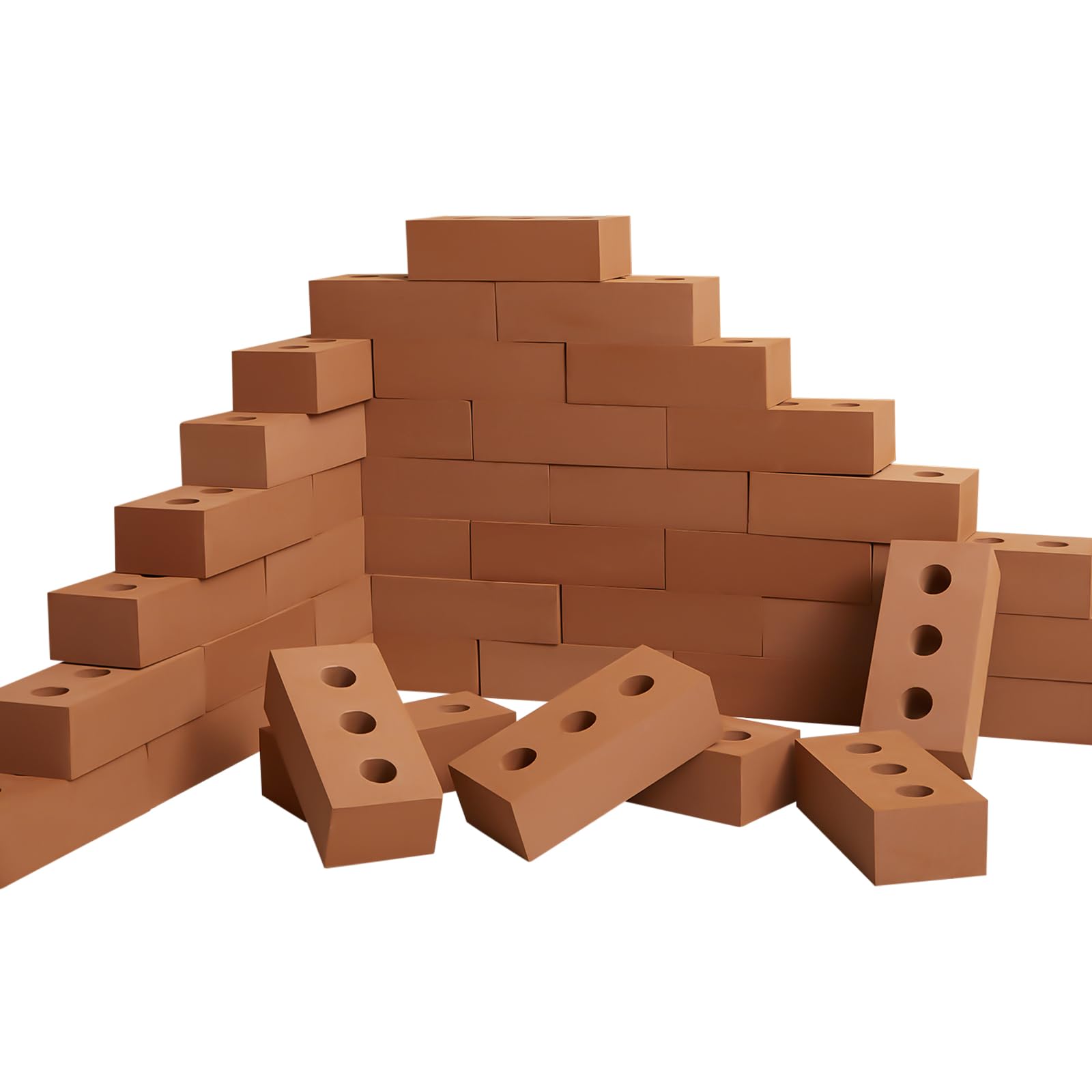
These are not stacking blocks in the usual sense. They are 30 foam bricks, each 8 by 4 by 2.4 inches and molded to look like the real thing, with a red finish that reads as brickwork from across the room. For the kid who wants to build a wall and then demolish it, we think that realism is worth more than another bucket of pastel cubes — and it is the only set here that patterns like actual brick. It is also the priciest thing on this list.
The catch is range. One shape means walls, columns and steps, not castles with windows, and the set is aimed at adults as much as children — six years and up, with craft and display use in mind. Buy it for an older builder with a project; a toddler gets nothing from it that the jumbo sets do not give more cheaply.
Pros
- Realistic brick look in 8-inch pieces
- Dense EVA stacks into a wall
- Light enough to knock down safely
Cons
- One shape only, so walls rather than castles
- Stated age starts at six years
For an older kid who wants bricks that look like bricks, this is the set — one shape, real proportions, and a pile of them builds a wall worth knocking down.
Best for First Block Set
Pleykele 25-Piece Foam Blocks
Key Features
- Colors: Six colors
- Pieces: 25
- Block size: 1.9 inches and up
- Recommended age: 18 months and up
- Price: Budget
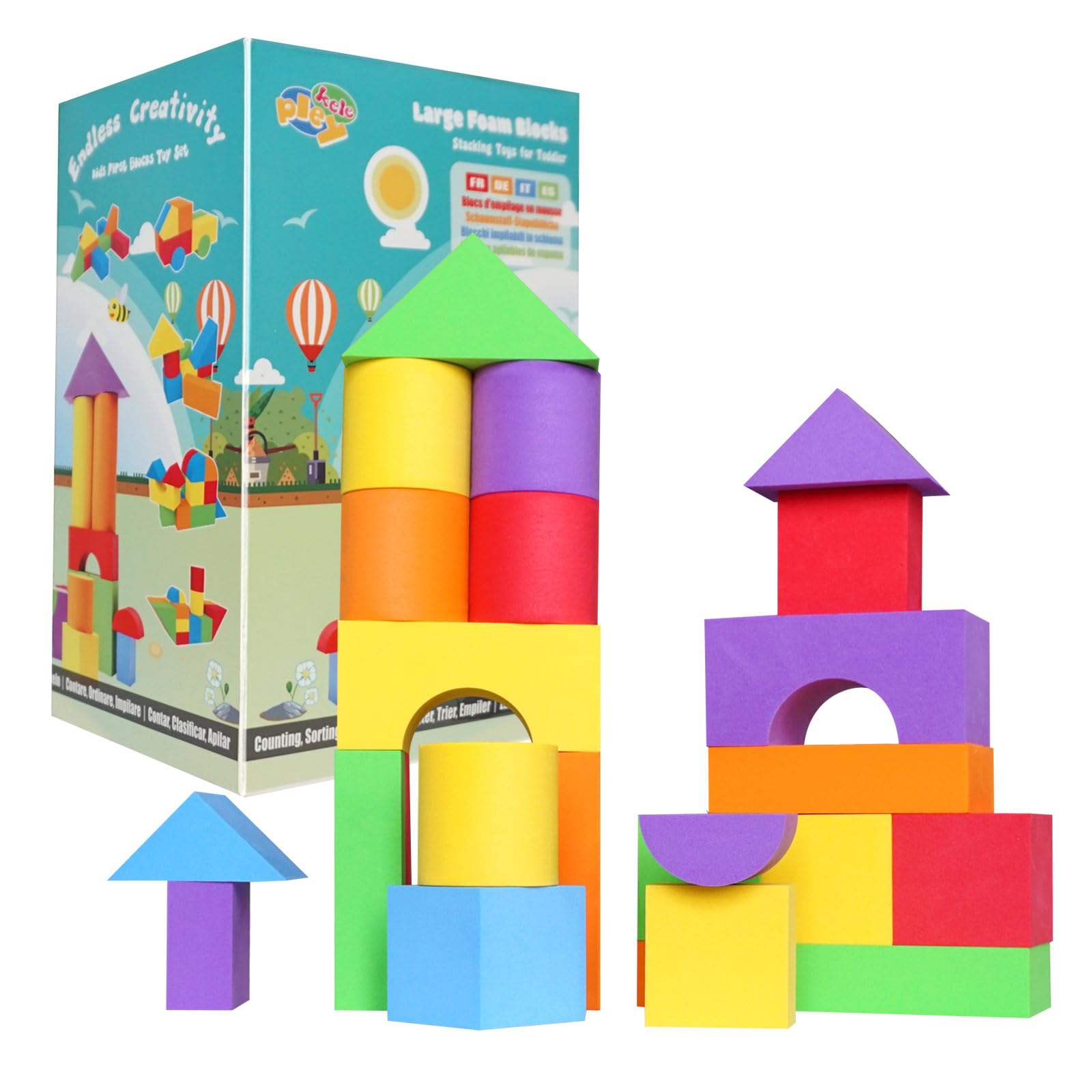
This is the small-set answer: 25 foam blocks, each at least 1.9 inches, in six colors, for a small room and a small outlay. The pieces are light and easy for an 18-month-old to pick up, they float for bath play, and there are enough shapes to stack a first tower. If you want to find out whether your child cares about blocks before committing to a jumbo set, this is where we start.
What you get for that is modest. At under two inches these are hand blocks rather than build-a-house blocks, and 25 of them make a low pile, so an older child runs out of material fast. The shapes are simple and the colors are bright, and the honest summary is that this is a first set: enough to learn whether stacking holds a child’s attention, and not much beyond that.
Pros
- Small blocks sized for toddler hands
- Floats for bath play
- Six colors in a compact 25-piece set
Cons
- 1.9-inch pieces build very little
- 25 pieces runs out fast for older kids
A modest way to find out whether your toddler is a builder — small blocks, six colors, and enough to stack a first tower without committing to a jumbo set.
How We Chose and Tested Foam Play Blocks
We started by pulling together every foam block set we could find that’s sold in the U.S. and actually in stock, then cut the list by reading specs closely: foam type, individual block dimensions, piece count, and the age range the maker claimed. Sets that paired a 4-inch block with a 12-month-old, or that wouldn’t say what the foam was, didn’t make it. We compared price per piece rather than sticker price, since 100 tiny blocks aren’t the same value as 50 stackable ones.
Ten sets went home with families on my team, with kids ranging from about 1 to 6, for six months. That meant morning builds before preschool, after-nap towers in the living room, and blocks permanently underfoot in the kitchen. We dropped each block from counter height onto hardwood to see whether corners chipped, stood on one with full adult weight to check if the foam sprang back or held a dent, and stacked to kid height to count the bumps it took before everything slid apart. Every set was wiped with a soapy cloth and left in a sunny window for a week; we noted which colors came back dull.
Size got checked with a tape measure, not the listing — we measured a sample from each set against the advertised dimensions, because these photograph bigger than they arrive. Color we judged two ways: how many distinct shades came in the box, and whether they still matched after washing. For fun, the real test was the calendar — which sets got pulled out unprompted again in week four, week twelve, and month five. Value came last: price per block still intact and still being played with at the end.
How to Choose Foam Play Blocks
The right foam block set is decided by one measurement — how big a single piece is in your child’s hand — and the rest follows from there.
Judge the size of one block, not the piece count
The photographs are the trap. A jumbo set and a hundred-piece set look equally enormous online, because both are shot close up, and the number that actually matters is the stated size of a single piece. In this group that runs from about 1.9 inches for the smallest cubes to 8 inches for the brick-shaped set, and the gap decides who can really use them. Under two, look for a piece a whole hand can wrap around; from three, a two-inch cube is workable at a table but frustrating to build a tower with.
EVA foam or a fabric-covered sponge
Almost every set here is EVA foam: firm, waterproof, wipeable, and dense enough that a tower holds its shape. The exception is the fabric-covered cube set, where a sponge core sits inside a zipped polyester cover. That one is softer to fall on and the cover can be washed, but the cube squishes, so tall buildings lean. Choose EVA when you want construction, and covered cubes when you want something a one-year-old can sprawl across. Both wipe clean; only the covered ones go in the washing machine.
Cleaning, bath time, and the wipe-down routine
EVA blocks are the easy ones. They are waterproof, so a rinse in the sink or a session in the bath handles most of it, and several sets here float, which gives a handful of pieces a second life as bath toys. Fabric covers take the other route: unzip, wash, reshape the sponge. Neither needs special soap, and both benefit from a quick wipe before the blocks go back in the bag, because crumbs and sand work into the edges and stay there.
How many pieces you need, and where they live
Piece count means nothing without size attached: twelve large cubes fill a play space, while 138 small pieces fit in a shoebox and build something far more detailed. For a first set, 25 to 30 pieces is enough for a wall and a tower with something left over; for a child who builds with intent, the big assortments earn their keep. Take the storage bag seriously, too — thirty loose foam blocks underfoot at bedtime is its own argument for the one that comes with a bag.
Frequently Asked Questions
Will foam blocks survive a toddler who chews on them?
Dense EVA takes a mouthful better than most soft toys: the blocks here hold up to teething, and what shows is bite marks rather than chunks coming away. Check the edges every week or two and discard any piece with a chunk missing, since a torn block is the one a child can pull apart. The fabric-covered cubes are gentler on gums, but the same inspection rule applies.
Are foam blocks quiet enough for an apartment?
Yes, and that is why a lot of people switch. A foam tower going over lands as a series of thuds instead of the clatter of wooden blocks, which matters at seven in the morning with neighbors below. Hardwood is where the difference is most obvious; carpet muffles both. The trade-off is that foam slides rather than grips, so a tall build on a smooth floor wanders and needs a wide base.
Do compressed foam blocks go back to their normal shape?
Usually. Sets that ship vacuum-compressed can arrive looking squashed, and the fix is time — a day or two out of the packaging, with a squeeze and a slap at the corners, brings them back. Give them that time before you judge the size. If a piece is still visibly deformed after a few days, send the set back rather than making your child work around it.
Final Verdict
If you are buying for a three-year-old or older, the LOLO set is the one to get: the blocks are big enough to build with, dense enough to stay where they are put, and soft enough to land on a hardwood floor at bedtime. It is the set we keep coming back to, and the bag means it goes away in one motion.
Change the child and the answer changes. Under two, or if you are the one doing the cleaning, the zip-off cubes are the better buy — softer, washable, and easier on a baby. And for a five-year-old who wants a castle with windows, 138 small pieces will do more than any jumbo set.
