This post contains affiliate links. We may earn a small commission when you buy through our links — at no extra cost to you.
At 2 a.m., a baby’s forehead tells you something is wrong but not how wrong, and you’re standing in a dim nursery fumbling one-handed with a device that may not have beeped yet. A good baby thermometer answers one question fast and clearly: how high is it, and does this warrant a call to the pediatrician? My team and I have spent four months with 14 of them, and the gap between a reading you trust and one you redo three times comes down to a few small details.
What nobody tells you before the first fever: the method matters as much as the device. Forehead scanners are only as good as the swipe, ear thermometers fight a newborn’s narrow ear canal, and any of them is useless if you can’t read the screen with the lights off. We weighed speed against accuracy, checked how each handled age settings, and paid attention to batteries and build quality, because one that dies mid-fever is worse than none. The picks below are the ones I’d hand a nervous parent.


Best for Everyday All-Round
Braun ThermoScan 7
Key Features
- Power: 2 AA (included)
- Reading site: Ear (infrared)
- Response time: 0.5 seconds
- Fever guidance: Age-adjusted, color-coded display
- Price: Premium
Most thermometers hand you a number and leave you to interpret it. The ThermoScan 7 interprets with you: you choose an age band before each reading and the fever threshold moves with it, so a temperature that counts as a fever in a three-month-old is not treated as one in a four-year-old. That single feature is why it leads this group. It is the difference between a gadget and a piece of guidance at two in the morning.
Readings come back in about half a second from the ear, and the pre-warmed tip means you are not pressing a cold probe against a baby who is already unhappy about the whole business. The feature we came to rely on is the stability indicator, a light and a beep that confirm the probe is seated properly, so fewer attempts ended in the shrug of trying again. That matters more than the speed does. A fast wrong reading is worse than a slow right one.
The screen lights up green, yellow or red, bright enough to read across a dark nursery without switching on a lamp. Whether that is a virtue depends on your setup, because in a co-sleeping room it is a lot of light at three in the morning. We also appreciate that the lens caps are disposable. A fresh cap per person is the simplest way to pass one thermometer around a household without passing around everything else.
Two things to know going in. You re-select the age band every time you switch it on, a small tax on every use and the detail we minded most. And the caps are a purchase you keep making. The failure worth watching for is a unit that will not power on, so put it through its paces in the first weeks while the return window is open. Past the newborn stage, this is the thermometer that leaves the least to interpretation.
Pros
- Fever thresholds adjust to the child’s age
- Half-second ear readings with position confirmation
- Backlit, color-coded display for night checks
- Disposable lens caps make it shareable
Cons
- Age band must be re-selected on every switch-on
- Lens caps are an ongoing purchase
This is the one we hand to a first-time parent: ear readings in half a second, and fever thresholds that adjust for how old the child is.
Best for Newborns
Frida Quick-Read Rectal
Key Features
- Range: Up to 104 °F
- Reading site: Rectal
- Response time: 10 seconds, final at 30
- Insertion depth: 1.5 inches
- Price: Budget
Rectal is the reading a pediatrician asks for in a newborn, and it is the one most parents quietly avoid. The Frida is built to make that about as quick and unremarkable as it can be: a slim body, a soft tip, a first number in roughly ten seconds, and a hard case to keep it in.
We recommend it as the newborn pick without much hedging. In the first weeks, the number that matters is 100.4 °F, and a rectal read gives you that number with the fewest arguments: no cold forehead, no ear canal to seat a probe in, no wriggling. The tip flexes enough that a baby who decides to arch mid-reading is not fighting a rigid stick, and the final reading lands at about thirty seconds, so nobody is holding a position for long.
Two practical notes. Wait for that second reading before you act on it, because the early number is provisional, and wipe the probe with alcohol before and after every use. This one is not shared, ever, and the manual’s 1.5-inch insertion depth is the figure to follow rather than a guess. The 104 °F ceiling is the honest limit: it covers ordinary fevers but not the extremes, so a reading pinned at the top is a floor rather than a full answer, and worth confirming another way.
Pros
- First reading in about ten seconds
- Soft, flexible tip babies tolerate
- Hard carry case keeps it clean and findable
Cons
- Rectal only, so it cannot grow with your child
- Readings sometimes disagree with a second thermometer
We keep this for the newborn stage, when the number a pediatrician wants is a rectal one and speed matters more than elegance.
Best for Budget No-Touch
ANMEATE No-Touch Forehead
Key Features
- Power: 2 AAA (included)
- Memory: 35 readings
- Reading site: Forehead, no-touch
- Response time: 1 second
- Price: Budget
At the bottom of this group’s price range is a small black thermometer that does the two things a no-touch unit has to do: it reads in about a second and it never touches skin. That combination is most of why it is here.
We point budget shoppers here rather than to the mid-priced forehead units, and not only because it costs less. The three-color backlight gives you a read at a glance in a dark room, the 35-reading memory means you can check at ten and again at two without hunting for a pen, and the batteries come included. One thing worth knowing: the same FC-IR202 model number turns up under more than one brand name in this category, so it pays to check the box before assuming you are comparing different machines.
What you give up is the certainty of a contact reading. A forehead scan is a screen, and we use it to answer one question in the dark, which is whether something is going on at all. When the answer is yes, we follow up with an ear or rectal reading. As a first thermometer for a household that wants one, or as the second one for the changing bag, it is hard to argue with.
Pros
- One-second readings without contact
- Batteries and a color-coded fever display included
- 35-reading memory for overnight checks
Cons
- Repeat readings on the same child can drift
When the budget decides, this is the one we name: a second per reading, no contact, and batteries already in the box.
Best for Backup and Travel
Boncare Digital Thermometer
Key Features
- Tip: Soft silicone, waterproof
- Battery: 1 LR41 (included)
- Reading sites: Oral, rectal, axillary
- Response time: 10 seconds
- Price: Budget
After a row of pistol-grip thermometers, the Boncare looks like a pen, and that is the point. It is slim enough for a side pocket of a diaper bag, it comes with a hard case, and it takes up less space than the spare batteries for everything else you are carrying.
It reads in about ten seconds from the mouth, armpit or bottom, the tip is soft silicone over a stainless probe, and it wipes down under the tap. The display is small but clear, there is a beep when it is done, and it remembers the last reading. Start measuring only once Lo °F appears, as the instructions say, or the first number will be nonsense.
Ten seconds is a long time with a toddler who has decided the whole enterprise is a personal attack, and that is why this is our spare rather than our first choice. Where it earns its place is as the backup: the one in the bag, the one that reads an older child under the arm without a fight, the one that still works when the good thermometer’s battery is flat. Keep it, use it, and do not expect it to replace an ear unit on the shelf.
Pros
- Three reading sites in one small stick
- Soft waterproof tip wipes clean
- Hard case and battery included
Cons
- Ten seconds is slow beside the one-second picks
- Runs on a button cell, not AAA
We think of it as the second thermometer: a small, cheap stick for underarm and oral checks that earns its place in the diaper bag.
Best for Quiet Night Checks
Viproud V-FC-IR209
Key Features
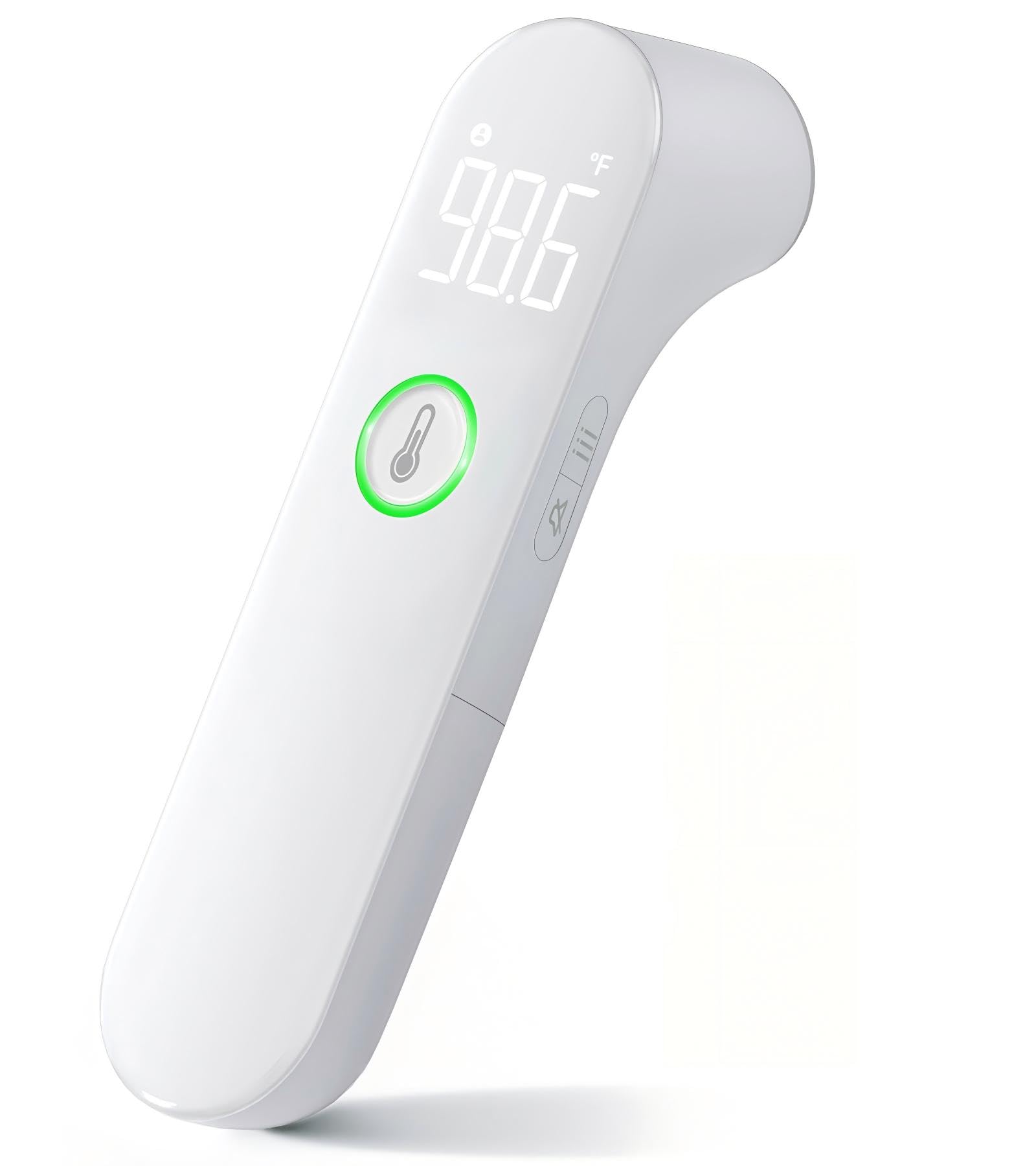
- Alert: One-touch mute, color beeps
- Memory: 35 readings
- Reading site: Forehead, no-touch
- Response time: 1 second
- Price: Midrange
The one-touch mute is the design detail we did not expect to care about. A beep that confirms a reading is exactly the thing that wakes a sleeping baby, and silencing it takes a single press before you point the thermometer.
That is the reason this is our pick for night checks in a shared room. You get a one-second forehead reading, a color-coded screen that is legible without a lamp, and 35 stored readings, so you can build a picture of a night without writing anything down. The carry pouch sounds trivial and is not: a thermometer that lives loose in a drawer collects dust on the sensor, and a dusty sensor is a wrong number.
The catch is power, and it is worth planning around. Batteries come included, but they can run down faster than you expect, and a no-touch thermometer that reports a low battery after a handful of uses is the wrong thing to discover mid-fever. Keep a spare pair of AAAs in the pouch. Otherwise this is a tidy, quiet, easy-to-read unit that does the everyday job well.
Pros
- One-touch mute for sleeping-room checks
- Large backlit display readable at night
- 35-reading memory and a carry pouch
Cons
- Batteries can run down faster than expected
- Readings are less consistent than the ear pick’s
For silent overnight checks we reach for this one, because the beep can be switched off and the screen still reads in the dark.
Best for Bottle and Room
Berrcom JXB-178
Key Features
- Memory: 32 readings
- Batteries: 2 AA, not included
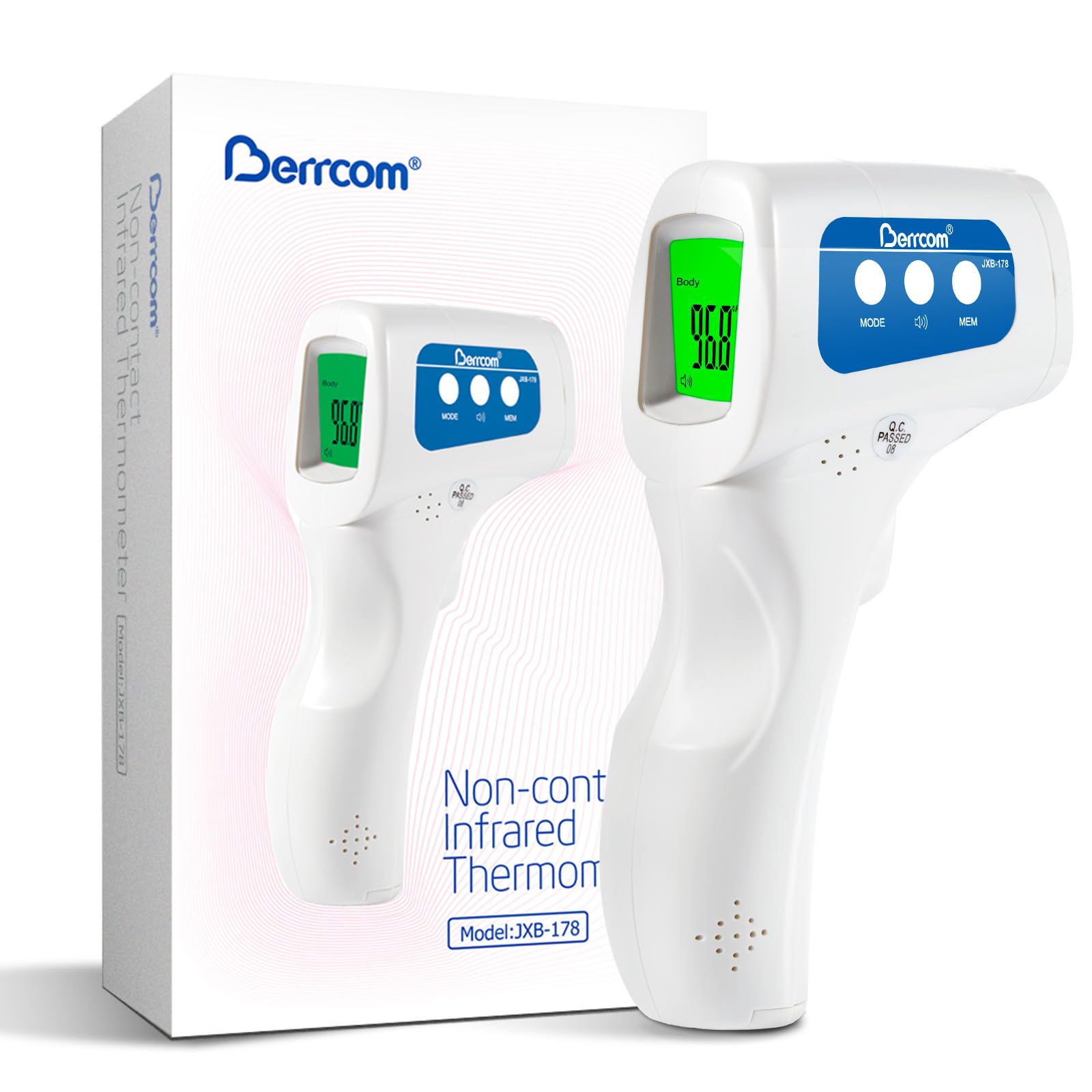
- Reading modes: Body, object, room
- Response time: 1 second
- Price: Budget
Point it at a bottle and it tells you whether the milk is too warm. That object mode is the reason to look at this one at all, because as a straight forehead thermometer it is a familiar shape at a familiar sort of price.
Body readings work the way the rest of the no-touch group does: about a second, held a few centimeters off the forehead, with a color-coded fever alarm and 32 stored readings. The range runs wide because the same sensor handles surfaces as well as people, which is what makes the milk check and the room check possible in the first place.
The box is where it gets annoying. Two AA batteries are required and not included, so the thermometer you bought for an emergency is unusable until you find a pair. Order them with it, or do not order it at all.
We rank it below the ANMEATE and well below the ear pick, and the reason is simple: it does more jobs than a baby thermometer needs and the one job you bought it for is not obviously better here. If warming a bottle at three in the morning is a real part of your week, the extra mode is genuinely useful. If not, put the money toward the Braun.
Pros
- Measures body, milk, food and room temperature
- Color fever alarm with 32-reading memory
- Wide range covers surfaces as well as people
Cons
- Batteries not included, so it arrives unusable
We like it as a nursery all-rounder: forehead readings for the baby and a bottle or room check from the same device.
Best for Fever Tracking
GoodBaby FC-IR2000

Key Features
- Power: 2 AAA (included)
- Memory: 35 readings
- Reading site: Forehead, no-touch
- Response time: 1 second
- Price: Midrange
Thirty-five stored readings is more history than most parents will ever want, and it is the reason to consider this one: you can chart a fever across a night without writing anything down or waking a child to re-check.
The rest is competent and familiar. One-second forehead readings, a large backlit LCD that changes color with the temperature band, Fahrenheit and Celsius switching, and two AAAs already in the box. The single button is easy to find in the dark, which sounds like faint praise until you have fumbled a three-button thermometer at three in the morning.
Where it loses ground is longevity. Of the no-touch units here, this is the one we trust least to still be working in three years, and the failures that turn up are the boring kind: it simply will not turn on one evening when you need it. Test it every few weeks, register it, and keep the receipt, because a dead thermometer has no resale value and no sentimental one either. The memory is a real feature. It just is not the thing that should decide your purchase.
Pros
- 35-reading memory tracks a fever overnight
- Large color-coded backlit display
- Batteries included and one-button operation
Cons
- Durability is the weakest in this set
Buy it for the 35-reading memory that lets you chart a night of fever, not for the expectation that it outlasts everything else here.
How We Chose and Tested the Best Baby Thermometers
We started with every thermometer marketed for infants and toddlers that we could get our hands on — pharmacy staples, big-box models, and the ones pediatric nurses kept bringing up unprompted — then filtered by price, whether the age settings were actually distinct, and how easy replacement probe covers were to find. Fourteen made the cut. Testing ran four months, across my own kids’ well visits and a colleague’s newborn, and each unit lived where these things really live: a diaper bag, a nightstand drawer, a bathroom cabinet, the pocket of a bath towel.
In the moment, we timed each one from the second we picked it up to the second a number appeared, doing it one-handed with a squirmy kid on a hip. We took three readings on the same child inside a minute to see how far they drifted, and we compared forehead, ear, and underarm results against one another rather than trusting any single number. Every display got read in a closed closet with the lights off, which sorted the genuinely legible backlights from the ones that wash out.
Battery life we tracked by logging how often each unit needed a change and whether it warned us first, and durability got tested the unglamorous way: a drop from counter height onto tile, weeks of riding beside keys and a sippy cup, and a wipe-down after every run-in with a cold. For value, we counted what came in the box and whether the covers, when a model needed them, were proprietary and pricey or cheap to restock. The ones that rose to the top were fast, agreed with each other, and stayed readable at 3 a.m.
How to Choose a Baby Thermometer
The site you measure from matters more than any feature on the box: an ear or rectal reading carries more weight than a forehead scan, and the best thermometer is the one your child will hold still for.
Match the site to the age
Rectal is the reference standard for newborns and young infants, and it is the reading a pediatrician will ask about. Ear thermometers need a canal big enough to seat the probe, so they suit older babies and toddlers better than brand-new ones. Forehead no-touch units work from day one, because there is no canal and no contact, but they read surface temperature over the temporal artery.
That gives you the trap to avoid: buying a forehead unit as the only thermometer in a house with a newborn and then treating its number as final. Treat a no-touch reading as a screen, and confirm with a contact method when the number and the baby disagree.
Speed only helps if the probe stays put
Reading times here run from half a second to about thirty. The gap matters less for convenience than for error: the longer the hold, the more likely the probe shifts, and a shifted probe gives you a number that looks like data and isn’t. Ear units that light up or beep to confirm a stable position earn their price on exactly this.
Watch for two-stage readings on digital sticks. Some post a provisional number around ten seconds and a final one at thirty; act on the second, not the first. A reading you can repeat is worth more than a reading you got fast.
Age changes what the number means
A rectal reading of 100.4 °F or higher counts as a fever, and the same figure lands differently on a three-month-old than on a four-year-old. That is why age-adjusted fever guidance is worth paying for: it moves the threshold with the child instead of handing you a flat number to interpret alone.
None of these devices diagnoses anything. A green, yellow or red band tells you how a reading compares with a threshold. What it buys is a decision you can make at three in the morning without opening a search tab: call now, or watch and re-check in an hour.
What is in the box, and what runs out
Batteries are the classic first-night failure. The Berrcom here ships without them, and some units take button cells rather than the AAs in your kitchen drawer. Read the included list before you order, and put the right batteries in the same drawer as the thermometer.
Ear thermometers add lens caps, which are both a running cost and the thing that makes the device shareable; no-touch units have no consumables but often no case either. If the thermometer is going to live in a diaper bag, buy the version that comes with a pouch or a hard case.
Frequently Asked Questions
How do I take a rectal temperature without hurting my baby?
Lubricate the tip, insert only as far as the manual directs, and stop if you meet resistance instead of pushing. On the Frida here that depth is 1.5 inches. Rest a hand on your baby’s lower back so they cannot roll, hold the thermometer steady, and wait for the final reading rather than the provisional one at ten seconds.
Wipe the probe with rubbing alcohol before and after every use, and keep that thermometer for rectal use only.
Do new thermometers need calibrating?
There is no user calibration on any of these, so there is nothing to adjust at home. What you can do is establish a baseline: take a reading on a healthy day, on the same site, so you know what normal looks like for your child before anyone gets sick.
A unit that gives you a different number on the same spot a minute apart is not giving you information, and it is the clearest sign to replace it.
Can the whole family use the same thermometer?
Yes, with one rule per type. An ear thermometer needs a fresh lens cap per person, a digital stick needs the probe wiped with alcohol between users, and a no-touch unit never touches anyone, which makes it the easiest to pass around.
A rectal thermometer stays a rectal thermometer. Do not move that one between sites, even after cleaning.
Why is my reading different from the one at the doctor’s office?
Different site, different device, and usually several minutes apart. A fever moves, and an ear reading and a rectal reading of the same child at the same moment will not match exactly.
Pick one device and one site for the length of an illness and follow the trend. Comparing numbers across three thermometers tells you about the thermometers, not about your child.
Final Verdict
Buy the Braun ThermoScan 7 if you want a single thermometer that handles a baby, a toddler and the adults in the house. Age-adjusted fever thresholds and half-second ear readings are the two things we would not give up, and it is the pick we hand to first-time parents.
If there is a newborn in the house, add the Frida: a rectal reading is what you will be asked for in the first weeks, and it is the least expensive way to get that number quickly. On a tight budget, the ANMEATE covers the overnight screen and keeps the good thermometer for when it matters.
