This post contains affiliate links. We may earn a small commission when you buy through our links — at no extra cost to you.
Brushing a toddler’s teeth is less a hygiene routine than a two-person negotiation at the sink. A brush that’s too big makes them gag, stiff bristles feel like a punishment, and a boring one gets abandoned for the faucet. The right one buys you cooperation: a small head, soft bristles, and a handle small hands can grip. Over the past four months, my team and I have put 14 toddler toothbrushes through our own morning and bedtime routines, and the differences showed up fast.
Head size matters more than anything printed on the package — a brush labeled for ages 1 to 3 can still be too wide to reach the back molars without a fight. Bristles need to be genuinely soft, since toddlers chew their brushes like gum. A timer earns its place only if your kid can see or hear it; the ones built into the handle got ignored, and the ones that played a song got used. Below are the brushes that earned a spot in the cup.


Best for First Brush
Dr. Brown’s Giraffe Toothbrush
Key Features
- Power: Manual
- Bristles: Super-soft
- Age range: 0 to 3 years
- Dimensions: 1.3 x 3.1 x 7.5 inches
- Price: Budget
Most first toothbrushes are either a teething toy with bumps on it or a shrunken adult brush that’s still too big for a twelve-month-old’s mouth. The giraffe is one of the few that lands in between: a real bristle head, small enough to sit against a back tooth, on a body a baby can close a fist around. That head size is the thing we kept coming back to. It’s the difference between cleaning a tooth and pushing a brush around a cheek.
The grip is the other half of it. The whole brush weighs about an ounce and measures 7.5 inches tall, so there’s enough handle above a toddler’s hand for an adult to hold at the same time, which is how brushing actually gets done in the first year. The comfort-grip body gives a little when a child clamps down, and the bristles are soft enough that a missed jab at the gum doesn’t end the session.
Where it runs out is around the third birthday. Once the molars are in, the head starts to feel small and the very soft bristles do less work than a slightly firmer brush, so that’s the moment to move up to a 1-4 or 2+ model. Before then, expect a toddler to gnaw on the giraffe’s body, because it’s soft enough to invite it. Supervise that, since it isn’t a teether, but it does get the brush into their mouth without a fight.
Pros
- Genuinely small head for first teeth
- Soft body a one-year-old can grip
- Lowest price of the brushes here
- Bristles gentle enough for sore gums
Cons
- Runs out of headroom around the third birthday
This is the brush we hand to parents of a one-year-old: a genuinely small head, very soft bristles, and a grip a toddler can close a fist around, for the least money here.
Best for Upright Storage
Dr. Brown’s Dinos Toddler Toothbrush 2-Pack
Key Features
- Base: Suction cup
- Pack: 2 brushes
- Power: Manual
- Age range: 1 to 4 years
- Price: Budget
Same maker, one age bracket up: where the giraffe is built for a mouth with four teeth in it, this one is sized for ages one to four and arrives two to a pack. The difference you notice first is the base. A suction cup holds the brush upright on the counter instead of letting it lie in whatever’s beside the sink.
That cup is the reason we point a two-year-old’s parent here rather than to the giraffe. On smooth tile, a mirror, or the side of the tub it grips and stays; on a textured or grouted surface it lets go, so pick your spot. The head also sits at a slight angle to the handle, which feels wrong for the first pass and then makes the back molars easier to reach without tipping the whole brush sideways.
The four-year ceiling is real. By the time a full set of adult teeth is pushing through, the head is small again and you’re back to a big-kid brush. Between one and four, though, this is the one that gets a toddler brushing on their own sooner, because it’s a brush they can grab and put back.
Pros
- Suction base keeps it upright and dry
- Wider age band than a first brush
- Two brushes in the pack
Cons
- Bristles splay within a few weeks of daily use
For a two-year-old with a full mouth of teeth, this is the practical two-pack: a bigger head than the giraffe, a suction base that keeps it off the counter, and a spare on hand.
Best for Fast Brushing
Frida Toothhugger Toddler Toothbrush 2-Pack
Key Features
- Head: Triple-angle
- Pack: 2 brushes
- Age range: 2 years and up
- Replacement cue: Blue bristles fade to white
- Price: Midrange
Three panels of bristles meet at a point, so the head cups a tooth across the front, the back, and the top in a single pass. For a toddler who grants you a few seconds with their mouth open, that’s the whole argument: one stroke does what a flat brush needs three sides and a lot of wriggling to manage.
The detail we didn’t expect to care about is the wear indicator. The blue bristles fade toward white as the brush is used, which builds the replacement reminder into the object instead of into your memory. Nobody remembers when they last swapped a toddler’s toothbrush. This one tells you.
The catch is firmness. Three panels press on both sides of a tooth at once, and that feels like more than a soft flat brush. Some toddlers lean into it; others clamp their jaw shut and end the session. If yours already opens up without a fight, a plain soft brush is the gentler choice, and cheaper.
Pros
- Cleans three tooth surfaces at once
- Fading bristles signal replacement
- Cuts brushing time for impatient toddlers
Cons
- Bristle panels bend once a child chews on it
If brushing is a negotiation, the triple-angle head earns its place: it cleans three sides of a tooth in one pass, and the bristles fade when it’s time to swap.
Best for Character Motivation
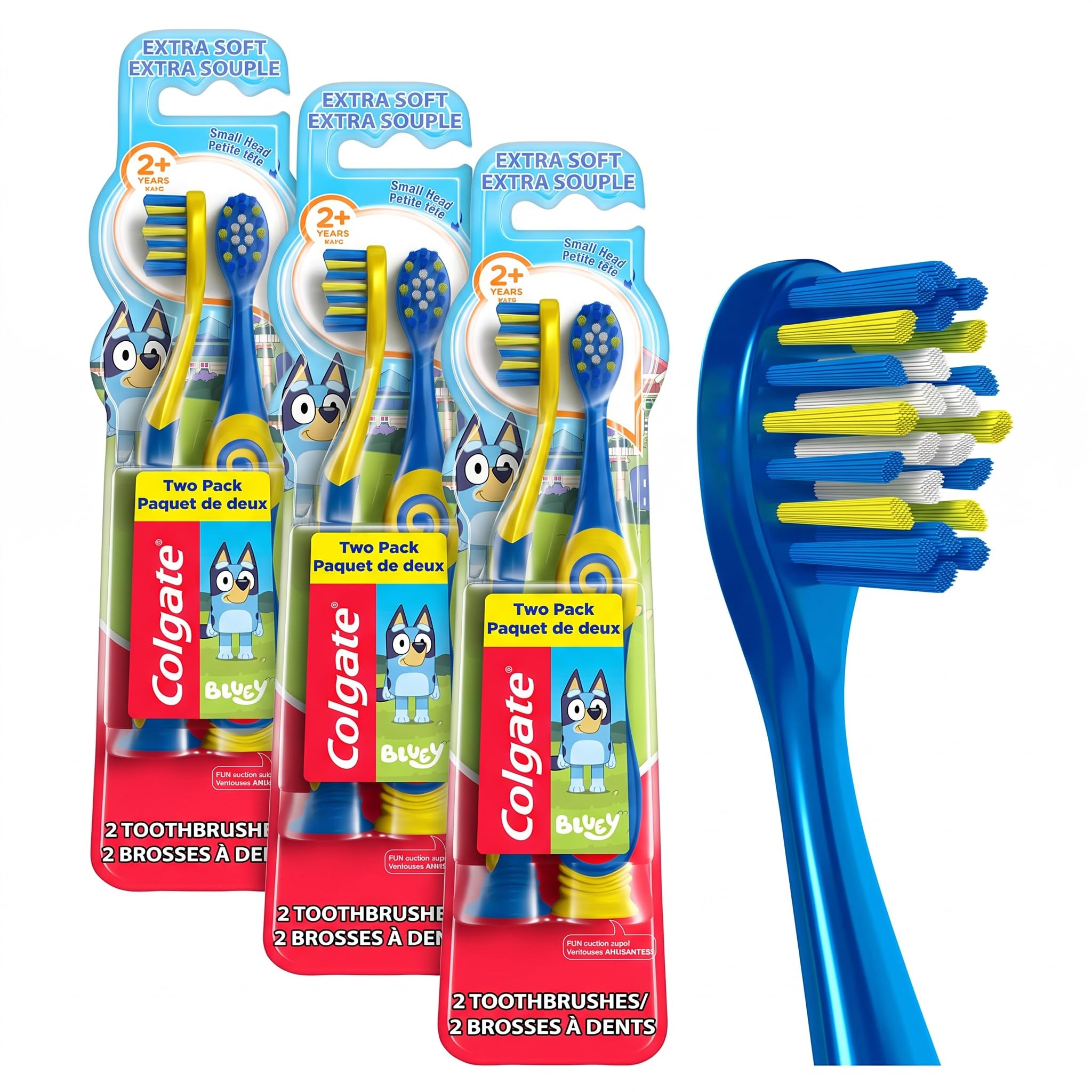
Colgate Kids Bluey Toothbrush Pack
Key Features
- Base: Suction cup
- Power: Manual
- Bristles: Extra soft, multi-height
- Age range: 2 years and up
- Price: Midrange
There’s a version of this where the Bluey print is decoration. Then there’s the two-year-old who won’t open for a plain blue brush and opens for Bluey, and the print is doing the actual work. Underneath it is a well-made brush: a slim handle sized for small hands, extra-soft bristles, and a real tongue scrubber on the back of the head.
The suction cup on the base is the part we appreciated most. It stands the brush up beside the sink instead of letting it lie in whatever’s on the counter, and on smooth tile or a mirror it holds. Small thing; it’s the difference between a brush that dries and one that sits wet all day.
The bristles are multi-height, which matters more than it sounds for a two-year-old. Their mouth is a mix of small baby teeth and the first adult molars pushing through, and the longer bristles reach the new teeth while the shorter ones work the small ones. Extra soft all the way through, so nothing scratches.
Pros
- Suction base keeps the head off the counter
- Multi-height bristles suit a mixed set of teeth
- Character print that gets a toddler brushing
Cons
- Bristles soften before the three-month mark
The Bluey handle does real work on a resistant two-year-old, and underneath it is a sound extra-soft brush with a suction base and a tongue scrubber.
Best for First Electric
Colgate Kids Unicorn Battery Toothbrush

Key Features
- Head: Vibrating, extra soft
- Power: Battery, 1 AA included
- Handle: Flat-laying
- Age range: 3 years and up
- Price: Midrange
The number that matters is three. This is a kids’ battery brush labeled for ages three and up, and in a two-year-old’s mouth it’s the wrong tool: the head is built for a fuller set of teeth, and the buzz is a distraction rather than a help when a child is still learning to tolerate a brush at all. At three, when they’ve watched you use one and want their own, it’s the least expensive way into power here.
Two details show somebody thought about how a child actually holds one. The handle is flat on one side, so it lies still on the counter while you load toothpaste instead of rolling onto the floor, and the head buzzes rather than spinning, which means nothing yanks at a gum and there’s less machinery to fail. One AA battery is included, and swapping it is a drawer job rather than a new brush.
What it won’t do is clean as hard as a spinning brush. The vibration is mild, closer to a hum, so most of the cleaning is still your hand moving the head. For a first electric that’s the right trade; a child already comfortable with power will want more.
Pros
- Flat handle stays put while loading toothpaste
- Replaceable AA instead of a sealed battery
- Gentle start for a first powered brush
Cons
- Mild buzz does less cleaning than the motor suggests
Once a child turns three and wants their own powered brush, this is the sensible place to start: mild vibration, a flat handle, and a battery you can swap.
Best for Timed Brushing
Brusheez Kids Electric Toothbrush Set

Key Features
- Power: Battery, 1 AA required
- Timer: 2-minute sand timer
- Age range: 3 years and older
- Set contents: 8 pieces including cup, stand, timer
- Price: Premium
What arrives is closer to a starter kit than a toothbrush: the brush, an animal cover, a spare head, a rinse cup, a stand, a two-minute sand timer, and a printed brushing chart. The timer is the piece that earns its keep. A three- or four-year-old can flip it and watch the sand run down, which does more for brushing length than being told twice a day to keep going.
The rest of the kit is about building a routine a child owns. The cup, the stand, and the chart put everything at their height, and the brush takes one AA battery, so there’s no charging cradle to lose. It’s also the heaviest setup here, at about half a pound in the box: this is a brush that lives on a counter, not one that goes in a diaper bag.
One caution on the motor. It has real intensity, and a three-year-old who has never used a powered brush may hand it back. Give it another year and the chart, the cup, and the timer start to mean something; that’s when this set earns the space on the counter.
Pros
- Sand timer makes two minutes visible
- Spare head, cup, and stand included
- Chart gives a child something to own
Cons
- Some units arrive not powering on
The most complete kit here for a four-year-old: brush, spare head, cup, stand, and a sand timer that finally makes two minutes feel like two minutes.
How We Tested Toddler Toothbrushes — and What Survived
We started with roughly 40 brushes sold for kids under 4 and cut anything with medium or hard bristles, a head that looked too wide for a small mouth, or a price that felt silly for something destined to be chewed. That left 14, most of them under $15, and each one got at least two weeks of real use across four months.
Testing happened where brushing actually happens: the bathroom sink at 7 a.m. before daycare, and again at bedtime when everyone is tired. Each brush took a turn with a 2-year-old brushing solo and with a parent finishing the job, so we could see how it handled both. We watched whether the head slipped past the back molars without triggering a gag, whether the bristles reached the gumline, how the grip held up in wet hands, and how much toothpaste the bristles carried without drooping.
Then we were unkind to them. Every brush was dropped on tile from counter height a dozen times, gnawed on during the two minutes it was supposed to be cleaning, and left wet in the cup overnight. We noted cracks at the neck, bristles that splayed within a week, and any head that came loose. Timers were judged on whether the kid actually brushed longer, and vibration on whether it was welcomed or met with a clamped-shut mouth.
Appearance counted for more than I expected — brushes with a character a toddler recognized got picked up voluntarily, and the plain ones sat there. We weighed all of it against price, because a cheap brush that survives four months beats a fancy one that splays in three weeks.
How to Choose a Toothbrush for a Toddler
The best toddler toothbrush is the one your child will let near their mouth twice a day, so head size and handle shape decide more than any feature on the package.
Match the brush to the age band on the label
A brush sold for ages three and up is built for a bigger jaw and a fuller set of teeth. Put that head in an 18-month-old’s mouth and it covers two or three teeth at once, which is where gagging and refusal start. The bands in this group run 0-3, 1-4, 2+, and 3+, and they’re a better guide than how tall your child is for their age.
Our test is simple: if the brush head covers more than about two of your child’s teeth in one go, size down. That single check explains most of the brushing battles we’ve watched.
Small head, rounded bristles, no gimmicks
A head that reaches the back molars without the handle hitting a cheek cleans better than a big head with a light on it, because you can put it where the plaque actually sits. Softness is harder to judge from a listing, since extra soft means something different on every package. Rub the tips against your fingertip: rounded ends feel smooth, cheap ones feel scratchy.
A three-sided head trades a little gentleness for speed. That trade is worth it only if your toddler will hold still for one pass and not three.
Decide who holds the handle
Until about three, most of the brushing is yours, often with a small hand wrapped around the same handle. That argues for length above the child’s grip and a surface that doesn’t slip when wet; the giraffe and the Toothhugger both leave an adult somewhere to hold on.
Once they want to try it themselves, a shorter, fatter grip helps a fist stay closed. Keeping two brushes in rotation, one for practice and one for finishing the job, costs little and heads off the nightly tug of war.
Manual first, battery later
Manual is the default for the first two years: nothing to charge, nothing to break, and you control the pressure. Powered brushes earn their place around three, when a child can hold still and gets a kick out of the motor. Vibration is gentler than rotation for a beginner, and a brush that takes a replaceable AA outlasts one with a sealed battery that dies with the brush.
The powered brushes here are all labeled for ages three and up, and the difference is real: those heads are built for a fuller set of teeth, not for a mouth still full of gaps.
Storage is part of the purchase
A brush that lies flat on the counter picks up whatever’s there and stays damp, and a damp brush is where the smell and the spots come from. A suction base or a stand that holds the head upright to air-dry is worth more than it sounds; two of our picks have one, and it’s the difference between a brush that dries between sessions and one that sits wet all day.
Skip closed caps and travel tubes at home. Let the head breathe.
Frequently Asked Questions
How often should I replace a toddler toothbrush?
Every three months, and sooner if the bristles look splayed or your child chews the brush. A toddler who bites down while brushing flattens bristles in weeks, and a flattened brush cleans very little. Write the swap month on the handle with a permanent marker, and buy a multipack so the replacement is already in the drawer.
My toddler chews the brush instead of brushing. What should I do?
Chewing is normal and it’s the main reason toddler brushes wear out early. Let them gnaw on something else first, like a cool teether or a wet washcloth, then start brushing. Check the bristles before every use and throw the brush away if any are loose, because a detached bristle in a small mouth is a real risk.
A brush that has been chewed into a fan isn’t cleaning anything anyway.
Can my toddler brush on their own?
Let them try, then finish the job yourself. Toddlers can grip a brush and move it around, but the dexterity to clean back molars arrives well after the toddler years. Keep a second brush for your pass, or take the brush back for a few seconds a side once they’ve had their turn. The independence is worth encouraging; the thoroughness isn’t there yet.
Final Verdict
Start with the Dr. Brown’s giraffe. It has the smallest head, the softest bristles, and the lowest price in this group, and for a child between one and three that combination does more than any motor or cartoon character.
When the molars come in and the giraffe starts to feel small, the Dinos two-pack is the natural next step if you want a brush that stands by the sink, and the Toothhugger if brushing is still a fight. Past the third birthday, the battery brushes finally make sense.
