This post contains affiliate links. We may earn a small commission when you buy through our links — at no extra cost to you.
The 3 a.m. arm escape is a rite of passage: your baby sleeps longer, then one tiny hand shoots free, the startle reflex kicks in, and everyone is awake. A transitional swaddle bridges that gap – snug enough to calm the Moro reflex, loose enough for arms-out sleep and rolling practice. The details matter more than I knew: a fit that adapts as they grow, closures that stay put after a wash, and a design you can open for a diaper change without fully waking a drowsy baby. That’s the job – a few more hours of sleep while your baby learns to self-soothe.
Over four months, my team and I tested 14 transitional swaddles with our own babies and a small parent panel, from 3 to 9 months old. We watched for the details you only notice at 2 a.m.: Velcro loud enough to startle a sleeping baby, zippers that snag, size charts that run small, fabric that pills. The best ones made the switch easier on both baby and parent – and held up long enough to justify the price.

Best for First Transition
Love to Dream 2-in-1 Transition Bag
Key Features
- Closure: Two-way zipper
- Size range: 13–19 lbs (M)
- TOG rating: 1.0 TOG
- Transition style: Zip-off wings
- Price: Premium
One wing zips off at a time, and that single detail is why this is the one we hand to parents first. Instead of choosing between a fully wrapped baby and one with both arms loose, you free a single arm, leave the other wing in place for a few nights, then remove the second when the flinching stops. The two-way zipper runs the whole front, so a 3 a.m. diaper change doesn’t mean undoing the arm your baby finally settled with.
The arms-up cut is the other half of the argument. Hands sit near the face, where a lot of babies want them, and the 93% cotton knit has enough give to feel like a wrap without pinning the shoulders. At 1.0 TOG it is the middleweight of this group — enough over a short-sleeve bodysuit in a normal nursery, light enough that a warm room won’t leave your baby damp at the back of the neck. Size M covers 13 to 19 lbs, which lines up with the three-to-six-month stretch when most babies are ready to come out of a swaddle.
Chest room is the thing we check first. Some babies find it snug across the chest, and when it is tight the fabric pulls at the back of the neck; if yours is between sizes, take the larger one and let the wings do their job. Beyond that there is very little to learn — it goes on over a bodysuit, the arms come free in seconds, and nothing about it needs a demonstration at bedtime.
Pros
- Zip-off wings free one arm at a time
- Arms-up cut suits babies who fight a wrap
- Two-way zipper for quiet night changes
Cons
- Must be dried flat between washes
The one we hand to parents first: zip-off wings let you free a single arm at a time, and the arms-up cut keeps a startle-prone baby settled in between.
Best for Hands-Up Babies
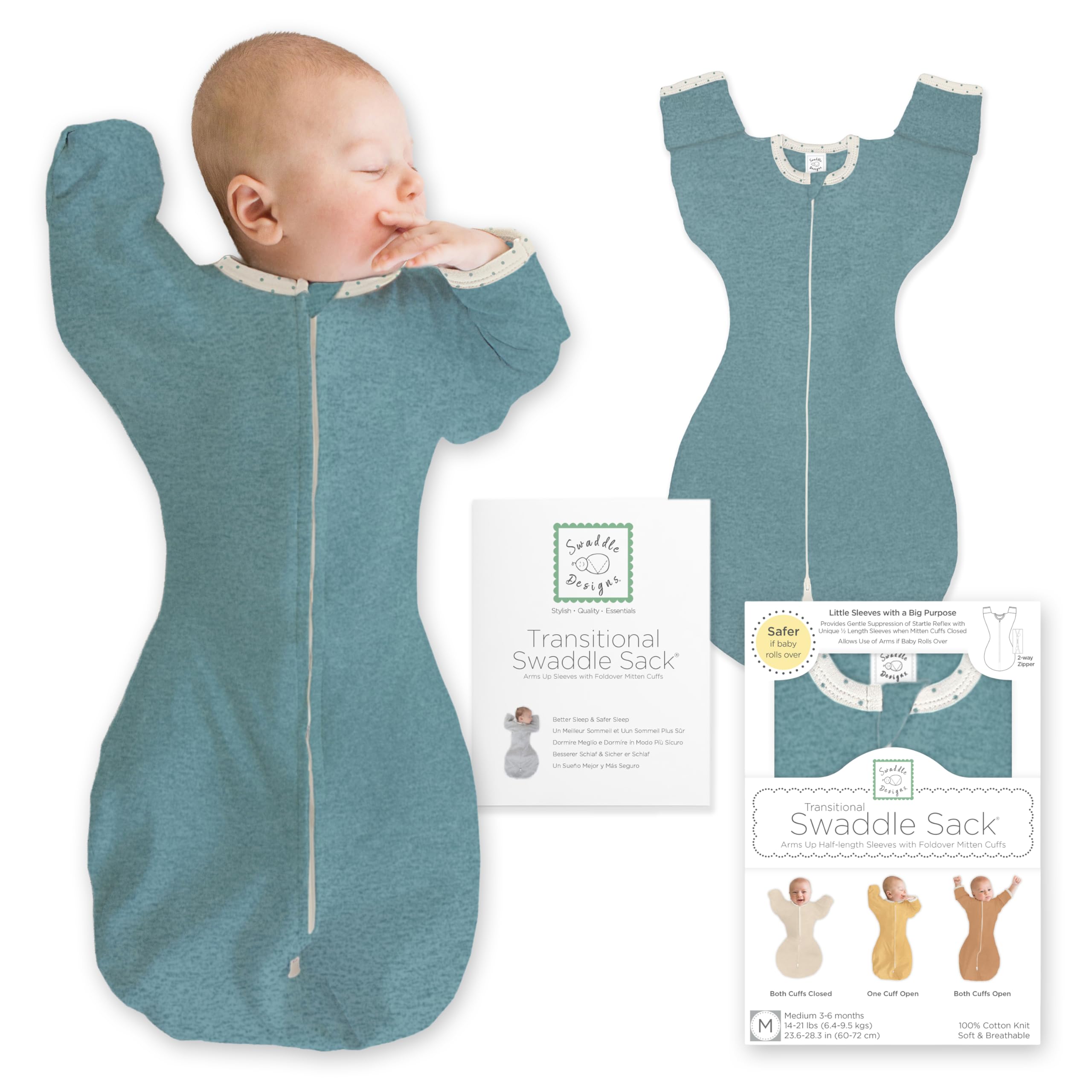
SwaddleDesigns Transitional Swaddle Sack
Key Features
- Fabric: 100% cotton
- Closure: Two-way zipper
- Size range: 6–14 lbs (S)
- Transition style: Arms-up sleeves, fold-over mitts
- Price: Budget
Of the arms-up options here, this is the cheaper one, and it also happens to be the most gradual. The half-length sleeves end in fold-over mitts, and the mitts are the design: closed, they take the edge off the startle reflex while the arms stay free to move; one open, and your baby can get a hand to their mouth to self-soothe; both open, and the transition is done. You can move between those three positions night by night without buying anything else, which is more steps than the zip-off wings give you.
The rest is sensible rather than clever, which is exactly what we want in a garment a baby wears twelve hours a day. It is 100% cotton with a light hand, it carries a hip-healthy recognition, and the two-way zipper opens from the bottom so a diaper change doesn’t mean peeling the sleeves off a sleeping baby. Legs drop into the frog position instead of being pinned straight, which is the difference between a sack a baby settles in and one they fight.
Fit is the part to get right. Chest measurements divide babies on this one — snug on some, loose on others — and length usually decides it rather than weight. A long baby can sit comfortably inside the weight band and still be cramped at the shoulders, so hold the sack against a sleepsuit that currently fits before you commit. Once the mitts are open the sleeves are short, deliberately so, since the point is to free the hands rather than add bulk.
Pros
- Three gradual mitt positions
- Hip-healthy leg room
- Light cotton with a two-way zip
Cons
- Loose across the chest for some babies
A real transition for hands-up babies without spending much: fold-over mitts stage the move, the cut is hip-friendly, and the cotton stays light.
Best for Warm Nurseries
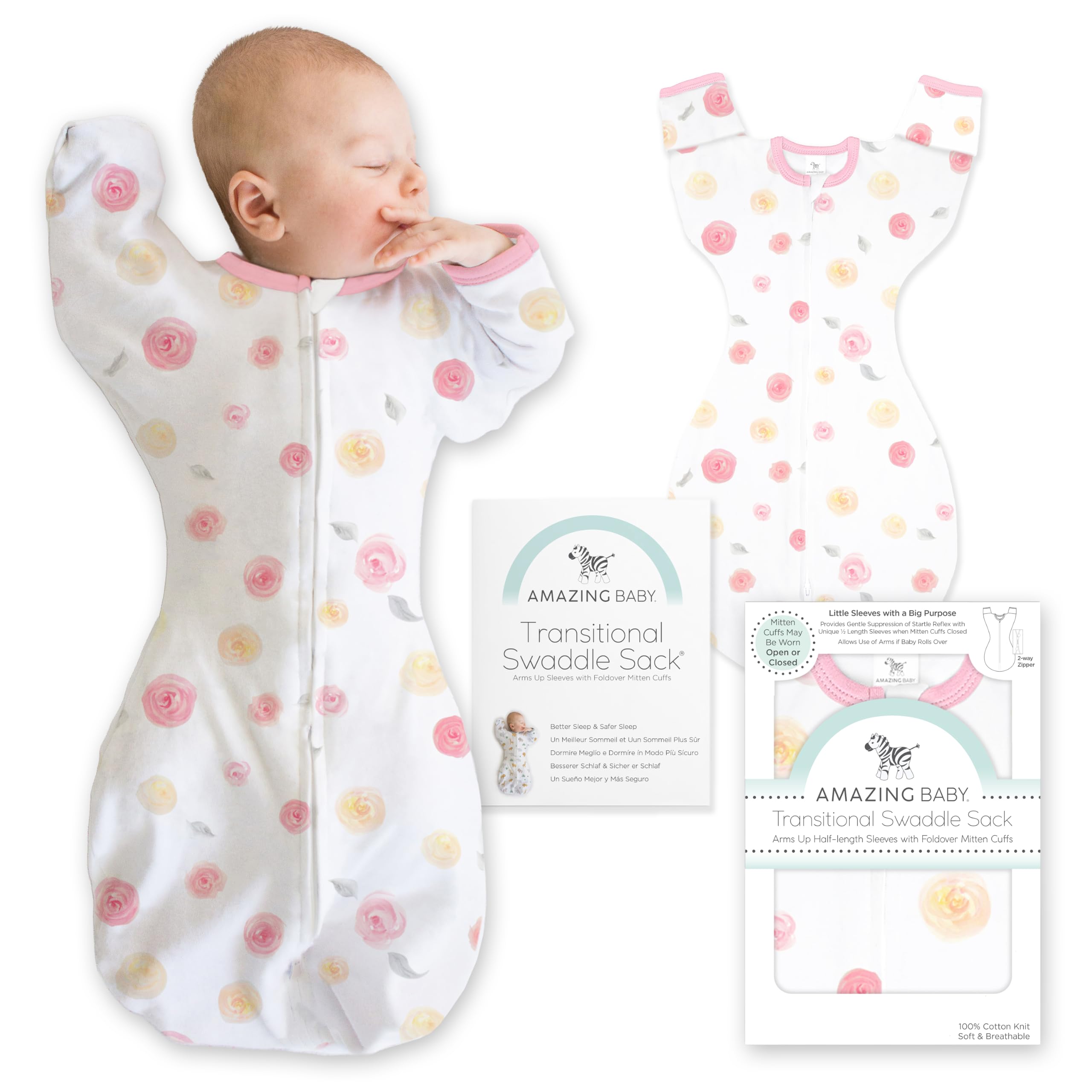
Amazing Baby Transitional Swaddle Sack
Key Features
- Closure: Two-way zipper
- Size range: S 6–14, M 14–21, L 21–24 lbs
- TOG rating: 0.5 TOG
- Transition style: Arms-up sleeves, fold-over mitts
- Price: Budget
At 0.5 TOG this is the lightest thing in the group by a clear margin, and that is the reason to buy it. We reach for it when the nursery already runs warm, where a heavier sack leaves a baby hot and clammy at the back of the neck and this one goes over a short-sleeve bodysuit and lets the room do the rest. The cotton is thin and soft, the watercolor rose print is genuinely pretty, and the arms-up shape with fold-over mitts does the same job as the SwaddleDesigns sack for about the same money.
Sizing takes some care. Three sizes look generous on paper, but this one runs small, and the neckline is where it shows: on a baby near the top of the band the shoulders tighten and the opening pulls at the throat instead of sitting on the chest. Go by length as much as weight, and take the next size up if your baby is long or solid.
The bigger trade is through the middle. This cut is roomier around the torso than the other arms-up pick, which is comfortable but does less to damp a startle reflex — a baby who needs a firm wrap to stop flinching will still flinch in this one. What you get in return is a light, inexpensive layer that a hands-free baby can sleep in through a warm stretch, with a two-way zipper that makes night changes quick.
Pros
- 0.5 TOG suits warm rooms
- Fold-over mitts free the hands gradually
- Two-way zipper for quick changes
Cons
- Runs small against its stated weight band
- Zipper can stick or fail with use
Buy this one for a warm nursery: 0.5 TOG is a genuinely light layer, as long as you size up and check the neckline first.
Best for Newborn Months
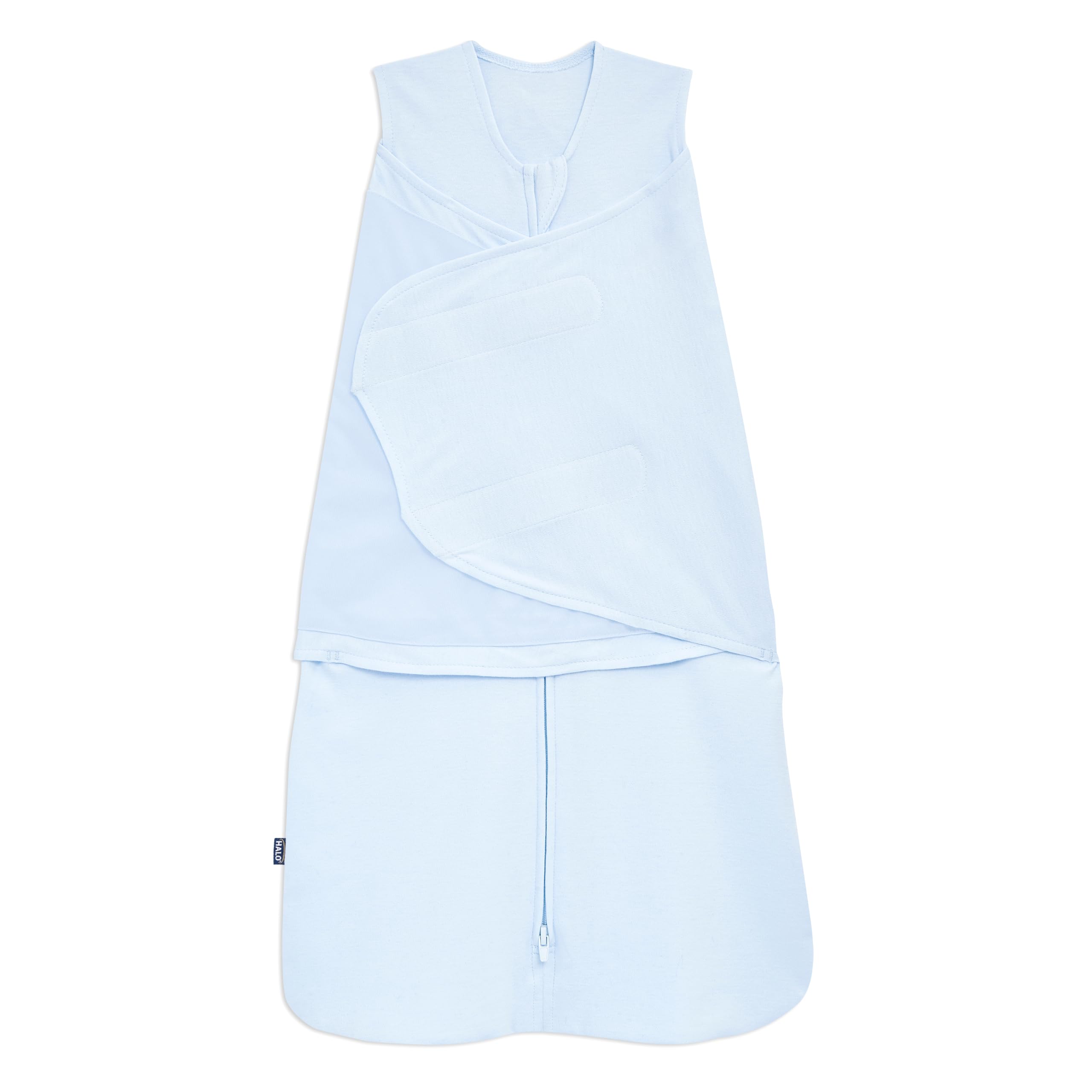
HALO SleepSack Swaddle
Key Features
- Closure: Velcro wings with two-way zipper
- Size range: 6–12 lbs (Newborn)
- TOG rating: 1.5 TOG
- Transition style: 3-way: arms in, hands-to-face, arms out
- Price: Midrange
Velcro is the first thing you notice, in the sense that you hear it. The tabs are quicker than any zipper and they hold a thrasher better than anything else here, but they are loud enough to wake the baby you just got down and they grab whatever fabric is nearby, including the sack itself. Press them shut before it goes in the wash and the pulls stay minor.
The size band is the bigger issue. Six to twelve pounds is newborn territory, and arms-out is the last stop on the way out of it, so plenty of babies reach the setting that makes this a transition product at almost exactly the point they outgrow the sack. We think of it as a newborn purchase with a transition built in rather than a transition purchase — if your baby is already past twelve pounds, start somewhere else.
What it does offer is three arm positions, more than any other pick here: both arms in for a tight wrap, one hand up to the face for a partial release, and both arms free at the end. The double zipper means a diaper change doesn’t cost you the swaddle at all, and at 1.5 TOG — rated for rooms between 68 and 75°F — it is the warmest of the four, which suits a cool nursery and is too much for a warm one.
Pros
- Three arm positions in one sack
- Double zipper keeps the swaddle intact
- Warmest rating for cool rooms
Cons
- Newborn weight band caps the transition stage
- Velcro can be loud and lose grip
The most adjustable sack here and a solid newborn buy, but the 6–12 lb band means many babies outgrow it just as the arms-out stage matters.
How We Tested Transitional Swaddles
We started by narrowing a long list of transitional swaddles using size charts, fabric specs, and safe-sleep guidance, then cut anything that didn’t offer a clear arms-in-to-arms-out path or a realistic size range. Fourteen made the cut, and we tested them over four months with our own babies and a small panel of parent testers, all between 3 and 9 months old. Each swaddle stayed in rotation for at least two weeks of naps, bedtimes, and overnight diaper changes.
Fit came first: we put each swaddle on babies of different heights and weights, checked whether the labeled size matched reality, and watched for fabric that bunched under the chin or rode up during sleep. To judge how well each one handled the startle reflex, we noted whether babies settled faster with arms in, and whether the arms-out conversion actually helped or just gave tiny hands a way to escape. We also listened to Velcro in the dark – a closure loud enough to startle a sleeping baby is a real strike – and checked whether it stayed stuck after repeated washes.
Zippers got the one-handed test during night changes: we checked for snags at the neckline, whether a two-way zip made diaper changes easier, and whether the pull tab stayed where we left it. Durability meant washing each swaddle at least ten times and looking for pilling, shrinking seams, and closures that lost their grip. We kept rough notes on sleep, too – how often babies woke, how quickly they resettled, and whether the swaddle made the transition easier for the parent doing the 3 a.m. shift. Value came down to whether it held up long enough to hand down, not just the tag price.
How to Choose a Transitional Swaddle
The right transitional swaddle matches the way your baby already sleeps and the weight they are today; get those two right and the rest is detail.
Start With the Shape of the Arms
Three designs cover almost everything here, and they suit different babies. Arms-up half sleeves with fold-over mitts keep the hands where many babies want them while damping the startle reflex. Zip-off wings let you free one arm at a time, the gentlest version for a baby who is still sleeping well wrapped. Convertible sacks with arms-in and arms-out settings are the most adjustable and the least specialised. Choose for what your baby does now, not what you hope they’ll do next month.
The trap is the word transitional itself. Plenty of ordinary sleep sacks carry it while offering no way to keep an arm in. If there is no closed-arm or arms-up configuration, it isn’t a transition garment, whatever the listing calls it.
Buy by Weight and Length, Not the Age on the Label
Every sack here is sized by weight, and the bands move fast. A 6–14 lb size and a 13–19 lb size overlap by about a pound, which is roughly a month of growing. Length is what catches people out: a long baby can sit comfortably inside the weight range and still be cramped at the shoulders, so hold the garment against a sleepsuit that currently fits before you commit.
The trap is buying the size that fits today at the exact moment of transition. The arms-free stage only helps if the sack still fits when you reach it, which is why a newborn-rated convertible is a different purchase from a true transitional one.
Choose Warmth by the Room, Not the Season
TOG measures insulation, and it is the only useful warmth number on these garments — higher is warmer. The range here runs from 0.5 TOG, which is barely more than a cotton layer, up to 1.5 TOG, which the HALO sack rates for rooms of 68 to 75°F. Pick for the temperature your nursery actually holds at night rather than the calendar: a 1.5 TOG sack in a warm room is the quickest route to a sweaty, wakeful baby.
The trap is compensating with layers instead of buying the right rating. If the room runs cool, put a footed sleepsuit under the sack. A blanket over the top puts something loose in the crib, which is the one thing a swaddle exists to avoid.
Weigh the Closure Against the Rest
Two-way zippers are quiet, secure, and let you change a diaper from the bottom without freeing the arms; every pick here has one. Velcro is faster to fasten and harder for a determined baby to defeat, but it is loud enough to wake the baby you just settled, it grabs fabric in the wash, and its grip fades over months of washing.
Neither is a dealbreaker. If your baby sleeps lightly, the noise matters more than the speed. If they are a committed escape artist, Velcro may hold better than a zip. Check that any zipper has a fabric guard at the chin, because that is where a too-short neckline shows first.
Frequently Asked Questions
How many transitional swaddles do I need?
Two is the realistic number. Spit-up and diaper leaks mean one is in the wash most days, and one of our picks has to dry flat, which can eat most of a day. A second in the same size means you are never improvising with a blanket at bedtime.
If you are sizing up mid-transition, buy the new size before you need it and keep the old one in rotation for the nights it is still in the dryer.
How do I wash one without wrecking the closure?
Machine wash cold on a gentle cycle and fasten every Velcro tab and zip before the sack goes in, so the hooks cannot grab the cotton and pull it. Skip fabric softener, which leaves a film that makes stretch fabrics stiff.
Then read the drying line: the Love to Dream bag has to dry flat, while the cotton sacks here can go on low. Air-drying anything with a zip keeps the teeth from warping.
When can I move to a regular sleep sack?
Once your baby has slept with both arms free through a week or two of nights and naps without the startle coming back, and can roll both ways, the transition is finished. A plain sleeveless sleep sack in the same TOG is the next step.
Keep the weight the same when you switch so you are changing one thing at a time — a new garment plus a new warmth rating is how a good sleeper turns into a bad week.
Final Verdict
Start with the Love to Dream 2-in-1 Transition Bag. Zip-off wings are the least disruptive route from a wrapped baby to a free-armed one, and the arms-up cut suits the babies who fight a swaddle hardest. When budget is the tightest constraint, the SwaddleDesigns sack runs the same play with fold-over mitts for a good deal less.
If the nursery runs warm, take the Amazing Baby sack in 0.5 TOG instead, sizing up and checking the neckline before you commit.
