This post contains affiliate links. We may earn a small commission when you buy through our links — at no extra cost to you.
A leaking sippy cup doesn’t ruin one shirt — it soaks the spare outfit, the wipes, and the emergency change of clothes at daycare. Silicone solves most of that. It’s soft on new teeth, it doesn’t crack when it comes off the high chair tray, and it doesn’t hold onto a sour milk smell the way some plastics do. What silicone can’t fix is the lid, and that’s where these cups separate.
We’ve spent six months with 14 silicone cups, from 4-ounce starters to 9-ounce sippies, handed to a rotating crew of babies and toddlers. The thing I’d tell any first-time buyer: count the parts before you commit. Every valve and gasket is something you’ll be rinsing by hand at 9 p.m., dishwasher safe or not.
Size matters more than it looks, too — a 4- or 5-ounce cup is really a training tool for the under-1 crowd, while a 7- or 9-ouncer with removable handles is what actually gets thrown in the diaper bag. Here are the ones that earned a permanent cabinet spot.


Best for Learning Straws
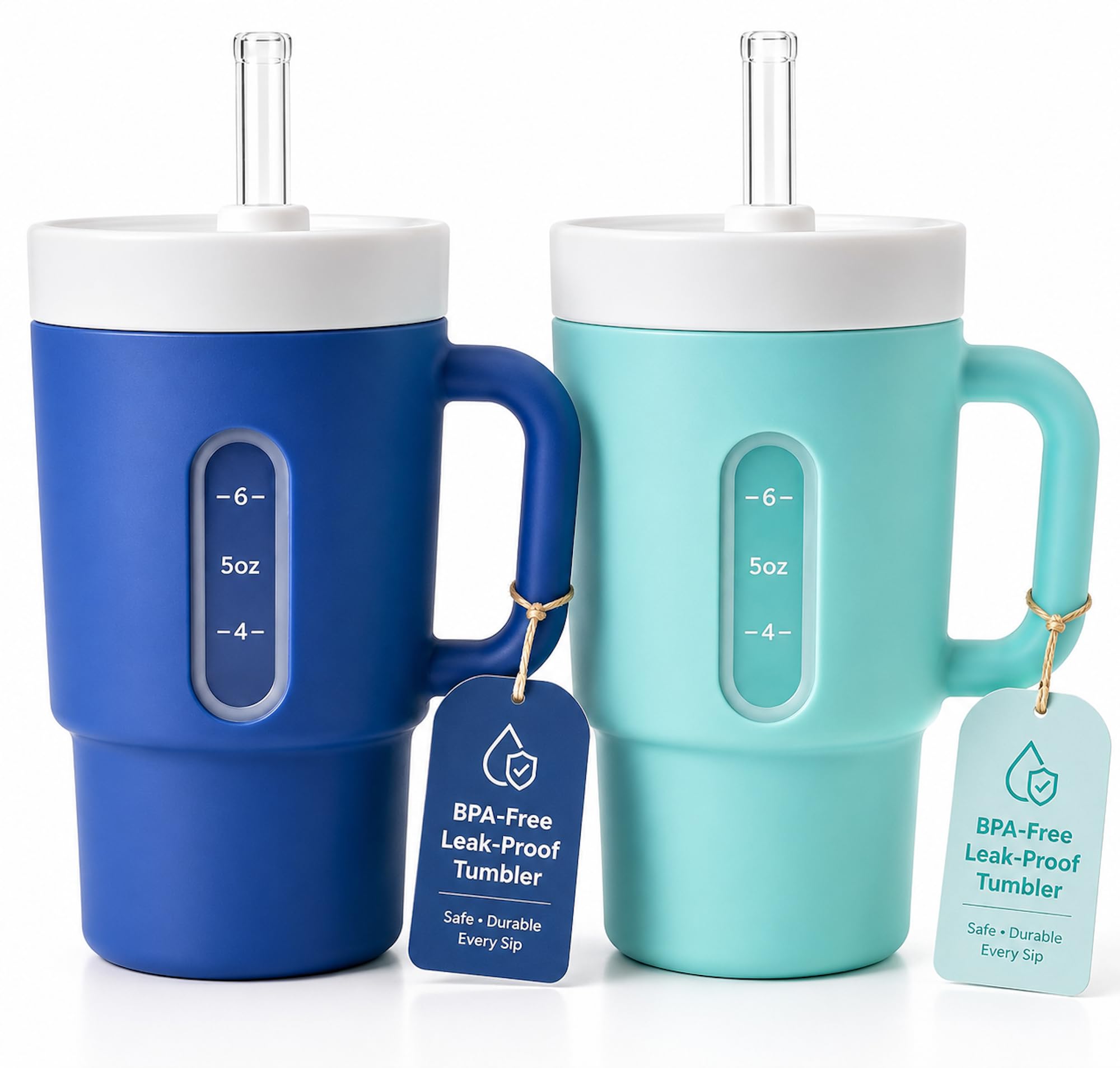
The First Years Squeeze & Sip
Key Features
- Capacity: 7 oz
- Dishwasher: Top rack
- Cups per pack: 2
- Drinking style: Squeeze-assist straw
- Price: Midrange
A baby who can’t yet pull on a straw can still drink from this cup. Squeeze the silicone body and liquid rises into the straw, so the first successful sip happens in the highchair instead of after three weeks of trying, and a valve inside the straw meters the flow on the way up. At 7 ounces and about 5 inches tall, it’s sized for a baby who grips with both hands and no thumbs.
That squeeze is why it’s our top pick. Of everything here, it’s the cup that does the teaching and then keeps working once the lesson is over, and two come in the box — which is the difference between washing it once a day and washing it twice. The whole thing also comes apart, lid off and straw out, and a training cup you can’t properly wash ends up at the back of the cabinet.
Where it falls short is at the edges. Water that has already climbed into the straw can dribble out when the cup is thrown, so the valve is a spill reducer rather than a seal — knock the straw clear before it goes back in the bag. The squeeze itself wants a firm hand; a light pinch moves nothing, which is fine for us and maddening for anyone expecting a soft pouch.
It’s top-rack dishwasher safe, BPA-free, and labeled from 6 months. The two cups also come in different colors, which sounds trivial until you’re matching lids before coffee — you can tell at a glance which one went to daycare.
Pros
- Squeeze assist teaches straw drinking early
- Valve controls flow and limits spills
- Comes fully apart for a real wash
- Two 7-ounce cups in the pack
Cons
- Water in the straw can dribble when thrown
- Squeeze takes firm pressure to move liquid
We keep recommending this one because the squeeze body lets a parent start a baby on a straw before suction clicks, and the valve keeps most of the water where it belongs.
Best for First Cup
Olababy Silicone Straw Training Cup
Key Features
- Base: Weighted, non-slip
- Capacity: 5 oz
- Age range: 6 to 18 months
- Cup material: Silicone
- Price: Premium
The Olababy is the cup we set on the highchair tray rather than drop in the diaper bag, and that’s a deliberate trade. A wide weighted base keeps it from going over when a 6-month-old slaps it, the non-slip surface gives small hands something to hold, and the body is soft silicone from rim to base — which matters for a baby who chews the edge between sips.
Clear walls with ounce and milliliter markings turn out to be more useful than they sound: you can see how much went in and how much came back out. The straw has a stopper, so it can’t be pulled free and waved around, and with the straw out the cup works as a small open rim, which is where drinking ends up anyway.
What it isn’t is leak-proof. An open straw plus a soft body means liquid finds its way out when the cup is tipped or dropped, and a hard squeeze or a fall can lift the lid. Neither is a defect so much as the shape of the design, and the fix is placement: water at the table, milk at home, and the diaper bag for something with a valve.
Five ounces holds a small serving, which is the point — a full cup a baby can lift beats a big one they can’t. It’s one cup per box at the highest price here, so it earns its place on the tray rather than in the rotation: this is the one we hand a baby first.
Pros
- Weighted wide base resists tipping
- Entirely silicone, gentle on gums
- Clear walls with ounce markings
- Straw stopper keeps the straw seated
Cons
- Not spill-proof; open straw spills when tipped
- One cup per box at the highest price here
We reach for this one at the table, not in the car: an all-silicone body, a weighted base, and see-through walls make it the steadiest first cup here.
Best for Transitioning
Moonkie 3-Stage Silicone Cup Set
Key Features
- Capacity: 4 oz
- Dishwasher: Dishwasher safe
- Cups per pack: 2
- Lids included: Straw, spout, open
- Price: Midrange
Two 4-ounce cups, two straw lids, two spout lids, four straws, and a brush. The Moonkie is the only set here that covers spout drinking as well as straw drinking, and the same two bodies work as open cups once the lids come off. For a 6-month-old with opinions, that flexibility is worth more than any single feature on the box.
The cups are soft food-grade silicone with a valve built into the straw to even out the flow, and the double-seal lid is designed to stay put. At 2.8 inches wide, the body is something a small hand wraps around rather than a tall cup to balance, and 4 ounces is the right pour for a baby who is mostly practicing.
The honest catch is the lid. A hard drop can pop it off, and a 4-ounce cup that opens on the floor is a 4-ounce puddle — this isn’t the cup to hand a thrower. The size cuts both ways too: fine for water with meals at 6 to 9 months, less so once a toddler is drinking a full cup at snack time. We treat it as the training set it is and keep bigger cups for later.
The brush is the part we didn’t expect to care about. The valve is where milk goes to hide, and a brush small enough to push through it is the difference between a cup that gets cleaned and one that gets rinsed. Everything is top-rack dishwasher and microwave safe, and the parts come apart without tools.
Pros
- Straw, spout, and open-cup options in one set
- Soft silicone body and straw
- Includes a straw cleaning brush
- Two cups so one is always clean
Cons
- Lid can pop off when dropped hard
- 4-ounce cups empty quickly
We like this set for the baby who hasn’t settled on a drinking method: two cups and three lid styles cover spout, straw, and open cup.
Best for Daycare
DeeCoo 7 oz Silicone Sippy Cup
Key Features
- Straw: Flow-control valve
- Capacity: 7 oz
- Material: Food-grade silicone
- Cups per pack: 2
- Price: Budget
Less than any other cup or set on this page buys two 7-ounce cups, two lids, two straws, and a chunky handle on each. That’s the whole case for the DeeCoo, and it’s a sound one: the cup you don’t mind losing at daycare is the cup that actually gets sent.
The design is plain but sensible. A flow-control valve in the straw slows what comes up, the squat 4-inch-wide body is hard to knock over, and everything comes apart in seconds with no special brush and no hidden corners. The silicone is food-grade and free of BPA, PVC, and phthalates, and all the parts go on the top rack.
What you give up is options. There’s no weighted straw, no spout lid, no open-cup conversion, and the maker’s own wording is leak-resistant rather than leak-proof — expect a valve that slows a spill, not a seal that survives a highchair throw. For a baby who already drinks from a straw, that’s an easy trade. For a baby still learning, the squeeze-assist cup is the better teacher.
While we haven’t tried to disprove the unbreakable claim, a soft body has no rigid shell to crack, and there are few enough parts that nothing goes missing in the dishwasher. Two cups make the rotation work: one on the shelf, one in the bag.
Pros
- Two handled cups for the lowest outlay here
- Flow-control valve slows spills
- No special brush or hidden corners
- Squat 4-inch body resists tipping
Cons
- No weighted straw or open-cup option
- Leak-resistant, not leak-proof, by the brand’s own wording
Our pick for daycare: two 7-ounce handled cups with flow valves at the lowest outlay of anything here, so a lost cup isn’t a crisis.
Best for Toddlers
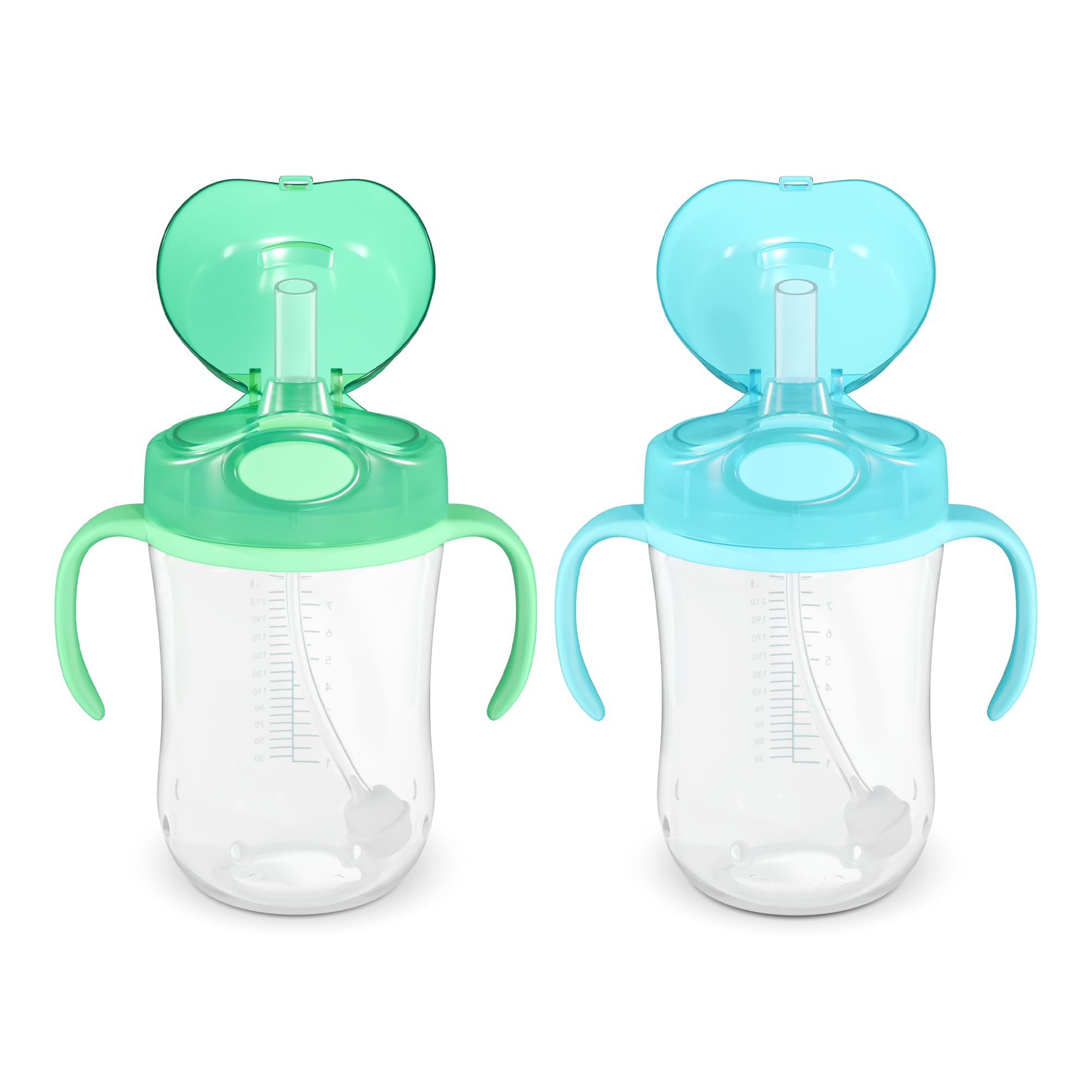
Amazon Basics Weighted Straw Cup
Key Features
- Straw: Weighted silicone
- Handles: Removable
- Capacity: 9 oz
- Cups per pack: 2
- Price: Budget
Nine ounces is the largest capacity in this group by a wide margin, and that changes who the cup is for. This is a toddler cup rather than a first-sips cup: it holds enough for a whole snack, the weighted straw lets a child drink while tipped back in a car seat, and the handles come off when they’re no longer wanted.
The economics are hard to argue with — two cups and a cleaning brush for less than anything else here — and the silicone straw stands up to chewing better than the cup around it. That’s the trade: the body is thin plastic, the attached flip cap takes two hands and a thumbnail, and it isn’t the cup we hand a baby who is still learning.
The lid is the part to watch. It can cross-thread, and a lid that isn’t seated squarely will leak at the seam no matter how hard you turn it. Screw it on dry and empty first and check that it sits flush; if it won’t, that’s a return rather than a cup to work around. Snap the straw in with the rubber collar visible, as the instructions specify, because a straw that isn’t seated all the way pulls air instead of water.
For a 1-year-old who already drinks well and throws everything, that’s a reasonable set to own: cheap enough to lose, big enough to be useful, and easy to take apart for washing.
Pros
- 9-ounce capacity, the largest here
- Weighted straw works at any angle
- Removable handles
- Lowest cost per cup in this set
Cons
- Lid can cross-thread and leak at the seam
- Thin plastic body and stiff flip cap
The toddler cup of the group: 9 ounces, a weighted straw that drinks at any angle, and enough capacity that we’re not refilling it every ten minutes.
What Six Months and 14 Sippy Cups Taught Us
We started with a long list of silicone cups sold in the U.S. and cut it to 14 by filtering for food-grade silicone, no BPA, PVC, or lead, a straw a 6-month-old could actually draw from, and a stated capacity between 4 and 9 ounces. We kept budget two-packs and pricier singles in the mix so the results hold up whether you’re outfitting a daycare bag or buying one cup to try.
Testing ran six months, in the messiest conditions we could manage without a lab bench: breakfast in the high chair, water by the crib at naptime, a thick fruit puree on a Saturday, and a full day wedged sideways in a diaper bag before landing in a stroller cup holder. Each cup also went home with a parent on the team, so it survived daycare drop-off, car seats, and the top rack of the dishwasher over and over.
For leaks, we filled each cup, screwed the lid on the way a distracted adult would, shook it upside down over a paper towel, then laid it on its side in a bag for an hour and checked whether anything wicked into the fabric. We took every lid apart, counted the pieces, and washed them the way people really do — bottle brush, warm water, not much patience — noting which valves held onto residue and which rinsed clean in a few seconds.
Durability came down to the lids. We dropped loaded cups from high chair height onto hardwood and tile and checked whether the silicone still seated after repeated washings or had started to stretch. We also watched how easily a 1-year-old got the straw to their mouth, and whether the handles popped off without a fight when it was time to pack the cup away.
How to Choose a Silicone Sippy Cup
The cup that actually gets used is the one that matches the stage your baby is at right now, which is why the picks here run from a 4-ounce trainer to a 9-ounce toddler cup.
Pick the drinking method first
Straw, spout, or open rim changes everything else about a cup. A straw is the skill that carries over to restaurant glasses and school water bottles, and a valve inside the straw makes it manageable long before a baby has strong suction. A spout is the fallback for a baby who refuses a straw outright, and an open rim is where you end up anyway.
If you don’t know which your baby will accept, buy the set that covers all three. The Moonkie does spout, straw, and open cup with the same two bodies, which is why it’s the pick we point uncertain parents to.
Read spill-proof as spill-reducing
Almost every training cup here has a valve, and a valve slows liquid rather than locking it in. Water that has already climbed into the straw will dribble out when the cup lands on its side, and a soft body squeezed hard can lift a lid. The cups that hold up best are the ones with a lid that seats squarely and a straw that stays put.
Test the lid dry, before there’s milk in the cup, and keep a full cup off the sofa. For a diaper-bag cup, a seated valve and a lid you trust matter far more than the wording on the box.
Count the parts you’ll actually wash
A cup that comes apart in three pieces gets washed; one with a valve, a gasket, and a brush-only straw gets rinsed and put away wet. Silicone is the reason to bother — it doesn’t crack and it’s soft on gums — but it also has to dry completely, especially inside the straw, or the next drink tastes like the last one.
Top-rack dishwasher is fine for every pick here. Our rule: if you can’t push a brush through the valve in under a minute, you won’t do it nightly, so pay attention to what comes in the box. The Moonkie includes a straw brush; the DeeCoo is built to clean without one.
All-silicone versus silicone-topped
Silicone sippy cups come in two builds. The Olababy and Moonkie are silicone through the body, the lid, and the straw, so there’s no hard edge against a baby’s gums and the cup stays light in one hand. The First Years puts silicone along the drinking path — cup body and straw — and uses polypropylene for the lid and collar, which gives the lid a more positive seat.
Neither approach is safer, and BPA-free is the baseline across every cup we recommend. Choose on feel: all-silicone is grippier and quieter on a highchair tray, while a firmer collar is easier to screw or press down one-handed while you’re holding a baby.
Match ounces to age, not to appetite
The 4- and 5-ounce cups are for the first months of water with meals, when the point is practice and a full cup is a puddle waiting to happen. Seven ounces is the everyday size from around 9 months, and 9 ounces is a toddler cup that gets carried from room to room.
Bigger isn’t better early on: a heavy cup is harder to lift and makes a bigger mess when it lands. Buy small first, then size up once your baby is finishing the cup and looking for more.
Frequently Asked Questions
When can my baby start using a straw cup?
Most of the cups here are labeled for 6 months and up, which lines up with a baby sitting with support and taking water alongside solids. Before that, a straw is a skill without much purpose.
The squeeze-assist design is the exception worth knowing about: you push liquid up the straw so a baby who can’t yet generate suction still learns the motion. Introduce it with water at a meal rather than milk at bedtime, when a spill matters more.
Can I put milk, smoothies, or warm liquids in a silicone cup?
Yes, with limits. The Olababy is the one here the maker rates for cold, warm, and hot liquids and thin solids like smoothies; the others specify cold drinks or leave it open.
Warm is fine, boiling isn’t. Whatever goes in, wash it the same day — once milk dries inside a straw or a valve, a rinse won’t reach it, and that’s the part of a training cup that’s hardest to get clean.
How often should a silicone straw cup be replaced?
Replace the straw as soon as it’s torn, stretched, or chewed through, and replace the cup when the lid stops seating or the silicone has gone cloudy and rough.
Pull on the straw every couple of weeks to check it. Silicone is durable but not indestructible, and a chewed-through straw is a choking risk in a way a chewed spoon isn’t.
Final Verdict
The First Years Squeeze & Sip is the cup we hand to a baby who hasn’t worked out a straw yet: the squeeze does the teaching, the valve limits the mess, and two cups in the box mean one is always clean. It’s the default for most families starting this month.
When you want one all-silicone cup to leave on the highchair tray, the Olababy is steadier and simpler to live with. If your toddler already drinks well and you need capacity and a weighted straw, the Amazon Basics set is the practical buy.
