This post contains affiliate links. We may earn a small commission when you buy through our links — at no extra cost to you.
Portable breast pumps free you from the outlet, but they come with a built-in trade-off: the freedom to pump anywhere usually costs you suction, and the quietest motors aren’t always the ones that empty you fastest. What you actually want is a pump that holds its charge through a full workday away from home, pulls hard enough to keep your supply steady, and doesn’t announce itself to everyone within earshot.
Over the past six months, my team and I have pumped with 12 of them — at desks, in parked cars, on the couch at 2 a.m. — and the pattern showed up fast. Flange fit matters more than any motor spec on the box; a mid-priced pump with the right size will out-empty a premium one with the wrong size. Ease of use is the thing nobody warns you about, because you’ll be washing and reassembling parts several times a day. The models that came through with crisp valves, clear plastic, and no dropped sessions are the ones that made the list.


Best for Primary Portable Pumping
Spectra S1 Plus
Key Features
- Power: Rechargeable battery or cord
- Weight: 3.3 lb
- Pump type: Double electric
- Noise level: 45 dB
- Price: Premium
The Spectra S1 Plus earns its place as our top pick because it makes the least portable part of pumping portable: the pump itself. At 3.3 pounds, it is a bag-friendly pump rather than a pocket one, but the rechargeable battery means we can set it on the kitchen table, move it to a bedroom, or leave the wall adapter packed. The 45 dB rating is believable in use; it is quiet enough that a closed door does most of the work.
Performance is the reason to choose it over the smaller wearables. It has hospital-style suction and cycle control, two flange sizes (24mm and 28mm) in the box, and a backflow protector that keeps milk out of the tubing. We came to trust it for the sessions where output matters, and the two included bottles mean you can pump and store without hunting for a container. The two-year pump warranty is also a useful cushion for a primary pump.
The S1 is the pump we choose when output matters more than walking around. It is a set-down pump: you need a table, a chair, and a few minutes, and it rewards that routine with a calmer session than a wearable. If your day is built around pumping while moving, choose a wearable instead.
We recommend it first to anyone who wants one pump for most sessions and is willing to carry a small bag. If your priority is walking around while you pump, the Elvie is the more discreet tool; if you need no power at all, the Medela Harmony is the backup. The S1 sits in the middle as the best all-round portable electric here.
Pros
- Rechargeable battery frees you from an outlet
- Hospital-style suction with two flange sizes
- Quiet 45 dB motor
- Two-year pump warranty
Cons
- Bulkier than wearable or manual pumps
- Premium price for a primary pump
We recommend the Spectra S1 Plus for a primary portable pump: rechargeable, quiet at 45 dB, and stronger than the wearables here without giving up bag-friendly use.
Best for No-Power Backup
Medela Harmony
Key Features
- Shield: PersonalFit Flex
- Pump type: Manual
- Power source: No cords or batteries
- Bottle capacity: 5 oz / 150 ml
- Price: Budget
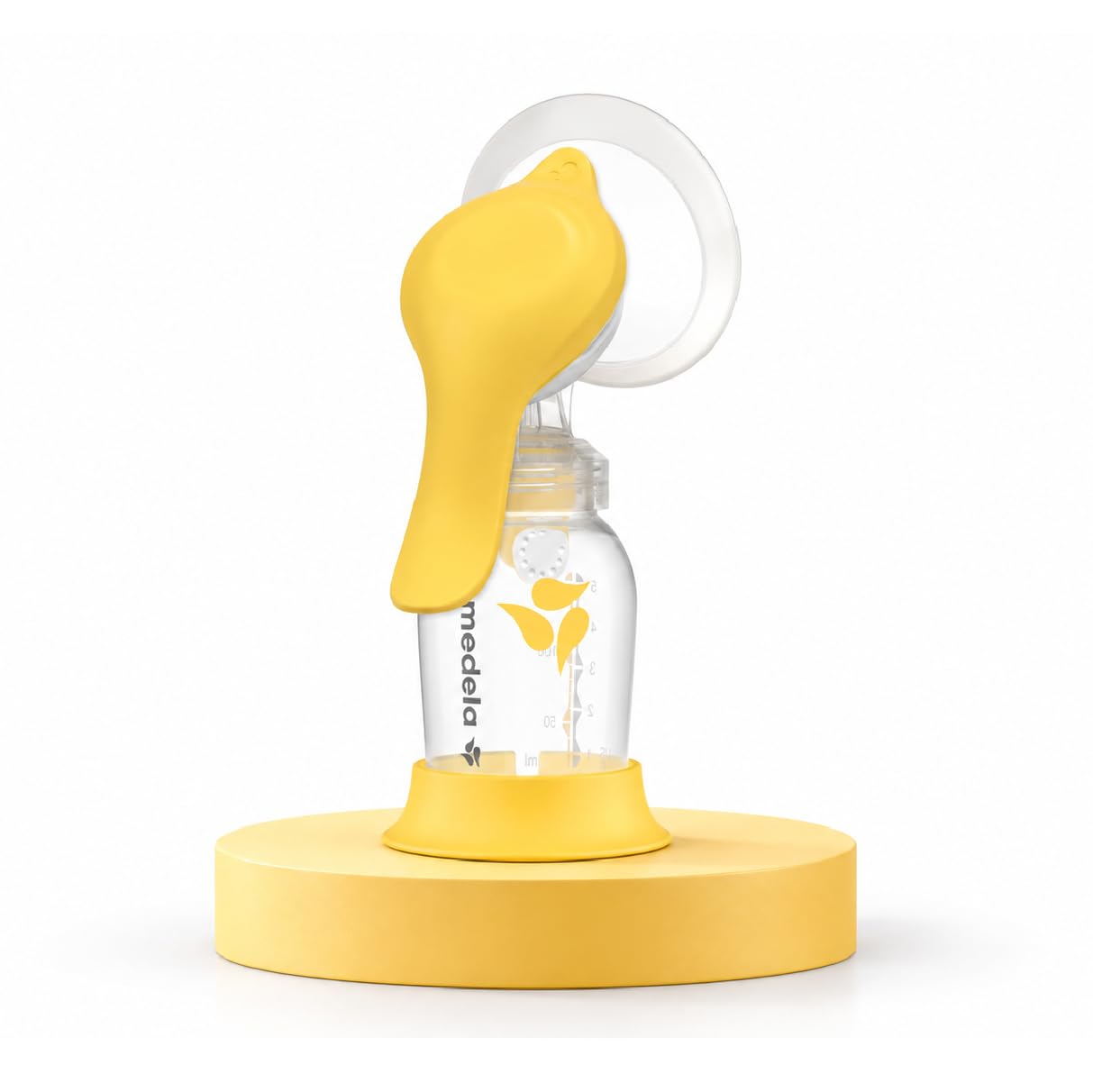
The Medela Harmony is the pump we reach for when the electric pump stays home. It has no cord, no battery, and no charging routine: the handle does the work, and the 5-oz bottle takes a lid so you can pump and store in the same container. The PersonalFit Flex shield rotates 360 degrees, which helps you find a seal without fighting the angle of the bottle.
We like it most as a backup, not as the only pump for every day. The two-phase handle gives you a quick stimulation rhythm and a slower expression stroke, and with a good seal it can empty a breast efficiently. The catch is that manual pumping asks more of your hand and attention than a double electric; it is best for a missed session, a travel day, or the middle-of-the-night pump when you do not want to set up a machine.
Cleaning is one of its quiet advantages: fewer parts than an electric, and the parts are dishwasher-safe. The 5-oz bottle is a useful size for a single session, and the compact body slips into a diaper bag without a dedicated pump bag. We did not find it as effortless as the wearables, but that is not the job.
Pros
- No cords, batteries, or charging
- Two-phase handle and rotating shield
- Pump-and-store 5 oz / 150 ml bottle
- Few parts and dishwasher-safe
Cons
- Single pump, one side at a time
- No powered suction settings
We recommend the Medela Harmony as the no-power backup for a bag or a bedside table, especially if you want a pump that stores straight into its own bottle.
Best for Discreet Hands-Free Pumping
Elvie Double Wearable
Key Features
- Motor: Piezo pumps
- Weight: 14.8 oz
- Controls: App-controlled
- Pump type: Double wearable
- Price: Premium
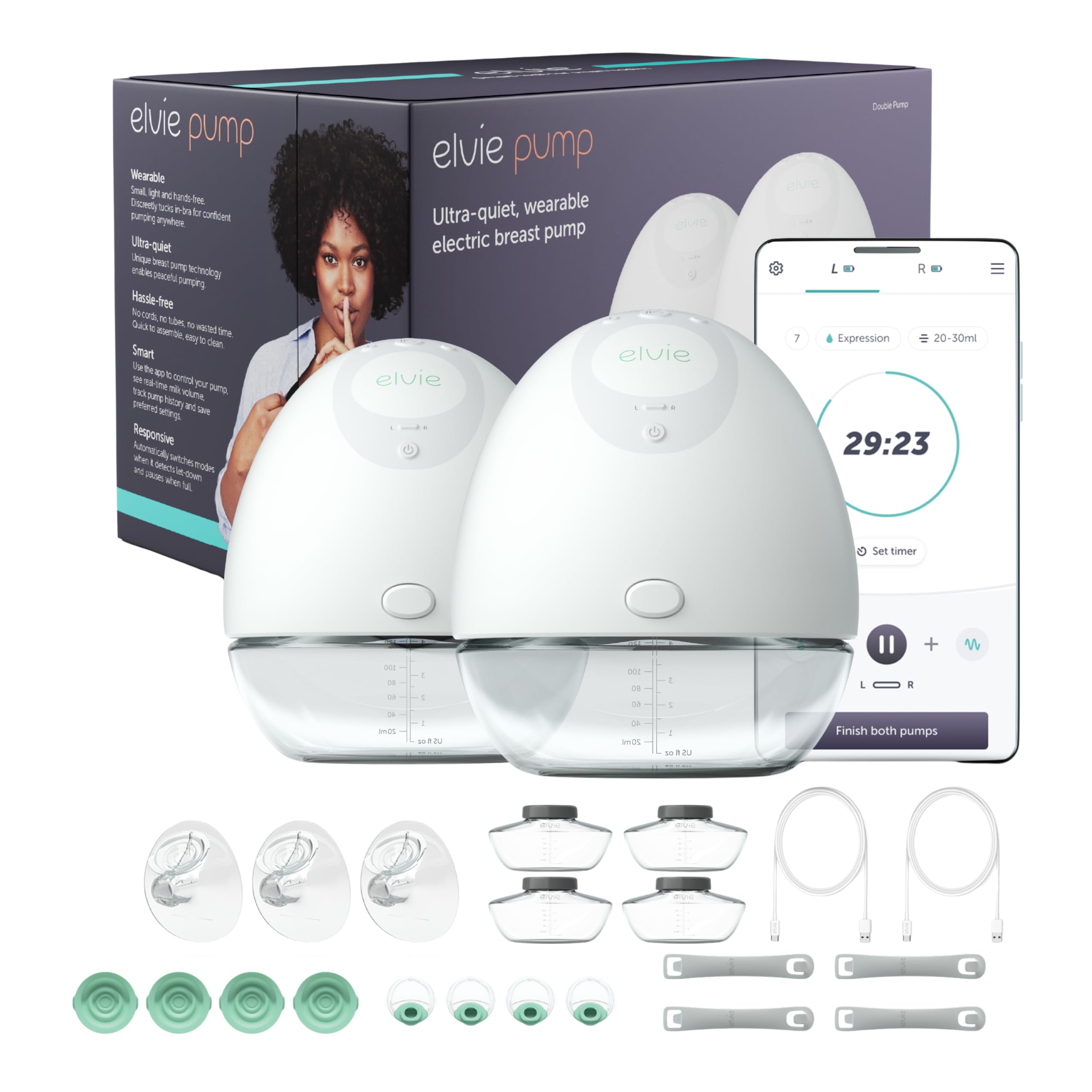
The Elvie is the pump that makes the most sense when pumping in public or at a desk is the whole point. Two cups sit inside a bra with no tubes, and the app handles settings, output tracking, and session history. The piezo motors use tiny discs moving at high speed rather than a conventional pump mechanism, and the result is a wearable that is genuinely quiet enough to use in a shared room.
That discretion is what you pay for. At 14.82 ounces for the pair, it is not weightless, but it is far less conspicuous than a pump with bottles hanging off a bra. The four personalized settings and app control make it easy to adjust without reaching into your shirt. We recommend it to a buyer whose pumping happens on the move, in a meeting, or on a commute; if most sessions are at a desk with an outlet, the Spectra S1 gives more pump for the money.
It is not the pump we choose for a high-output primary session, but it is the one we choose when being seen pumping is the problem. The discretion is the feature, and it is worth paying for if that is your daily reality.
Pros
- Tubeless in-bra double pump
- Quiet piezo motor
- App control and output tracking
- Four personalized settings
Cons
- Premium price
- Two cups to charge and track
We recommend the Elvie for anyone who needs a discreet, hands-free double pump for work or travel and can accept the premium price and app routine.
Best for Budget Double Pumping
NCVI 8782
Key Features
- Modes: 4 modes, 9 levels
- Battery: 2200mAh
- Pump type: Double electric
- Noise level: 40 dB
- Price: Budget
The NCVI 8782 is the budget double electric that covers the basics without making you feel like you are settling for a toy. It has four modes and nine suction levels, a 2200mAh rechargeable battery, and a 40 dB noise rating. The double setup means two flanges and two bottles, so you can pump both sides at once; the anti-backflow design is the detail that keeps milk out of the tubing in normal use.
We recommend it when a double electric has to stay affordable. The controls are simple, the motor is quiet enough for a shared room, and the battery makes it easy to move from bedroom to kitchen. The caveat is suction: if it weakens, check the tubing and valves before blaming the motor, because milk or moisture in the line is the first thing to rule out. A good flange seal matters more here than the top suction number.
It is not as discreet as a wearable and it will not replace a premium pump for every session, but it does the core job at a much lower price than the top picks. For a second pump, a work bag, or a buyer who is not ready to spend wearable money, that is a sensible trade.
Pros
- Double pumping at a budget price
- 2200mAh rechargeable battery
- Quiet 40 dB motor
- Four modes and nine levels
Cons
- Battery runtime drops at higher suction
- No app or session tracking
We recommend the NCVI 8782 as the budget double electric for a second pump or a work bag, provided you check the tubing and flange seal when suction drops.
Best for Budget Wearable
Momcozy S9 Pro
Key Features
- Pack: 2 pack
- Battery: Up to 270 minutes
- Pump type: Double wearable
- Flange size: 24mm
- Price: Midrange
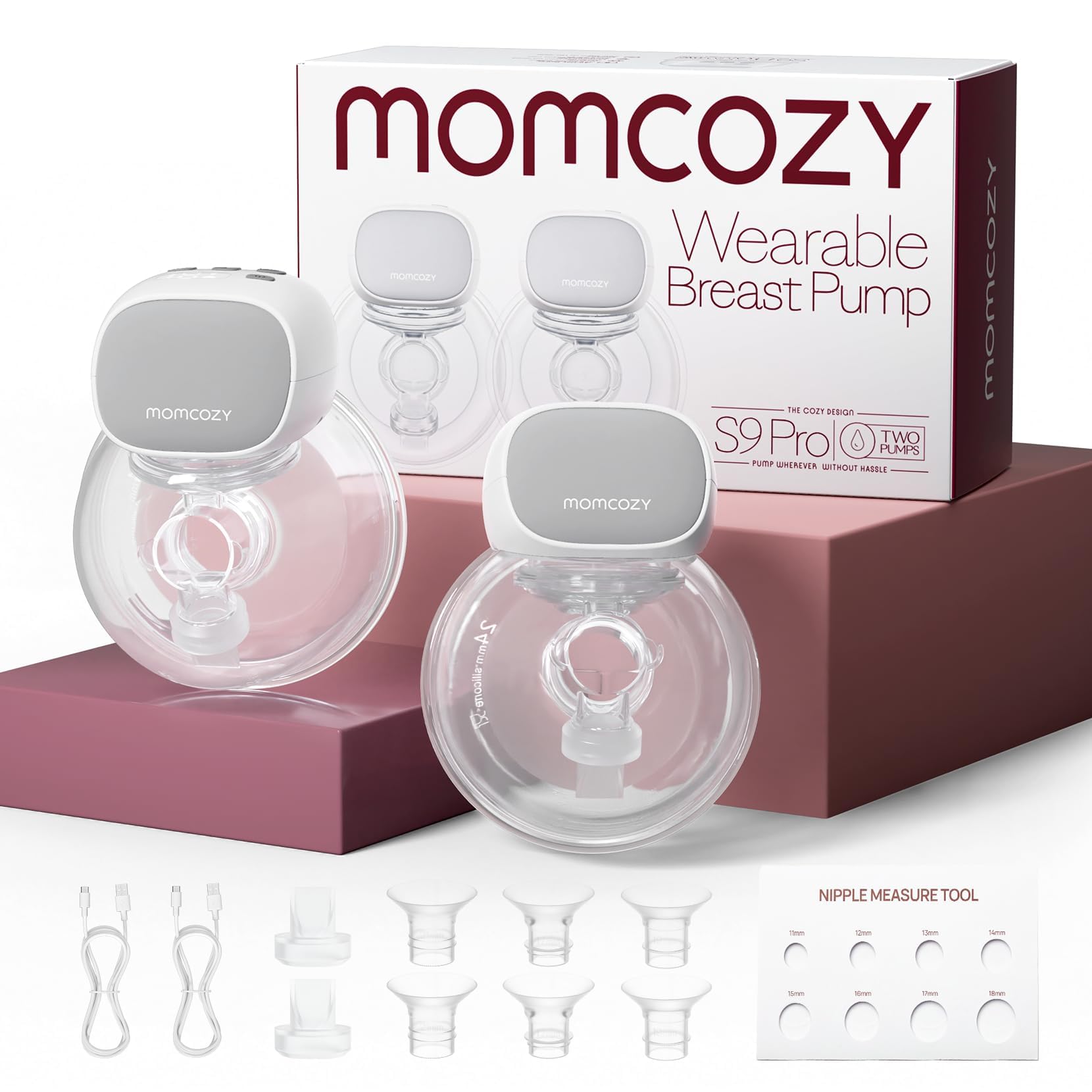
The Momcozy S9 Pro’s 270-minute battery rating is the number that makes it a workday wearable. That is enough for several sessions before a charge, and the auto shut-off every 30 minutes is a useful guard against losing track of time. The two-cup kit sits in a bra with no tubes, and the controls live on the cups rather than a phone.
The controls are deliberately simple: two modes, nine levels, and an LED display that shows the gear at a glance. The silicone buttons are a practical choice for a pump you operate without looking, and the body is 20% smaller than the earlier S9. We found the shorter menu easy to live with, though it gives you less fine-tuning than the app-driven wearables.
The cup parts are simple to clean, and the two-cup kit means two sets to keep together; that is the everyday cost of hands-free pumping. The 270-minute rating is the feature that matters most for a work bag, but it is still a battery, so a charging habit belongs in your routine.
We recommend the S9 Pro as the budget wearable for a buyer who wants simple hands-free pumping. It is less adjustable and less discreet than the Elvie, but it costs far less and still covers the basic job.
Pros
- 270 minutes of runtime
- Simple LED controls
- Two-cup hands-free kit
- Smaller than earlier S9
Cons
- Only a 24mm flange included
- No app control or session tracking
We recommend the Momcozy S9 Pro as the budget wearable for hands-free sessions at work or home, as long as the included 24mm flange fits you.
Best for Heated Comfort Sessions
Momcozy Wellness 1
Key Features
- Modes: 4 modes, 12 levels
- Warmth: 99°F–106°F
- Suction: 0–295 mmHg
- Capacity: 180ml/6oz
- Price: Premium
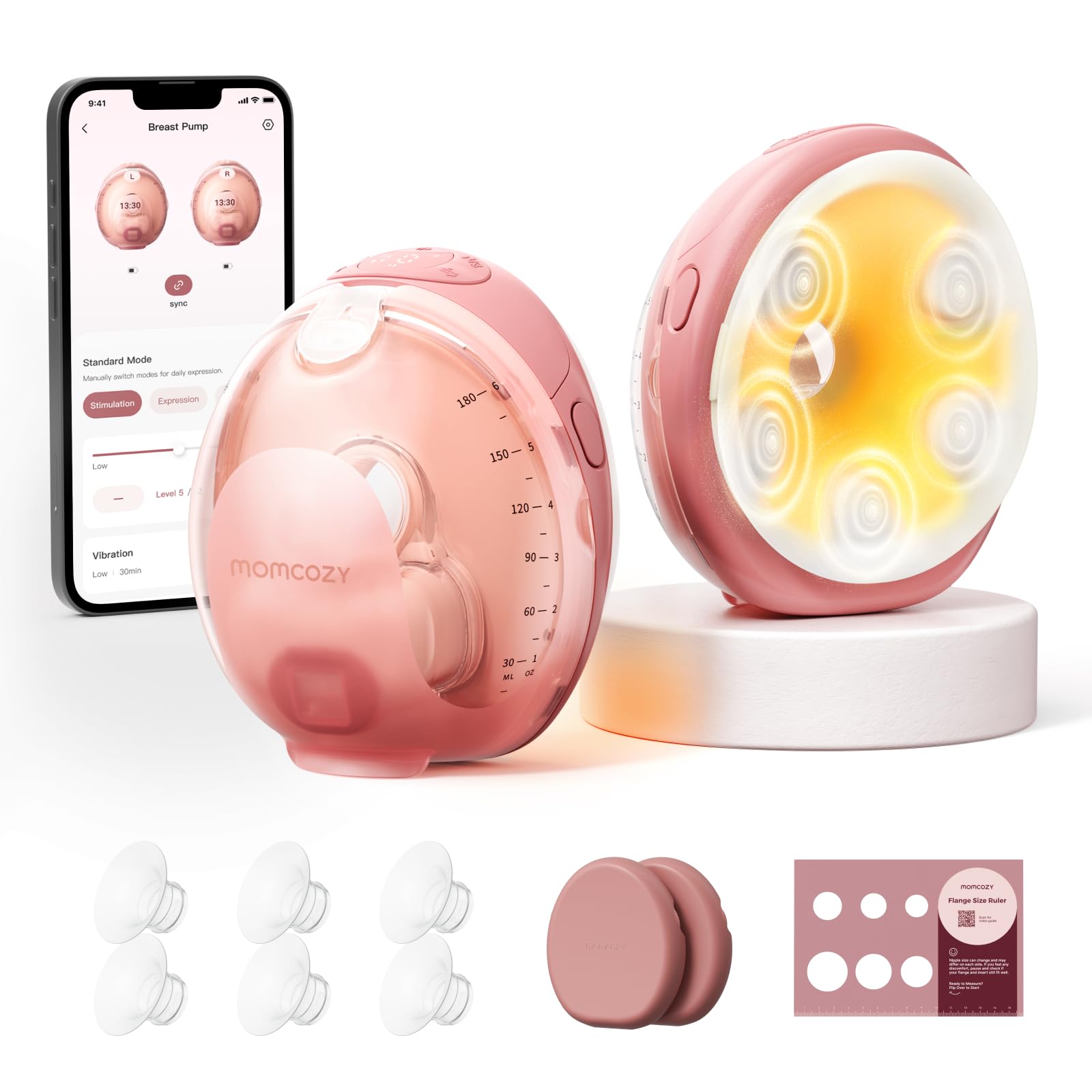
The Momcozy Wellness 1’s heated flange is the most distinctive comfort feature in this group. The flange warms to 99°F–106°F in seconds, with three warmth levels, three massage levels, and a five-zone circular massage around the breast. The idea is to relax tissue before suction does the work, and the app adds four modes and 12 suction levels up to 295 mmHg.
The 180ml/6oz capacity is generous for a wearable, and the clear top helps you check alignment instead of guessing. We liked the heat as a comfort feature, not as a fix for a poor flange fit; if the cup is not sealed, warmth will not rescue the session. The extra parts are the price of that feature, and they need a rinse between uses.
We recommend the Wellness 1 to a buyer who finds the first minutes of pumping uncomfortable or slow to start and wants a wearable that addresses that directly. If you just want hands-free output, the S9 Pro does the basic job at a lower price; if you want the most discreet premium wearable, the Elvie is the quieter choice. The Wellness 1 sits between them as the comfort-first option.
Pros
- Heated flange with three warmth levels
- 180ml/6oz capacity
- App control with 12 suction levels
- Clear top for alignment
Cons
- Premium price
- Battery life can fall short on long days
We recommend the Momcozy Wellness 1 for a comfort-first wearable, especially if a heated flange helps your letdown and you want app control.
Best for Lansinoh Bottle Users
Lansinoh Manual

Key Features
- Phases: Let-down and expression
- Weight: 4.8 oz
- Pump type: Manual
- Bottle type: Wide-neck
- Price: Budget
The Lansinoh manual pump is the one to choose if you already use Lansinoh bottles. Its wide-neck body pumps directly into them, and the kit includes a slow-flow NaturalWave nipple, so you can go from pumping to feeding without decanting. The let-down and expression phases give the handle two rhythms, and the ergonomic shape is meant to reduce hand fatigue.
At 4.8 ounces, it is light enough to keep in a diaper bag. The two-phase handle is simple to use, and cleaning is quick because there are fewer parts than an electric. The suction is the piece that varies: a good seal gives strong, efficient pulls, while a shield that does not fit makes the handle feel like work. Measure before you rely on it for every session.
We recommend it as a low-cost manual for Lansinoh bottle users or as a backup for travel and emergencies. It earns its place by being light, simple, and ready without a power source; the trade-offs are the ones inherent to a hand pump, and they are easy to accept for short sessions.
Pros
- Wide-neck Lansinoh bottle compatibility
- Two-phase handle
- Pump-and-feed NaturalWave nipple
- Light 4.8-ounce body
Cons
- Manual action ties up a hand
- Not suited to long double sessions
We recommend the Lansinoh Manual for Lansinoh bottle users who want a light, no-power backup that pumps straight into a feeding bottle.
How We Tested 12 Portable Breast Pumps
We started with the roughly 30 portable pumps on the market and narrowed by closed-system design, a rechargeable battery rated for at least a full day of sessions, multiple flange sizes sold with the pump, and replacement parts you can buy without replacing the whole unit. That left 12.
For six months, those 12 went everywhere our testers went: office desks between calls, parked cars in grocery store lots, a couch at 2 a.m., a bathroom during a friend’s dinner party. Every session was logged — output in ounces, session length, and whether the pump was still pulling with the same strength at minute twenty as it was at minute one — then compared against a hospital-grade double pump used as a baseline.
Suction was tested at the top of each pump’s range: we noted whether max settings pulled firmly or pinched, and whether turning it up produced more milk or just more discomfort. Noise got two measures — a decibel reading at arm’s length, and the blunter test of whether someone on a video call could hear it. We timed battery life from a full charge to a dead motor and counted sessions per charge. For ease of use, we assembled each pump one-handed and counted how many parts landed in the sink afterward.
Durability played out over months, not days: valves and membranes were checked weekly for clouding or tears, and anything claiming to be dishwasher-safe went through the top rack repeatedly. Reliability meant logging stalls, dropped connections, and sessions that had to be finished by hand. Value came down to what a full replacement parts kit cost, since flanges and valves are recurring purchases rather than one-time ones.
How to Choose a Portable Breast Pump
The first decision is not brand or battery size; it is whether you need a pump that sits on a table, a pump that sits in your bra, or a manual pump that needs no power at all.
Match the pump type to where you pump
A portable electric such as the Spectra S1 is the closest thing to a full-size pump you can carry: it has stronger suction and more adjustment, but it needs a surface and a way to hold the flanges. A wearable such as the Elvie or S9 Pro sits in your bra and frees your hands, but it gives up some power and capacity. A manual pump such as the Medela Harmony is the no-power backup. We start with the setting, because a pump that is wrong for your usual spot becomes a chore no feature can fix.
Fit matters more than the highest suction setting
A pump with a perfect seal at a modest setting moves more milk comfortably than a powerful pump with the wrong flange. Check the sizes in the box: the Spectra S1 includes 24mm and 28mm flanges, while the S9 Pro comes with a single 24mm size. If your nipple measures outside those options, budget for the correct flange or insert before your first session. Suction numbers are less useful than a sealed, comfortable fit.
Battery, noise, and the real cost of portability
Runtime and weight trade off against each other. The S9 Pro is rated for up to 270 minutes, the NCVI 8782 has a 2200mAh battery, and the Spectra S1 carries a 3.3-pound body for stronger performance. Noise matters if you pump near a sleeping baby or a coworker: the NCVI is rated at 40 dB and the Spectra at 45 dB. Count the sessions you need between charges, then choose the smallest pump that covers them.
Cleaning is a daily decision
The pump you clean most easily is the one you use most willingly. Manual pumps such as the Medela Harmony have fewer parts and dishwasher-safe components; wearables have cups, flanges, and valves that need a rinse between sessions. Before you buy, count the milk-contact parts and decide whether you will wash them at work or wait until you get home. A clear-top wearable like the Wellness 1 helps with alignment, but it adds pieces to keep track of.
Frequently Asked Questions
Do I need a pumping bra to use a portable breast pump?
For a double electric like the Spectra S1 or NCVI 8782, yes: a hands-free bra holds both flanges and frees your hands. A wearable like the Elvie or S9 Pro sits inside the bra and does not need a separate pumping bra, though a snug bra helps. A manual pump like the Medela Harmony works without one, but you will hold it.
When should I replace pump parts?
Replace valves, membranes, or tubing at the first sign of wear, cloudiness, tears, or a drop in suction, and follow the manufacturer’s schedule. Keep a spare set for wearable cups, because a stretched valve can make a good pump feel weak. If suction falls suddenly, check the flange seal and tubing for milk or moisture before buying a new pump.
Final Verdict
We recommend the Spectra S1 Plus first because it is the best all-round portable electric here: rechargeable, quiet enough for shared space, and stronger for daily output than the wearables. If you need to pump while walking around or in a meeting, choose the Elvie; if you want a no-power backup for the diaper bag, the Medela Harmony is the one. The right answer depends on where the pump will live, not on which one has the longest feature list.
