This post contains affiliate links. We may earn a small commission when you buy through our links — at no extra cost to you.
A playhouse changes how an entire room gets used, and the category splits three ways, each with a trade-off. Molded plastic shrugs off rain but can look like a fast-food playland; cedar photographs beautifully and then eats a Saturday in assembly; a fabric tent folds into a closet but wilts in a breeze.
We lived with 12 of them over eight months, from a cardboard gingerbread kit my kids colored in over a week to a wooden cottage now anchoring my yard. The footprint on the box is not the play value — a compact tent with a padded mat held two kids longer than a wide plastic set with nothing inside to do.
Small details separate the rest: a working doorbell, a snack bar at kid height, a molded floor that hoses off, string lights that make a tent feel like a hideout. Then the things nobody photographs, like whether the walls lean when a kid hangs off them. Playrooms, backyards, and one that gets recycled once the crayon wears off — they’re all below.


Best for Year-Round Pretend Play
Step2 Neat & Tidy Cottage
Key Features
- Material: Double-walled plastic
- Warranty: 2-year limited
- Recommended age: 18 months to 10 years
- Assembled dimensions: 49.75" H x 53.25" W x 33.75" D
- Price: Premium
The molded-in floor is why this one won. Most playhouses that sit on grass let the ground in through the doorway, and the ones without a base rock on uneven patio stones. This cottage has a solid plastic floor built into it, so the interior stays dry and clean wherever you put it down, and there’s no mat to haul out and straighten. We set it up on a lawn and then moved it indoors without the walls complaining, which is more than most plastic cottages this size manage.
The pretend-play hardware is where Step2 clearly spent the money. There’s a Dutch door and shutters that swing, a doorbell and a play phone that make sounds, a molded sink, a fireplace, a skylight, and a drive-thru window. The doorbell is the piece that holds attention — it gets rung long after the door stops being interesting — and the half door means you can leave the top open and still keep a crawler where you can see them. The built-in seat is the other detail we appreciated: an adult can perch there while a toddler serves pretend coffee.
It’s toddler-scale, so a tall 5-year-old will be folding themselves through the doorway. Assembly is straightforward — panels and hardware, one adult, an afternoon — and the double-wall plastic wipes down with a household cleaner and won’t fade or peel the way single-wall panels do. If you want one playhouse that stays out all year and still looks tidy in a playroom, this is the easiest recommendation on the page.
Pros
- Molded-in floor keeps damp, dirt, and bugs out
- Doorbell, play phone, sink, and BBQ drive pretend play
- Double-wall plastic wipes clean and holds its color
- Works in a yard or a playroom
Cons
- Premium price for a playhouse
- Toddler-scale interior, outgrown by preschool
Buy this one if the playhouse will live outside and has to survive a toddler leaning on the walls; it is the most complete, best-built playhouse here.
Best for Permanent Backyard Cottage
Backyard Discovery Sweetwater Playhouse
Key Features
- Material: Cedar wood
- Warranty: 5-year limited
- Recommended age: 2 to 6 years
- Assembled dimensions: 46" D x 42" W x 55" H
- Price: Premium
Cedar is what separates this from every plastic cottage here. The Sweetwater looks like a small garden building — 55 inches tall, 42 wide, four windows, a hinged half door that swings shut, flowerpot holders under the sills, and a snack bar sized for passing a juice box through. It’s the best-looking playhouse on this list, and the only one that comes with a five-year warranty.
The build is the part to plan around. This arrives as a stack of numbered boards and a lot of hardware, and while the instructions and the assembly video are genuinely good, it’s an afternoon of work that goes much faster with two adults. The cedar is thin in places and can split when a screw goes in hard, so slow and steady beats fast and proud. We think the weekend is worth it: the result reads as part of the yard rather than a toy parked on it.
Play value is unusually complete for a wooden house — a pretend sink and stove, cookware and utensils, a cordless phone, a working doorbell, and a snack bar that turns the side window into a serving hatch. Four windows mean you can see a child from the kitchen, and the half door keeps a toddler contained without making them feel shut in. It’s the pick for a family with a permanent yard and the patience for a project.
Pros
- Cedar construction with a five-year warranty
- Kitchen, snack bar, phone, and working doorbell
- Four windows and a half door you can see through
- Looks like a garden building, not a toy
Cons
- Multi-hour build that wants two adults
- Thin cedar can split at the screws
Choose this if you want a wooden playhouse that will anchor a corner of the yard for years and you have a free weekend and a second pair of hands.
Best for Indoor Toddler Cottage
Little Tikes Cape Cottage
Key Features
- Windows: 2
- Material: Plastic
- Recommended age: 2 to 6 years
- Door and shutters: Working
- Price: Midrange
This is the cheapest hard-sided playhouse here, and it arrives in a box light enough to carry upstairs with one hand. The Cape Cottage snaps together — no tools, no numbered boards, no afternoon lost — and it’s the one playhouse on this list that fits a bedroom corner without rearranging the furniture.
The cottage shape does the work: a door that opens and closes, two windows with shutters that swing out, and a pink-and-white palette that photographs better than it has any right to. It’s rated for ages 2 to 6, and realistically it’s a 2-to-4 toy — a kindergartner has to duck to get through the doorway.
It’s also the least substantial plastic here. The panels are single thickness, the door is wobbly on its hinge, and a child leaning on a wall will feel it give. Kept indoors with one or two toddlers it holds up fine, and we don’t recommend it for a daycare or a winter left out in the yard. If you want a first playhouse for a 2- or 3-year-old and you aren’t expecting a hand-me-down, this is the sensible buy.
Pros
- Snap-together assembly with no tools
- Working door and two swinging shutters
- Small footprint fits a bedroom corner
- Cheapest hard-sided playhouse here
Cons
- Single-wall panels and a wobbly door
- Outgrown by kindergarten
For a first playhouse on a small budget — a working door, swinging shutters, and a no-tools build — buy this one, and keep it indoors.
Best for Playroom Reading Nook
Tiny Land Play Tent with Mat
Key Features
- Included: Soft mat and star lights
- Material: Polyester fabric
- Recommended age: 3 years and up
- Assembled dimensions: 52" W x 35" D x 53" H
- Price: Midrange
This is the playhouse you leave up. The house-shaped frame, Swiss-dot curtains, and cream-and-pink fabric read as decor rather than toy storage, and it’s the only one here we’re happy to park in a living room. The star string lights and a soft mat come in the box, so the corner is finished the day it arrives.
Assembly is tool-free and puzzle-like: you push rods through fabric sleeves and join them at the corners. Fit the cover loosely before the last joints go together — the fabric is cut close, and a finished frame makes the last seam a wrestling match. Once it’s standing, it’s light enough to slide across the floor and simple to fold away when guests arrive.
What it is not is a climbing frame. The walls are polyester over a light frame, and leaning on them makes the whole thing lean; treat it as a reading nook or a doll corner and it’s lovely. Two small children sit inside comfortably and a third is a negotiation. If your kid wants a fort to bounce off, buy the plastic cottage instead.
Pros
- Looks like furniture, not a toy
- Tool-free, puzzle-simple assembly
- Mat and star lights included
Cons
- Fabric walls lean under a child’s weight
- Comfortable for two small kids, no more
If you want a playhouse that doubles as playroom decor and goes up without tools, this is the one we point people to.
Best for Castle Pretend Play
Monobeach Princess Castle Tent
Key Features
- Included: Carry bag and star lights
- Material: Polyester taffeta
- Recommended age: 3 to 9 years
- Assembled dimensions: 55" D x 55" W x 53" H
- Price: Budget
Fifty-five inches square is a lot of interior for a fabric playhouse — enough for two children and a beanbag, or three kids sitting cross-legged. The castle front, the pink taffeta, and the star lights do the rest: this is a princess playhouse in the sense a five-year-old means it, not the sense a product listing means it.
The frame is plastic poles feeding into connectors, and assembly is the part that splits opinion: there are two instruction sheets in the box, and the simpler one is the one to follow. The connectors are also the weak link. They flex when a child tumbles against a wall, and they’re what eventually gives out on a tent that gets dragged from room to room.
The star lights are the least reliable thing in the package and sometimes arrive dead; we count them as a bonus rather than a reason to buy, and the tent stands perfectly well without them. At this size, that’s the pitch: the most interior space of any fabric playhouse here, light enough to carry from playroom to yard, and it packs into a bag for Grandma’s house.
Pros
- 55-inch footprint fits three kids sitting
- Castle front and star lights
- Light enough to move room to room
- Carry bag for trips
Cons
- Plastic connectors flex and wear out
- Instructions in the box are inconsistent
If the wish list says castle and the budget says keep it simple, this is the one — the roomiest fabric playhouse here.
Best for Shaded Outdoor Kitchen
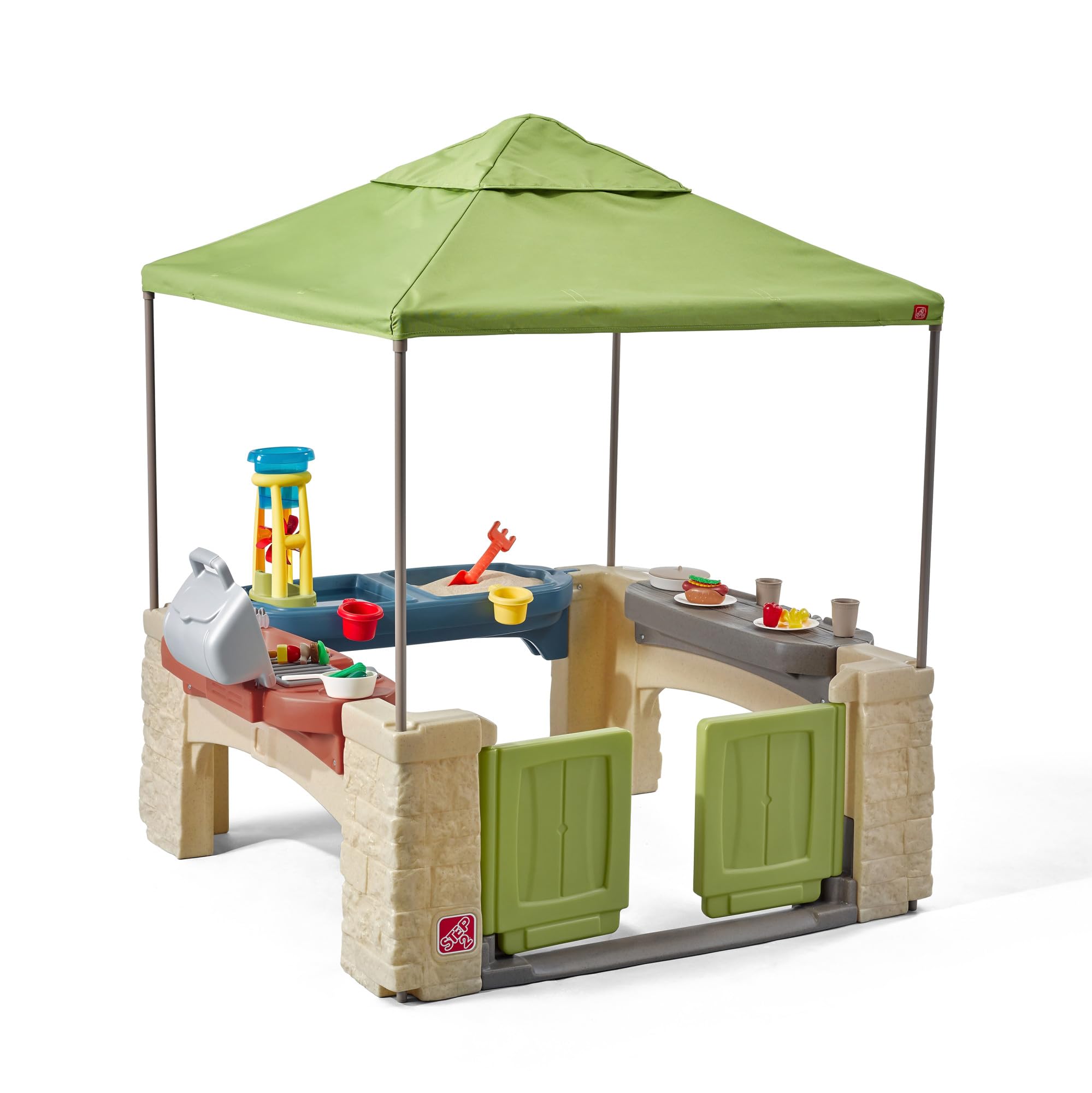
Step2 All Around Playtime Patio
Key Features
- Included: 16-piece accessory set
- Material: Double-walled plastic
- Recommended age: 2 to 8 years
- Assembled dimensions: 60" H x 47.5" W x 47.5" D
- Price: Premium
The removable canopy is what makes this one work in a real yard: it shades a countertop, a water table, and a sand pit at once, and it lifts off in a minute when the whole thing moves indoors for the winter. It’s an open-air patio rather than an enclosed house — kids stand at the counter and circle around it instead of disappearing inside — which is exactly why two or three of them can play at once without anyone being in the way.
What we like is that it’s a station, not a hideout. There’s a pretend grill, a wide counter, a sink with decent drainage, and 16 accessories, and the double-wall plastic has handled weather that would have sent a fabric tent running for the garage. Assembly is mostly a one-person job; plan on a power drill for a couple of steps. If your yard needs somewhere for water, sand, and pretend cooking to happen under shade, it earns its price. If you’re shopping for a house a child can shut themselves into, it isn’t that.
Pros
- Canopy shades the whole play surface
- Water, sand, grill, and counter in one footprint
- Double-wall plastic handles weather
- Open design fits three kids at once
Cons
- No enclosed interior to retreat into
- A couple of assembly steps need a power drill
Buy it if you want one shaded outdoor station for water, sand, and pretend cooking — not if you’re after an enclosed playhouse.
Best for Craft-Day Project
Easy Playhouse Gingerbread House

Key Features
- Material: Cardboard
- Mail slots: 2
- Recommended age: 3 years and up
- Assembled dimensions: 32" x 26.5" x 40.5"
- Price: Budget
The build is the activity here. Two big printed cardboard panels fold into a gingerbread house, and every surface is line art waiting for markers — gumdrops, candy canes, a teddy bear, a wreath on the door. Coloring it properly takes several sittings, which is exactly the point: it’s a project that buys quiet afternoons before it ever becomes a playhouse.
The play value afterward is better than a plain box. There are two mail slots you can push letters through from inside or out, windows to lean out of, and a door wide enough for a child to crawl through with a pillow. Two children fit; that’s the comfortable limit.
It is a sit-inside house, not a walk-in one — 40 inches tall, so a 6-year-old is on their knees — and it’s corrugated cardboard, so a season of hard play softens the corners and one rainy afternoon on the lawn ends it. Taping the inside seams before the first play session buys you a few more weeks.
What we like most is that it’s disposable by design. When the walls sag, it goes in the recycling, and nobody has to find garage space for it or feel guilty about the money. For a birthday, a snow day, or a holiday project that’s a good trade — just don’t buy it expecting a hand-me-down.
Pros
- Every wall is colorable line art
- Two working mail slots and a crawl-in door
- A family project, not a solo build
- Recyclable when it wears out
Cons
- Cardboard softens within a season
- 40 inches tall — sit-inside scale
Buy it for the coloring afternoons and the few weeks after — an inexpensive, absorbing playhouse that is meant to be used up.
Best for Cozy Reading Corner
Tiny Land Teepee Tent

Key Features
- Frame: Pine wood poles
- Material: Poly-cotton canvas
- Recommended age: 3 years and up
- Assembled dimensions: 47" x 47" x 60"
- Price: Midrange
The canvas is what makes this teepee worth buying: a poly-cotton blend that’s noticeably thicker than the taffeta tents here, with a window, two inner pockets, and a removable cover that can go in the washing machine. In a playhouse that gets sat in, spilled on, and dragged to the hallway, washable counts for more than any other feature.
Sixteen pine poles and twelve connectors go together in a few minutes, and the whole thing collapses into a bundle you can stand in a corner. It’s 60 inches tall, so an adult can sit inside without folding in half — that’s the difference between a tent you supervise from outside and one you actually get into.
The poles aren’t joined at the base, so on hardwood the teepee walks: a child leaning on the back wall shifts the whole frame, and it wants a corner or a rug to stay put. It’s a sitting tent, not a fort. Put a cushion and a flashlight in it and it’s the coziest thing on this list.
The star lights and the little cardboard campfire are the kind of extras that get played with for a week and then live in the pockets — but the pockets are genuinely useful, and the window lets you check on a quiet child without opening the flap. For a reading corner in a living room or a nursery, this is the one we choose.
Pros
- Washable 60/40 poly-cotton canvas
- 60 inches tall — adults fit inside
- Window, two pockets, and star lights
- Collapses into a corner bundle
Cons
- Poles aren’t joined at the base, so it shifts
For a washable canvas teepee that looks made rather than molded and fits an adult inside, this is the one for a reading corner.
How We Tested Playhouses, From Assembly to Bedtime
We started by reading customer reviews across plastic cottages, wooden kits, canvas teepees, pop-up tents, and one cardboard kit, then cut anything with a footprint too big for a standard playroom or an age range that didn’t cover toddlers through early elementary. That left 12 playhouses, which we tested over eight months.
Each one got built cold with a stopwatch running and one adult on the job — two for the wooden kit, which is a genuine afternoon. Then my 3-year-old and 6-year-old moved in. We noted which doors got slammed, which walls got leaned on, and whether anything tipped when a kid hung off the side. Fabric tents went outside on a breezy afternoon to see if they stayed upright without stakes, and we packed each one back into its bag to see how small it actually folded.
Material and durability got judged after weather, not before. Post-rain, we checked wooden panels for swelling and plastic floors for standing water; molded floors wiped clean, fabric mats went through the wash, and the cardboard house was lucky to survive three weeks of juice cups. Appearance we measured by whether my kids went in it without being asked.
Lighting surprised me — the tents with string lights got used at bedtime, so we left them on nightly to see whether batteries and wires held. Size we measured twice, on the ground and at head height, because a playhouse that fits the room but not the kid gets abandoned. Last, we counted what came in the box — kitchen, phone, doorbell, canopy, mat — and asked whether the price bought more play or just more parts.
How to Choose a Playhouse
Decide where it will live before you compare a single model, because the surface underneath rules out half the options on this page.
Start With the Surface It Will Sit On
Grass is the hardest surface for a playhouse. Without a base, the ground works its way in through the doorway and the walls sit in damp for months; a molded floor, like the one in the Step2 cottage, solves both problems at once. On a deck or patio, a lightweight plastic house skates in the wind and a cedar one doesn’t, but the cedar wants a level footing so the door keeps swinging.
Indoors the rules flip. Carpet anchors a fabric teepee and stops its poles walking; hardwood does the opposite. Measure the corner before you pick, too — a 55-inch tent takes up more of a bedroom than it looks like it will in a photo.
Match the Material to the Years You Want
Double-wall plastic is the low-effort outdoor choice: it wipes clean, needs no refinishing, and a good one carries a multi-year warranty. Cedar looks best and lasts longest, but it arrives as a kit, wants a sealer coat, and can split if a screw goes in hard. Fabric play tents are indoor furniture — they handle a dry afternoon outside and not much more — and cardboard is a season by design, which is fine as long as you buy it knowing that.
Budget the Build, Not Just the Box
Assembly ranges from a few minutes to a full weekend across the playhouses here. Snap-together plastic panels need no tools; wooden kits want two adults, a drill, and a free afternoon. Pole tents land in between but have their own trap: more than one instruction sheet in the box, and the simpler one is generally the right one. Check whether tools are included before you start — on at least one plastic cottage here, they aren’t.
Working Parts Beat Painted Ones
Every playhouse on this list has graphics; the ones children go back to have something that moves. A doorbell that rings, shutters that swing, a mail slot that takes a letter, a snack bar that passes a cup through — those turn a structure into a game. Comparing two houses at a similar price, count the moving parts rather than the decals.
Size It to a Seated Child
Interior height decides who can actually use it. A 40-inch house is a sit-inside toy for a preschooler and a knees-and-elbows squeeze for a 6-year-old; 53 to 60 inches lets a kindergartner stand up and an adult fold in for story time. Capacity is a separate number — two children is realistic for most of these, three only in the big fabric tents and the open patio. And check the door opening, because a wide crawl-in door matters more than an extra inch of headroom.
Frequently Asked Questions
Can a playhouse stay outside all year?
Double-wall plastic can, and cedar can with upkeep — plan on a sealer coat every year or two and expect some graying. Polyester play tents and cardboard houses can’t; bring them in after a dry afternoon outside.
If it is staying out through winter, buy plastic or cedar and check the warranty length before you commit. The outdoor picks here carry two-, three-, and five-year coverage.
How do I keep a lightweight playhouse from moving in the wind?
Weight is the tell. The plastic cottages here run roughly 30 to 65 pounds, which is fine on a sheltered patio and marginal on an open deck. A tent that weighs a few pounds will go over in a gust, lights and all.
On an exposed site, set the house against a fence or the lee side of the building, and take fabric tents in whenever wind is forecast.
At what age do kids outgrow a playhouse?
Most houses here are rated from about 2 up to 6, and the real limit is the roofline. Sit your child on the floor against a wall and measure from the floor to the top of their head; if that number is within a few inches of the interior height, they are already folding over.
A 40-inch cardboard or plastic house is a 2-to-4 toy. A 55- to 60-inch one lasts into kindergarten.
Final Verdict
Step2’s Neat & Tidy Cottage is the playhouse we recommend first. The molded floor means it can sit on grass, the double-wall plastic shrugs off weather that destroys fabric, and the doorbell, phone, and sink give a toddler a reason to go back after the door stops being the attraction.
If you want wood and a garden feature instead, the cedar Sweetwater is the better-looking answer — clear a weekend and find a second adult for the build. For a small room and a tight budget, the Little Tikes cottage covers the preschool years for a fraction of the premium picks.
