This post contains affiliate links. We may earn a small commission when you buy through our links — at no extra cost to you.
There’s a stretch of a few weeks when your baby is desperate to sit up and see the room but can’t get there alone. A floor seat buys them that view and buys you two hands back. The catch: a seat that holds a baby upright has to be shaped right, or it rounds the spine and tips the hips instead of supporting them.
Two kids in, I’ve learned the seat that works is the one you keep reaching for — light enough to carry into the kitchen, wipeable enough that a smashed blueberry doesn’t live in the seam until Tuesday, stable enough that a sideways lunge doesn’t take the whole thing with it. My team and I spent seven months with 11 seats sorting that out.
Leg openings are the spec nobody advertises and every parent notices: snug on a chunky-thighed 6-month-old, unwearable by 10 months. Below are the seats that held up to real babies, real purées, and real trunk strength.




Best for Upright Posture
Upseat Ergonomic Floor & Booster Seat
Key Features
- Tray: Extra-large, removable
- Age range: 4 to 24 months
- Weight limit: 30 lb
- Seat material: Soft polyurethane foam
- Price: Premium
The Upseat is the most expensive seat here, and we recommend it first anyway. What the money buys isn’t a longer feature list — it’s the shape. The back and hip area is molded with input from physical therapists so a baby’s pelvis stays upright instead of sliding into a slump, which is the difference between a seat that supports a new sitter and one they gradually ooze out of.
Two things follow from that shape, and both held up when we used it. The seating area is wide, so bigger thighs and diapered bottoms drop in without the winching that narrower foam seats demand, and it’s rated from 4 to 24 months and up to 30 pounds, which covers the whole supported-sitting year and then some. Babies sit tall in it. Where soft foam lets a 5-month-old fold forward over their own knees, this one keeps them back against the seat.
The tray is the other reason it’s our default. It’s extra-large, it locks in, and it has no grooves for puree to hide in, so a snack, a spoon, and two toys can be up there at once. The foam wipes clean in one pass and the harness straps are machine washable. One caution: a baby who rocks hard against the sides can tip the seat, so it belongs on the floor with you within arm’s reach.
At this price it’s a one-seat purchase — the one you buy when you want the support right the first time. If your baby is small for their age and you mostly need somewhere to park them while you cook, a cheaper seat does the same job.
Pros
- Shaped with physical therapists for upright posture
- Wide seat fits bigger thighs
- Rated 4 to 24 months, up to 30 pounds
- Extra-large tray locks in for meals
Cons
- Tray clips can snap after months of use
We recommend the Upseat to anyone buying one floor seat: the therapist-shaped molding holds a new sitter upright, and the range and tray carry it through self-feeding.
Best for Growing Babies
Bumbo 3-in-1 Multi Seat
Key Features
- Tray: Removable, stores on back
- Modes: Floor seat, high chair, booster
- Age range: 6 to 36 months
- Weight limit: 33 lb
- Price: Midrange
There’s a slot molded into the back of this Bumbo where the tray parks when it comes off, and that small piece of design is why we rate it above the seats with loose trays. It’s also the most versatile seat here: a foam floor seat with a three-point harness, a booster strapped to a dining chair, and a high chair with the tray clicked on, from 6 to 36 months and up to 33 pounds.
The adjustment is real rather than marketing. The foam insert comes out as a baby grows, and the leg opening is listed at 3.25 inches, which is generous for a category where tight leg holes are the standard frustration. A baby who fits at six months tends to still fit at two, which is more than most of these can say.
At two pounds it’s the easiest seat here to carry from room to room, and the non-slip base grips hardwood instead of skating across it. Cleaning is a wipe-down, though the foam isn’t waterproof, so a spilled sippy cup needs blotting rather than a rinse. For a grandparent’s house or a small kitchen, it does three jobs and takes up one cupboard shelf.
Pros
- Converts to booster and high chair
- Tray stores on the seat back
- 3.25-inch leg openings
- Two pounds, easy to move
Cons
- Tight squeeze for very chunky thighs
- Tray can take a firm push to seat
For a seat that keeps working after your baby can walk, we point you to the Bumbo 3-in-1: it turns into a booster and a high chair, and it’s rated to 36 months.
Best for Playtime and Snacks
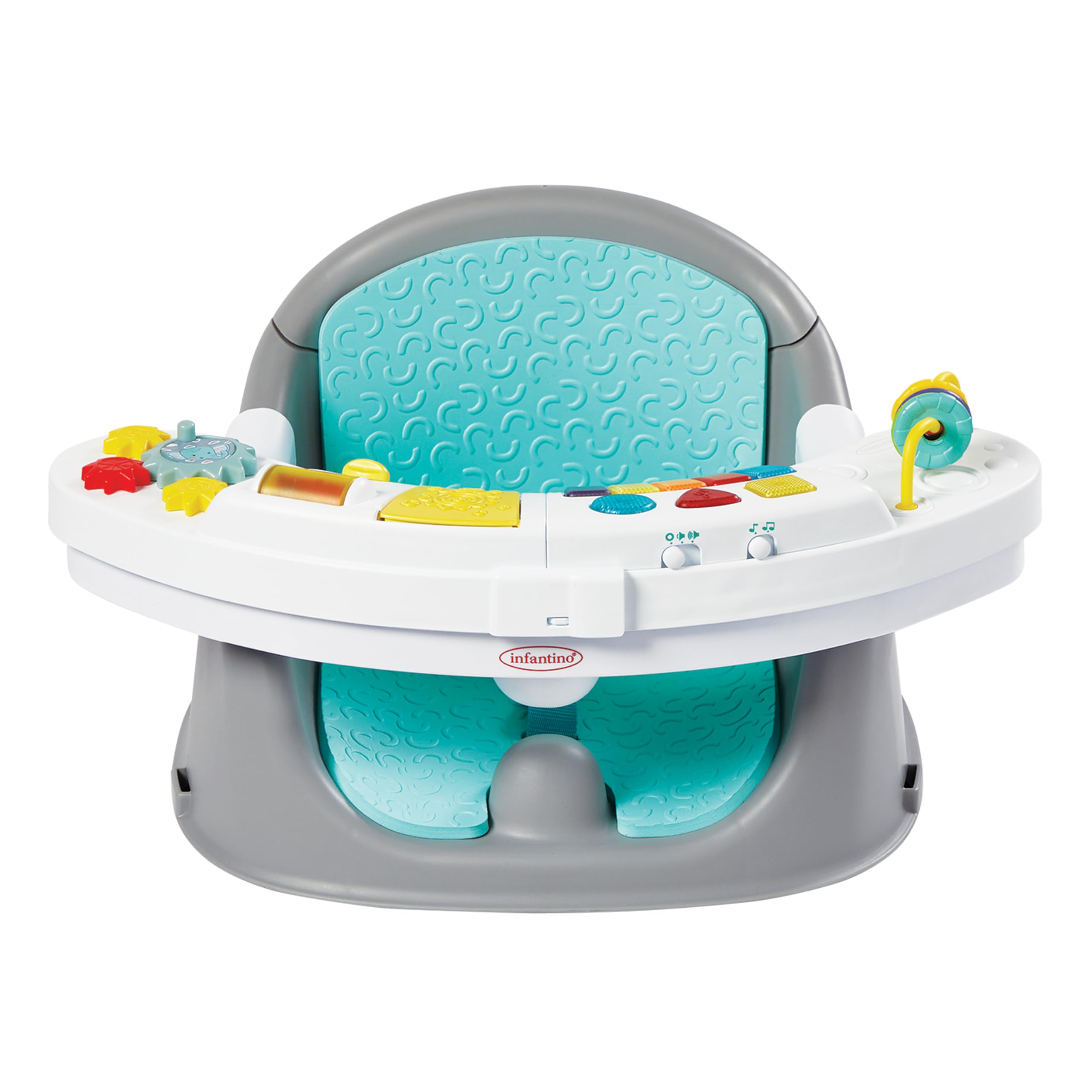
Infantino Music & Lights 3-in-1 Discovery Seat
Key Features
- Tray: Hidden snack tray with cup holder
- Sounds: 20 songs and sounds
- Age range: 4 months to 4 years
- Weight limit: 33 lb
- Price: Midrange
Slide the two toy pods apart on this Infantino and a snack tray with a cup holder appears underneath. That one motion is the whole idea: the seat a baby plays in at nine in the morning is the seat you spoon cereal into at noon, with no separate tray to store and no second piece of gear to haul out of the closet. The pods carry a light-up piano and 20 songs and sounds, which buy a solid stretch of happy distraction.
It converts properly, too — discovery seat on the floor, snack seat, then a booster strapped to a dining chair — and it’s rated from 4 months to 4 years or 33 pounds, so it outlasts most of the seats here. The pad wipes clean, the tray comes off in one piece, and the whole thing is light enough to carry between rooms with a baby on your hip.
What we don’t love is how it treats a small baby. The seat is deep and wide, so a 6-month-old on the smaller side slumps against the harness instead of sitting up in it — this is a seat for a baby already sitting with a little help, not for the floppy stage. The music is a matter of taste as well: 20 songs is a lot of the same three tunes by the second week.
Pros
- Toy pods slide apart to reveal a tray
- 20 songs and sounds keep babies engaged
- Converts to a booster to age 4
Cons
- Base can crack with daily use
- Tray is too shallow for a full plate
For the play-and-snack years, the Infantino is our pick: the light-up piano keeps a baby in the seat, and the tray hidden under the toy pods means no separate piece to store.
Best for Wider Legs
Nuby My Floor Seat
Key Features
- Weight: 3.5 lb
- Harness: 3-point
- Age range: 4 to 12 months
- Seat material: Soft foam
- Price: Midrange
The leg openings are what sell this seat. They’re cut extra wide so they don’t pinch, which matters more than any feature on the box, because a floor seat your baby dreads being lowered into is a floor seat that stays in the closet. The back is high enough to give a wobbly sitter something to lean into, there’s a three-point harness for the escape artists, and the foam is soft enough that bare legs don’t complain.
It arrives in one piece — nothing to click together — and at three and a half pounds it moves around the house in one hand. The foam wipes clean with a damp cloth, so there’s no pad to wrestle off and no seams for crumbs to work into, which is the reason it stays out on the kitchen floor instead of folded away. The angled seat and high back do the supporting, and that’s the position most first-time sitters settle into fastest.
What it doesn’t have is a growth plan. There’s no booster mode and no removable insert, so this is a seat for the sitting-up months and not much beyond them. Buy it as exactly that, and it’s one of the easiest seats here to live with day to day.
Pros
- Extra-wide leg area doesn’t pinch
- High seatback supports new sitters
- Wipes clean, arrives assembled
Cons
- Foam can crack at the crotch support
We point parents of round-thighed babies to the Nuby: the extra-wide leg area and high back give a new sitter room and support without the winching.
Best for Travel and Camping
Bright Starts Pop ‘N Sit Portable Booster
Key Features
- Tray: Dishwasher safe
- Age range: 6 to 36 months
- Folded size: 5 x 15 inches
- Weight limit: 37 lb
- Price: Budget
Folded, the Pop ‘N Sit is 5 by 15 inches and hangs off a shoulder in its own bag — and it’s the cheapest seat here. Three modes: a floor seat with a tray, a travel high chair strapped to a dining chair, and a toddler booster with the tray off. Bright Starts rates it from 6 months to 3 years, up to 37 pounds.
What you give up for the fold is structure. The seat is fabric stretched over a folding frame rather than molded foam, so it cradles a baby in a sling instead of propping them upright, and a 6-month-old who still lists to one side will list in this too. What it does better than anything else here is leave the house: it’s the seat that goes to the beach, the campsite, and the restaurant where the high chair turns out to be a wooden antique.
The tray is dishwasher safe and the seat pad is machine washable, which is more than most travel seats offer, and a rear pocket holds a bib and a couple of pouches. Ours has spent a summer in the trunk and still sets up square, which is about the right standard for a seat in this bracket.
Pros
- Folds to 5 x 15 inches with a carry bag
- Three modes for travel and home
- Dishwasher-safe tray and washable pad
- Least expensive seat here
Cons
- Fabric cover can tear at the seams
We recommend the Pop ‘N Sit as the second seat: it folds flat, travels in its own bag, and costs the least of anything here, so it can live in the car without a second thought.
Best for Small Spaces
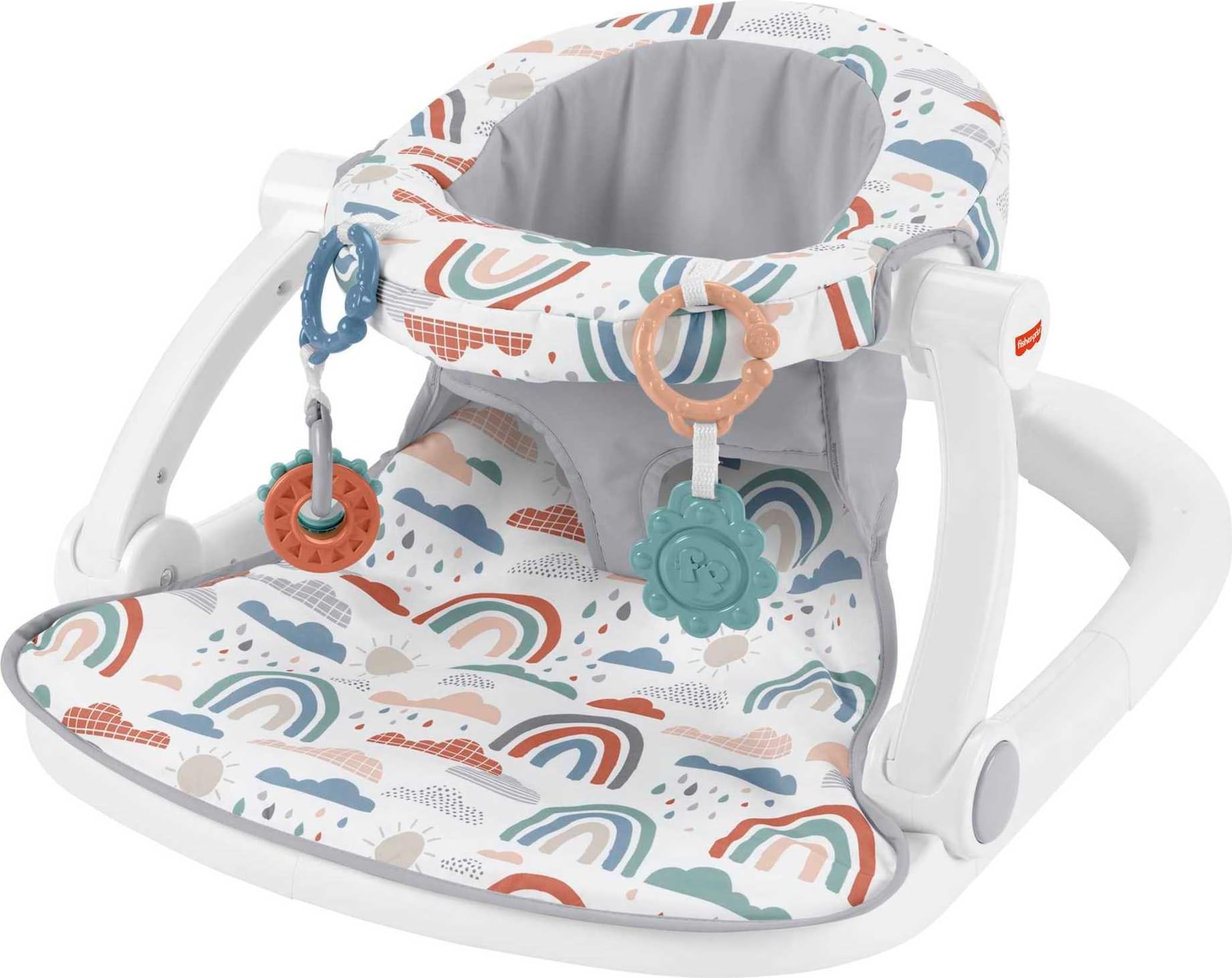
Fisher-Price Sit-Me-Up Floor Seat
Key Features
- Seat pad: Removable, machine washable
- Dimensions: 8.27"D x 20.8"W x 12.2"H
- Weight limit: 25 lb
- Included toys: Clacker and flower teether
- Price: Midrange
Getting a baby into this seat is the part the product photos don’t show. The leg openings are narrow and the seat is deep, so a round-thighed baby needs a two-handed lowering, and lifting them out again takes a proper tug. That friction is the first thing we noticed, and it’s why the Upseat and the Nuby sit above this one for us.
Everything else is well judged. The base is wide and low, so the seat doesn’t walk across the floor when a baby kicks, and the recline suits a 4- or 5-month-old who can hold their head up but can’t sit alone yet. The pad lifts out and goes in the washing machine — the detail you’ll care about most once puree arrives — and the seat folds flat enough to slide behind a sofa.
The two toys, a clacker and a flower teether, are modest and will buy a few minutes each, which is about what a floor seat should promise. For a baby in the middle of the growth curve this is a lot of seat for the money and one of the easiest to live with. For a baby in the ninetieth percentile for thighs, it’s a wrestling match twice a day.
Pros
- Wide, stable base with a supportive recline
- Pad removes for machine washing
- Folds flat for storage or travel
Cons
- Caps out at 25 pounds
For an average-sized baby, the Sit-Me-Up is the one we hand to new parents: it folds flat, the pad goes in the wash, and it holds a new sitter steady.
Best for Early Sitters
Ingenuity Prop Spot Learn-to-Sit Floor Seat

Key Features
- Extras: Removable tray and tummy time mat
- Age range: 4 to 12 months
- Weight limit: 33 lb
- Seat positions: 3
- Price: Midrange
Three seating positions in a floor seat is unusual, and it’s the reason this one is worth a look. The back adjusts as a baby’s sitting improves, so a 4-month-old gets more support and a 7-month-old gets more room, and the seat insert lifts out to become a tummy time mat with a crinkle panel, two linkable toys, and three tags.
It folds flat, the tray comes off and wipes down, and the cushioned pad is removable for washing. Rated 4 to 12 months and up to 33 pounds, it’s the seat here that thinks hardest about the stage between propped-up and sitting alone; even the zebra on the seat back gives a baby something to look up at while they work on it.
Size is the compromise. The seat runs small, and a baby in a higher percentile can be tight in it by 8 or 9 months, so the adjustability pays off most for smaller babies and first-time sitters. A big, fast-growing baby will spend more of the year in a roomier seat.
For that four-to-nine-month window we like what the adjustability does. It’s the only seat here that changes shape as the sitting gets better, and the insert keeps earning its place as a tummy time mat after the seat is outgrown, which is more than most of the extras here manage.
Pros
- Three adjustable seat positions
- Insert converts to a tummy time mat
- Folds flat for storage
- Removable wipe-clean tray and pad
Cons
- Outgrown around 12 months
The Prop Spot is our pick for the in-between stage: three seat positions ease a baby from propped-up to sitting alone, and the insert doubles as a tummy time mat.
Best for Beach and Travel
EKEPE Inflatable Baby Seat

Key Features
- Weight: 13.4 oz
- Age range: 3 to 36 months
- Inflation: Built-in pump
- Weight limit: 66 lb
- Price: Budget
Inflatable seats sound like a compromise until you’re packing for a week at the beach. This one folds into a corner of a diaper bag, weighs 13.4 ounces, and has the pump built into its own base — no separate inflator to lose in a suitcase, and about three minutes of pressing to fill it.
Blown up, it’s a ring with a raised back and a soft, arm-like curve that holds a baby in a slight recline. It’s rated from 3 to 36 months and up to 66 pounds, the widest range here by a distance, though a baby who can’t hold their head up still needs your hands on them. The PVC wipes clean in seconds, sand shakes off, and it deflates flat enough for a drawer.
Air is the catch. Some of these seats hold pressure for hours; others start to soften within minutes of a baby settling in, and a soft seat is a seat that stops supporting anybody. Check the valve and the seams before each use and top it up if it gives.
What we like it for is the second location. It’s the cheapest seat here and the only one that disappears into a bag, which makes it right for travel, the sand, and the grandparent who has everything except somewhere to put a baby. It isn’t the seat your baby sits in every day, and it isn’t trying to be.
Pros
- Built-in pump, about three minutes to inflate
- 13.4 ounces and packs flat
- Wipes clean, sand shakes off
Cons
- Can lose air and need re-inflating
We keep the EKEPE for travel: the pump is built into the base, it inflates in minutes, and it flattens into a bag, all for the least money here.
How We Chose and Tested 11 Baby Floor Seats
We started by pulling every floor seat sold for babies roughly 4 to 12 months and reading the things a product photo won’t tell you: leg-opening width, seat-back height, harness type, and what the cover is made of. That narrowed it to 11 seats across a wide spread of prices and formats — inflatable, foam, molded plastic, and the convertible ones that turn into boosters and travel high chairs. Each one got seven months of use in our own homes.
The seats lived where babies live: on the living room rug during the 7 a.m. play window, pulled up to the kitchen table for purées and oatmeal, folded into a trunk for weekends at grandma’s, and set down on the patio. We measured every leg opening with calipers, then re-checked the fit with a 20-pound baby actually in the seat, since thighs spread when they sit.
For stability, we watched what happened when a baby threw their weight sideways or backward — whether the base slid across hardwood, tipped, or held. We smeared yogurt and mashed blueberries into every seam and crevice, let them sit 20 minutes, then cleaned the way the maker instructed. Portability meant carrying each seat up and down a flight of stairs one-handed with a baby on a hip, then packing it for a car trip. We also tracked posture: whether a baby’s chin dropped toward the chest, whether the hips rolled back, and whether they could still kick and reach.
Comfort and fit got judged by the babies, honestly — the ones they fussed in at minute five were the ones we stopped reaching for. We buckled and unbuckled every harness one-handed, because that’s how it happens when you’re holding a bowl of oatmeal, and we weighed each stated age and weight range against how our testers actually fit to see whether spending more bought anything beyond a nicer cover.
How to Choose a Baby Floor Seat
A floor seat is one of the shortest-lived pieces of gear you’ll buy, and the one that most depends on fit: almost every seat here holds a baby upright on day one, and the regrets arrive later, when the thighs stop fitting or the tray won’t come off.
Support Comes Before Features
The job is to hold a baby upright while their trunk muscles catch up, and seats do that in one of two ways. A molded foam shell or a shaped seat back props the pelvis and spine into position, so a new sitter stays tall instead of folding forward. A fabric sling stretched over a folding frame cradles the baby instead — comfortable, easy to pack, and much less help to a baby who still slumps.
If your baby is only just holding their head steady, buy the shaped seat and add a folding one later. If they are already sitting with a hand hovering nearby, a sling seat like the Pop ‘N Sit is fine and far easier to carry.
Fit Is About Thighs, Not Age
The age range on the box is a rough guide; the leg opening is the real limit. A narrow, deep leg hole turns every transfer into a two-handed wrestling match well before the weight rating runs out, which is the story behind the Skip-Hop of complaints across this category. Wide cuts solve it: the Nuby’s leg area is the roomiest here, and the Bumbo lists a 3.25-inch opening.
If your baby is above the middle of the growth chart, choose on leg room first and treat the stated weight limit as a secondary number. If they’re small, the tighter seats will fit longer and the difference matters less.
Decide How Much Tray You Need
A tray is what turns a seat into a feeding station, and it’s also the part most likely to annoy you. A tray that needs a firm push to clip on makes every transfer a two-step job, and a shallow one won’t hold a plate. A big, flush tray like the Upseat’s suits self-feeding; a dishwasher-safe one like the Pop ‘N Sit’s is easier to clean but better for crackers than dinner.
If you already own a high chair, you can skip the tray entirely and buy purely on support, leg room, and how easily the cover comes off for washing.
Buy the Travel Seat Second
Folding and inflatable seats are tempting as a first purchase because they’re cheap and small, but they trade structure for packability, and a baby who can’t sit alone yet gets very little from one. Buy the supportive seat for the house first, then add a folding or inflatable one for the car, the beach, and the restaurant.
Two seats sound excessive until you’ve carried a molded foam seat through an airport. The pair still costs less than most high chairs, and each does the job the other can’t.
Frequently Asked Questions
Does a floor seat help my baby learn to sit up?
A floor seat supports a baby who is learning to sit; it doesn’t teach the balance that comes from their own muscles. That work happens during tummy time and unassisted floor play, and the seat is where a tired sitter gets a break and you get your hands back.
Use it in short stretches through the day, and keep putting your baby on the floor without it so they can practice toppling over safely.
Can my baby sleep in a floor seat?
No. Floor seats hold a baby at an incline, so a baby who nods off in one needs to be moved to a crib or bassinet right away, on their back.
Keep the seat on the floor and within arm’s reach while it’s in use. It can tip, and a sleeping baby can slump into a position they can’t correct.
Do I need a floor seat if I already have a high chair?
Only if you want somewhere to put the baby that isn’t the high chair. A high chair lives at the table; a floor seat follows you into the kitchen while you cook, the bathroom while you shower, or the living room while you answer email.
If your high chair reclines and you have room to drag it around the house, skip the floor seat. If it doesn’t, this is the least expensive hands-free time you’ll buy.
How do I clean a floor seat with a foam base?
Wipe the foam with a damp cloth and mild soap, and don’t soak it — Bumbo’s foam isn’t waterproof, and a soaked seat takes days to dry. Seats with removable pads, like the Sit-Me-Up and the Pop ‘N Sit, can go in the washing machine, and the Pop ‘N Sit’s tray is dishwasher safe.
Run a finger through the folds of the pad and the harness straps; that’s where crumbs collect and where the smell comes from.
Final Verdict
The Upseat is the seat we recommend first, because support and leg room are the two things a floor seat can’t fake, and it gets both right for the whole supported-sitting year. If you want one seat that also becomes a high chair, the Bumbo 3-in-1 is the better buy.
And if the seat is going to live in the trunk, skip both and get the Pop ‘N Sit.
