This post contains affiliate links. We may earn a small commission when you buy through our links — at no extra cost to you.
A door that swings shut on a small hand is a problem you don’t think about until it happens. The fix sounds simple—prop the door, add a guard—but the category includes foam pieces that slide off, stiff silicone guards that fight the latch, and handle locks that are harder to open than the door. What you’re buying is breathing room: a soft, stable gap that keeps fingers clear and keeps a toddler or pet from getting shut in.
We spent four months with 14 guards and door locks in homes with toddlers, dogs, and cats—on nursery doors, bathroom doors, and the closet that always gets slammed. I checked which ones survived a yank, whether a 2-year-old could peel them off, and if an adult could get through. The best were easy to install, hard for little hands to remove, and soft enough that a slam wasn’t a crisis. Thickness matters, too: a chunky foam guard can leave a generous gap but make the door feel loose, while a slim silicone C-guard can be tougher and easier to wipe clean.


Best for Multiple Doors
Jool Baby Door Pinch Guards
Key Features
- Material: EVA foam
- Placement: Side or top
- Mount type: Slip-on door edge
- Pack count: 6
- Price: Budget
Six soft EVA guards make the Jool Baby set our first choice for a family with several interior doors. The guards slip around the door edge in seconds, and when you need the door to shut, each one lifts off and hangs on the doorknob. We like that there are enough to cover the doors a toddler actually reaches, not just the one where the last pinch happened. The design is often sold as a door slam stopper, and that is exactly the job it does best.
The shape is about as simple as it gets: a C-shaped piece of foam wraps the edge, cushions the closing door, and sits high enough to stay out of small hands. We appreciate that it does not use adhesive, so there is no tape to peel or paint to worry about, and you can move a guard from the bathroom to the laundry room without tools. The white foam blends into most trim.
For pet owners, the same guard keeps a door from latching all the way, which is useful when a cat needs a room and a dog does not. We keep the spare guards in a kitchen drawer because they are easy to misplace once they come off the door.
If you need to keep a child out of a room, pair it with the Door Monkey; the Jool guards are happiest doing the simple job of stopping a door before it shuts. The six-pack is the version to buy if you want a spare in the drawer.
Pros
- Six guards cover multiple doors
- Slips on and off without tools
- Soft EVA foam won’t mar trim
- Can be placed high or on top
Cons
- Foam can split after repeated slamming
We recommend the Jool Baby six-pack as the best default for covering several interior doors with soft, tool-free guards.
Best for Room Containment
Door Monkey Child Proof Door Lock
Key Features
- Material: Plastic
- Mount type: Clamp-on door edge
- Pack count: 1
- Fits door thickness: Standard 1-3/8-inch
- Price: Premium
A foam guard stops a door from closing. It does not stop a toddler who can already turn a knob. The Door Monkey clamps to the edge of the door and holds it an inch or two open, so a child can see and hear you but cannot get into the room. That is a different job, and it is the reason this one earns a place.
We recommend it for the parent who needs containment, not just cushioning. It installs without tools or tape, works with a standard knob or lever handle, and can be operated from both sides, so you are not locked in with a crying toddler. The clamp is small enough to leave on the door and simple enough that an older child can work it.
The fit is the catch: it is made for standard 1-3/8-inch interior doors with standard rectangular stop molding, and it does not suit every nonstandard door. Measure before you order. For the right door, it is the most useful containment tool in this group.
Pros
- Holds door partly open for containment
- No tools or tape needed
- Works with knobs and levers
- Operable from both sides
Cons
- Plastic arm can snap under hard pushing
We recommend the Door Monkey when you need to keep a toddler out of a room, not just keep fingers out of the hinge.
Best for Snug Door Fit
Wittle Baby Proofing Door Stopper
Key Features
- Material: EVA foam
- Dimensions: 6"L x 2"W x 1.99"Th
- Mount type: C-shape slip-on
- Pack count: 4
- Price: Midrange
The Wittle guards are the snug fit in this group. The C-shaped foam wraps the door edge with a tighter grip than a loose slip-on, and the 6-inch length gives you something to grab when you move it from one door to another. If your last set slid down the door every time it was touched, this is the shape to try.
The package covers a bathroom, a bedroom, and the closet a toddler treats as a challenge. We like that the foam is soft enough to cushion a slam without marking the trim, and that you can place it high on the edge or over the top of the door, away from small hands. The white color disappears against most interior doors.
We recommend it for standard interior doors where you want a quiet, no-tools guard that stays where you put it. It is foam, so it is not the one we reach for on the door that gets slammed all day; the Neobay silicone pair is better for that. For a standard door in a main room, the tight fit is the detail that makes it feel less like a baby gadget and more like part of the door.
Pros
- Snug C-shape resists sliding
- Four guards cover main rooms
- Soft foam cushions without marks
- Can sit high out of reach
Cons
We recommend the Wittle four-pack when you want a snug foam guard that stays high on the door and comes off without a fight.
Best for High-Traffic Doors
Neobay Silicone Door Pinch Guard
Key Features
- Door gap: 1.5 inches
- Material: Silicone
- Mount type: C-shape slip-on
- Pack count: 2
- Price: Midrange
Silicone is the reason the Neobay guard earns a spot. The C-shape flexes around the door edge, the 1.5-inch gap stops the door from closing on fingers, and the material is built for the door that gets pushed open and shut all day. If you have already replaced a torn foam guard once, this is the upgrade.
The silicone has a firm, slightly grippy feel that does not remind us of a pool noodle, and the molded teeth help it hold its position on the edge. We like that it is easy to wipe down and that it does not need adhesive or tools. It is the guard we reach for when the door is handled with sticky hands.
The two-pack is sparse for a whole house, so we see this as a targeted buy: one for the door your child uses most, one for the bathroom or the door that catches the wind. On top of a door, it can slide out of position; on the side edge, it stays put better.
We recommend it when durability matters more than covering every door at once. For a busy hallway or a door that gets pushed open and shut all day, the silicone is the difference between a guard that stays and a foam one that needs replacing. The two guards are easy to move when the busy door changes, which is more than we can say for an adhesive latch.
Pros
- Silicone resists daily wear
- 1.5-inch gap stops full closure
- Easy to wipe down
- Fits around heavy doors
Cons
- Costs more per guard than foam sets
We recommend the Neobay pair for the busiest door in the house, where silicone toughness matters more than covering every room.
Best for Travel
Toddleroo Premium Pinch Protector
Key Features
- Material: Plastic
- Dimensions: 7.9"L x 4.5"W x 0.8"Th
- Mount type: Clip-on top or edge
- Pack count: 1
- Price: Midrange
One guard is the right amount if the problem is a single door at Grandma’s house or a vacation rental. The Toddleroo Premium Pinch Protector clips onto the top or outer edge, holds the door back from a full close, and comes off without tools. It is the one we toss in the diaper bag.
The soft plastic body has more structure than a foam block, and the 7.9-inch length gives it enough surface to stay put on a standard door. We like that it is white and low-profile enough to leave on a door without looking like a piece of baby gear. It also works on a bi-fold door in the right spot.
We recommend it as a travel guard or a one-door fix, not as the value pick for a whole house. For a single door you want to protect without buying a set, this is the neat solution. It is the one you can hand to a grandparent and not worry about getting back.
Pros
- Single guard fits in a diaper bag
- Clips on without tools
- Soft plastic cushions a slam
- Low-profile white finish
Cons
- Can get knocked loose when clipped on top
We recommend the Toddleroo single guard for travel or one problem door, not for whole-house coverage.
Best for Pets and Toddlers
EUDEMON Door Finger Pinch Guard

Key Features
- Door gap: 3 adjustable spacings
- Material: Plastic
- Mount type: Adhesive mount
- Pack count: 1
- Price: Midrange
A foam wedge gives you one gap. The EUDEMON gives you three. It is a two-part latch with a rod and hook that mounts to the door and frame, and the spacing adjusts so a cat can slip through while a toddler stays out. That makes it a different category of babyproofing from a slip-on foam guard.
We recommend it when the width of the opening actually matters, not just the fact that the door stays open. The adhesive mount needs no drilling, the transparent body disappears against white trim, and the press-button release is easy for an adult to work one-handed. It is a more deliberate install than a foam guard, but it also stays put.
The longest setting may still be too narrow for a large cat or a small dog, so measure the pet, not just the door. For a pet household that needs a controlled gap, the adjustment is worth the fuss. It is the one guard here that solves a pet-access problem and a finger-pinch problem with the same piece of hardware.
Pros
- Three adjustable gap settings
- Press-button release is easy for adults
- Adhesive mount needs no drilling
- Transparent body blends in
Cons
- Less portable than a slip-on guard
We recommend the EUDEMON when you need an adjustable gap for a cat or small dog while still protecting little fingers.
Best for Spare Guards
Tonsmile Door Pinch Guards

Key Features
- Material: EVA foam
- Placement: Side or top
- Mount type: U-shape slip-on
- Pack count: 6
- Price: Budget
The math on the Tonsmile six-pack is simple: six guards, no tools, and enough coverage for the doors a toddler can reach. The U-shaped EVA foam slips over the door edge and stays high enough to keep small hands away. We like it as a spare set for a rental, a grandparent’s house, or the doors you did not think about until your toddler found them.
The U-shape is the least fussy design in this group: no adhesive, no latch, no adjustment. The foam cushions a slam and protects the trim, but it is still foam: this is not the set for a door that gets punished every day. For spare coverage, it is the set we hand to a new parent without a long explanation.
Pros
- Six guards for spare coverage
- U-shape slips on without tools
- Soft EVA cushions slams
- White finish blends with trim
Cons
We recommend the Tonsmile six-pack as a low-cost spare set for rentals, grandparents, or the doors you forgot to babyproof.
Best for Bulk Coverage
BYETOO Door Finger Pinch Guards
Key Features
- Material: Foam
- Thickness: 2.2 cm
- Mount type: C-shape slip-on
- Pack count: 8
- Price: Budget
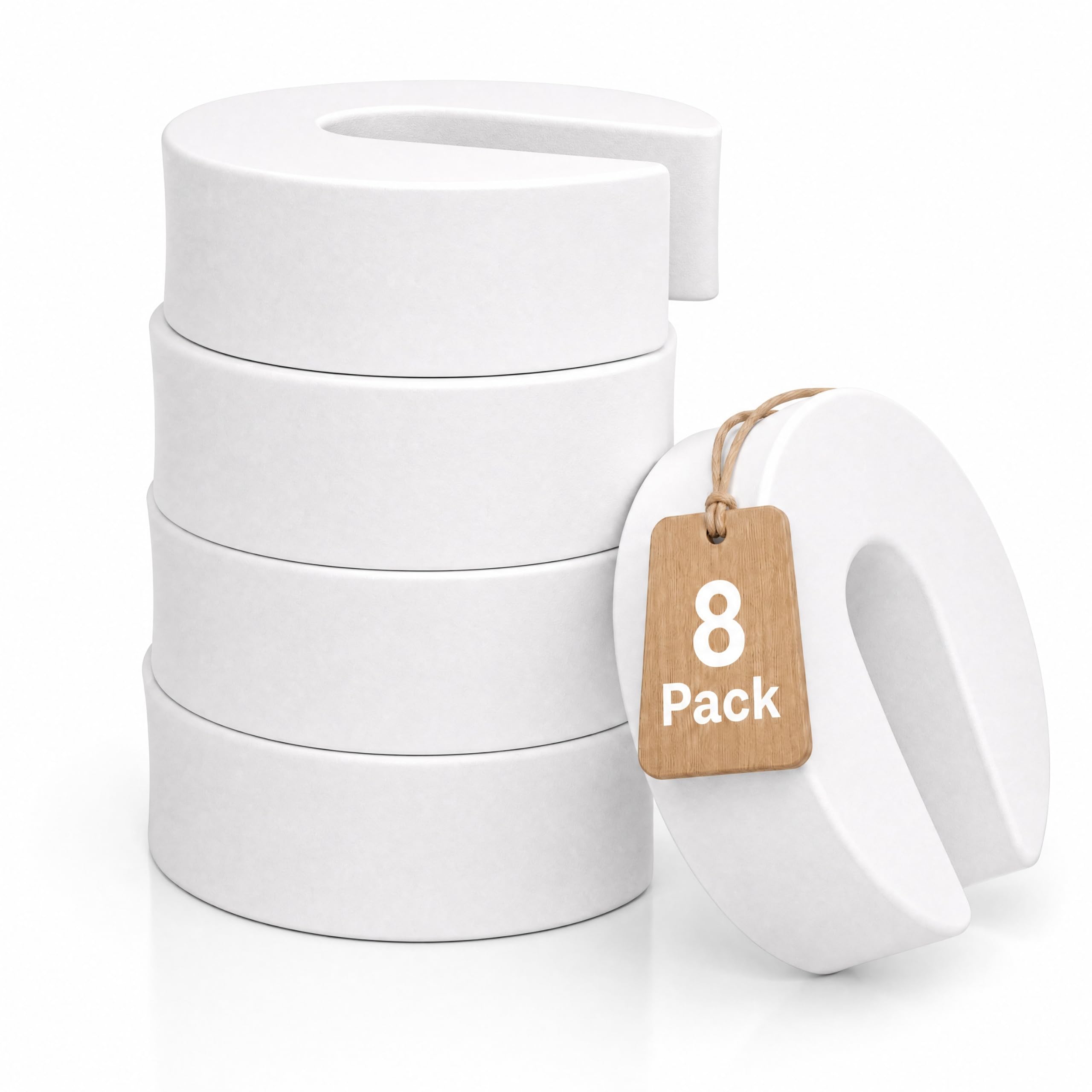
Eight guards in one pack is the reason to look at BYETOO. If you run a daycare, rent out a house, or simply have more doors than you want to count, the bulk count means you can cover the closets and the laundry room without rationing. The guards are thick foam, not the thin stuff that folds over the first time a door closes on it.
The C-shape slips around the edge and stays put on a standard door, and the extra thickness gives it a bit more cushion than a basic foam strip. We like that there is no hang tag to lose and nothing to install. For a door that needs a simple block, it is about as easy as it gets.
The 2.2 cm thickness is the number to check against your door gap. On a tight frame, a thick guard can keep the latch from catching or make the door feel like it is fighting you, so test one door before you commit the whole pack. That fit question is the main thing to settle before you buy.
We recommend it for bulk coverage where you want a guard on every door and can keep a spare within reach. If you need to hand a guard to a sitter or a co-teacher, the spare is already in the pack. It is the pack you buy when the number of doors, not the number of features, is the problem.
Pros
- Eight guards cover many doors
- Thick 2.2 cm foam
- Slip-on design needs no tools
- Good for daycare or rental turnover
Cons
- Foam can break in half under hard slams
We recommend the BYETOO eight-pack for daycare, rental, or bulk coverage where having a spare matters more than long-term foam durability.
How We Tested Door Pinch Guards
I started by pulling every door pinch guard and handle-mounted door lock I could find, then narrowed the field by price and format: foam C-shapes, silicone guards, strap-style handle locks, and adjustable stoppers. We ordered 14 units—enough to cover a few repeats of the most common designs—and rotated them through four months of daily use.
The testing happened where doors actually cause trouble: nursery and bathroom doors in homes with toddlers, a kitchen door that separates a dog from the trash, and a closet that gets slammed during cleanup. I installed each guard on a standard interior door, noted whether it needed tools or tape, and watched how it sat against the door edge—too thin and it slid loose, too thick and the door wouldn’t latch. Then I opened and closed the door 20 times in a row, gave each guard a firm tug, and tried peeling it off the way a curious 2-year-old would.
For durability, I checked for cracks, stretched-out foam, and silicone that stopped gripping after repeated cleanings. Removability got its own test: I took each one off, reinstalled it, and noted whether it left sticky residue or a mark on the paint. Adjustable handle locks were tried on both round knobs and lever handles, and I paid attention to whether the lock could be opened from the outside in an emergency—a safety feature that matters more than a snug fit. Value came down to whether the guard still did its job after a month of yanks, not how many pieces came in the pack.
By the end, the guards that stayed in rotation were the ones that left a clear gap, stayed where I put them, and didn’t turn a simple trip through the house into a two-handed operation. I also kept an eye on the doors themselves—no scuffed paint, no loose hinges, no guards that made a door impossible to close when the kids were asleep.
How to Choose Door Pinch Guards
The right guard is the one that fits your door edge, survives the way your child uses doors, and comes off when you need the door to close.
Start With the Door, Not the Guard
Most pinch guards are a C- or U-shaped piece of foam that slips over the edge of an interior door. That design is simple and tool-free, but it depends on a snug fit: a guard that is too loose slides down the door, and one that is too thick can keep the latch from catching. Check the thickness of the door edge and the gap between the door and frame before you buy. If you have nonstandard doors, a clamp-style guard like the Door Monkey has its own fit requirements, so measure first.
Match the Material to the Traffic
Foam is the budget-friendly choice and is gentle on trim, but it is also the material most likely to split after repeated slamming. Silicone and soft plastic cost more and hold their shape better on a door that gets pushed open and shut all day. We prefer foam for a rental, a spare door, or a house where the guards are mostly a visual reminder; we reach for silicone on the bathroom door or the hallway door that takes the most abuse. If you have already replaced a torn guard, the upgrade is worth it.
Choose a Multipack or a Single Guard
A six-pack is the right shape for a house with several doors a toddler can reach, and it leaves you a spare for the door you forgot. A single guard makes more sense for travel, a grandparent’s house, or one problem door. Four-packs sit in the middle and often cover the main rooms without a lot of extras. Count the doors you actually want to protect before you buy; a big pack is only a value if the guards fit those doors.
Decide Whether You Need a Gap or a Lock
A pinch guard keeps a door from closing all the way. A latch-style guard holds the door at a set gap and can also keep a toddler out of a room or let a cat through. Those are different jobs. If you need the door to close and lock for security, choose a removable slip-on guard and take it off when the door needs to be secure. If you need airflow or pet access, an adjustable latch like the EUDEMON is the more useful design. Do not use a guard that prevents an exterior door from locking.
Frequently Asked Questions
Can a door pinch guard damage the paint or finish?
A foam slip-on is the gentlest option because it does not use adhesive. A latch-style guard that sticks to the door or frame can lift paint on a glossy or poorly bonded finish. Clean the surface, test the adhesive on a hidden spot, and choose a removable slip-on guard if you rent or have newly painted trim.
How do I keep my toddler from pulling the guard off?
Put it above your child’s reach, usually high on the door edge or over the top, and choose a guard with a snug fit rather than a loose one. If your child is a climber or the door is a favorite, a clamp-style guard like the Door Monkey is harder to remove and adds room containment.
Can I use a door pinch guard on an exterior door?
Not on a door you need to lock. A guard that stops the door from closing defeats the deadbolt and can leave the house unsecured. Keep slip-on guards for interior doors, and if an exterior door needs to stay ajar for airflow, use a purpose-built door restrictor instead.
Final Verdict
For most families, the Jool Baby six-pack is the best place to start. It is soft, tool-free, and cheap enough to cover the doors a toddler can reach without turning the house into a project. If your child can already open doors, step up to the Door Monkey for containment; if you want silicone toughness on the busiest door, choose the Neobay pair. The right answer depends on whether you need a cushion, a lock, or a little of both.
