This post contains affiliate links. We may earn a small commission when you buy through our links — at no extra cost to you.
The first time my daughter rolled out of bed, I heard the thud before I heard the crying — and then spent the rest of the night on the floor beside her. A bed rail is a small, unglamorous purchase that fixes exactly that: it keeps a sprawling sleeper on the mattress and lets the whole house sleep through the night.
There are really two kinds, and they solve the problem differently: foam bumpers tuck under the fitted sheet as a soft speed bump, while framed rails with mesh sides sit above the mattress and anchor down. We spent six months testing 12 of them with kids ages 2 to 5, and the ones that held up had one thing in common — they stayed put when a kid leaned on them.
The details decide the rest. A rail has to match your mattress thickness and bed size, install without a second adult holding a flashlight, and a cover you can pull off and wash is worth more than you’d think after a juice spill. Here are the ones we’d buy again.




Best for First Big-Kid Bed
Hiccapop Foam Bed Bumper
Key Features
- Foam: CertiPUR-US
- Cover: Machine washable
- Weight: 12 oz
- Dimensions: 52" x 7" x 5"
- Price: Midrange
The test we run on every rail here is the same: put it in place, then push on it the way a sleeping 2-year-old will at three in the morning. The Hiccapop foam bumper is the one that surprised us. There is nothing to tighten and nothing to clamp, and it still ends up where we put it, because a silicone-beaded underside and a snug fitted sheet do the work a strap usually does.
What we appreciate most is how little it changes the bed. Fifty-two inches of CertiPUR-US foam sits about 5 inches tall — soft enough that a kid rolls over it in the morning and gets out on their own, firm enough that the same roll doesn’t happen at night. There’s no bar to crack a shin on and no cage look, which matters in a room you actually sit in.
It’s also the easiest of these to live with. At 12 ounces it goes in a suitcase for a night at grandma’s, and the cover unzips and machine washes. The catch is that the whole system leans on the sheet: on a bed with a loose or thin fitted sheet, expect to re-tuck it, and in a hotel the sheet is the only thing holding it. On a floor bed or a mattress with a proper deep-pocket sheet, none of that comes up.
One bumper per pack covers one side. If the bed is against a wall, that’s the entire job and you’re done. If it’s out in the middle of the room, buy two — the second one is not optional, because the open side is the side a toddler finds.
Pros
- Stays put under a fitted sheet, even with active sleepers
- Soft 5-inch profile kids can climb over
- Cover unzips and machine washes
- Light enough at 12 ounces to pack for travel
Cons
- One bumper per pack; open beds need two
Our default pick: a soft foam bumper that holds a rolling toddler without a frame, a strap, or a bruise, and washes clean when it needs to.
Best for Crib Conversions
Hiccapop Convertible Crib Bed Rail
Key Features
- Fits: Standard cribs, not IKEA
- Size: 16 x 33 inches
- Weight: 3 lb
- Install: No tools
- Price: Midrange
A crib-conversion rail has one job the mattress bumpers can’t do: stay attached to a crib frame that no longer has a fourth side. This Hiccapop rail does it with reinforced clamps that bite onto the frame instead of sliding a plate under the mattress, and that single difference is why we point parents here the week the front panel comes off.
Setup is genuinely tool-free and takes minutes, and the 33-by-16-inch panel folds down for story time and for changing sheets. The 3-pound frame is rigid, which is what stops a toddler from pushing the rail out of the way when they lean on it. Check that your crib has a frame rail for the clamps to grab before you order.
The fabric is where age shows. It’s heavy-duty nylon and it’s the part that takes the leaning, the climbing, and the hanging, so it’s the part worth watching as your child gets heavier. And once the crib becomes a twin bed, this rail is too crib-specific to follow you — that’s a bumper or a long panel, not this.
Pros
- Clamps to the crib frame instead of sliding under a mattress
- No tools, a few minutes to install
- Folds down for bedtime and sheet changes
Cons
- Not compatible with IKEA cribs
- Nylon panel is the first thing to wear
For a convertible crib with the front panel off, the frame clamps make this the most securely attached rail in this group.
Best for Big Beds
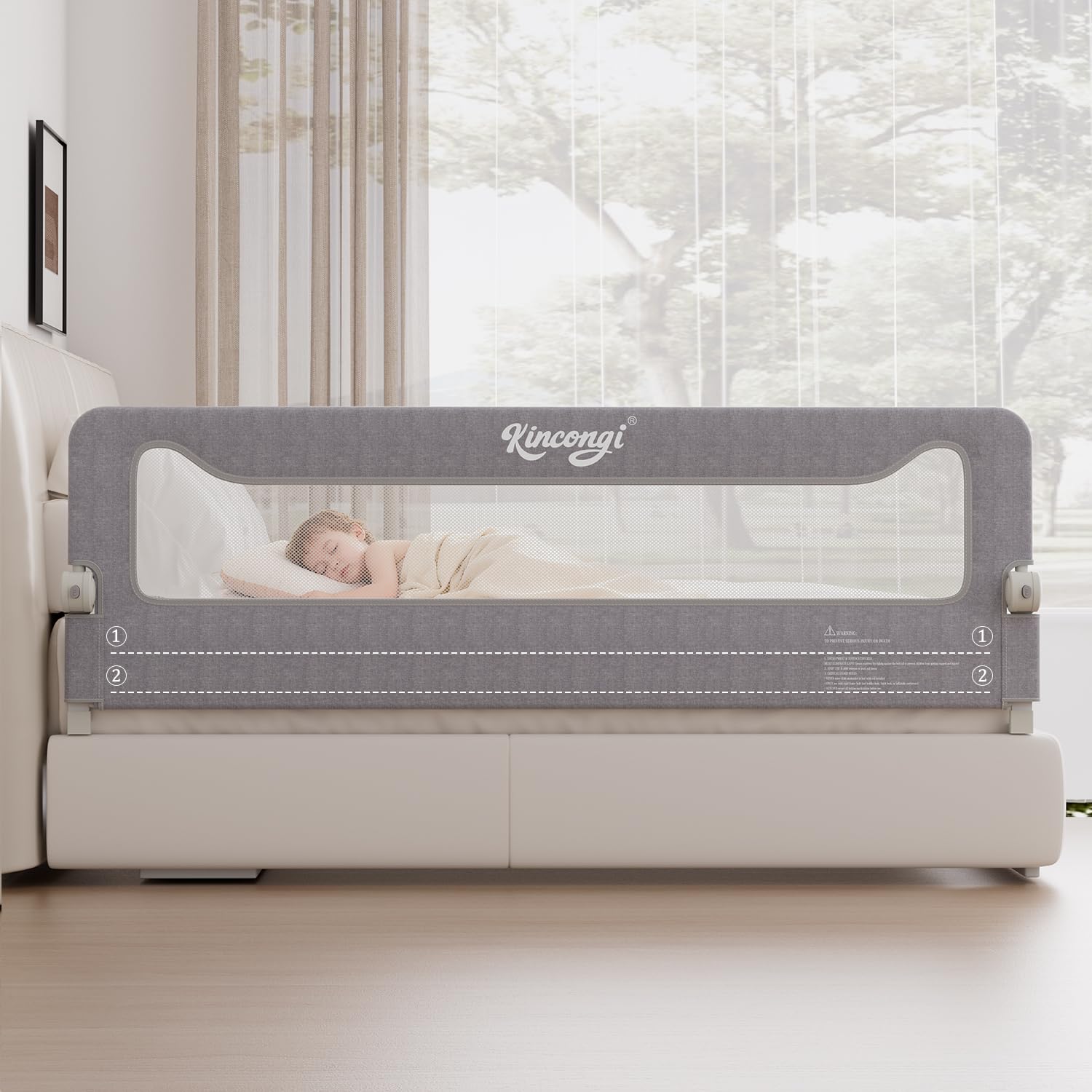
Kincongi 71-Inch Bed Rail
Key Features
- Base: Wide U-shape
- Size: 71"L x 24"H
- Weight: 6 lb
- Warranty: 3 years
- Price: Premium
Seventy-one inches is a lot of rail. On a queen, it covers most of one side, which is exactly what you want when a child sleeps sideways, starfishes, or has already rolled out twice in a week. Set against the 33-inch rails in this group, the coverage is the whole argument.
The base is a wide U that slides deep under the mattress, backed up by an anchor strap and tie straps, and in place it doesn’t wobble. The one-hand button that swings the panel down is the detail we kept coming back to at bedtime — you can hold a book in the other hand while you drop it.
At 24 inches tall and 6 pounds, though, this is a serious piece of furniture, and it’s the most expensive pick here. On a low toddler bed that height is more wall than a small child needs, and you’ll want to confirm they can still get out by themselves. On a full or queen, that same height is exactly right.
Pros
- 71 inches covers most of a queen side
- Wide U-base slides deep under the mattress
- One-hand swing-down for bedtime
- Three-year warranty backs the frame
Cons
- Heaviest rail here at six pounds
- 24-inch panel is a lot on a low toddler bed
The rail we point to for a full or queen bed: 71 inches of coverage and a base that stays put, as long as the bed isn’t a low toddler frame.
Best for Waterproof Two-Pack
Sleepah Bed Bumpers (2-Pack)
Key Features
- Pack: 2 bumpers
- Cover: Waterproof
- Dimensions: 7"W x 5"H
- Certification: CertiPUR-US, OEKO-TEX
- Price: Midrange
Nighttime accidents are the part of bed-rail shopping nobody puts on the list. The Sleepah two-pack is the answer we give for the household where a stomach bug or a soggy pull-up is a question of when: the cover is waterproof, it comes off, and it goes in the washing machine.
Under the cover these are memory foam bumpers with grip particles on both the top and the bottom, and that two-sided grip is the part we care about — the sheet holds the top, the mattress holds the bottom, and the whole thing creeps less than a plain foam noodle. The plush knit is soft enough that a kid who rolls into it stays asleep instead of waking up annoyed.
Both bumpers in the box means both open sides of a bed get covered, which is the scenario this pack is built for. Give them a day to puff up out of the vacuum packaging before the first night, and know that the foam core itself stays out of the wash — the cover is the part that gets cleaned.
Pros
- Waterproof cover unzips for machine washing
- Two bumpers cover both sides of a bed
- Non-slip top and bottom keep it in place
Cons
- Foam core can’t be washed, only the cover
Buy the Sleepah pair if you want a bumper you can strip and wash after a messy night; two of them cover both sides of a floating bed.
Best for Tight Budgets
YENING Foam Bed Bumper
Key Features
- Foam: CertiPUR-US
- Cover: Grey, wipe clean
- Weight: 1.7 lb
- Dimensions: 52"L x 6"W x 5.5"H
- Price: Budget
The YENING bumper is the least expensive foam rail in this group, and it does the same basic job as the top pick: 52 inches of CertiPUR-US foam that tucks under a fitted sheet and stops a rolling toddler at the edge. If the budget is the deciding factor, nothing here makes a strong case against it.
The differences are small but real. It’s 5.5 inches tall rather than 5, so it’s a slightly higher wall for a small sleeper, and the grey cover suits a grey-and-white nursery better than the usual white. The cover wipes clean instead of zipping off for the machine, which is part of what the lower price buys.
Grip is the thing to plan around. It holds best on cotton sheets; on silky or sateen ones it slides more than the Hiccapop does. The maker also rules out top bunks and loft beds outright, which is worth repeating for anyone eyeing a bunk setup.
Pros
- Cheapest foam bumper in this set
- CertiPUR-US foam at a budget price
- Slightly taller 5.5-inch profile
Cons
- Cover wipes clean but doesn’t machine wash
- Grips less well on silky or sateen sheets
The budget pick: same foam and same under-the-sheet method, with a wipe-clean cover and a slightly taller wall.
Best for Thin Mattresses
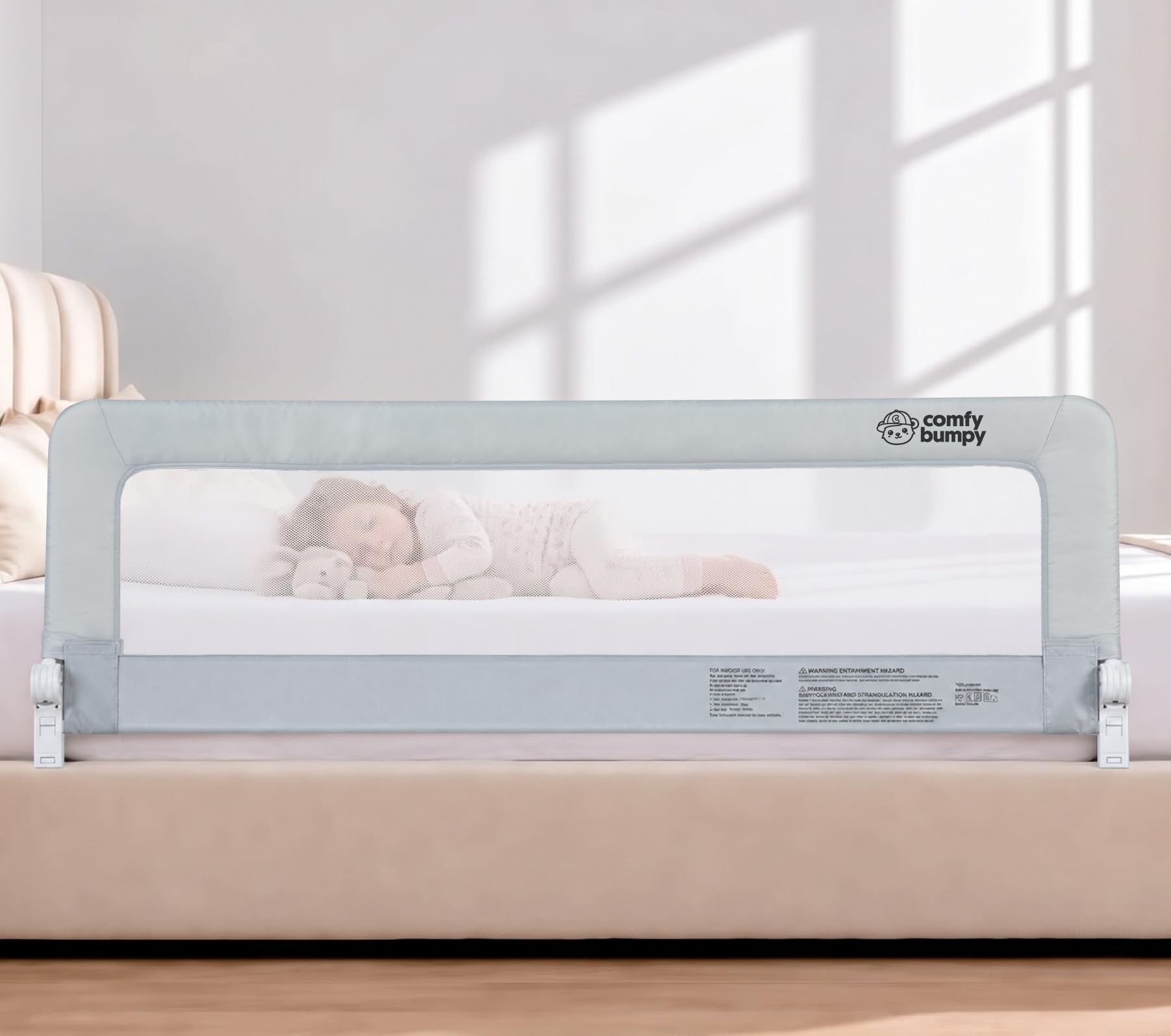
ComfyBumpy Bed Rail
Key Features
- Height: 19.5"
- Length: 55.5"
- Attachment: 3-way anchor
- Mattress fit: 2 to 8 inches
- Price: Premium
"Fits 2- to 8-inch mattresses" is an unusually specific claim on a bed rail, and it’s the reason the ComfyBumpy is in this guide. Most rails quietly assume a thick mattress. This one is built for the thin ones — a low-profile toddler mattress, a trundle, a bunk in a camper.
It attaches three ways: the base slides under the mattress, a strap tightens, and for daily use the maker recommends screwing the base into the bed frame. That last step is the difference between a rail that stays and one that leans, and it’s also a commitment, because screws leave holes in a frame you may want to hand down.
The curved pull-down is the best of the fold-down mechanisms here. The panel drops below the mattress line, so the bed looks like a bed in daylight, and we appreciate that in a small room where the bed doubles as the sofa. The padded mesh panel is removable and wipes clean, and 55.5 inches covers a twin well.
Two things to know before you order. The printed instructions are the weakest part of the package — give yourself a clear half hour and dry-fit the rail in the afternoon rather than at bedtime. And it’s the second-priciest rail here, which is a lot for something that still needs screws to be at its best.
Pros
- Stated fit for 2- to 8-inch mattresses
- Fold-down panel hides below the mattress
- Removable, wipeable padded mesh panel
Cons
- Screws into the bed frame for the most secure fit
- Printed instructions are hard to follow
The pick for a thin mattress or a low-profile frame: the only rail here that states a fit down to 2 inches.
Best for Two-Sided Beds
Ceekliybear Foam Bumpers (2-Pack)

Key Features
- Pack: 2 bumpers
- Size: 52" x 7" x 5"
- Color: Fun Dinosaur
- Certification: US CPC
- Price: Midrange
The dinosaurs are doing real work here. A toddler who is unsure about a big bed is more willing to lie down next to a bright green stegosaurus than next to a plain white foam cylinder, and at bedtime that is not nothing.
Under the print it’s a 52-by-7-by-5-inch foam bumper with non-slip fabric and grip particles on the underside, so it behaves like the rest of this group: under the fitted sheet, holding the edge, easy for a child to climb over in the morning.
Where it separates itself is the math. Two bumpers come in the box for roughly what a single bumper costs elsewhere in this guide, which makes it the sensible buy for a bed standing out in the middle of the room with two exposed sides.
The reason it’s not ranked higher is simply that we’ve seen less of it than the Hiccapop or the Sleepah, so the long-term record on the seams and the foam is thinner. Two bumpers that grip, wipe clean, and get a toddler into the bed without an argument is a fair trade for that.
Pros
- Two bumpers in one box
- Non-slip base holds under the sheet
- Print kids actually respond to
Cons
- Only comes in the dinosaur print
The two-pack to buy when both sides of the bed need guarding: one box, two bumpers, and a print that makes the move out of the crib feel like an upgrade.
Best for Kids in Twins
Dream On Me Mesh Bed Rail

Key Features
- Fits: Twin to king
- Material: Metal mesh
- Age range: 2 to 5 years
- Dimensions: 32.7"L x 14.1"W x 23.5"H
- Price: Budget
The box on this one carries a warning worth reading before you order: not for cribs or toddler beds. Believe it. This is a rail for a kid who has moved into a real twin, full, or queen, and at that job it’s fine — but it is not the rail for the crib-to-toddler-bed moment.
What you get is a 32.7-inch mesh panel on a metal frame, anchored by a strap that runs under the mattress, with two height settings so you can drop the panel as the mattress settles. It’s the least expensive framed rail here, and assembly with the included tools runs about five minutes.
Coverage is the caveat. At roughly 33 inches it guards the spot where a child rolls, not the length of the bed, so a kid who travels the whole mattress will find the ends. On a twin pushed against a wall, one panel is usually enough; on a queen out in the open, it isn’t.
For a 3- or 4-year-old in a twin who rolls toward one side, this is a cheap, sensible way to add a barrier, and the breathable mesh keeps the room feeling open rather than caged. Just don’t buy it for the crib conversion — that’s a different product, and this one admits it on the box.
Pros
- Anchors with a strap under the mattress
- Two adjustable heights
- Breathable mesh keeps sightlines open
Cons
- Not for cribs or toddler beds
- Short 33-inch panel leaves the ends open
A budget rail for a child already in a twin or full bed — and a poor fit for a crib conversion, which the packaging says outright.
How We Tested Toddler Bed Rails
We started by pulling together every toddler rail we could find that named an actual bed size and a mattress thickness range; anything vague about fit got cut before testing began. That left 12 rails, which we installed on twin, full, and queen beds in four households, plus one crib. Testing ran six months, through bedtimes, naps, sheet changes, and a hundred or so middle-of-the-night reach-overs. We also counted what came in the box, because a rail that needs a separate strap kit isn’t the bargain it looks like.
Each rail went on using only the included instructions, and I timed the first solo install — then took it apart and started over to see whether the second attempt went any smoother. I noted every step that needed a tool, a second set of hands, or a guess. Fit got checked against the real mattress: whether the rail sat flush, whether it left a gap at the seam a small kid could slip through, and whether it worked on a mattress sitting in a frame rather than on a box spring. Then we leaned on them — body weight, kid weight, a 5-year-old using the top bar as a handhold — and measured how far each one had shifted after a week of real sleeping.
For coverage, we measured how much of the bed each rail spans and where a determined climber could get around the end. On swing-down styles, we timed the one-handed lower-and-raise in a dark room. Covers went through the wash three times; we checked seams, shrinkage, and whether the waterproof backing survived. Over six months we watched for foam that flattened, hinges that loosened, and fabric that frayed where it anchors.
How to Choose a Toddler Bed Rail
The first decision is not brand or budget — it’s whether your child needs a wall at the edge of the mattress or a soft reminder that the edge is there.
Bumpers or Rails: Start With the Bed
Foam bed bumpers sit on top of the mattress, under a fitted sheet, and ask nothing of the bed frame. That makes them the easy answer for a floor bed, a foam mattress, a trundle, or a bed that moves between rooms. Rails clamp or strap to something solid and give a taller barrier, which is what you want for a child who sleeps hard and climbs.
The trap is buying a rail for a bed with nothing to attach to: an air mattress, a mattress on bare slats, or a convertible crib whose frame is a different shape than the clamps expect. Look at the frame before you look at the price tag.
Measure the Mattress, Not Just the Bed
A rail’s usable height is measured from the top of the mattress, not the floor. A 24-inch panel over a 12-inch mattress shows 12 inches of wall; the same panel over a 6-inch mattress shows 18. Thin mattresses are their own category — the ComfyBumpy is the one here that states a fit down to 2 inches — and a deep pillow-top can swallow a base plate whole.
How Much of the Side You Need to Cover
Lengths in this group run from about 33 inches to 71. A long panel is not automatically better: it protects more of the side, but it makes more of the bed feel closed in and it costs more. What matters is where your child actually rolls.
A bed pushed against a wall needs one guard; a bed floating in the middle of the room needs two, which is the argument for a two-pack. Watch the ends as well — the gap between the headboard and the start of the panel is exactly where a determined sleeper ends up.
Attachment, and the Gap That Matters
There are three ways these attach: sheet tension, a strap running under the mattress, or clamps and screws on a frame. Each works and each fails predictably. Sheet tension gives up if the sheet is loose. A strap gives up if it isn’t tight. Screws don’t give up, but they leave holes.
Whatever you choose, the safety question is the same: is there a gap between the rail and the mattress where a small body could wedge? Push the rail snug, re-check it after every sheet change, and use a gap guard if the design offers one.
What Wears Out First
Look at the part that takes the load. On mesh rails it’s the fabric and the stitching where the panel meets the frame; on bumpers it’s the cover seam and the foam itself, which softens with use. A strap under a mattress is in tension every night of its life.
Washing matters more than people expect. A machine-washable cover, like the ones on the Hiccapop and the Sleepah, is worth paying for if your child is prone to accidents; wipe-clean is fine if not. And give a vacuum-packed bumper a full day to expand before the first night.
Frequently Asked Questions
At what age can my child stop using a bed rail?
Most rails and bumpers are sold for the two-to-five range, and the honest exit test is behavior, not birthday. Once your child gets in and out of bed unassisted and hasn’t rolled out for a couple of weeks, take the rail off for naps first. If naps hold, try nights.
Can I use a bed rail on a bunk bed or a loft bed?
Not on the top bunk. Our budget bumper’s listing rules out top bunks and loft beds outright, and the reasoning holds generally: a fall from that height is a different kind of fall, and the under-mattress plate has less to grip.
A bottom bunk can work with a rail whose panel sits well above the mattress, but measure the panel against the bunk’s thinner mattress before you buy.
How do I clean a foam bed bumper?
Check whether the cover comes off. The Hiccapop and Sleepah covers unzip and go in the washing machine; the YENING cover is a wipe-clean job. The foam core never goes in the washer or the dryer — spot clean it, press the water out, and let it air flat until it’s dry all the way through before it goes back under a sheet.
Will a bed rail damage my mattress or bed frame?
Bumpers leave nothing behind. A rail with an under-mattress plate can leave a soft compression line that fades in a day or two. The one that commits is a screw-in anchor: the holes stay in the frame, so decide before you drill, especially on a bed you plan to hand down.
Final Verdict
The Hiccapop foam bumper is the one we hand to most families: it installs in the time it takes to change a sheet, holds a rolling toddler through the night, and lets that same toddler climb out in the morning without calling for help. Its one real limit is coverage — a bed floating in the middle of the room needs two.
If your child is still in a crib with the front panel off, buy the Hiccapop crib rail instead; the frame clamps are the difference between a rail that stays and one that leans. And if the bed is a queen or full that a 5-year-old sprawls across, the Kincongi’s 71-inch panel is the one that finally matches the size of the mattress.
