This post contains affiliate links. We may earn a small commission when you buy through our links — at no extra cost to you.
A toy tool set lives or dies on one question: does the tool actually do anything? A drill that spins, a screw that bites into a hole, a wrench that grips a bolt — those keep a kid at the workbench. A molded hammer that thuds hollowly gets abandoned by the second afternoon, and then you’re the one stepping on loose bolts in the dark. The right set turns a restless rainy afternoon into something that looks a lot like concentration.
With a 2-year-old and a 5-year-old in the house, I’ve lived with a lot of these, and we’ve put 14 sets through three months of preschooler use — playdates, quiet time, car rides, and a lot of playroom mornings. The differences aren’t subtle. The piece count on the box matters least; what matters is whether every piece has a job, whether a small hand can turn the wrench, and whether the noisy ones have a switch. If your kid still mouths everything, watch the small parts. The eight that survived are below, sorted by which kid they suit.


Best for First Tool Set
Learning Resources New Sprouts Fix It!
Key Features
- Material: Soft plastic
- Batteries: None required
- Pieces Included: 6 tools and toolbox
- Recommended Age: 2 years and up
- Price: Midrange
Six pieces is the entire set: a saw, a hammer, a screwdriver, a wrench, a drill, and a toolbox to carry them in. What convinced us is what isn’t there — no screws, no nails, no bolts, nothing that ends up in a mouth or under a couch cushion. Everything is molded from thick, slightly rubbery plastic, so a hammer swing lands on the coffee table with a thud instead of a dent. For a first tool set, that’s the right trade.
The drill makes its noise when you squeeze the handle, so there are no batteries, no volume switch, and no dead toy on a Tuesday morning. We like that it gives a two-year-old the payoff — a tool that responds — without a motor to burn out, and the screwdriver has a trigger that clicks for the same reason. The handles are short and fat, sized for a fist rather than a hand, which means a young two-year-old can hold the wrench the right way up on the first try.
The limits are real. Nothing here threads, builds, or holds two pieces together, so a four-year-old who has watched you use a real screwdriver will want bolts that bite; the Hape box or the KIDWILL set is the better spend for that kid. For the under-three crowd the plainness is the point — there’s no wrong way to play with a hammer that doesn’t do anything, and nothing to explain.
Pros
- No small parts to swallow or lose
- Soft plastic won’t dent furniture or siblings
- Squeeze drill needs no batteries
- Chunky handles fit a toddler’s grip
Cons
- Six pieces is thin for the price
The one we hand a 2-year-old without hovering: six chunky, soft-plastic tools, no small parts, and a squeeze drill that needs no batteries.
Best for Wooden Classic
Hape Fix-It Tool Box
Key Features
- Size: 9.4 x 5 x 5.9 inches
- Includes: Hammer, wrench, screwdriver, nuts and bolts
- Material: Wood
- Recommended Age: 3 years and up
- Price: Budget
Turn the screwdriver in this box and something happens: the bolt backs out. That sounds like a low bar until you have handed a preschooler a wooden set where the screw spins in a hole that doesn’t hold it. Hape’s hardware mates — screwdriver to bolt, wrench to nut — and the tools themselves are smooth, sanded wood with no splinters.
We keep this one near the top for a three-year-old because it does the thing a toy tool set is supposed to do: it lets a kid copy you. No batteries, no songs, nothing to charge. It comes out while someone is actually fixing a cabinet, and it doesn’t have to compete with its own noise to hold attention.
It’s small, roughly the footprint of a lunchbox, and light enough for a three-year-old to carry by the handle in one hand, which is why it moves from room to room instead of living in a toy bin. Count the pieces when the box arrives; sets occasionally turn up a part short, and the hardware is the whole point of owning this one.
Pros
- Screwdriver and wrench really turn the hardware
- No batteries, no sound, nothing to charge
- Smooth sanded wood with no splinters
- Small enough for a preschooler to carry
Cons
- Little to build beyond nuts and bolts
Our wooden pick for a three-year-old: tools that really turn the hardware, sanded smooth, with no batteries to go flat before the novelty does.
Best for Sounds and Songs
VTech Drill and Learn Toolbox
Key Features
- Size: 12.6 x 5.7 x 4.9 inches
- Includes: Electronic tray, drill, hammer, wrench, nails
- Batteries: 2 AA (demo set included)
- Recommended Age: 2 to 5 years
- Price: Budget
This is one of the least expensive ways here to put a spinning drill in a toddler’s hands. The drill drives the included screws into holes in the electronic tray, the gears turn, and the tray clicks back. For a two-year-old who has been told no to a real drill, the effect is immediate.
The learning layer is the part we didn’t expect to like. Press a light-up button and the tray names a tool and the sound it makes; slide in one of the double-sided cards and it starts asking about colors and numbers. There’s also a volume control, which is the most welcome feature on any talking toy in this guide.
The drill is where our patience thinned. It’s stiff, and a small hand has to hold it square and lean on it before it turns; when it slips, the screw stays put and the play stalls. Plan on the set living on the floor, too — the drill doesn’t fit inside the box with the rest of the tools, and the lid won’t shut over them.
That leaves a very specific buyer: the kid who wants buttons, songs, and a tool that lights up, and who is happy to drive the same four screws in and out for twenty minutes. If that’s your kid, there’s a lot of toy here for the money. If the box needs to close and go on a shelf, there isn’t. Run the drill before you wrap it — if it doesn’t spin freely out of the box, that’s the whole toy.
Pros
- Drill actually drives the screws into the tray
- Names tools, colors, and numbers
- Volume control for the songs
- Budget price for an electronic set
Cons
- Drill and tools don’t fit in the box
- Drill switch is stiff for small hands
If your toddler wants the loud version of your drill — songs, light-up buttons, and a bit that actually spins — this is the one we point you to.
Best for Budget Wood
Melissa & Doug Take-Along Tool Kit
Key Features
- Size: 9.84 x 4.72 x 5.51 inches
- Pieces: 24
- Material: Wood
- Recommended Age: 3 to 6 years
- Price: Budget
Twenty-four wooden pieces for less than the other wooden sets here, plus a box to keep them in. You get a hammer, a wrench, a screwdriver, boards with holes in them, and enough nails and screws to fill those holes twice over. If you want the most parts for the least money in wood, this is it.
The catch is what the screws do. They thread into the bolts and pass through the holes in the boards, but they don’t bite into the wood the way a real screw does, so the building is stacking and bolting rather than assembling. A three-year-old won’t mind. A five-year-old who wants to build a truck will, and that’s where the KIDWILL set earns its place instead.
The pieces are on the small side for a young three, and lining up a bolt takes a couple of tries, which is where the frustration in this kit comes from — this is a four-year-old’s set, honestly. What it has over the pricier wooden boxes is sheer quantity, and all of it goes back in the case in one sweep, which is not a small thing on a preschool morning.
Pros
- 24 wooden pieces at the lowest wooden price here
- Everything packs into the lidded box
- No batteries and no sound
Cons
- Screws hold only in the bolts, not the boards
- Fiddly bolts frustrate young threes
Most parts for the least money in wood: 24 pieces that screw, stack, and pack away, and the right set for a four-year-old who takes things apart.
Best for Pattern Drilling
Educational Insights Design & Drill Bolt-It Bucket
Key Features
- Storage: Bucket with activity-board lid
- Includes: Power drill, 52 bolts, pattern guide
- Recommended Age: 3 to 7 years
The bucket is the toy. The lid is the work board, the handle is the carry strap, and inside are 52 bolts in four colors and a power drill that tightens and loosens them. A pattern guide gives a kid something to copy, so the drilling has a target instead of just a hole.
We like it for the kid who has already worked out that a hammer is a stick. This one is all mechanism: tighten, loosen, move to the next hole, follow the pattern. It’s the closest thing in this guide to a task a child can finish on their own, and the four bolt colors give you a way to sort and count without a worksheet.
It runs on batteries, so have them on hand before you hand it over. The bucket catches every bolt when the play is done, which is more than the sets whose drills don’t fit back in their own boxes can manage, and that storage is the reason it travels well. Buy it for the three- or four-year-old who likes repetition and a tool that does one job.
Pros
- 52 bolts keep the drilling going
- Lid doubles as the work board
- Everything stores in the carry bucket
- Pattern guide gives the play a goal
Cons
- No hammer, saw, or toolbox role-play
All mechanism, no make-believe: 52 bolts, a power drill, and a bucket lid that doubles as the work board, for a kid who likes patterns.
Best for Building Models
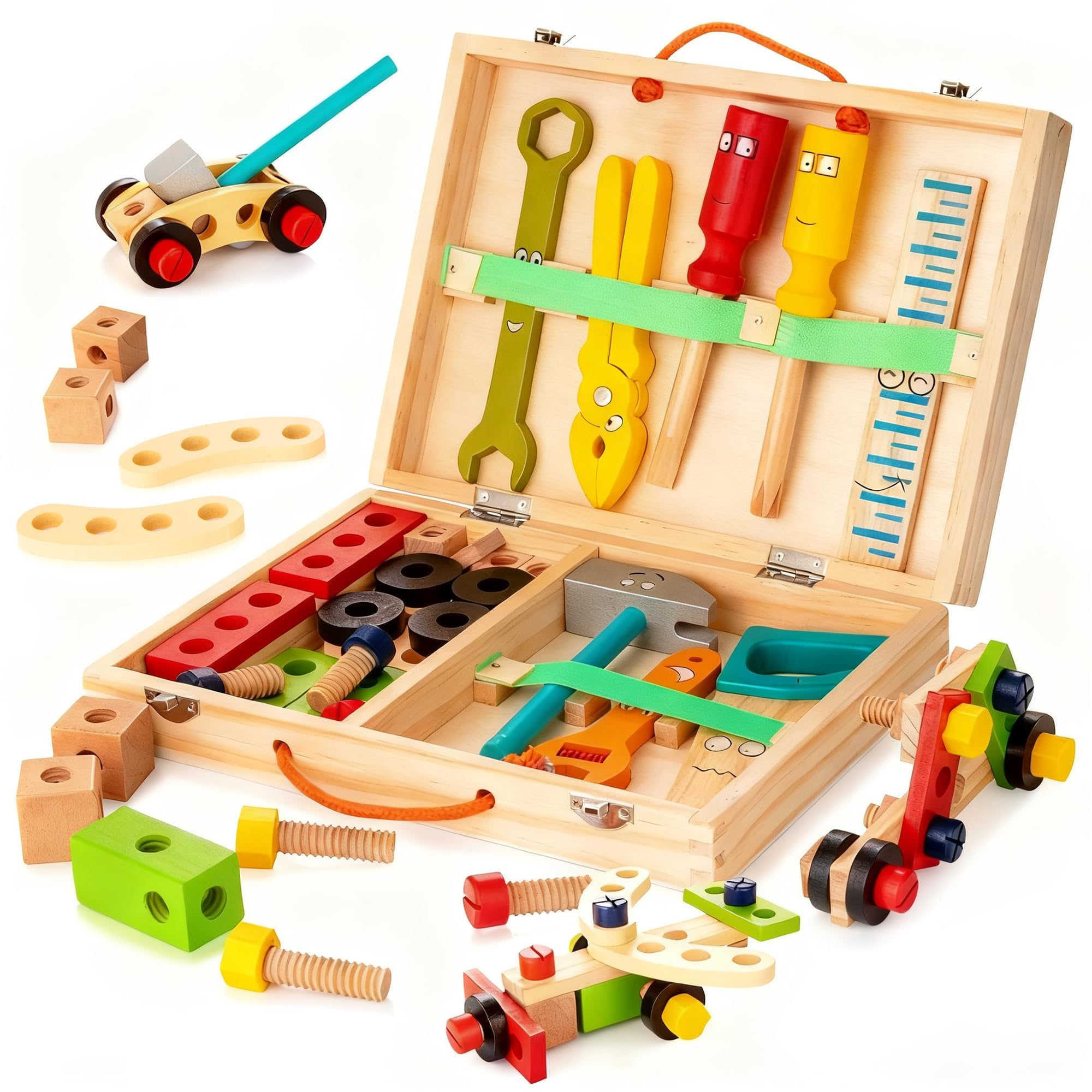
KIDWILL LAND Wooden Kids Tool Kit
Key Features
- Size: 12 x 9 x 3 inches
- Pieces: 36
- Material: Wood
- Recommended Age: 3 years and up
- Price: Budget
Most sets here stop at hammering a nail into a hole. This one comes with wheels, blocks, and assembly pieces, so the parts become a car, a windmill, a balance scale, or a robot, and the tools are how you get there. Thirty-six pieces, all wood, all in a case with a handle.
The handles have little faces on them, and we’re not above admitting that’s why a two-year-old picks up the wrench before they can use it. The saw, the pliers, and the two screwdrivers are shaped like the real thing without being sharp, and the paint is water-based, which matters if your kid tests things with their teeth.
Where it earns its place: it’s the wooden set with something to build, which puts it ahead of the plainer boxes for a four-year-old. What it asks in return is patience — the guided builds take real hand-eye work, and a three-year-old will mostly take the car apart rather than put one together. Build the first model with them and the idea lands.
The case is the weak spot. It’s thin wood, the latch is the first thing to work loose, and the tools are better made than the box they live in. That’s a fair trade for the only set here that turns a toolbox into a workshop.
Pros
- Wheels and blocks make real models
- Tools shaped like the real thing, minus sharp edges
- Faces on the handles draw kids in
- Everything stores in the carry case
Cons
- Guided builds test a young three’s patience
- Thin wooden case with a latch that works loose
The wooden set that builds something: wheels, blocks, and 36 pieces that become cars and windmills, aimed at a patient four-year-old.
Best for Ages 12 Months+
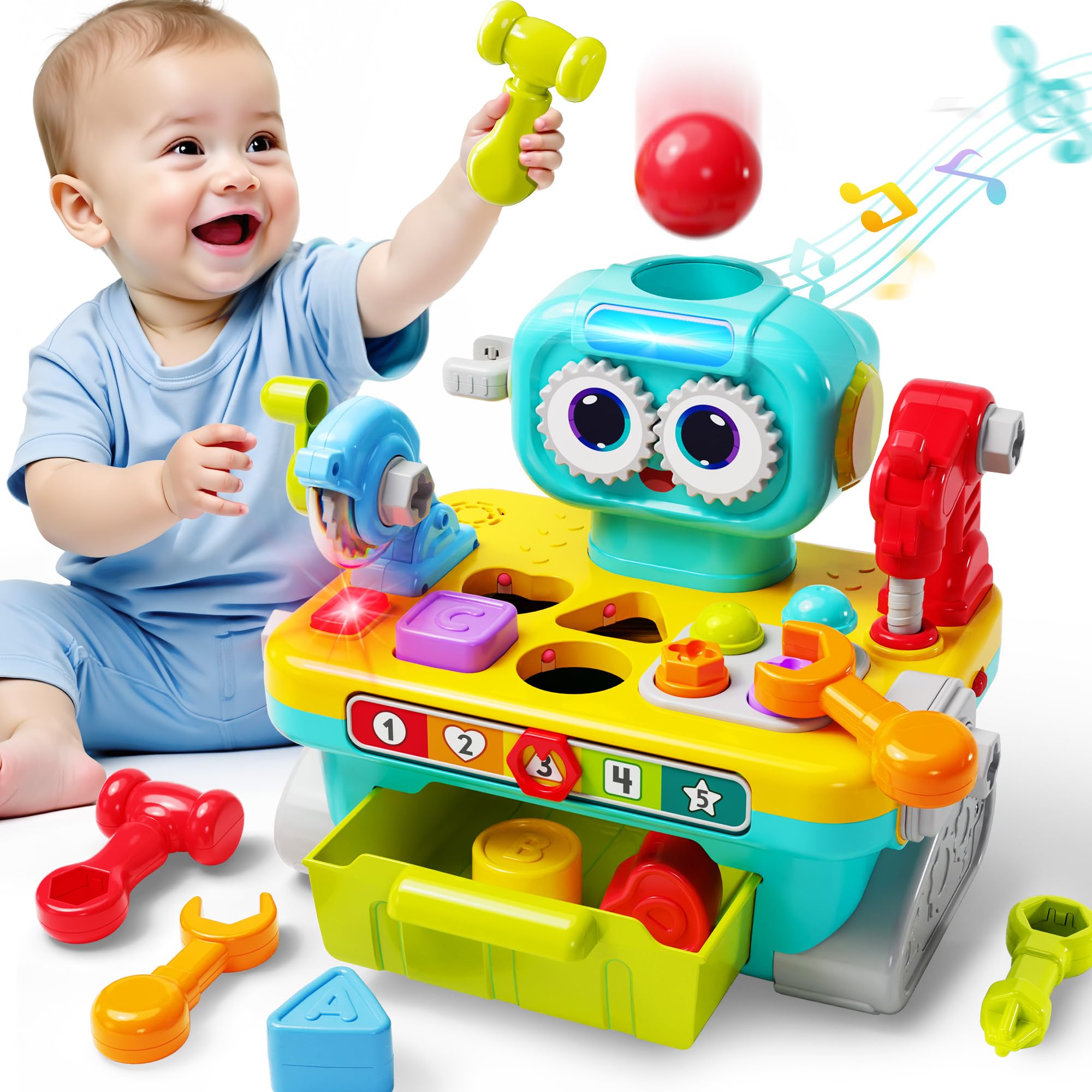
iPlay, iLearn Musical Workbench
Key Features
- Size: 10.63 x 6.75 x 8.63 inches
- Batteries: 2 AA required
- Activities: Pounding ball, shape sorter, number slider, tools
- Recommended Age: 12 months and up
- Price: Premium
Nearly every set in this guide starts at three. This one starts at twelve months, and it’s built accordingly: a pounding ball, a shape sorter, a number slider, a bench clamp, and a small drill, chainsaw, wrench, hammer, and screwdriver sized for a one-year-old’s fist.
What we like is that the baby play and the tool play are the same object. Drop the ball in the top and music plays; hammer it through; sort the shapes; then grab the drill and press the trigger. For a kid who is too young for a toolbox but old enough to want whatever you’re holding, that’s the whole trick.
It’s smaller than the pictures make it look, which we count as a feature: it sits on a shelf, in a corner, or beside the couch without taking over the room, and the songs are quiet enough to ignore. The lights are what get a reaction.
Be clear about what it isn’t. The drill is a rattle with a bit on it, not a driver, and nothing here screws into anything. A four-year-old will be done with it in an afternoon. For the one-year-old who wants to be in the room while someone fixes a cabinet, though, it’s the right first tool set — and the only one here built for that kid.
Pros
- Rated from 12 months, not three years
- Pounding, sorting, and drilling on one bench
- Compact enough for a corner or shelf
- Music and lights reward cause and effect
Cons
- Drill is a rattle, not a driver
- Little challenge past age three
The only set here built for a one-year-old: a pounding, sorting, music-making bench with a first drill that survives a diaper-age grip.
Best for Dress-Up Play
KidBloom Kids Tool Set

Key Features
- Size: 10.83 x 3.35 x 9.25 inches
- Includes: Drill, hand tools, vest, goggles, tool case
- Batteries: Required for drill
- Recommended Age: 3 years and up
- Price: Midrange
The vest is the point. The tools are ordinary — a battery drill, a saw, a hammer, a screwdriver, a wrench, a tape measure, screws, bolts, nails — but the high-vis vest with pockets and the safety goggles turn a plastic tool set into a uniform. A three-year-old puts it on and stops playing with tools; they’re on the crew.
The whole case weighs about as much as a hardcover book, so a small kid can carry it and drag it around without help, and every tool in it is molded plastic with nothing much to break. There’s a tape measure in the box, which is the piece kids ask for once they’ve watched someone use one.
The drill turns both ways and takes batteries, and it’s the piece that decides how long the set lasts; everything else is static. If the drill is the part your kid ignores, you’ve bought a costume with a toolbox attached, which is fine — just know which one you’re paying for.
That’s the trade, and for the right kid it’s a good one: this is the set for the child who wants to look like you, not the one who wants to build what you’re building. If your three-year-old puts on a hat and announces they’re going to work, this is their kit. If they want to make something, buy wood instead.
Pros
- Vest and goggles turn play into role-play
- Drill runs forward and reverse
- Everything fits in one small case
- Light enough for a preschooler to carry
Cons
- More costume than construction
The dress-up option: a working drill and a full tool case, plus the vest and goggles that make a three-year-old feel like part of the crew.
How We Tested Toy Tool Sets
We started by pulling every tool set we could find aimed at ages 1 through 6, then cut the ones that felt like filler: sets where half the pieces were duplicate bolts, sets with tools molded into a single chunk that couldn’t turn or grip anything, and sets that needed a screwdriver just to load the batteries. We also weighed what was actually in the box against what it cost, since a cheaper set with eight working pieces beats a bigger one with thirty duds. That left 14 sets, all bought at retail so no brand could send us a beefed-up version.
Testing ran three months, starting at the playroom’s busiest hour and stretching through Saturday playdates and one long car ride. Each set went to a 2-year-old, a 5-year-old, and whatever friends were in the house that week. We tracked how long it held attention after the first dump-out, and noted whether kids invented a job for themselves — fixing a chair leg, installing a doorknob — or just scattered the pieces and walked off. We checked whether the drill chuck still held its bit after ten minutes of use, whether the wrench fit the bolts it shipped with, and whether anything cracked when it went down the stairs.
Because so many of these make noise, we kept a running tally of which ones had a volume or off switch and which ones we’d tolerate on a highway. We packed each set back into its box and had a 3-year-old carry it by one handle to see if the lid stayed shut and the whole thing was manageable solo. Gift-worthiness we tested the honest way: wrapped a few, watched them come out of the box, and timed how long before a kid could play, batteries and all. We also asked whether the set was cute enough to leave out in the living room or bound for the bottom of the toy bin. Anything that needed a parent hovering got marked down; the sets still being dragged out on day 90 are the ones that made the list.
How to Choose a Toy Tool Set
The first decision isn’t the brand or the piece count — it’s the shape: a toolbox a kid carries around, a workbench that stays in one room, or a bucket of bolts, and each one suits a different kind of play.
Toolbox, Workbench, or Bucket
A toolbox is the safest bet for most families. It stores itself, moves from room to room, needs no assembly, and turns into a kids tool set the child can carry by the handle. A workbench buys a dedicated play station, but it takes floor space, usually needs putting together, and puts the powered parts where they get the most use.
The trap is assuming a toolbox set actually packs away. On one of the sets here, the drill doesn’t fit inside with the rest of the tools and the lid won’t close over them, so the whole thing lives on the floor. Read what the listing says fits inside before you buy, not just how many pieces come in the box.
What the Drill Can Actually Do
Toy drills come in three kinds. Squeeze drills make a sound with no batteries and no motor to burn out — the safest bet for a two-year-old. Manual tools turn real nuts and bolts at a preschooler’s pace and never run out of power. Battery drills spin a bit and drive screws into a tray or board, which is the most satisfying of the three and also the part most likely to fail.
If you buy a powered set, put batteries in and run the drill before you wrap it. A drill that doesn’t spin freely out of the box isn’t going to improve, and it’s the reason the toy exists. Also look for a volume control: a talking tool set without one is a toy you end up hiding.
Wood or Plastic, and What Breaks First
Wood is heavier, quieter, and holds up to being dropped, stood on, and handed to a younger sibling. Plastic is lighter and cheaper, and it’s the only place you’ll find sound, lights, and a motor. Neither choice decides how long the set lasts, because the tools themselves are simple.
What breaks is the case and the switch. On wooden sets, the thin plywood box and its latch go before the hammer does. On powered sets, the drill trigger is the failure point. Check the latch on arrival and keep the drill away from a bathtub, and either material will outlast the enthusiasm.
How Many Pieces Is Enough
Piece counts here run from six to more than fifty, and the number tells you less than what the pieces do. Six chunky tools with nothing to lose suit a two-year-old better than forty parts that need sorting. Twenty-four wooden pieces that screw and stack are right for a four-year-old. Fifty-two bolts and a drill suit a kid who likes repetition and finishing a pattern.
Extra parts are only worth it when they do something different. A set with forty pieces that all perform the same motion is a set with forty things to pick up, and the pieces that build — wheels, blocks, assembly hardware — are the ones that keep a five-year-old coming back.
Frequently Asked Questions
What age is a toy tool set appropriate for?
Three is the line for any set with loose screws, nails, or bolts, because those are choking hazards for a two-year-old no matter how the play is described. Under three, choose a set with no loose hardware — each tool a single molded piece.
A quick test at home: if a part slides through a cardboard toilet paper tube, it’s too small for a child under three. That rules out most 24-piece wooden kits and lets the chunky plastic sets through.
Why buy pretend tools instead of letting my kid use real ones?
Real tools are sized for adult hands, and a full-weight hammer or a chisel isn’t a toy. A pretend set lets a child practice the motions — twisting, hammering, holding a tool the right way up — without supervision becoming the entire activity.
If you want real, hand over a screwdriver and a scrap of softwood and stay in the room. The toy set is what they can use when you’re not standing over them, which is most of the day.
How do I clean a toy tool set?
A damp cloth with a little dish soap handles almost everything. Wipe painted wooden tools and cases rather than soaking them — water lifts paint and swells the thin plywood most toy tool cases are made of.
Plastic pieces can be washed in the sink, but dry them before they go back in the case so the box doesn’t stay damp. Skip the dishwasher for anything wooden or battery-operated.
Final Verdict
The Learning Resources New Sprouts Fix It! set is the one we recommend first for a toddler, because it removes the two things that go wrong with tool sets: small parts and batteries. Six chunky tools, no loose hardware, and a drill that makes its own noise — it’s a set a two-year-old can genuinely own.
If the child is three or older and wants tools that work, the Hape Fix-It Tool Box is the better buy: wood, no batteries, and hardware that actually turns. And if they want the noise and the songs, the VTech toolbox is where that lives.
