This post contains affiliate links. We may earn a small commission when you buy through our links — at no extra cost to you.
The sound of a forehead hitting a coffee table corner is one you don’t forget. Mine came on a Tuesday evening, mid-pull-up, and by the next morning there was foam tape on every sharp edge in the living room. That’s the whole job here: corner protectors soften the furniture your baby is learning to cruise along, so a wobble turns into a bump instead of a trip to the emergency room. They also have to disappear visually and come off eventually without taking your table’s finish with them — which is where a lot of them fall short.
Part of the problem is that many look softer than they are. Over four months, my team tested 15 sets on coffee tables, kitchen islands, a fireplace hearth, and a TV console, installing them and then yanking on them the way a determined one-year-old does. The ones worth buying share something you can’t see in a product photo: foam dense enough to absorb a knock but soft enough to actually give, and adhesive strong enough to hold through daily abuse yet clean enough to peel away later. Plenty of nice-looking, reasonably priced options failed one of those checks. The ones that passed are below.



Best for Whole-House Coverage
CalMyotis 24-Pack Corner Protectors
Key Features
- Count: 24 protectors
- Shape: Round dome
- Colour: Clear
- Adhesive: 3 strips per corner
- Price: Midrange
A twenty-four pack sounds like overkill until you count: four corners on the coffee table, four on the TV stand, four on the side tables, four on the bed frame, and you are out before you reach the kitchen. That is exactly why this is the pack we point most people to. Baby proofing happens in one motivated afternoon, and running short halfway round the living room is how the sharpest table in the house ends up last in line.
The domes are clear PVC with real density to them, not the soft squishy balls that flatten against a corner the first time a toddler leans on one. Density is also what the adhesive needs: each corner gets three custom-cut strips, one for each face, rather than a single pad. It takes a minute per corner and a little patience lining the strips up, which is the trade for a pad that sits tight against the furniture instead of hovering over it.
Where it goes wrong is the surface, not the shape. On a waxed or dusty tabletop the tape lets go, and a corner guard that peels is worse than none because it becomes a small object on the floor. Wipe the corner with rubbing alcohol, press firmly for half a minute, and leave it a day before you trust it; we re-press ours when we dust. The round dome also caps the point of the corner rather than the flat faces beside it, which matters on a thick overhanging top – for those, an L-shape covers more.
Pros
- Twenty-four pieces cover a whole floor
- Clear PVC blends with any furniture
- Three adhesive strips per corner, one per face
Cons
- Round dome leaves the flat corner faces bare
We buy this one for the whole house: twenty-four clear domes that suit any furniture and grip properly once you clean the corner first.
Best for Wood Tabletops
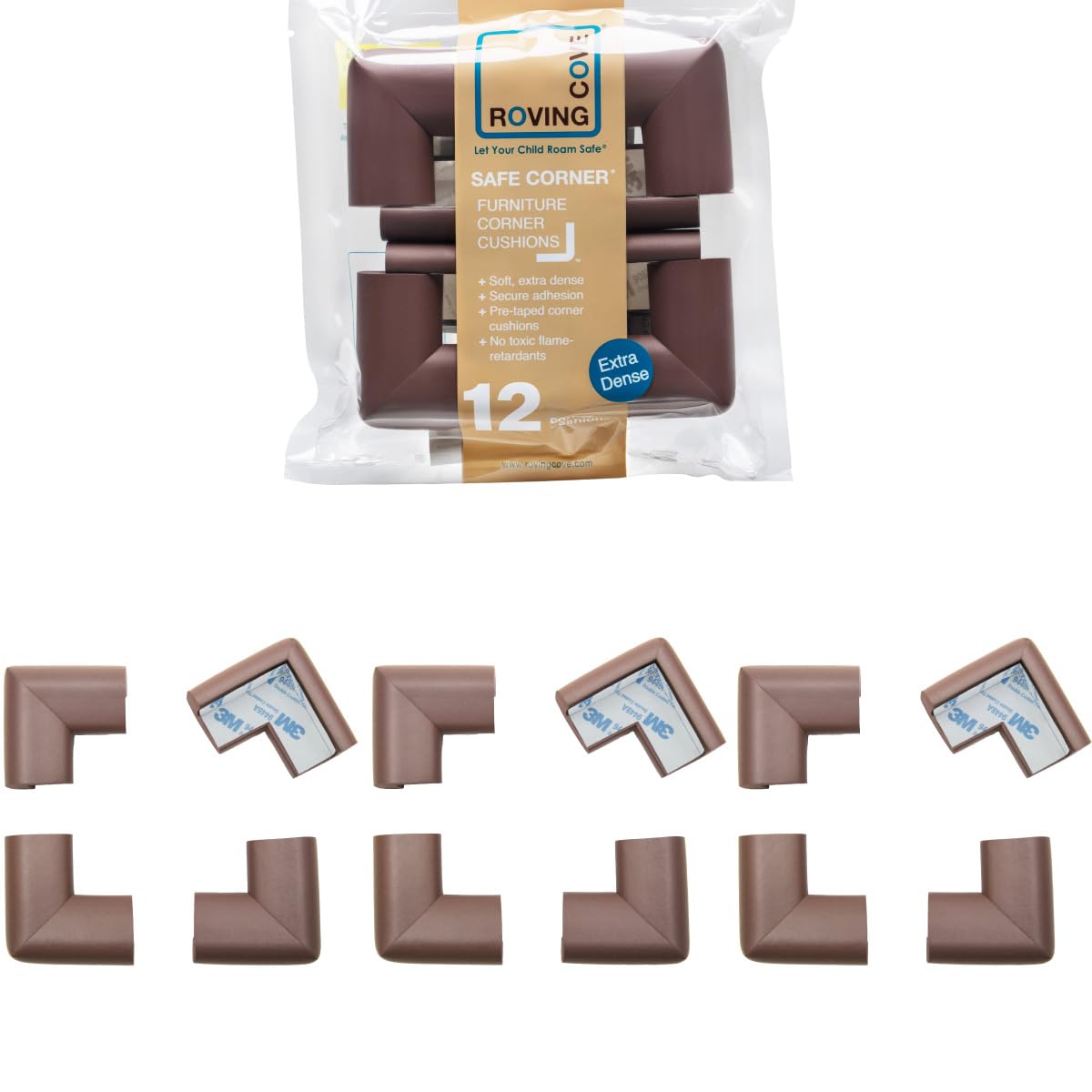
Roving Cove HeftyFit Corner Guards
Key Features
- Count: 12 guards
- Colour: Coffee brown
- Adhesive: Pre-applied 3M tape
- Foam density: Shore A 20-N
- Price: Midrange
A 0.4-inch slab of rubber foam behaves nothing like a hard plastic dome. These are Shore A 20-N, dense enough to resist a knee or a forehead and spring back, where a stiff PVC corner simply transfers the hit to the person who bumped it. The pitch is that density matters more than thickness, and handling both kinds convinces us it is right – a thick soft foam that squashes flat does less than a thinner dense one.
The tape comes pre-applied, 3M 9448A cut to the shape of the guard, and that detail is what decides it for us. Loose adhesive squares are where these things fail: you line them up by hand, one shifts, and the pad ends up a millimeter off the surface, which is exactly where a toddler’s fingers get purchase.
Twelve large L-shapes wrap the point and both faces, so a thick wooden tabletop gets covered rather than capped. Coffee brown is a deliberate choice rather than a compromise, and on oak, walnut, cherry, or dark brown furniture it disappears into the grain in a way a clear dome never quite does.
Where it earns its place in our kit is head height: the coffee table corner that meets a forehead, a bed frame at shin level, a fireplace hearth. Twelve covers about three tables, so this is the pack you buy for the furniture that actually hurts rather than for the whole flat.
Pros
- Dense 20-N foam absorbs a real impact
- Pre-applied 3M tape, no loose adhesive squares
- L-shape wraps both faces of the corner
- Blends into oak, walnut, and dark wood
Cons
- Coffee brown only, so pale furniture is out
The corner guard we fit on wood furniture and anywhere a fall lands: dense foam that cushions an impact instead of just capping the corner.
Best for Mixed Corners
Wappa Baby Corner Protectors
Key Features
- Count: 12 guards
- Colour: Clear
- Shapes: Ball and L-shape
- Material: PVC
- Price: Budget
One box, two shapes: ball-shaped bumpers and L-shaped guards, both in clear PVC. That combination is the reason to pick Wappa over a single-shape pack, because furniture corners are not all the same job. A chunky coffee table corner wants a ball that sits proud and takes a hit from any angle; a thin shelf or dresser edge wants the L, which lies flatter and covers more of the corner’s face. Twelve pieces let you match the guard to the furniture.
The extra-wide L is the one we noticed most: it fits over the edge of a tabletop rather than perching on the point, and on light wood and glass both shapes stay close to invisible. Where this pack is ordinary is the tape. Ours went on easily and a couple worked loose over the following weeks, so press each one firmly, give the tape a day, and check them when you dust. That is a familiar story with corner guards, and it is the reason we keep pressing.
Pros
- Ball and L shapes cover different corners
- Clear PVC suits light wood and glass
- Extra-wide L wraps the tabletop edge
Cons
- Twelve pieces will not cover a whole house
We reach for this box when the furniture is a mix, because two shapes let you fit the guard to the corner rather than the other way round.
Best for Soft, Dark Corners
USfloatwishes Foam Corner Guards
Key Features
- Count: 12 guards
- Colour: Black
- Material: Nitrile foam
- Thickness: 1.24 in
- Price: Midrange
Black corner guards are a narrow, specific buy. If your furniture is black – a metal bed frame, a dark TV stand, an espresso desk – nothing else actually disappears the way these do. The set is nitrile foam rather than hard PVC, cut in an L that measures 2.27 inches across with a deep pocket, so it settles over a range of corner thicknesses instead of perching on the point.
Softness is where these earn their place on our list. A dense PVC dome stops an impact; foam absorbs it and springs back, which matters most at the corners a small head actually meets – a low TV stand, the rail of a bed frame, the edge of a hearth. That give is the point, and it is why we reach for this pack ahead of the hard clear ones on anything below waist height.
Installation is peel-and-press with the tape already on, and the nitrile takes a firm press better than a slick plastic shell does. Twelve guards cover three or four pieces of furniture, which is right for a bedroom and a living room rather than a whole house.
Pros
- Soft foam absorbs rather than blocks
- Black blends with dark metal and wood
- Deep L fits a range of corner sizes
Cons
- Bulky 1.24-inch profile on thin shelves
- Foam can tear where small fingers pick at it
For black furniture and low corners, we fit these: soft nitrile foam that gives under a bump instead of stopping it dead.
Best for Slim Edges
UXU Clear Corner Protectors

Key Features
- Size: 1.29 in across
- Count: 12 protectors
- Shape: Round dome
- Colour: Clear
- Price: Budget
At 1.29 inches across, these are the smallest clear domes in this group, and that is either the whole point or a dealbreaker. On a bookshelf edge, a picture frame, or a desk where a fat bumper would catch your sleeve every time you reach past it, the small footprint is exactly right. Clear PVC against glass and pale wood is close to invisible, and twelve of them cover a lot of awkward little corners.
The tape is ordinary in the way most of this category is ordinary: on a clean, unwaxed surface they hold; on a polished or dusty one they do not. Wipe, press, and leave them a day, and they settle in. Where they disappoint is a thick tabletop, because a dome this size only reaches the point.
Our take is to buy these for low-profile, low-traffic spots and a couple of glass shelves, and to use a bigger dome or an L where a head might land. They are among the cheapest clear packs here, which makes them an easy way to finish the corners a larger guard will not fit.
Pros
- Small footprint suits shelves and desk edges
- Nearly invisible on glass and pale wood
- Budget pack of twelve clear guards
Cons
- Does not wrap the flat faces of a corner
Buy it for slim shelves and desk edges where a bigger dome gets in the way; it covers the point neatly and stays out of sight.
Best for Cheap First Pass
YIIFELL 20-Pack Corner Protectors

Key Features
- Count: 20 protectors
- Colour: Clear
- Shapes: 10 ball, 10 L-shape
- Material: PVC
- Price: Budget
Cover a two-bedroom flat corner by corner and you need somewhere north of twenty guards. This is the cheapest way to get there in a single order, and the box splits into ten ball bumpers and ten L-shapes, so you are not stuck with one design for every piece of furniture.
Where it sits for us is the value pick rather than the best pick. The arithmetic is simple: more corners covered per pack than anything else here, in two shapes, which means you can be generous with the awkward spots – the underside of a desk, the frame of a bed nobody sees, the shelf in a hallway. It suits a rental, a first pass over a new flat, or a family that wants every room done at once and will replace the odd one as it goes.
Pros
- Twenty pieces, the most coverage per pack here
- Two shapes in one box
- Clear enough for light furniture
Cons
- Stiff PVC with very little give
- Adhesive lets go on slick or dusty surfaces
Our budget pick: twenty clear guards in two shapes, enough to cover a flat in one order if you clean each corner first.
Best for Countertop Corners
saicheek T-Shape Corner Protectors

Key Features
- Count: 4 protectors
- Shape: T-shape
- Length: 1.65 in
- Thickness: 3 mm
- Price: Budget
Kitchen counters and desk edges have a problem the round domes make worse: any guard that stands proud gets caught by a cloth, a hip, or a chair back and levered off. This one is a T rather than an L, folding over the front edge and down both sides at 3 mm, so it lies almost flush with the surface it protects.
It is clear silicone, and it trims. A pair of scissors takes it down to the thickness of your countertop in a few seconds, which is how it ends up fitting a one-inch worktop edge as neatly as a thin shelf. Twelve pieces this is not – you get four, so measure the corners that actually bother you before ordering.
Where that is the job, it does it neatly and stays put better than most of the domes here, with the strongest adhesion record in this group. It is a targeted buy for the corners you brush past rather than a whole-house kit, and at three millimeters it is a hard-edge cover, not a cushion for a corner at head height.
Pros
- Wraps three faces of a thin corner
- Low 3 mm profile sits flush
- Trims with scissors to fit the surface
Cons
- Only four pieces per pack
Counters and desk edges are where a T-shape earns its place: thin, flush, and much harder to knock off than a dome.
How We Tested the Corner Protectors
There’s no lab bench for this category, so we built the shortlist the way a parent would. We read the specs that actually matter — foam density, the type of tape backing, how much of the corner each shape covers — and filtered out anything with vague adhesive claims or a per-corner price that crept toward a dollar. We ended up buying 15 sets and installing them across four households over four months, on coffee tables, a TV console, a kitchen island, a fireplace hearth, and one very reachable dresser.
Installation came first, since most of us did it one-handed with a baby on a hip. We cleaned each surface with an alcohol wipe, timed how long a full set took, and noted whether the backing peeled off in one piece or shredded into confetti. Then we waited a day and pulled. Every corner got a hard tug at the one-week mark and again each week after, and we watched for edges that curled up, protectors that slid out of alignment, and tape that gave way when a toddler hung off the table. Softness got its own crude check: a thumb press, plus a knuckle rap on a bare corner versus a covered one, because a bumper that looks plush but feels firm is just a hard edge in a nicer color.
At the end we peeled everything off and looked at what was left behind — sticky residue, lifted paint, foam that tore and stranded adhesive on veneer. That final step settled as much as the four months of use did, and the picks that made the list are the ones that held through daily abuse and still came away clean.
How to Choose Corner Protectors for Babies
The bumper is the easy part – the tape is what you are really shopping for, and the right guard is the one that suits your furniture’s surface and the shape of its corners.
The tape is what you are really buying
Every guard here is a block of foam, silicone, or PVC with adhesive on the back, and when one fails it is almost always the bond rather than the bumper. Pre-applied branded tape saves you the fiddliest step; the separate strips on our top pick take an extra minute but can be positioned one face at a time, which is why they sit flat.
Preparation beats brand names. Wipe the corner with rubbing alcohol and let it dry, skip waxed or oiled wood entirely, press firmly for half a minute, and give the tape a day before you trust it around a climbing baby. Check the guards at head height every few weeks and re-press any that lift at the edge.
Match the shape to the corner
A round dome covers the point of a corner and little else. That is fine on a shelf or on furniture with no overhanging lip, and less fine on a thick butcher-block top where the faces either side of the point are just as hard as the point itself. An L-shape wraps both faces and holds up better on a tabletop that gets leaned on.
The T-shape is the specialist: it folds over a thin edge and down both sides, which suits countertops, desk edges, and shelves, and it can be trimmed with scissors to the thickness of the surface. Buy by shape first, then by count.
Density, not thickness, is what cushions
The thickest guard is not automatically the safest. A soft foam that squashes flat under a knee does less than a thinner, denser foam that resists and springs back – the 20-N foam on our Roving Cove pick is the densest here and the safest bet for corners at head height. Hard PVC domes dull an edge enough to stop a bruise, but they still hurt on a real impact, so use them on corners you brush past rather than the ones a toddler falls into.
Count the corners, then pick a colour
Four per table, four per bed frame, four per shelf unit adds up faster than most people expect. Twelve guards covers roughly three pieces of furniture; twenty or more covers a flat. Buy the bigger pack if you are still discovering corners you missed, because the job you half-finish is the one that matters.
Clear is the safe default because it works on everything from white melamine to glass. Coffee brown and black exist for furniture that matches them, and on dark wood they hide better than clear does – a clear dome on a walnut table catches the light and reads as a plastic lump.
Frequently Asked Questions
When should I start using corner protectors?
Fit them before your baby starts pulling to stand, not after the first bruise. Start with the corners at head height in the room where your baby spends the most time, then work outward to the furniture along the route between the sofa, the toy box, and the kitchen. Cruising comes next, and that is when they start grabbing table edges on the way past.
Can my baby pull them off and choke on them?
Yes – anything taped on can be peeled by determined fingers, especially once the tape has been wiped around a few times. Run the toilet-roll test on each guard: if it slides through a cardboard tube, it is small enough to be a hazard and should come off the furniture. Press-test the fitted guards weekly, and bin the backing strips as you peel.
Will they damage the finish or leave sticky residue?
Usually they lift cleanly, but veneer, paint, and older lacquer are where tape can take a flake of finish with it. Warm the guard with a hair dryer on low for half a minute, peel it slowly back on itself rather than pulling outward, and lift residue with a drop of cooking oil on a cloth. Try one in a hidden spot first.
Final Verdict
For most homes, the CalMyotis 24-pack is the sensible order: clear enough to leave on any furniture, the lowest cost per corner of the packs here, and dense enough that a bump lands on something with give. Clean each corner with alcohol first and it holds.
Change one requirement and the pick changes. If the corners you care about are dark wood, or the ones a head actually meets, Roving Cove’s dense foam does more cushioning work and its pre-applied 3M tape is fuss-free. If the problem corner is a kitchen counter you keep catching a hip on, the saicheek T wraps flush and stays out of the way.
