This post contains affiliate links. We may earn a small commission when you buy through our links — at no extra cost to you.
Play food looks adorable in the box. The real question is whether it survives a toddler who bakes pretend soup, drops the basket on the kitchen floor, and chews the corn. I’ve watched cheap sets lose their paint and their charm within a week, so over the past three months we tested 14 play food sets with kids ages 2 to 6.
What separates a set kids return to from one that gets swept into the toy bin isn’t volume. It’s whether the pieces feel good in small hands, survive being sorted and served, and look cute enough for a teddy bear picnic. The best ones made the grown-ups want to play, too.
Paint quality turned out to be the sleeper issue. A set can have forty pieces and still flop if the tomato looks scuffed and peeling by snack time. We noted how each set handled pretend cooking, basket hauling, and the inevitable floor drop, then watched which pieces stayed in rotation after the novelty wore off. The keepers are below.



Best for Pretend Ice Cream Shop
Melissa & Doug Ice Cream Counter
Key Features
- Pieces: 28
- Material: Wood
- Age Range: 3 to 6 years
- Counter Size: 13.43 x 7.72 x 8.7 in
- Price: Premium
The working scooper is the first thing we hand a child, because it turns a pile of wooden pieces into a shop with a transaction. The scoops sit in the counter’s ports, the toppings have their own wells, and the menu and play bills give a kid a script to follow. We think that completeness is why this set works as the default here: it is not just food, it is a place to put the food and a reason to serve it.
With 28 pieces, there is enough variety for two children to take turns without the set feeling picked over. We like that the wooden scoops, cones, cup, tongs, spoon, and six toppings all support the same scoop-and-serve routine instead of scattering into unrelated accessories. The reusable menu is a small thing that adds a lot, because it gives a shy player a way into the game and gives an older child a reason to read orders aloud.
The wooden counter is the piece that makes it feel substantial, and it doubles as storage, which we appreciate at cleanup time. It is also the reason the set has a footprint: this is a countertop toy, not a basket you can tuck into a cabinet. For a play kitchen or a low table with room to leave it out, that trade-off is worth it; if you need something that disappears into a bin, this is not that set.
Age is the other boundary. The manufacturer recommends 3 to 6 years, and the paper bills and smaller toppings are not for a child who still mouths everything. For a preschooler who wants to run a shop, the scooping action is simple enough to master, while the menu and money leave room for an older sibling to keep playing.
Pros
- Complete shop setup with working scooper and storage
- 28 wooden pieces support two-child play
- Menu and play money add a serving routine
- Sturdy wood construction with a tidy counter
Cons
- Paper play money is less durable than the wood
This is a complete wooden ice cream shop with a working scooper, menu, play money, and counter storage; it suits families who want a set that stays out and invites serving.
Best for Balanced Meal Play
Melissa & Doug Food Groups
Key Features
- Pieces: 21
- Storage: Four wooden crates
- Material: Wood
- Age Range: 2 to 5 years
- Price: Midrange
If the ice cream counter is the dessert-shop set, Food Groups is the grocery run. The 21 pieces cover dairy, produce, grains, and meat and fish, and the four wooden crates give each group a place to land. That makes it the better choice for a play kitchen that needs actual ingredients for soup, sandwiches, and dinner, rather than another single-theme counter.
We like the crates more than we expected to. They turn cleanup into a sorting game, and they make the set easier to put away than a loose pile of wooden food. The pieces are solid wood with simple painted details, and the assortment includes recognizable staples plus a few items that invite naming and counting. For a 2- or 3-year-old, that is a lot of play value in a compact set.
The set is aimed at ages 2 to 5, and the pieces are sized for preschool hands. We noticed that the wood gives the food a satisfying weight, so it stays put on a play stove instead of sliding around like hollow plastic. That also means a dropped piece makes a real clunk, which is worth knowing if your play area is upstairs or over a hard floor.
What we keep coming back to is the way the set supports conversation. A child can sort by group, name the items, or build a meal, and an adult can follow along without turning it into a lesson. It is a good staple for a play kitchen that already has pots and pans but needs something to cook.
Pros
- 21 wooden pieces across five food groups
- Four crates make sorting and storage easy
- Recognizable foods invite naming and counting
- Solid wood feels substantial in hand
Cons
- Paint can chip with heavy play
- Wooden crates can split
We recommend this for a play kitchen that needs a broad supply of wooden ingredients, especially if you want sorting and storage built into the set.
Best for Toddler Color Sorting
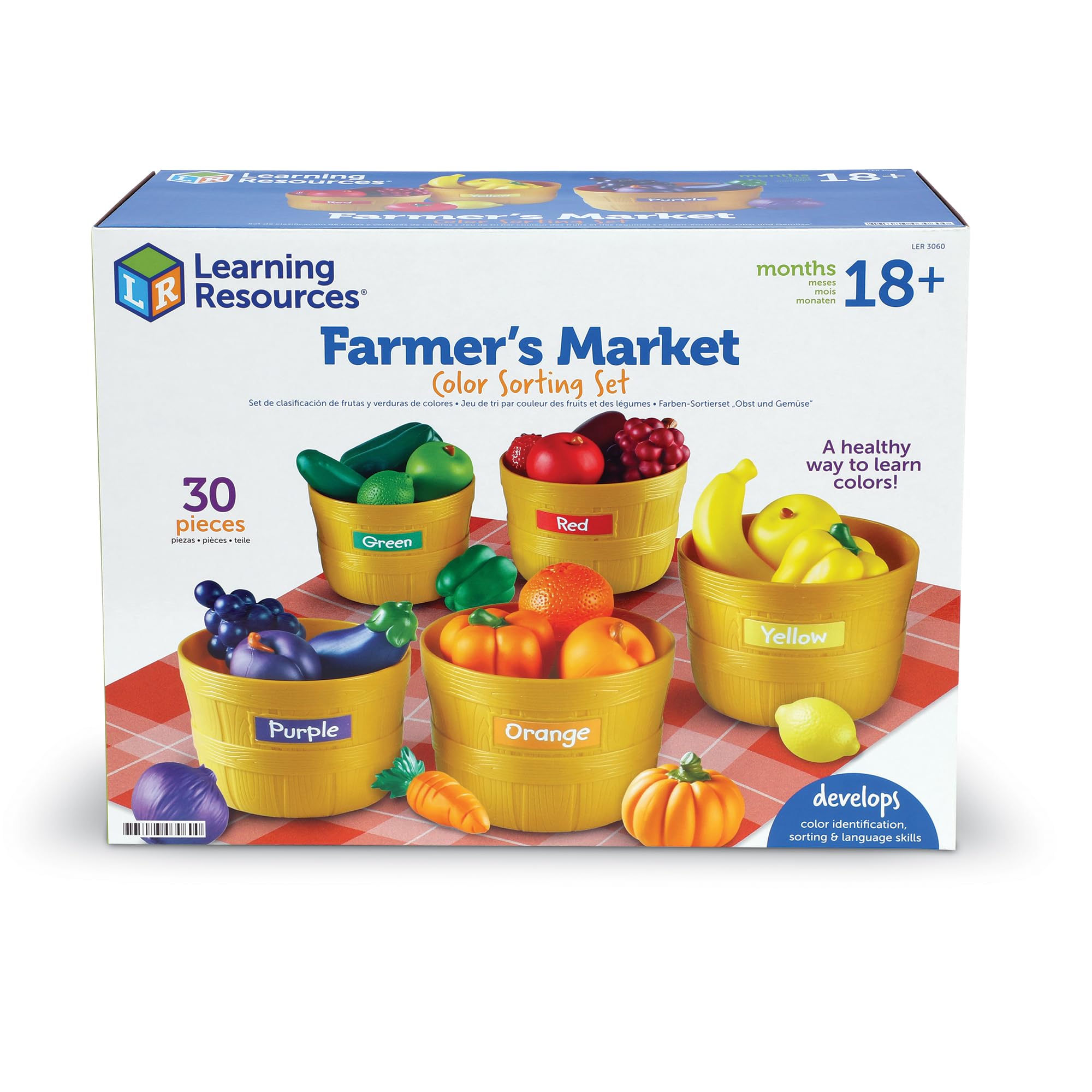
Learning Resources Farmer’s Market Set
Key Features
- Baskets: 5
- Material: Plastic
- Age Range: 18 months to 10 years
- Play Food Pieces: 25
- Price: Midrange
The 18-month age floor is what makes this set stand apart in this group. Most play food is aimed at 3-year-olds, but the Farmer’s Market set is built for a toddler who is still learning to name a banana and sort by color. The five baskets and 25 play-food pieces turn that early learning into a game with a clear finish line.
We think the sorting is the real draw. Each basket is a color, and the fruits and vegetables are grouped so a child can fill, dump, and refill without needing to read. The included activity guide and stickers give an adult a few starting points, but the set works without them. For a 2-year-old, that is the difference between a toy that gets played with and one that gets admired once.
The pieces are plastic with a soft, slightly rubbery feel, which makes them comfortable for small hands and easy to wipe down. The size is mostly right for toddlers, and the baskets are big enough to fill and dump without frustration. This is not the set for a child who wants to slice and serve, but it is the one we recommend for the earliest play-food stage.
What we appreciate most is how long it can stay in rotation. A young toddler can sort and dump; a preschooler can name, count, and play store. That range is why it earns a place beside a play kitchen even though it does not try to be a full meal set.
Pros
- Color sorting built into five baskets
- 25 play-food pieces sized for toddler hands
- Soft plastic is easy to wipe clean
- Activity guide gives adults starting points
Cons
- A few berries are small for mouthing toddlers
This is our pick for a toddler’s first play-food set, because the color baskets turn naming, sorting, and filling into a game.
Best for Cutting Practice
Battat Farmers Market Produce Basket
Key Features
- Pieces: 37
- Material: Plastic
- Age Range: 2 years and up
- Cutting Tools: 2 knives and 2 boards
- Price: Budget
The hook-and-loop center of each fruit is the reason this basket works. The knife slides through, the halves come apart, and they go back together for another round. That immediate cause and effect is what makes the Battat set so good for a toddler who wants to copy an older sibling at the play kitchen.
With 37 pieces, the set includes 16 fruits and vegetables in two halves, plus two cutting boards and two knives. We like that there are two of each tool, because it lets two children cut side by side without a negotiation. The basket is big enough to carry the whole set to the table, and the plastic wipes clean after play.
The cutting action is the main event, and it is easy enough for a 2-year-old to manage but still satisfying for a 4-year-old. We noticed that the pieces are not trying to be realistic in texture; they are bright, lightweight, and clearly toys, which suits a set that will be dropped and stepped on. The plastic is also easy to rinse, which matters for a toy that gets handled before snack time.
What we appreciate most is the way it lowers the barrier to pretend cooking. A child does not need to know how to slice a real cucumber to feel capable here; the knife does the work, and the basket gives the play a beginning and an end. It is the set we reach for when a younger child wants to join an older sibling’s kitchen game.
Pros
- 37 pieces include 16 sliceable fruits and vegetables
- Two knives and two boards let kids cut together
- Hook-and-loop halves are easy for toddlers to reset
- Basket makes cleanup and travel simple
Cons
- Hook-and-loop fasteners can pull loose over time
Choose this if your child wants to chop; it is the set we recommend for toddlers ready for a first cutting basket with tools for two kids.
How We Tested Play Food Sets
We started by scanning the play-food aisle and online listings for sets with a clear age range, enough pieces to support pretend cooking or shopping, and storage that made sense for a playroom. We ruled out anything with vague safety language or pieces too small for the under-3 crowd, then narrowed the shortlist to wooden crates, plastic produce baskets, and sorting sets that could double as pretend market inventory. The final 14 sets went home with families for three months.
Testing happened where the toys actually live: on the play kitchen counter before school, on the living room rug during playdates, and at a makeshift farmer’s market on the coffee table. We watched kids ages 2 to 6 load baskets, serve pretend meals, sort produce by color, and pack everything away. We noted which pieces were grabbed first, which sets sparked repeat play, and whether the colors and shapes were cute enough to leave out on display.
For quality and durability, we checked seams, hinges, and edges for splinters or rough plastic, then dropped loaded baskets from counter height and stepped on stray pieces in bare feet. We wiped each piece with a damp cloth and a dab of dish soap to see how the finish held up, paying special attention to paint at the corners and edges. We also watched for chipping, fading, or sticky residue after repeated loading and unloading.
At the end, we asked each family which set they loved enough to keep in the toy rotation and which pieces had lost their charm. The sets that earned the most repeat visits—and showed the least paint damage—made our list.
How to Choose Play Food Sets
The best play food set is the one that matches how your child already plays, not the one with the highest piece count.
Start with the play pattern
A set built around scooping, slicing, sorting, or serving will get more use than a general assortment that does not fit your child’s favorite routine. If your child likes to run a shop, a counter-style set gives the play a stage and a reason to interact. If they like to chop, a cutting basket puts the action front and center. A broad ingredient set is the better anchor for a play kitchen because it can become soup, sandwiches, or a grocery run. Choose the action first, then the theme.
Material and wear
Wood feels substantial and holds up to drops, but painted surfaces can chip and wooden crates can split. Plastic is easier to wipe and often cheaper, though hook-and-loop fasteners and stickers are the parts that wear first. Cardboard grocery accessories are the least forgiving around water and rough handling. We prioritize a sturdy core over a perfect finish: a few scuffs matter less than pieces that still fit together and can be stored without a fight.
Age, size, and small parts
The manufacturer’s age range is the first filter, especially for a child who still mouths toys. A set rated from 18 months can still include a few small pieces worth setting aside, and a 3+ set with paper money or tiny toppings is not a toddler toy. Check the smallest piece, not the average piece. If the set is for a mixed-age household, choose one large-piece set for the youngest child and keep the smaller accessories for supervised play with an older sibling.
Storage and footprint
Counter-style sets are wonderful for immersive play and terrible for small spaces. They need a low table or a dedicated shelf where the pieces can stay out, because packing them away every night defeats the purpose. Basket and crate sets are easier to move and store, and they teach cleanup as part of the play. Measure the spot before you buy a counter; a set that fits the play kitchen but not the room will end up in a closet.
How many pieces do you need?
Enough for two children to play without a fight is a better target than the biggest set on the shelf. A set in the low twenties gives a preschooler variety without turning cleanup into a hunt, while a larger cutting basket makes sense when the cutting action is the whole point. More pieces help only if they support the same play pattern; a pile of unrelated accessories usually ends up scattered. Buy for the game your child plays, not the piece count.
Frequently Asked Questions
Do you need a play kitchen to use play food sets?
No. A play kitchen gives the food a home, but most sets work fine on a low table, a tray, or the floor. The broad ingredient sets and the Battat cutting basket are easy to move; a counter-style set like the ice cream shop needs a spot where it can stay out. If you do not have a play kitchen, start with a basket or crate set and add a counter only when you have the space.
How do you clean play food sets?
Wooden pieces should be wiped with a damp cloth and dried right away; do not soak them or put them in the dishwasher. Plastic play food can be washed in the sink with mild soap, and cardboard grocery boxes should be spot-cleaned and kept away from standing water. Check hook-and-loop fasteners for lint and hair, since that is what usually stops the pieces from holding together.
Are play food sets worth it if we already have a play kitchen?
Yes, if your play kitchen has pots, pans, and dishes but very little to cook. The kitchen is the stage; the food is the script. Start with one broad ingredient set for everyday meals and one specialty set for a favorite routine, such as ice cream or pizza. That gives more play value than adding another appliance, and it keeps the food from becoming the same three pieces every time.
Final Verdict
For most families, the Melissa & Doug Ice Cream Counter is the set we recommend. It gives pretend play a complete shop, a working scooper, a menu, play money, and a counter that holds the pieces, so the fun has somewhere to go when the game is over. If your play kitchen needs ingredients rather than a dessert counter, choose Food Groups instead; it covers everyday meals with less footprint and a broader food mix.
