This post contains affiliate links. We may earn a small commission when you buy through our links — at no extra cost to you.
Kids walkie talkies live in an awkward gap: the cheap ones feel like toys that quit after a weekend, and the serious handhelds come with channels, menus, and buttons that need an adult. What you want is something a seven-year-old can switch on and hand to a friend, that survives a drop on the driveway, and that still reaches the back fence. I’ve watched my own kids negotiate whose turn it is across a yard, and the sets that get played with all summer share two things: buttons that make sense immediately and batteries that outlast the novelty.
We’ve spent four months with 14 sets — some bought, some sent by brands — through backyard tag, walks around the block, and a damp camping weekend, and the pattern was obvious early. One thing first-time buyers should know: the range printed on the box assumes open air and clear line of sight, so the big number nets you a few hundred feet once trees and walls get involved. Below are the ones worth handing to a kid, whether they’re five or eleven.


Best for Most Families
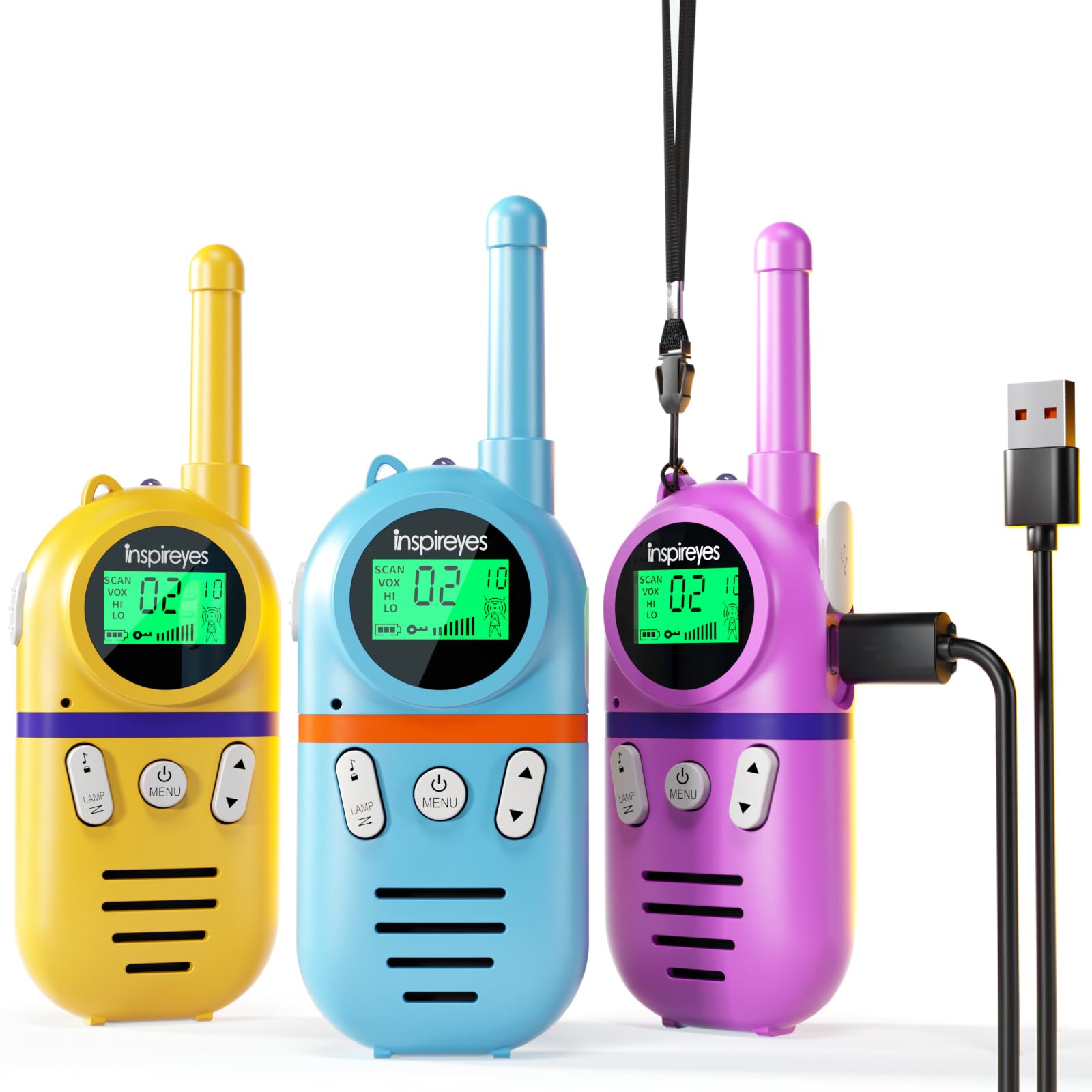
Inspireyes Rechargeable 3-Pack
Key Features
- Battery: Built-in rechargeable, 48-hour claim
- Channels: 8
- Radios included: 3
- Range (claimed): 3 km
- Price: Midrange
Batteries are the part of this category nobody warns you about. Each radio usually wants three or four cells, kids leave them switched on, and a set that is flat by Sunday gets buried in a drawer. The Inspireyes three-pack sidesteps the whole cycle: all three handsets have a built-in rechargeable battery, so there is no drawer of AA cells to keep stocked and no mid-week run to the store. The rated 48 hours per charge is optimistic for a household that never turns them off, but a recharge costs nothing, and that changes how often the toy comes back out.
Three radios is the other half of the argument. Two kids and one adult is the number most families settle on, and a spare handset means a parent can be on the channel while the kids are in the yard. The key lock is the detail we care about most: it freezes the buttons so a five-year-old cannot drift onto another channel and lose contact, which is the most common way a working set stops being fun. Hands-free VOX, a backlit screen, and a small flashlight round out the package.
Eight channels is a shorter list than the 22 offered by the Retevis and WisHouse sets, though on a quiet street or in a backyard it makes no practical difference. At 83 grams and about six inches tall, the handsets are light enough for a four-year-old to carry by the lanyard all afternoon, and the plastic has handled the ordinary drops and knocks of play. It is not the toughest body here — the Aikmi pair is the one rated for dust and water — but that is the trade for a radio this light.
The running cost is what we keep coming back to. A set that needs fresh cells every couple of weeks turns into a chore, and chores get left in a drawer. Hand two kids this set and there is nothing to remember except putting it back on the cable.
Pros
- Three handsets, so a parent gets one
- Rechargeable battery ends the AA cycle
- Key lock prevents accidental channel changes
- 83-gram body suits small hands
Cons
- Sealed battery cannot be replaced later
We recommend this set to most families: three rechargeable radios, a key lock that keeps the kids on one channel, and no battery bill.
Best for Tight Budgets
Retevis RT628
Key Features
- Channels: 22, plus 121 privacy codes
- Batteries: 6 AA (not included)
- Radios included: 2
- Range (claimed): 1 km
- Price: Budget
Twenty-two channels, a key lock, and a two-year warranty for less money than almost anything else here — the RT628 is the pair we point to when the budget is the deciding factor. It also has the longest track record in this group, and the volume runs from a whisper to genuinely loud across eight levels, which matters more than it sounds when a kid is calling from the bottom of a garden.
Those channels come with 121 privacy codes, so two radios can sit on the same channel with a sub-code and mostly tune out everyone else on the street. That is the feature separating a radio from a toy: at a campground or a busy park, the single-channel sets here pick up whatever else is nearby. We also appreciate that the keypad locks, because the channel button is exactly what a curious six-year-old finds first.
The costs are batteries and the antenna. Three AA cells per handset is the running expense — a pair left switched on will go through them, so budget for rechargeables or a bulk pack. The antenna is fixed, and it is the part that suffers when a radio gets swung around by it, so these suit kids who clip them to a belt.
Pros
- 22 channels with 121 privacy codes
- Key lock and hands-free VOX
- Two-year warranty on the radio body
- 3.5-ounce body is easy to carry
Cons
- Fixed antenna is the fragile point
We reach for this pair on a tight budget: 22 channels, a key lock, and a two-year warranty, as long as you keep AA cells in the drawer.
Best for Big Yards
WisHouse M8 3-Pack
Key Features
- Channels: 22
- Batteries: 9 AA rechargeable (included)
- Radios included: 3
- Range (claimed): 5 miles
- Price: Premium
Five miles is the number on the box, and the number that matters is the half-mile between your kitchen and the far end of the block. The WisHouse M8 makes the same claim as plenty of sets here, but it is the version we take camping: 22 channels, a real flashlight, and — the part that decides it — three rechargeable AA cells per radio that you can swap out rather than a sealed pack.
A sealed battery is convenient until it ages, and then the whole radio is finished. These run on 3000 mAh AA rechargeables with a two-headed USB cable in the box, so a tired cell is a swap rather than a replacement radio. Belt clips and lanyards come with it, and the squelch adjusts, which cuts the hiss when two kids are standing next to each other.
Check all three take a charge on day one: a handset that will not is the fault to catch before a return window closes. Otherwise the trade is simple. In a yard, the Inspireyes set does the same job for less money; on a campsite, with a flashlight and a spare cell in your pocket, this is the one that goes in the bag.
Pros
- Replaceable 3000 mAh rechargeable cells
- 22 channels with adjustable squelch
- Flashlight, lanyards, and belt clips included
- Charging cable handles two radios at once
Cons
- Heaviest handsets in this guide
- Priciest three-radio set here
For big yards and camping trips we take the WisHouse three-pack: 22 channels, replaceable rechargeable cells, and a flashlight that actually gets used.
Best for Character Fans
eKids Spiderman 2-Pack
Key Features
- Channels: 1
- Batteries: 4 AAA (not included)
- Radios included: 2
- Range (claimed): 750 feet
- Price: Budget
There is one channel, a 750-foot range, and a Spider-Man face on the front, and the order of those three tells you what this set is for. A three-year-old who wants to be Spidey does not need 22 channels; they need a big push-to-talk button that works when they press it, in a body that fits their hand. At just under six inches tall and a couple of inches wide, this is the easiest handset here for a preschooler to hold unaided.
Simplicity is the point. One button, no channel to lose, and an on/off switch a six-year-old can work without help — that is a better first radio than a 22-channel set a small child will spend ten minutes fiddling with. Four AAA cells also mean a flat battery is a two-minute fix instead of an evening on a charger.
Past the length of a house, it runs out of radio. Test both handsets before the birthday, since a unit that powers on but will not transmit is the failure to watch for, and treat this as a yard-and-living-room toy rather than the set that keeps track of a kid at the park.
Pros
- Big push-to-talk button for small hands
- One channel, so nothing to misconfigure
- Character design kids ask for by name
- Four AAA cells, quick to swap
Cons
- Quiet audio that breaks up with distance
- One channel picks up nearby toy radios
We send Spidey-obsessed preschoolers here: the simplest controls of the bunch, as long as the toy matters more than the audio.
Best for Preschoolers
JKGIFTS Unicorn 2-Pack
Key Features
- Channels: 1
- Age range: 3 to 6 years
- Radios included: 2
- Range (claimed): 1,000 feet
- Price: Budget
At 4.4 inches tall, these are the smallest handsets here, and that is the whole recommendation: a three- or four-year-old can wrap a hand around one, and the two hanging ropes mean it swings from a wrist instead of being dropped in the street. The unicorn design is aimed squarely at the 3-to-6 crowd, and it lands — this is a set children ask for by name rather than one a parent talks them into.
Operation is a single button held down to talk, and it needs a proper press rather than a tap, which is worth knowing before you hand them over: a small child who taps and lets go will hear nothing and decide the toy is broken. The range claim is 1,000 feet, realistic across a house and a yard, and the plastic is rated for drops of up to five feet — roughly wrist height.
This is a house-and-yard toy, and that is the right scope for the money. For the least outlay in this guide, it gets a very small child talking on a radio without a lesson in radio operation, and if one is lost in the park you replace it without wincing.
Pros
- 4.4-inch body fits a toddler’s grip
- Wrist ropes instead of a belt clip
- One button, no settings to lose
- Least expensive set in this guide
Cons
- Quiet speaker in a noisy yard
- Single channel shared with nearby radios
For a first radio in very small hands, we buy the unicorn pair: tiny, simple, and cheap enough to replace without flinching.
Best for Video Play
YUSSBCU Video 2-Pack
Key Features
- Extras: Camera and color screen
- Battery: 650 mAh rechargeable
- Radios included: 2
- Range (claimed): 400 m outdoors
- Price: Midrange
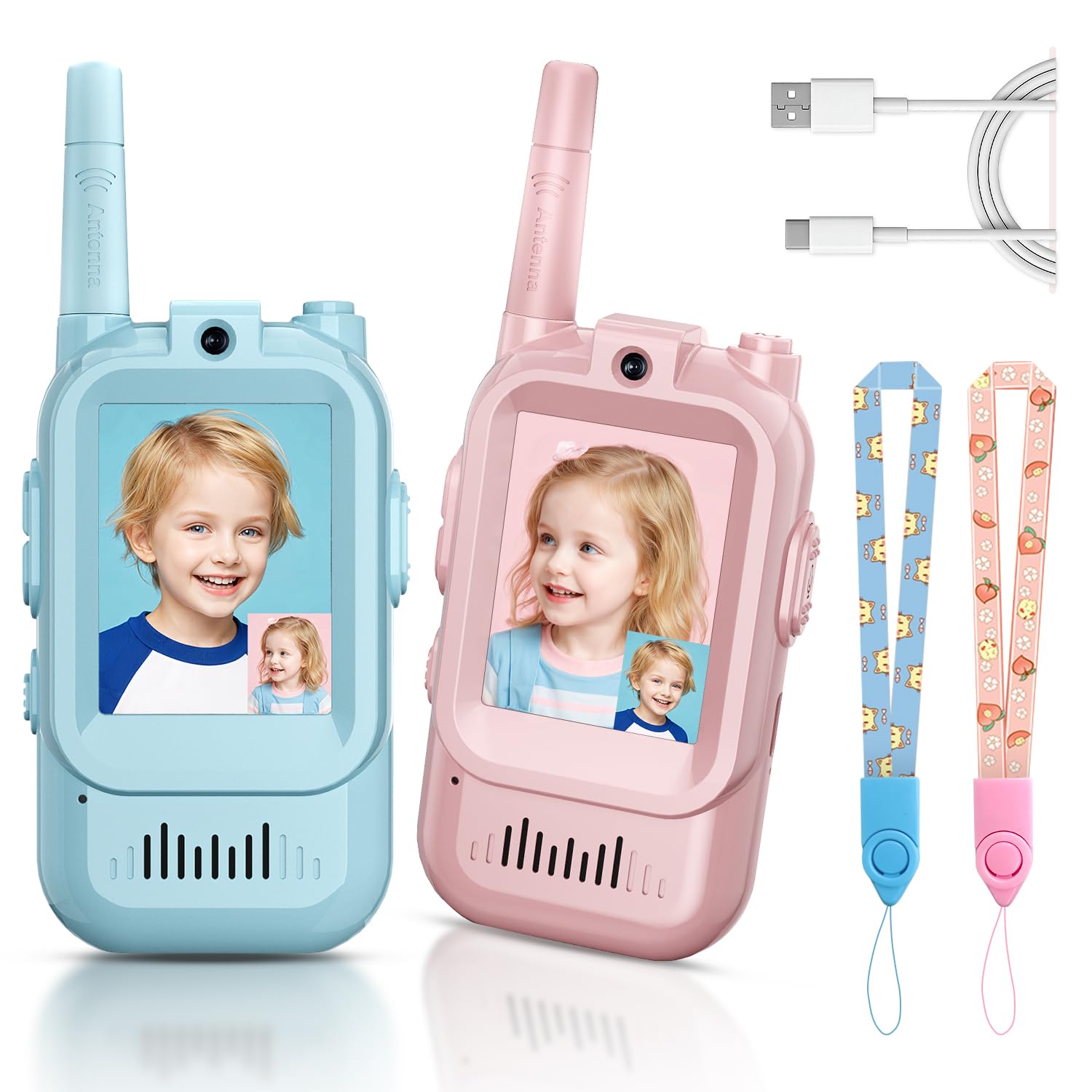
Every other set in this guide is a radio. This one is a video call in a plastic shell: a camera and a color screen on each handset, so kids can see each other while they talk. If your children prefer waving at a screen to pressing a button and waiting, this is the pair that gets used past the first afternoon.
Range is the honest limitation. It is rated for 400 meters outdoors and about 100 indoors, which covers a house, a garden, and a short walk — not the block. That is a shorter leash than any other set here, and it is the thing to weigh against the novelty of seeing your kid’s face.
It also only talks to its own pair. The link is 2.4 GHz rather than a radio channel, so it cannot join whatever the Inspireyes or Retevis sets are using, and there is no adding a third handset. What you get instead is a genuinely fun toy: four voice-change modes, a screen with a few display tricks, and a push-to-talk button simple enough for a five-year-old.
The case for it is simple. Two siblings who want to see each other will use this more than a plain radio, and that is worth the shorter range. A family trying to keep track of four kids at a campsite should buy the WisHouse four-pack instead.
Pros
- Camera and color screen on each handset
- Rechargeable, with USB cables included
- Voice-change modes add replay value
- Push-to-talk simple enough for a five-year-old
Cons
- About two hours of use per charge
- Toy-grade picture on the screen
We like this pair for siblings who want to see each other: a camera on each handset, a screen, and a toy the other radios here cannot join.
Best for Outdoor Play
Aikmi Camo 2-Pack

Key Features
- Channels: 22
- Batteries: 6 AAA (not included)
- Water rating: IP65
- Radios included: 2
- Price: Midrange
IP65 is the reason to look at this pair. That rating means dust-tight and able to take a spray of water, which is a real advantage for a toy that goes to a creek, a muddy trail, or the bottom of a beach bag.
Underneath the camo it is a conventional 22-channel radio with a three-mile claim, a flashlight, VOX, and a two-year warranty. The channel count puts it alongside the Retevis and WisHouse sets for keeping conversations to themselves, and the camo is the finish kids in this age group actually ask for.
It runs small — five inches tall and two wide — which suits a seven-year-old and can disappoint an adult expecting a fistful of radio. Buy it for a kid who wants a pocket-sized handset rather than one who wants something substantial to swing around.
It is the set we take on a hike and leave at home for a car journey, where the Retevis pair does the same job for less. Outdoors, with mud and a stream in the picture, the rating earns its keep.
Pros
- Rated IP65 for dust and splashes
- 22 channels plus flashlight and VOX
- Two-year manufacturer warranty
- Camo finish kids actually want
Cons
- Six AAA cells not included
We keep this pair for outdoor families: dust- and water-rated, 22 channels, and a camo finish kids ask for by name.
Best for Four Kids
WisHouse M8 4-Pack

Key Features
- Channels: 22
- Batteries: Not included
- Radios included: 4
- Range (claimed): 5 miles
- Price: Premium
Four handsets is the reason this set exists. If you have three kids, or two plus the neighbor’s, a four-pack settles the question of who is left out before it starts.
The radios are the same M8 design as the three-pack above: 22 channels, a five-mile claim that shrinks to a few blocks in a subdivision, a flashlight, VOX, and lanyards and belt clips in the box. Kids who have used one of these pick up the controls in a couple of minutes.
Where it loses to its own stablemate is the power. The three-pack ships with rechargeable cells and a charging cable; this one arrives empty, so the cheaper-looking four-pack is really the more expensive way to buy the same radio once you have added batteries and a charger.
Buy it if the count is what you need and you already own a charger and a drawer of rechargeables. Otherwise the three-pack with cells included is the better-equipped version of the same radio for about the same money.
Pros
- Four handsets in one box
- Same 22-channel M8 radio as the three-pack
- Flashlight, lanyard, and belt clip included
Cons
- No batteries or charger in the box
We point four-kid households here: the same 22-channel M8 radio as our long-range pick, in a pack that ends the argument over who gets one.
How We Tested Kids Walkie Talkies
We started by pulling every set marketed to kids rather than to hobbyists, then narrowed by what decides whether one actually gets played with: size for small hands, a battery door that doesn’t need a screwdriver, no menu diving, and a price that doesn’t feel reckless for something headed into a sandbox. That left 14 sets, which we ran for four months with a rotating crew of kids between four and eleven.
Testing happened where the radios actually live: backyard tag, hide-and-seek through a two-story house where floors and walls eat the signal, walks around the block, a park full of trees, and one wet camping weekend. We measured range by leaving one kid at a base point and walking away with the other unit, counting paces until the voice dissolved into static — once across open field, once through the house, once through trees. Battery life got timed two ways: continuous hours on rechargeables, and how many days fresh AAs lasted when a set was left switched on by accident.
Every set was dropped on concrete, stuffed in a backpack, and left in the sun on a driveway, because that’s a normal Tuesday for a seven-year-old; we noted cracked cases, popped battery covers, and units that switched themselves off mid-sentence. Kids were handed each one cold, with no instructions, to see how fast they found the talk button and worked out press-and-hold. We also listened — hiss at distance, voices turning robotic past the end of the yard, volume loud enough outdoors without shrieking up close — and judged the extras on whether kids came back to the voice changers and call tones after the first afternoon. At the end, we set each set’s features against what it cost.
How to Choose Kids Walkie Talkies
The decision that shapes everything else is how the radios are powered, because a set that is always flat is a set nobody plays with.
Rechargeable, replaceable, or disposable
A kids’ walkie talkie burns through three or four cells at a time, and children almost never remember to switch one off. That makes the power design the biggest single difference between a toy that gets used and one that lives in a drawer. A built-in lithium pack is the most convenient version: no battery purchases, no drawer of spares. It is also sealed, so when the pack stops holding a charge, the radio goes with it.
Loose rechargeable AA cells cost more upfront and can be swapped when they tire, which is the version that lasts a childhood. Disposables are the cheapest way in and the most expensive way to keep running. Whatever you choose, check what is in the box: several sets here ship with no cells and no charger, and a four-pack without batteries is not the bargain it looks like.
Channels, codes, and crosstalk
A single-channel character set shares its one frequency with every other single-channel toy within earshot, so a seven-year-old can end up listening to a stranger. The 22-channel sets pair that with dozens of privacy codes, which lets two radios sit on the same channel and code and mostly tune out the rest of the street.
More channels create their own problem: a child who presses the wrong button lands on channel 14 and has lost the group. That is why a key lock matters more than the channel count. Campgrounds and busy parks call for both; a backyard does not.
What the range figure is really telling you
Every range number here is a best case, measured over open ground with nothing in the way. Walls, trees, a hill, a car body, and a house full of appliances all shave it down. A set rated at three miles is realistically a few blocks in a subdivision, and a five-mile claim shrinks further than that.
Read the figure as a category rather than a promise. Anything around 1,000 feet covers a house and a yard, and the multi-mile numbers are for camping and hiking. If the plan is a parent at home and a child two streets away, no set at this price does that reliably.
Hand size, straps, and the one button worth checking
Handsets run from about 4.4 inches to just over six, and weight follows. A four-year-old does better with the short ones; a nine-year-old finds a five-inch radio fiddly. A lanyard or wrist rope keeps a set off the pavement, and a belt clip suits a kid on a bike.
Then check the buttons. Push-to-talk should be big enough to find with a thumb, the volume should go low enough for indoor play, and a keypad lock should be there or the channel changes within the hour. Flashlights, voice changers, and call tones are fun rather than functional.
Frequently Asked Questions
Can two different brands of kids walkie talkies talk to each other?
Usually yes, if both are 22-channel radios of the type covered here. Set them to the same channel and the same privacy code and the Retevis, WisHouse, Inspireyes, and Aikmi sets will all hear one another.
The exceptions are the single-channel character sets, which are built to pair only with each other, and the 2.4 GHz video pair, which is not on a radio channel at all. Match channel and code before you hand them out, not after.
How many walkie talkies do we actually need?
One per child, plus one for an adult. Two kids with a pair can only talk to each other, which works until a parent wants to call them in for dinner.
That is why three-packs suit a two-child household, and why a four-pack beats buying a second pair later: everyone stays on the same 22 channels instead of juggling two sets that cannot hear each other.
What age is old enough for a walkie talkie?
Most sets here are labeled 3 and up, but the practical marker is whether a child can hold a button down while speaking and then let go to listen. That usually arrives somewhere around three and a half to four.
Below that, check how the battery door fastens, keep the lanyards out of reach, and expect the radio to be carried rather than used.
Can I use kids walkie talkies as a baby monitor?
No. These are push-to-talk radios: the microphone is shut until somebody presses the button, so you get silence rather than a room.
VOX mode opens the mic on sound, but it is voice-triggered, it sits on a shared channel, and it will not reliably wake you. A monitor stays open and private; these are for play, not supervision.
Final Verdict
Start with the Inspireyes three-pack unless something specific pushes you elsewhere. Three handsets cover two kids and a parent, the built-in rechargeable battery removes the category’s biggest ongoing annoyance, and the key lock keeps everybody on the same channel.
If the budget is the whole conversation, the Retevis RT628 gives you 22 channels, a key lock, and a two-year warranty for less, provided you keep AA cells in the drawer. For camping and long backyards, take the WisHouse M8 three-pack and its replaceable rechargeable cells.
