This post contains affiliate links. We may earn a small commission when you buy through our links — at no extra cost to you.
Kids’ rackets are sold by length, not age, and that’s where most parents get it wrong: a racket a couple of inches too long tips forward in a small hand, so your kid drags the head through the swing instead of driving it. Have your child hold the racket out at their side — the tip should land around ankle height. Get the length and weight right and you get a kid who swings without thinking about it, which is the whole point.
I’ve spent the past four months handing 12 kids’ rackets to beginners and improvers between five and twelve, on real courts and a lot of driveway half-courts. Length and weight decided whether a kid kept swinging; build quality decided whether the racket made it through the season, and value had less to do with price than I expected. Appearance counts for more than parents realize — a racket a kid is proud of gets carried to practice without an argument. The picks below run the size brackets, from first-timers to juniors nearly ready for adult frames.



Best for First Beginner Racket
HEAD Speed Junior 19
Key Features
- Frame: Aluminum
- Length: 19 in
- Weight: 6 oz
- Head size: 76 sq in
- Price: Midrange
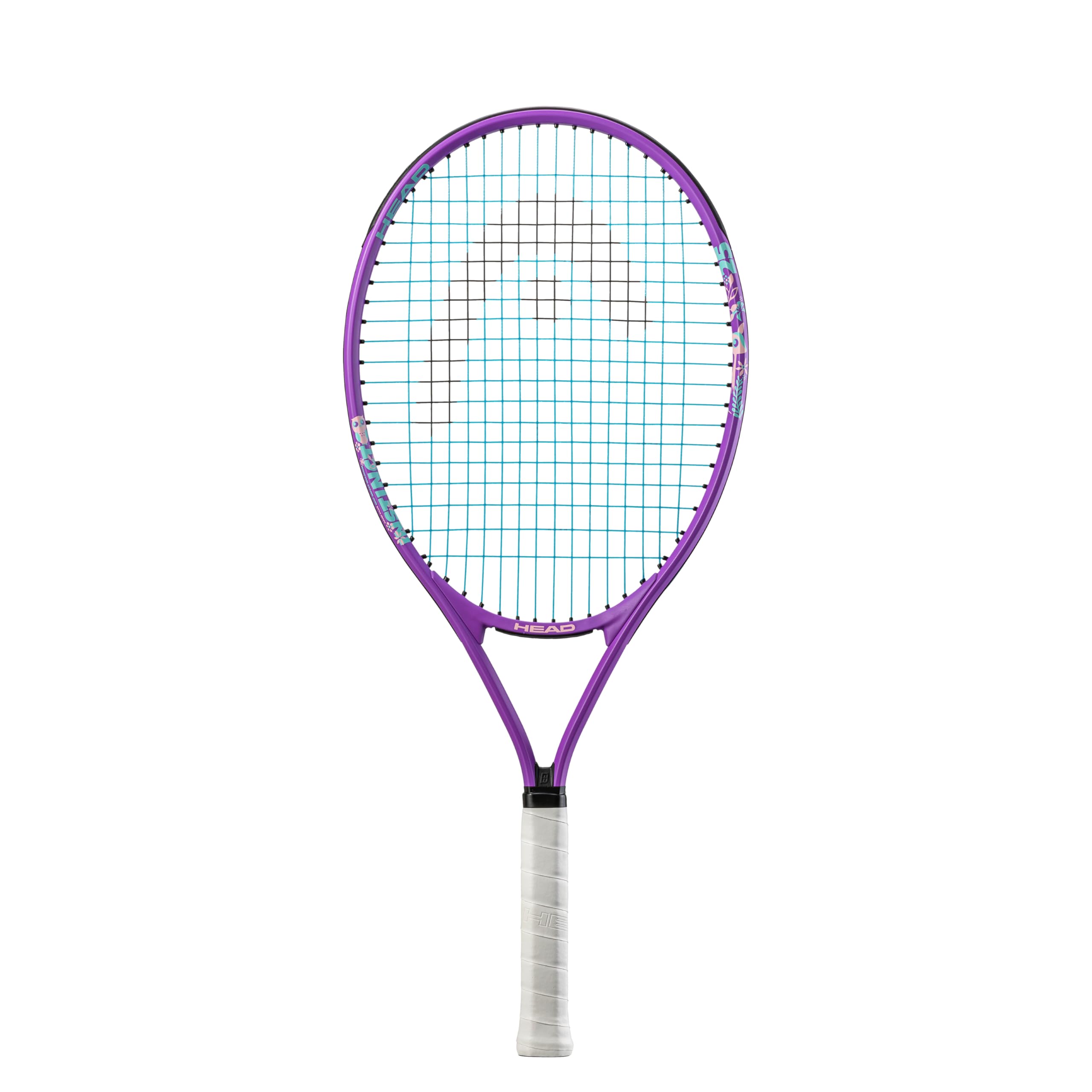
The 19-inch Speed is the junior racket we reach for first when a child is just tall enough for a real frame. At 6 ounces, it does not drag through the swing, and the 76-square-inch head gives a beginner a second chance on off-center contact. That combination is why we make it the top pick: it removes the two things that make first lessons frustrating, a heavy frame and a small sweet spot.
It arrives prestrung, which matters more than it sounds: you can hand it to a child on the first day instead of scheduling a stringing job. The aluminum O-beam frame is the right material for a racket that will be dropped, dragged, and occasionally used as a lightsaber. The 3 5/8-inch grip is small enough for little hands, and the tacky wrap helps when palms get sweaty.
For a four- or five-year-old, the 19-inch length is the point: it lets them set the racket head behind the ball without the tip hitting the court. The 6-ounce weight is what makes that length usable for a full lesson. It is a first racket, and it does that job without fuss.
Pros
- Light 6-ounce frame is easy to swing
- Forgiving 76-square-inch head
- Arrives prestrung and ready to play
- Small 3 5/8-inch grip for little hands
Cons
- 19-inch length leaves little room to grow
We recommend the 19-inch Speed as the first real racket for a preschool beginner: it is light, forgiving, and ready to play without a stringing trip.
Best for Older Kids
HEAD Instinct Junior 25
Key Features
- Length: 25 in
- Weight: 8.5 oz
- Grip size: 3 7/8 in
- Stringing: Prestrung
- Price: Midrange
The Instinct 25 is the racket we hand to a child who has outgrown a 19- or 21-inch frame but is not ready for an adult racket. At 25 inches, it is the last junior size before the adult range, and the 8.5-ounce weight gives a 9- or 10-year-old enough mass to meet the ball without the frame twisting.
We like the head-light balance for that transition. It keeps the swing easy while the longer frame gives more reach, and the factory stringing means it is ready for the first lesson. The 3 7/8-inch grip is sized for older kids; it will feel huge to a five-year-old. The aluminum O-beam construction is the same durable family as the Speed, just in a longer frame.
This is the simplest step-up in our set. The Dunlop Nitro 23 is the better choice for a 7- or 8-year-old, and the PIKASEN 17 is the toddler option. Don’t put a 25-inch frame in a small beginner’s hands just because it has room to grow; the extra length makes it harder to learn timing. For the right-age child, the reach is an advantage, not a stretch.
Pros
- Prestrung and ready for the first lesson
- Head-light balance suits older beginners
- Durable aluminum O-beam frame
- 25-inch length bridges junior and adult
Cons
For a 9- or 10-year-old ready for a longer frame, we recommend the Instinct 25: it is prestrung, head-light, and easier to control than an adult racket.
Best for Budget Beginners
Dunlop Nitro Junior 23
Key Features
- Frame: Aluminum
- Length: 23 in
- Weight: 4.23 oz
- Stringing: Strung
- Price: Budget
The Nitro is the budget pick, but the reason we kept it is not the price. At 23 inches and 120 grams, it is light enough for a 6- to 8-year-old to swing for a full lesson without the racket head dipping, and the aluminum frame is sturdy enough for the learning curve. That combination makes it the best value in this set for a first real racket.
The 23-inch length is the middle junior size, and it fits the child who has moved past a 17- or 19-inch toddler frame but is not ready for a 25-inch one. It arrives strung, so there is no setup step. The frame is plain, but a beginner does not need much more than a light stick and a predictable string bed.
If your child is still in a 17-inch frame, the PIKASEN is the better starting point; if they are already 9, the HEAD Instinct 25 is the right step up. The Nitro sits in the middle, which is exactly where many 6- to 8-year-olds land. For a family buying a first racket and a set of lessons, that balance is the point.
Pros
- Light 120-gram frame
- 23-inch length for ages 6-8
- Prestrung and ready to play
- Budget price leaves room for lessons
Cons
- No cover or balls included
We recommend the Dunlop Nitro 23 as the budget first racket for a 6- to 8-year-old: light, prestrung, and priced to leave room for lessons.
Best for Sibling Starter Set
OPPUM Kids Tennis Racket 2-Pack
Key Features
- Pack: 2 rackets
- Frame: Aluminum
- Length: 23 in
- Set contents: 2 balls and 1 bag
- Price: Premium
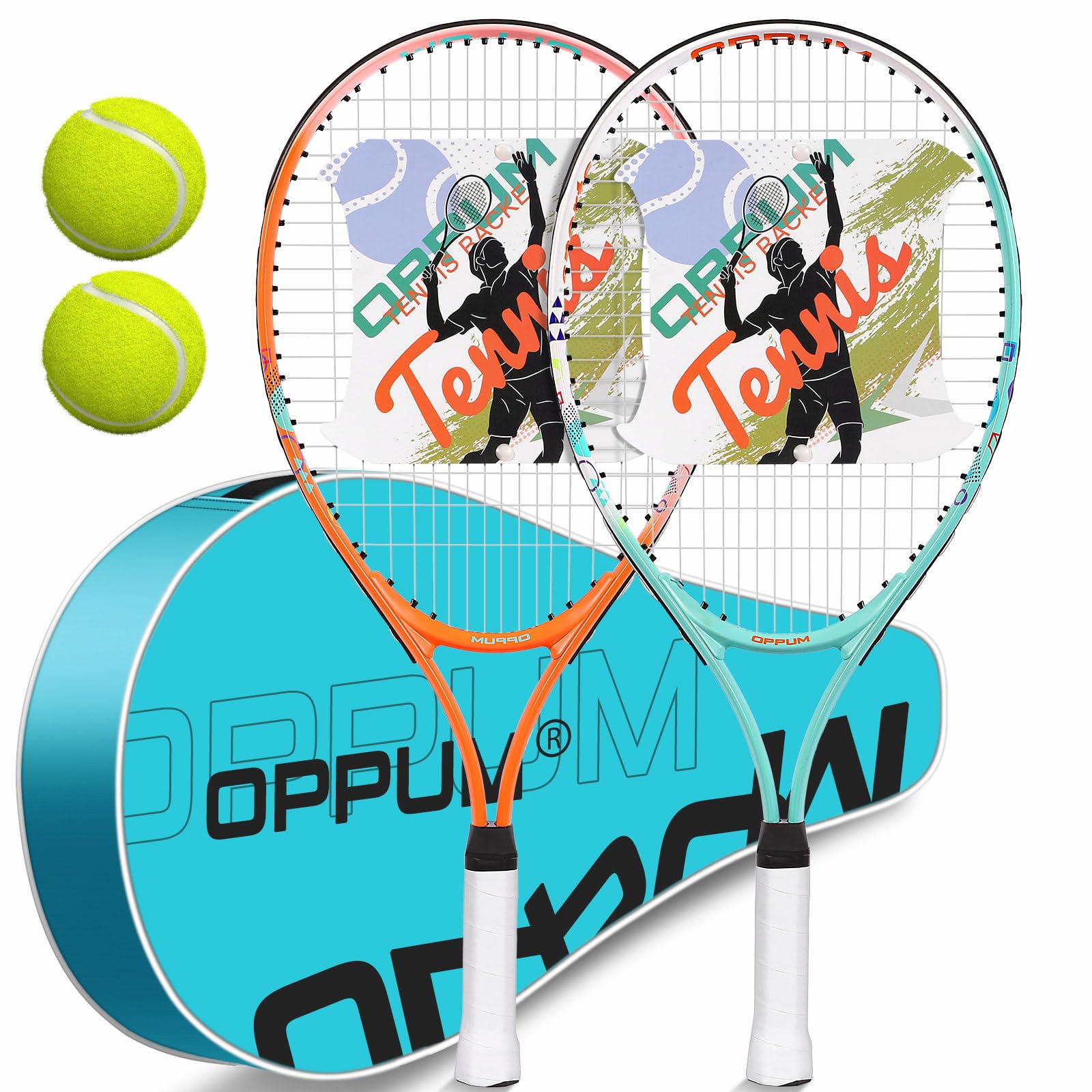
The OPPUM set is the one we point to when two kids want to start at once. You get two 23-inch aluminum rackets, two training balls, and a shoulder bag, which is enough for a pair of siblings or a parent and child to hit without buying two separate setups.
We like the shared bag more than we expected: it keeps both rackets and the balls in one place, so lesson day is one thing to grab instead of three. The 4-inch grip is small enough for kids, and the frames are prestrung. The catch is that both rackets are the same 23-inch length, so this is a poor fit for a 5-year-old and a 9-year-old; they need different sizes. The aluminum and composite frame is a step above the plastic toy sets, and the prestrung setup means no extra errand.
The set is tested to ASTM F963 and CPSIA requirements, which is reassuring for a product aimed at young children. It will not suit a child who is already tall for their age, but for two beginners in the same size range, it is the simplest way to get on court. The shared bag also gives each racket a place to live between lessons, which is more than some single-racket packages offer.
Pros
- Two 23-inch aluminum rackets
- Includes two training balls and bag
- Prestrung and ready for play
- Good value for siblings starting together
Cons
- One shared bag, no individual covers
For siblings close in age, we recommend the OPPUM two-racket set: two 23-inch aluminum frames, two training balls, and one bag for starting together.
Best for Toddlers and Preschoolers
PIKASEN 17-Inch Kids Racket
Key Features
- Frame: Aluminum
- Length: 17 in
- Weight: 5.3 oz
- Head size: 75 sq in
- Price: Midrange
The 75-square-inch head is the most important number on the PIKASEN: on a 17-inch frame, it gives a toddler a much larger margin for contact. At 5.3 ounces, the racket is light enough to swing without the tip scraping the ground, and the aluminum frame is a real racket rather than a plastic toy. That is the difference between a racket a toddler can swing and one they drag behind them.
The grip is 3 3/4 inches, which is appropriately small for little hands, and the nylon-soft strings take some of the sting out of off-center hits. It comes with a three-quarter head cover, not a full bag, so it protects the strings on the way to the park without pretending to be a travel case. The aluminum shaft keeps the frame from feeling whippy when a child makes contact. For a first taste of tennis, that is enough.
We make this the toddler pick because it removes the two common failure points: a head too small to hit and a frame too heavy to swing. The 3 3/4-inch grip and 75-square-inch head are the details that make that work. The frame is prestrung, so there is no setup step before the first park session. For a 3- or 4-year-old, that is the whole job.
Pros
- Large 75-square-inch head for toddlers
- Light 5.3-ounce aluminum frame
- Small 3 3/4-inch grip
- Includes a protective head cover
Cons
- 17-inch size is outgrown quickly
We recommend the PIKASEN 17 as the toddler pick: a 75-square-inch head and 5.3-ounce frame give a 3- or 4-year-old a real chance at contact.
Best for Cute Toddler Starter
AMA SPORT 17-Inch Kids Racket

Key Features
- Frame: Aluminum
- Length: 17 in
- Weight: 5.64 oz
- Includes: Shoulder bag
- Price: Midrange
The AMA Sport is the racket that makes a toddler want to pick it up. The bright cat-and-fish graphics and matching shoulder bag are the first things you notice, and the 17-inch aluminum frame is light enough for a small beginner to swing. It is not a plastic toy, even if it looks like one.
At 0.16 kg, it sits in the same featherweight class as the PIKASEN, and the 17-inch length is right for a 2- to 4-year-old. The grip is on the small side, which suits little hands, and the bag makes it easy to carry to a park or a first lesson. The frame is prestrung, so it is ready when you are. The aluminum shaft is the right choice for a first racket; it takes a knock without the flex of a plastic toy.
We keep the AMA as an also-consider because the bag and graphics are genuinely useful for a reluctant beginner, and the 0.16 kg frame is easy for a small child to manage. The PIKASEN remains the safer default for the smallest kids, but this one has more personality. For a child who is drawn to a particular color or character, that enthusiasm can matter more than a fraction of an ounce.
Pros
- Bright kid-friendly graphics
- Light 0.16 kg aluminum frame
- Includes matching shoulder bag
- Lower-cost toddler starter
Cons
- Inconsistent frame and grip durability
We recommend the AMA Sport 17 for a toddler who needs a little fun: bright graphics, a shoulder bag, and a light aluminum frame at a budget price.
Best for Coached Beginners
Street Tennis Club 17-Inch Racket

Key Features
- Frame: Aluminum
- Length: 17 in
- Weight: 7.04 oz
- Includes: Training videos
- Price: Midrange
The Street Tennis Club racket comes with a set of training videos, which is the most useful extra in this group for a parent who is not a tennis coach. The videos give you a sequence to work through instead of bouncing balls without a plan, and the racket itself is a real aluminum frame rather than a toy.
The 17-inch length is a small-child frame, despite the broad age label on the product. At 7.04 ounces, it is heavier than the PIKASEN, so it suits a 4- to 6-year-old who can handle a little more weight rather than a 2-year-old just starting. The polyester strings are thick and the grip has a soft neoprene feel, which is comfortable for small hands.
The smiley-face graphics are cute without being saccharine, and the racket feels like a normal junior frame in the hand. It is a fun first racket for a kid who likes a bit of personality.
We put it in also-consider rather than the top tier because the PIKASEN is lighter and more forgiving for the smallest kids. But the 7.04-ounce frame has enough substance for a 5- or 6-year-old, and the videos give a parent a place to start. For a family that wants a little coaching help, that is a better fit than a featherweight toddler frame.
Pros
- Training videos included
- Aluminum frame with thick strings
- Soft neoprene grip
- Cute smiley-face design
Cons
- No carry bag included
We recommend the Street Tennis Club 17 for a parent-coach: the included training videos add structure, and the aluminum frame is light enough for a 4- to 6-year-old.
How We Tested Kids’ Tennis Rackets
We started with the size chart, not the shelf. Every racket was checked against its listed length in inches, weight in ounces, grip size, and head size, and anything sold only by age range with no measurements attached got cut. From there we narrowed by price and availability until we had 12 frames spanning the junior sizes, from the smallest first-timer models up to 26-inch rackets for kids on the edge of adult frames.
Testing ran four months, mostly on a driveway with a pulled-together net and at public courts on Saturday mornings. We weighed each frame on a kitchen scale, then had kids hold it out at arm’s length and take a few swings — if the head dropped below the wrist on a forehand, it was too heavy or too long for that kid. We fed 20 underhand balls from close range and counted how many came back over, which sorted beginner-friendly frames from ones that punished a late swing. Kids swapped rackets constantly, and appearance was settled by them, not us: the ones they reached for first were usually the ones they played best with.
Durability got the ugly treatment it deserved. Frames were dropped on concrete, dragged along the ground between points, and stuffed into bags next to water bottles. We watched for cracks at the throat, strings that went dead or snapped within weeks, grip tape that peeled, and butt caps that started to rattle. Value was judged the long way — whether a frame looked likely to survive two seasons of lessons, and whether the grip could be replaced when a kid outgrew it.
How to Choose a Kids Tennis Racket
The right junior racket is the one your child can swing without dragging the head, not the one with the biggest brand name or the longest spec sheet.
Start With Length, Then Grip
Length is the first decision because it changes how the racket feels before your child ever hits a ball. A 17-inch frame is a toddler size; 19 inches is the next step for many 4- and 5-year-olds; 23 inches lands around 6 to 8; 25 inches is the last junior size before an adult frame. Age labels are a rough guide only, so check the child against the frame. Stand the racket upright beside them; the top should land around hip height. If it reaches the armpit, go shorter.
Then check the grip. A child should be able to wrap their fingers around it with a little room, not make a fist around a thick handle. A grip that is too big makes the racket harder to control; one that is too small can twist on contact. The 3 3/4-inch grip on the PIKASEN and the 3 5/8-inch grip on the HEAD Speed are the right kind of scale for small hands.
Weight and Head Size Matter More Than Age Labels
A racket that is too heavy teaches a child to drag the head and swing late. The toddler picks here run from about 5.3 to 7 ounces, while the 25-inch HEAD Instinct is 8.5 ounces; that difference is appropriate because the older child has more arm strength and a longer swing. If your child tires halfway through a lesson or the racket head dips on every swing, go lighter or shorter before you change brands.
Head size is the other forgiveness lever. A 75- or 76-square-inch head on a 17- to 19-inch frame gives a beginner a bigger margin for off-center contact. Bigger is not automatically better: a very large head on a long frame can feel clumsy, and the child still has to swing it. For a first racket, prioritize a light frame and a forgiving head over a fancy frame material.
Aluminum and Prestrung Beat Toy Plastic
A real junior racket has an aluminum frame and a strung bed. Plastic toy sets with molded strings are for backyard play, not for a first lesson; they do not give a child the same feedback or control. The aluminum O-beam frames in this group are the right starting point, and they will survive more than a few drops.
Prestrung matters because a beginner should not have to wait for a stringing appointment. Most of our picks arrive ready to play, but check before you buy; if a frame is unstrung, add a stringing trip to the budget. A head cover or shoulder bag is also worth having, not because it protects the frame from every knock, but because it keeps the strings from catching on car doors and school bags.
Durability Is the Shared Weak Spot
Kids drag frames, drop them, and hit the court on mishits. Grips loosen, strings break, and handles can fail. That does not mean you need the most expensive racket in the set; it means you should inspect the frame, strings, and grip when the racket arrives and teach your child to pick it up by the handle rather than the strings.
A one-year warranty is common on brand-name junior frames, so keep the receipt. The other practical step is to size the racket correctly: a frame that is too long for the child gets dragged more often, which puts more stress on the head and strings. Correct length is a durability feature as much as a comfort feature.
What to Spend
A first junior racket is a short-term purchase, so spend for the right size and weight rather than the longest feature list. A budget aluminum frame is enough for a first season; the Dunlop Nitro is our budget pick, and the HEAD Speed is the midrange default. The HEAD Instinct is the step-up when your child is ready for a 25-inch frame.
Save the premium spend for a later racket, once your child has played enough to know they want to continue and you know their next size. The money you do not spend on a fancy first frame is better put toward lessons, court time, or a bag that actually gets used.
Frequently Asked Questions
Can my child use an adult tennis racket?
No. Adult frames are longer and heavier than a junior racket, and a child who is still learning timing will struggle to control one. A 25-inch junior is the last step before adult sizing. Move up when your child can swing the 25-inch frame freely and their hand fits an adult grip without stretching.
What balls should we use with a first racket?
Start with foam or low-compression balls, not standard adult tennis balls. They travel slower and sit lower, which gives a beginner time to set the racket and make contact. Move to standard balls when your child can rally consistently and the racket no longer twists on contact.
Are two-racket sets a good idea for siblings?
Yes, if both children are close in height and can use the same length. A set like the OPPUM gives you two identical 23-inch frames, so it is a poor fit for a 5-year-old and a 9-year-old who need different sizes. Measure each child before buying, and treat the shared bag as a convenience rather than a reason to compromise on fit.
Final Verdict
For most families, the HEAD Speed Junior 19 is the right first racket: light, forgiving, prestrung, and sized for the preschool beginner. If your child is already 7 or 8, skip it and go to the Dunlop Nitro 23; at 9 or 10, the HEAD Instinct 25 is the easier step-up because it is ready to play.
The PIKASEN is the toddler exception, and the OPPUM set is the sibling value. Start with the size your child can swing today, not the one they might grow into next year.
