This post contains affiliate links. We may earn a small commission when you buy through our links — at no extra cost to you.
A kids’ football should be simple: grab it, kick it, chase it. But buy the wrong one and you get a ball that’s too hard underfoot, too small to kick properly, or flat by the second weekend. Light-up versions add another worry—will the light stay bright, or die before the game does? I’ve watched kids lose interest fast when a ball stings their toes or won’t bounce back after a few kicks. The right one fixes that: it feels good underfoot, holds its shape, and stays in the rotation long after the birthday party—without costing a fortune.
Over three months, my team and I put 14 kids’ footballs through backyard kickabouts, park games, and school playground scrimmages. We pumped them, kicked them, and accidentally sat on a few. The ones that stood out were sized for the kids using them, held their air, and stayed fun after weeks of play. One thing I wish I’d known earlier: check the age range and weight, not just the size number. The picks below are the ones that kept kids coming back.


Best for Backyard, Everyday Play
Franklin Grip-Rite 100 Junior
Key Features
- Ages: 6-8
- Size: Junior, 10 x 6 in
- Cover: Deep-pebbled molded rubber
- Laces: Raised pro-style
- Price: Budget
Ten inches long and six inches across is the whole argument for this ball. That is junior size, and it is the difference between a kid throwing something that spirals and a kid hugging the ball to their chest before heaving it. The deep-pebbled rubber does just as much work: it is the same principle as a basketball’s dimples, giving small fingers something to hold at the moment of release.
Rubber rather than foam is the call we make for most kids past five, and this is the ball that makes the case. The cover is molded in one piece with raised pro-style laces and no stitched seams to split, and neither wet grass nor a gravel driveway does much beyond scuffing it. It is firm, though, firmer than any foam ball in this group, so a catch that arrives wrong will sting a little, and it belongs in the yard rather than the playroom.
It ships deflated, which is normal for a boxed football, and the single ball does not come with a pump since that is a team-pack extra, so have one ready before you hand it over. Beyond that there is nothing to set up, charge, or peel off.
What we keep coming back to is how little this ball asks. No batteries, no light unit to fail, nothing to reorder, and the same ball works for a six-year-old’s first catch and a ten-year-old running routes in the yard. That is why it is the one we hand over first.
Pros
- Junior size fits a six- to nine-year-old’s hands
- Deep-pebbled rubber grips even when wet
- Molded one-piece cover with no seams to split
- Takes gravel, concrete, and rain without damage
Cons
- Air retention varies between balls
The best all-around kids football here: junior size, a deep-pebbled cover that sticks to small hands, and rubber that shrugs off grass, gravel, and rain.
Best for Pool and Beach
Nerf Weather Blitz
Key Features
- Grip: Molded ridges
- Size: 9 in
- Cover: All-weather foam
- Weight: 12.6 oz
- Price: Midrange
A foam football and a swimming pool are usually a bad pair. The ordinary kind soaks up water, gets heavy, and throws like a wet sock for the rest of the afternoon. The Weather Blitz is the one that does not. The covering sheds water, so the ball that comes out of the pool is the same ball that went in, and the same goes for a lake, a sprinkler, or grass still wet at nine in the morning.
Nine inches puts it in junior-size territory, and the molded ridges running down the sides are the detail we appreciate most. They give a kid’s fingers somewhere to sit, which matters more with wet hands than dry ones, and it is the difference between a catch and a fumble in the shallow end. It is softer than the rubber balls here too, which makes it the friendlier ball for a crowded yard or a beach with other people’s kids on it.
What you give up is some of the football feel. It is foam, and it will not throw a tight spiral the way a rubber junior ball will. What it buys you is a ball you can take anywhere, and for families with younger kids that is a trade worth making.
Pros
- All-weather cover will not waterlog
- Molded ridges help small, wet hands
- Softer catch than the rubber balls here
- Nine-inch junior size for younger throwers
Cons
- Heavier than the lightest foam balls here
Our pick for water and wet grass: the all-weather foam cover sheds water instead of soaking it up, and the molded ridges hold a grip when everything is slick.
Best for Long Throws
Nerf Vortex Aero Howler
Key Features
- Size: Medium
- Tail: 3-fin aerodynamic
- Sound: Whistle through air holes
- Weight: 5.64 oz
- Price: Budget
The whistle stops being a gimmick the first time a kid throws this ball. A weak lob barely makes a sound; a good spiral shrieks, so the ball gives feedback on the throw without an adult saying a word. It also means you can hear where it landed in tall grass at dusk, which is more useful than it sounds, since a foam ball the color of a lawn is a ball you find with your feet.
The three fins do the coaching. They straighten the flight out, so a kid who cannot yet get a clean release still ends up with something that looks like a spiral, and the molded grip sits where a hand naturally falls. At just over five ounces it will not tire out a young arm, and it is the ball we take when there is a big open field and nothing to break.
It is a thrower’s ball more than a game ball. A tailed ball bounces and rolls oddly, and running routes with one feels strange, so this is the one for long toss across a field, not for a pretend fourth quarter in the backyard. For that, take the Grip-Rite.
Pros
- Whistles in flight so it is easy to track
- Fins straighten throws from young arms
- Just over five ounces, easy on small arms
- Soft foam works indoors and on the beach
Cons
- The tail is the first thing to tear
- Whistles only on a solid throw
The most fun ball in this group to throw: a three-fin tail that straightens long spirals and a whistle that tells everyone where it is going.
Best for Small Hands, Gifts
Franklin NFL Team Mini 8.5-Inch
Key Features
- Size: 8.5 in
- Cover: Soft Air Tech
- Laces: Spacelace guide system
- Includes: Air pump and needle
- Price: Midrange
The pump in the box is the least glamorous thing about this football and the reason we hand it to someone as a gift. Every ball in this group ships deflated, and this is the only one here that arrives with a way to inflate it, so the ball is playable the moment the paper comes off instead of the day someone remembers to buy a needle.
At eight and a half inches it is a mini, smaller than the junior balls here and sized for hands that are still small. The cover is soft and forgiving, which lets a nervous thrower grip it properly instead of flinching, and the Spacelace lacing is a genuinely clever bit: raised guides steer fingers onto the laces instead of letting them wander across the panels. That is the difference between a kid learning to throw and a kid just pushing a ball.
It beats the other minis for a kid who actually wants to play. Soft covers usually mean a ball that will not fly, but this one has enough shape and weight to get through the air for a seven- or eight-year-old, and the team graphics give a young fan a reason to care. A ball with their team on it gets picked up more often than a plain one, and that is worth more than any line on a spec sheet.
It is also the one ball here that looks like a fan’s ball rather than a toy, with an embossed logo that holds up to being carried to a tailgate and left on a shelf between games.
Pros
- Soft cover builds confidence in young throwers
- Spacelace lacing teaches finger placement
- Pump and needle included in the set
- Officially licensed team graphics
Cons
- Air retention varies between balls
- Laces can lift with hard use
Our pick for a young fan: 8.5 inches for small hands, a soft cover, laces that guide little fingers, and a pump in the box.
Best for Night Games
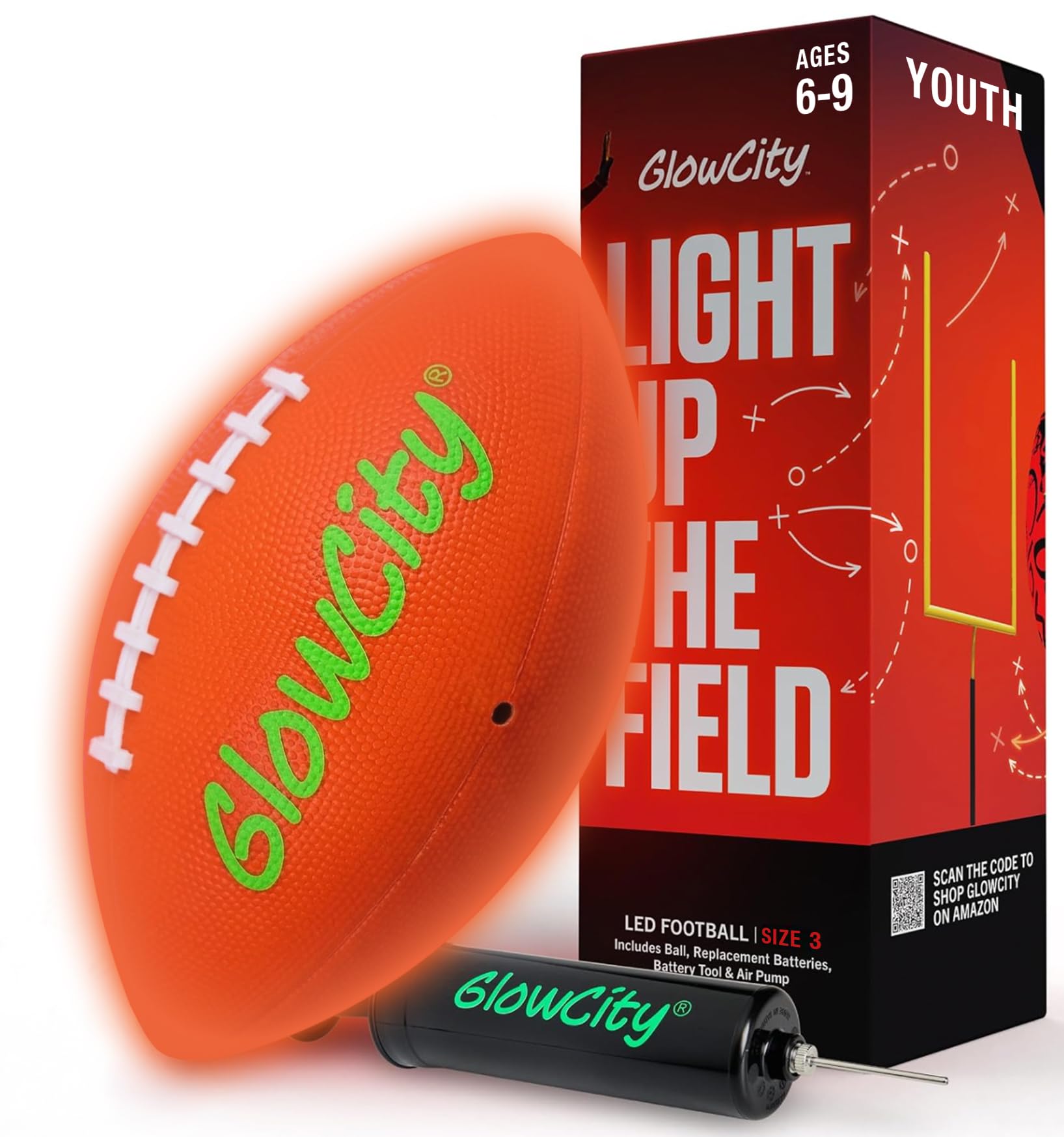
GlowCity Glow Football
Key Features
- Glow: Impact-activated LED
- Size: Size 3, 8 in
- Cover: Textured water-resistant rubber
- Batteries: 3 LR44 plus 3 spares
- Price: Premium
The end of daylight saving is the reason to own one of these. The yard goes dark at five, the kids still want to be outside, and a ball that lights up buys back the hour after dinner. That is the whole pitch, and for a lot of families it is enough.
It is a size 3 ball, eight inches and pee-wee sized, so it suits roughly six- to twelve-year-olds rather than a teenager. The light comes from LEDs behind grommets in the rubber, triggered by impact rather than a switch. We like that more than we expected to: there is no button to find in the dark and no way to leave it switched on, since it shuts itself off after about half a minute of stillness. Brightness is the other thing, and it reads clearly from across a dark yard, which is the only test that matters.
What it is not is a precision football. It is a rubber ball with a light unit inside, so it feels a little different in the hand, and nobody is learning a tight spiral with one. But that is not the job. The job is keeping a kid outside after sunset, and it does that better than anything else here.
Pros
- Lights on impact with no switch to find
- Bright enough to track across a dark yard
- Shuts itself off after about 30 seconds
- Spare batteries included in the box
Cons
- Light unit can quit within weeks
- Battery changes are fiddly and frequent
Our pick for after-dark games: it lights up on impact, glows bright enough to track across a yard, and comes in a kids size with spare batteries.
Best for Teens at Night
FlashCatch Light-Up Football

Key Features
- Size: 6
- Light: Impact-activated LED
- Weight: 15.5 oz
- Battery life: Up to 30 hours
- Price: Premium
Size 6 is what separates this from the other light-up ball here. It is the size an eight- to fifteen-year-old actually wants, not a pee-wee ball they will be done with by nine, and it is built like a football rather than a toy: stitched panels, proper laces, and enough weight in the hand that a throw feels like a throw.
The glow works on contact, so the ball lights when it is caught or thrown and fades out when the game stops. That is the right idea, since a switch on a dark lawn is a lost switch, and at this size an older kid can run real routes after sunset. It ships flat with no pump in the box, so that is one thing to sort before the first evening.
The light is where our enthusiasm cools. It is the reason to buy this ball, and it is also the part that can quit, leaving a perfectly good football that is no longer a glow ball. If you want a light-up ball for a pre-teen who has outgrown the small sizes, this is the one to get. Just go in knowing the electronics are the short-lived part, not the ball.
Pros
- Size 6 suits older kids and teens
- Stitched panels and laces feel like a real football
- Lights on contact and shuts off when idle
Cons
- Light mechanism can fail early
A glow ball for older kids: size 6, a real football feel, and a bright glow, as long as you accept the light may not last.
Best for Toddlers and Display
Wilson Mini NFL Duke

Key Features
- Size: Mini, 8.75 in
- Cover: Composite
- League: NFL Duke replica
- Weight: 7.41 oz
- Price: Budget
This is the smallest ball in the group and the one we put in a two- or three-year-old’s hands. It is a mini replica of the NFL’s Duke ball, 8.75 inches, with the panels and laces of the real thing, and a toddler can get both hands around it and feel like they are holding what the big kids are throwing.
It throws true enough for a game of catch in the yard, and the composite cover is smooth rather than tacky, which is the second job this ball does. It is an autograph ball: a clean surface that takes a signature and looks right on a shelf next to a helmet or a photo.
As a play ball for a kid with a decent arm, it runs out of ball quickly. Small and light is the whole point at three; at seven it is a ball that floats and wobbles instead of flying, and the junior-sized picks here take over from there.
Where it earns its place is as the first football and the keepsake. If you want something a toddler can carry around, drop on the patio, and hand to a grandparent to sign, this is the nicest one here. If you want a ball for actual practice, size up.
Pros
- Smallest and lightest ball here for toddlers
- Smooth composite takes autographs
- Official NFL Duke replica look
Cons
- Too small and light past about six
The smallest ball here, and the nicest looking: a mini Duke for toddlers’ hands, autographs, and the shelf, not for a kid who already throws.
How We Tested Kids’ Footballs
We started by pulling together footballs from brands we’d seen in schoolyards and toy aisles, then narrowed the shortlist by age range, size options, material, and whether a pump was included. We also sought out light-up models because brightness and battery life are real concerns for evening play. Price mattered, but only next to how the ball held up.
Over three months, we tested 14 balls in backyards, at local parks, and on school playgrounds. Each was pumped to its recommended pressure and checked again after 24 hours, one week, and two weeks to see whether it lost air. We kicked each ball against a brick wall and a chain-link fence to look for scuffs, seam separation, and shape changes. Kids ages 4 to 10 then dribbled, passed, and shot with each one, and we noted which balls they reached for unprompted.
For light-up versions, we switched them on at dusk and timed how long they stayed bright, plus noted whether batteries were replaceable or rechargeable. We also checked packaging and whether a pump was included, since several balls were bought as gifts. At the end, we compared wear and air retention against price to judge value, and watched for any reliability issues—valves that leaked, lights that flickered, or stitching that gave out.
How to Choose a Kids Football
Three things decide whether a kids football gets used or forgotten: it has to fit the hand, suit the surface it lands on, and survive more than a weekend.
Size the ball to the hand, not the birthday
A junior football runs about ten inches long, a mini about eight and a half, and a pee-wee ball around eight. Those couple of inches are the difference between a spiral and a two-handed heave. The quick test is simple: if a kid has to trap the ball against their chest to hold it, it is too big, whatever the age range on the box claims.
Under five, go mini. From about six to nine, junior is the size most kids can genuinely throw, which is why the Franklin Grip-Rite is our default. A ball that is too big teaches a kid to push it, and that habit is hard to undo once they have a season of it.
Foam or rubber: pick the surface first
Foam is softer, safer indoors, and friendlier to a nervous catcher. Rubber and synthetic covers feel like a real football, hold up on concrete and gravel, and are less forgiving when a catch arrives badly. The choice usually answers itself once you know where the ball will spend its life.
For a backyard kid, a rubber junior ball is the more durable purchase. For the pool, the beach, or a hallway with a toddler in it, foam wins, and an all-weather cover like the Weather Blitz’s is the difference between a pool ball and a sponge. Do not buy foam expecting it to survive a summer of gravel.
Grip is what keeps a kid playing
The first time a ball slips out of a kid’s hands, they stop asking to play. Deep-pebbled rubber, molded ridges, and raised laces all exist for that moment, and they matter more than any printing on the cover. A glossy printed surface on a mini is the giveaway that it was built for a shelf rather than a yard.
Look at how the laces are made, too. Molded-in laces survive seasons; glued-on ones lift at the edges. If a ball arrives feeling slick, give it a wipe with a damp cloth before you decide it is hopeless, then decide.
Inflation, valves, and pumps
Every football here ships deflated, and a pump is not a given: the Franklin team packs and the NFL mini include one, most single balls do not. Inflate a new ball a day before you need it and leave it overnight. A ball that arrives soft is ordinary; one that is soft again by morning has a valve problem and belongs back in the box for a return.
Keep a needle and a pump in the garage and this whole category gets easier, including the six months after the ball stops being new.
Water, dark, and concrete
Where the ball lands shapes what you should buy. Pools and beaches want an all-weather cover that will not waterlog. Evening games want a light-up ball, and those bring button batteries and an LED unit that can fail long before the ball does. Concrete and gravel eat foam and peel printed decals, so a molded rubber ball lasts longer on a driveway.
Frequently Asked Questions
Do glow footballs take regular batteries?
No. The light-up balls here run on LR44 button cells, three at a time, and both come with spares in the box. Buy a card of them before the first evening game, because a dead ball on a dark lawn ends the night early.
Keep the spares out of reach of young children. Button batteries are a swallowing hazard, and they are exactly the size a toddler picks up.
Does a foam football fly in the wind?
Not well. Foam is light, and a gust pushes it off line mid-flight, so a throw that was straight in the afternoon curls in the evening breeze. On a blustery day the rubber junior balls hold their line better, and the foam ball stays in the bag until the air is still.
How do you clean a muddy football?
Wipe it with a damp cloth and a drop of dish soap, then dry it before it goes back in the bag. That is enough for molded rubber and foam covers alike.
Do not soak a foam ball, and keep a light-up ball’s battery compartment away from running water. Mud that dries on a pebbled cover brushes off.
Final Verdict
For most families, the Franklin Grip-Rite 100 is the ball to buy: junior size, a cover that holds in small hands even when it is wet, and rubber that survives the driveway. Buy a pump with it, since the single ball does not include one.
If most of your throwing happens over water or on wet grass, the Nerf Weather Blitz solves a problem the rubber ball cannot. And if the games only start at dusk, go straight to the GlowCity and keep spare button cells in the drawer.
