This post contains affiliate links. We may earn a small commission when you buy through our links — at no extra cost to you.
The first snow day is pure joy for about 25 minutes. Then the toes go numb, the boots come off in the front hall, and there’s a puddle where the left one used to be. A good kids snow boot keeps feet dry through the slush at the bus stop, goes on without a fight while your kid is already halfway out the door, and survives being kicked against a fence all winter.
I’ve bought boots that looked warm in the photos and had a lining that soaked through by January. So over one winter, my team and I put 12 pairs through school runs, sledding hills, and backyard snow forts. Sizing up two full sizes doesn’t stretch a boot’s life — it makes a kid trip, and a loose fit cancels out the warmth of thick socks anyway. Closure matters more than parents expect, too: if your kid can’t pull a boot on and cinch it with mittens, they’ll wear it open and the snow gets in regardless. A few of the cheapest pairs outlasted the priciest, which is worth remembering as you read through the picks below.




Best for Deep Snow, Slush
Kamik Snobuster 1
Key Features
- Liner: Removable, washable felt
- On/off: Pull-on, no laces
- Snow seal: Drawcord at the top
- Waterproofing: Seamless rubber shell
- Price: Midrange
The liner comes out. That single decision is why the Snobuster is the boot we recommend first: after a wet afternoon the felt inner pulls free, both parts dry overnight, and nobody is forcing a cold, damp boot onto a warm foot the next morning. No other boot here solves the drying problem this directly.
The lower half is one piece of rubber running well above the ankle, and that is the other half of the argument. The seam where an upper meets a shell is where kids’ boots usually start letting water in, because it sits right at the crease over the toes; there is no seam there to fail. Above it, a drawcord pulls the cuff closed, so snow that comes over the top stops at the opening instead of sliding down to the heel.
Nothing needs tying, which matters more than it sounds in January. It is a straight pull-on with a shaft soft enough that a preschooler can get a foot in without an adult kneeling in the slush beside them.
The felt goes back in for the cold snap and comes out again in March, when the shell turns into a rain boot. We like a pair that covers the messy half of the year rather than six weeks of it, and the liner can be washed rather than just aired.
What it is not is a fashion boot. It looks like rubber, in plain colors, and a kid with opinions about school shoes will say so. That is the trade — plain looks for the most dependable dry feet in this group — and it is one we make happily.
Pros
- Seamless rubber lower keeps water out
- Removable felt liner dries overnight
- Top drawcord stops snow coming in
- Kids pull them on unassisted
Cons
- Liner can wear at the heel over time
Our top pick: a seamless rubber shell that cannot leak at the seams and a felt liner that pulls out and dries overnight.
Best for Long, Cold Winters
SOREL Youth Flurry
Key Features
- Liner: Removable liners
- Closure: Elastic-cinch pull-on
- Listed weight: 10 oz
- Price: Premium
One snow day is easy to dress for. It is the fourth week of them that sorts boots out — the walk to school, recess, the hill afterwards, all in the same pair. The Flurry is the boot here that reads as built for that whole stretch rather than for the first snowfall.
Warmth is where it separates itself from the rest of this group, and it does it without turning the boot into a brick. The elastic at the top gathers around the calf so snow stays out, kids pull them on themselves, and the liners come out to dry — the difference between a boot that is ready at breakfast and one that is not.
Waterproofing is the one soft spot. Slush and packed snow are handled; a long sit in wet snow can leave socks damp, so if your kid is a flopper rather than a runner, the Kamik’s rubber shell is the safer buy. Sizing at least is straightforward: these come back true to size, so order the measured size rather than going up.
Pros
- Warmest boot in this group
- Elastic top keeps snow out
- Liners pull out to dry
- True to size, easy to order
Cons
- Costs more than most boots here
The warmest boot in this group, and worth the extra if your winters are long and genuinely cold.
Best for Rain and Snow
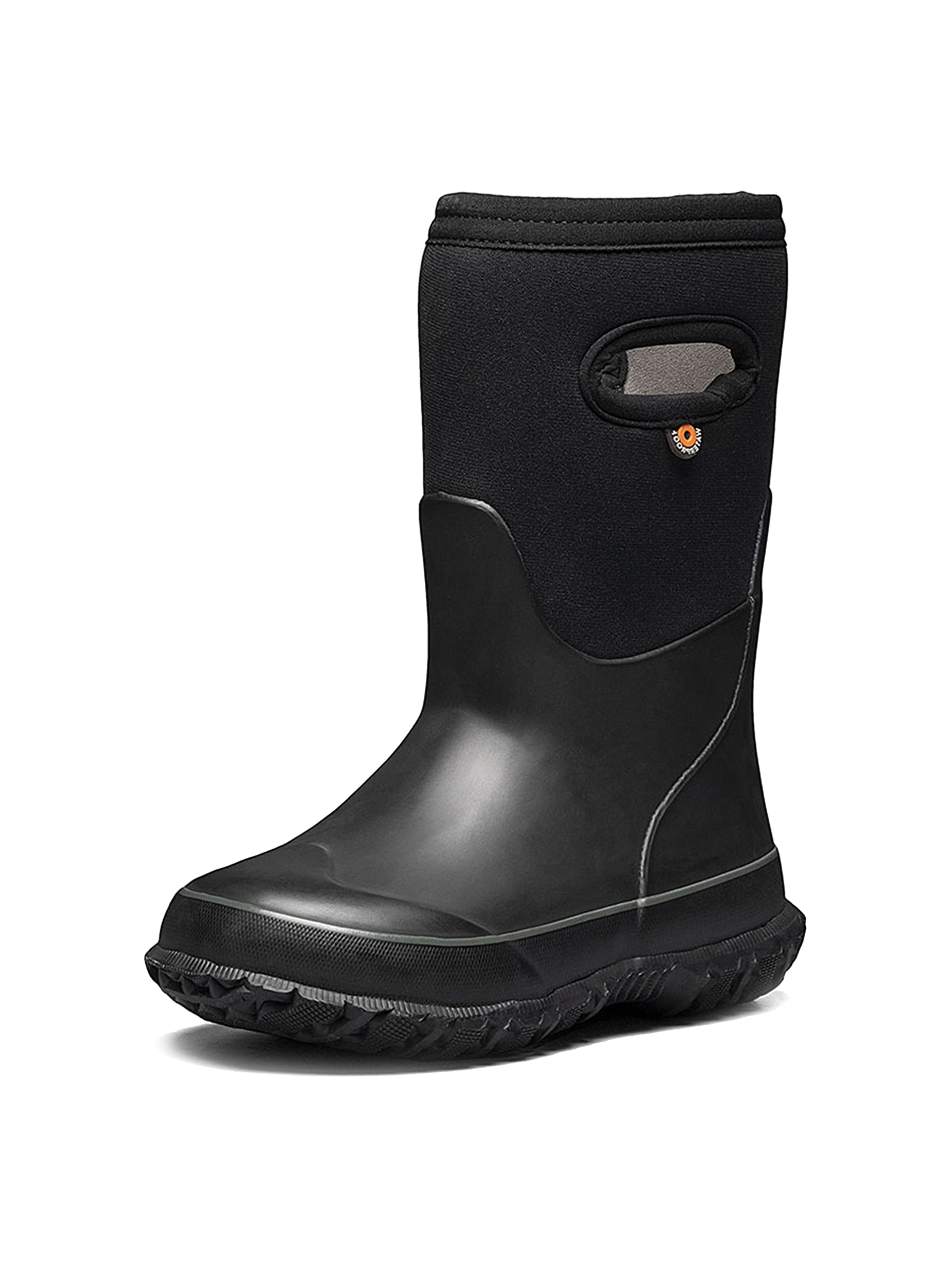
BOGS Grasp
Key Features
- Outsole: Non-slip
- Insulation: Insulated
- Waterproofing: Rubber to the top
- Price: Premium
Most families end up with two pairs: a rubber boot for wet grass and a snow boot for the cold. The Grasp is the argument for buying one. The rubber runs the full height of the shaft, so puddles, slush and mud stop at the top instead of soaking through, and there is insulation inside, so a cold morning does not turn it into a punishment.
They are also the pair here that kids handle entirely alone: the shaft is soft enough to pull on, and the boot is far less bulky than a traditional winter boot. Nothing about them suggests a single-season buy, which is why they are the ones we point to for a family that passes boots down.
Fit is the thing to be sure about. The same boot comes back described as true to size, a half size big and too narrow, which usually means the shape suits some feet and not others rather than the sizing being wrong across the board. Order somewhere with easy returns and measure the foot instead of guessing from age — near the top of the price range here, you want to get it right first time.
Pros
- Covers rain, mud and snow
- Rubber waterproofing to the top
- Kids manage them unaided
- Holds up for a second winter
Cons
- Most expensive boot in this group
One pair for rain, mud and snow, and the easiest boot here for a kid to pull on alone.
Best for Wide Feet
The North Face Alpenglow II
Key Features
- Outsole: Rubber
- Insulation: Insulated
- Listed weight: 12.8 oz
- Waterproofing: Waterproof construction
- Price: Midrange
It weighs next to nothing for a boot that handles a real winter, and that changes how a small kid moves: no dragging, no waddling, no complaints on the second block. For a first-grader who insists on doing everything themselves, lightness counts for more than another layer of padding.
The build is straightforward and sound. The construction is waterproof, the outsole is rubber and grips on packed snow, and the whole thing wipes clean. Nothing here is fussy, which is what we want in a boot that gets thrown in a heap by the door.
The fit is generous through the foot, with padding that fills the space around the ankle rather than leaving it loose, so wide feet and chubby ankles sit comfortably. It runs snug over a high instep, though, and a child with a narrow foot will find more room than they need. A single strap is all there is to work, which is why toddlers manage it themselves and why the boot is plain enough to wear to school without an argument.
Mid-priced for this group, the Alpenglow is the one we hand to parents whose kid has wide feet and small hands. That combination is not as common as it sounds, and it is the reason this boot is on the list at all.
Pros
- Light on small feet
- Waterproof with a rubber outsole
- Generous room across the foot
- One strap toddlers can work
Cons
- Velcro strap can be too short to hold
- Runs snug over a high instep
Light, waterproof and roomy through the foot — the pick for wide feet and small hands.
Best for Mud and Wet Ground
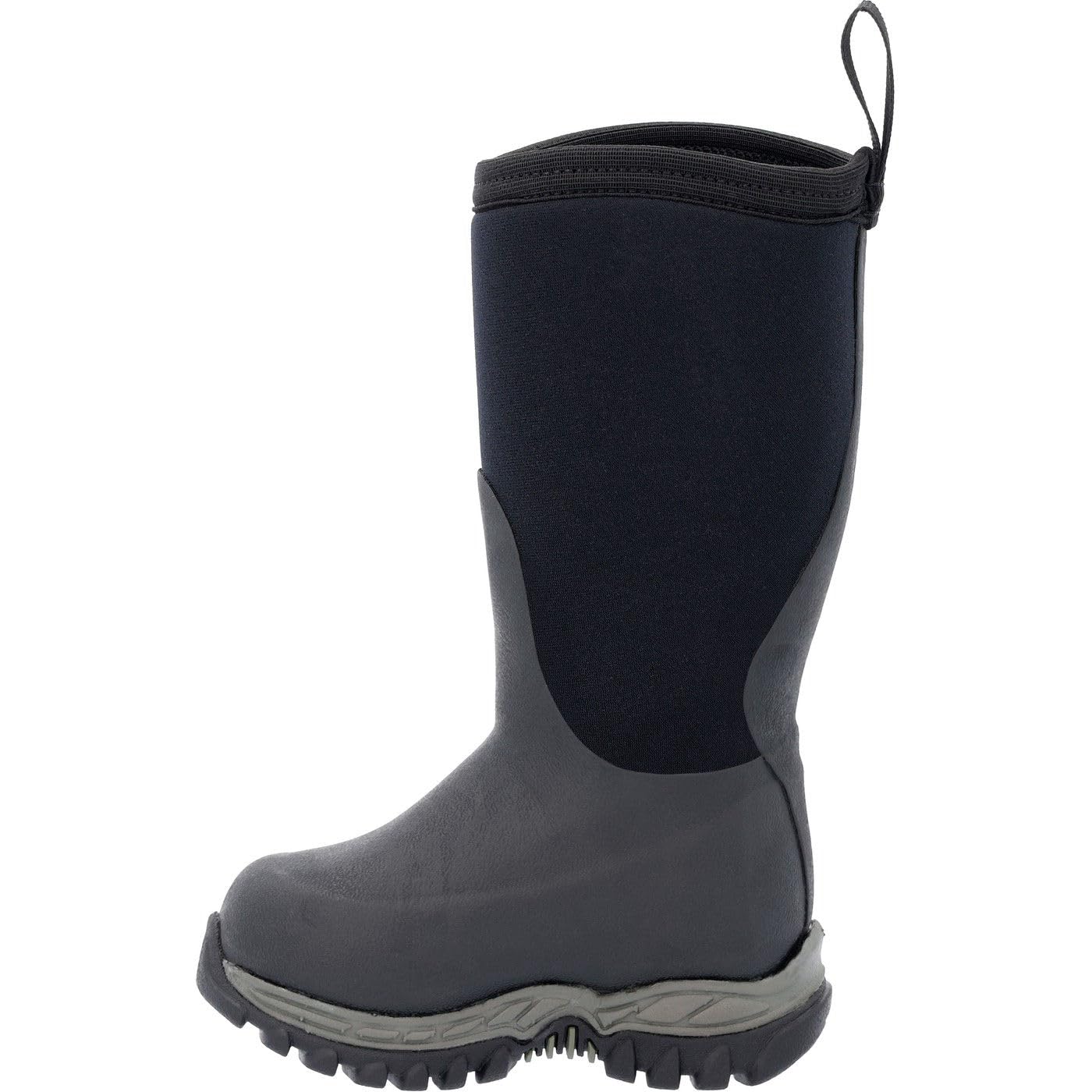
Muck Rugged II
Key Features
- Shaft: Tall
- Shell: Rubber
- Closure: Pull-on, no laces
- Waterproofing: Waterproof
- Price: Premium
There is a kind of wet that is not snow: the muddy gate, the soaked field, the puddle that turns out to be a hole. That is the Rugged II’s home ground. If your winter involves animals, a yard, or a garden that does not shut down in January, this is where the list starts.
The rubber is the boot. It runs from the sole up past the ankle in one piece, so there is nothing to soak through and nothing to split at a seam, and it wipes clean in seconds rather than drying on a radiator for two days.
Warmth is real, but this is not a winter specialist. It is the pair here that gets worn in October and again in April, which is where the value argument lands for a family that is outside all year.
It looks like a work boot, and that is either the point or a dealbreaker depending on your kid. It is not the boot for the school run in a smart coat.
Buy it for the wettest ground you have and keep the Kamik or the Flurry for deep, dry snow. As a second pair for a household that does not come inside when it rains, this is the strongest case in the group.
Pros
- Waterproof rubber with no seams
- Tall shaft keeps snow out
- Worn from October to April
- Wipes clean after mud
Cons
- Fit runs narrow for some kids
The boot for mud, wet grass and slush, and the one here that keeps earning its place after the snow melts.
Best for Budget Snow Days
DREAM PAIRS Snow Boots
Key Features
- Fit: Runs large
- Lining: Fur-lined
- Closure: Slip-on
- Waterproofing: Waterproof upper
- Price: Budget
Nothing else here costs as little, and nothing at that price comes close on warmth. That combination is why this is the pair we point to when a child has just gone up a size in October and the winter budget has already gone on a coat.
Inside is a thick fur lining that gets noticed on the first cold morning, and the upper is waterproof rather than merely water-resistant, so slush along the pavement does not come through. A five-year-old can get them on and off without help, which is the single biggest quality-of-life feature in this category.
Sizing is the complication. They run large for plenty of kids and tight across the toes for a few, so measure the foot in the socks it will wear and order that, rather than adding a size for growing room. Buy them big and you get a boot that slops and rubs; buy them right and this is a lot of boot for the money.
Pros
- Cheapest boot in this roundup
- Thick fur lining is genuinely warm
- Five-year-olds manage them alone
- Keeps feet dry in snow and slush
Cons
The best value here: warm, waterproof boots for less than anything else in this roundup.
Best for Preschool Independence
GUBARUN Boys Snow Boots

Key Features
- Lining: Soft, warm lining
- Closure: Velcro straps
- Outsole: Slip-resistant
- Listed weight: 7.05 oz
- Price: Midrange
Two wide velcro straps do all the fastening, and the width matters more than it sounds: they open far enough that a small foot goes in without a fight, and they close with a rip a preschooler can manage alone. In a hallway with a queue of kids waiting, that is the whole ballgame.
The rest is sensible. The lining is warm without being bulky, the boot is light enough that a run stays a run, and the sole grips on packed snow. Mid-priced for this group, it is one of the easiest buys here for a kid who is outdoors a lot but not out in the wild.
Water is the caveat. Snow that sits against the lace area can work its way in, so these are boots for the walk, the playground and the sledding hill, not for an hour parked in a drift. Dry them overnight and they are fine; leave a wet pair freezing by the door and the morning is miserable.
What we keep coming back to is how little fuss there is: no laces to tie in gloves, no liner to reseat, one piece of hardware to break. For a kid dressing themselves and a parent running late, that is worth more than another ounce of insulation.
Pros
- Wide velcro a preschooler can work
- Warm lining for cold mornings
- Light enough to run in
- Grippy sole on packed snow
Cons
- Runs small; size up if between sizes
Warm, light and easy for a preschooler to put on alone, as long as the day stays out of deep drifts.
Best for Cheap Spare Pair
K KomForme Snow Boots

Key Features
- Outsole: Anti-slip
- Insulation: Insulated, thick lining
- Waterproofing: Waterproof
- Price: Budget
The lining is the surprise. It is thick, soft against the ankle and warm enough that a kid in ordinary socks does not complain on a cold morning — not what you expect from the cheap end of the shelf, and the reason these are worth a look at all.
They are light and easy to walk in, true to size for most kids, and simple to pull on, with a drawcord at the top that seals the cuff and an anti-slip sole that handles a wet playground. For a nursery-to-home boot, that is most of what you need.
What you are gambling on is the hardware. The strap and the drawstring are where the money was saved, and a boot that loses either is finished. Buy them for a gentle wearer — the walk to nursery, the garden, the occasional snow day — and they will see out a season. Buy them for a kid who destroys shoes and you will be shopping again in February.
Pros
- Thick lining for the money
- True to size and easy to pull on
- Light enough to run about in
- Anti-slip sole
Cons
A warm, true-to-size boot for very little money, and a good first snow boot for a gentle wearer.
Best for Light Everyday Wear
CIOR Fur-Lined Snow Boots

Key Features
- Lining: Fur-lined
- Snow seal: Top drawstring
- Listed weight: 15.5 oz
- Waterproofing: Waterproof
- Price: Budget
The drawstring at the top does more work than it looks like it does: pull it and the cuff closes around the ankle, so snow that comes over the boot stops there instead of running down the leg. On a cheap boot that is often the first thing missing, and here it is present and it works.
Inside is a fur lining that is warmer than the price suggests, and the rubber lower keeps feet dry through slush and wet grass. For a toddler who mostly needs a boot to get from the door to the car and back, that covers the job.
They are easy on and off, they run true to size, and the weight is reasonable for a lined boot. Plenty of kids wear this kind of boot for a whole winter without complaint, and the low price means a second pair is not painful.
Sizing is kind: they run true, with enough room to grow without the boot slopping off, and the shaft comes up about halfway to the calf — enough for playground snow, not enough for a deep drift. Near the bottom of the price range, these are the pair to buy when you need two and do not want to spend like it.
Pros
- Fur lining is warm for the price
- Top drawstring seals out snow
- Toddlers manage them alone
- Water-resistant rubber lower
Cons
- Drawstring and zip can fail early
A warm, fur-lined budget boot that works best as a spare pair rather than the daily one.
How We Tested (and How the Kids Tested Them)
We started with roughly 40 pairs sold in kids’ sizes and cut the list by looking at what manufacturers would actually commit to about water resistance, whether a boot came in half sizes or a wide, how the closure worked with small hands, and where the price sat — we wanted budget picks and splurge picks in the same lineup. That left us with 12 pairs, in sizes running from toddler 7 to big-kid 5.
Testing ran from the first snow in November through the February slush. Kids wore the boots on the 20-minute walk to school and at the bus stop, at recess, on sledding hills, and in backyard snow forts, and parents logged how long it took each kid to get them on and off without help — mittens on, because that’s the real test.
For water resistance, we stuffed each boot with paper towels, ran a faucet over the toe and seams for five minutes, and checked whether the towels came up damp. Warmth got judged on the kid, not the label: a thin cotton sock and a toe check after 40 minutes outside. We inspected seams, toe caps, and tread at weeks four, eight, and twelve to see what was wearing through, and measured the insides against each size chart after a few kids tripped over boots that ran a full size long. Value came down to how many seasons a pair could plausibly survive, not what it cost on the shelf.
How to Choose Kids Snow Boots
The boot that keeps a kid dry is the one with the fewest places for water to get in, and that decision is made below the ankle rather than on the label.
Start with the lower, not the lining
Snow soaks in at the flex point, where the upper creases over the toes, and that is where stitched seams give up first. A one-piece rubber lower running above the ankle, as on the Kamik and the BOGS, removes that failure point altogether.
A fabric upper can work well and is usually lighter and more flexible, but treat a waterproof claim on a seamed boot as something to check rather than a guarantee. If your kid plays in slush more than powder, buy rubber height before you buy insulation.
Warmth is easy; drying is the hard part
The lining keeps feet warm, but what happens at four in the afternoon decides how the winter goes. A removable liner, like the felt inner on the Kamik, pulls out, dries overnight and can be washed, so one soaked afternoon does not become a cold walk the next morning.
Fixed linings are fine on a boot that rarely gets soaked and they cost less. For a child in daycare or school, where boots come off in a heap by the door, drying speed is worth more than a few extra grams of insulation.
Getting them on is part of the performance
Fastenings decide whether a kid dresses themselves or waits to be dressed. Wide velcro straps a preschooler can rip open, a soft shaft a child can pull on, and a single strap all beat laces, which are a two-adult operation in mittens.
The trade-off is that a short strap will not hold a narrow ankle. Work the closure with the boot on a foot before the tags come off; that is the moment to discover it, not at the top of a sledding hill.
Sizing: measure the foot, not the age
Every brand here sizes differently, and sizing up for growing room is how kids end up in boots that slop, rub and come off in a drift. Measure the foot in the socks it will wear, leave about a thumb’s width at the toe, and order that.
The DREAM PAIRS runs large, while the GUBARUN and the BOGS run small for plenty of kids. Between sizes, go up half rather than a whole, and check the size chart against a measured foot instead of the age range.
Deep snow is a height question
Once snow is over the ankle, shaft height and a closed cuff matter more than anything else on the boot. A drawcord or elastic top, as on the Kamik, the SOREL and the CIOR, stops snow that comes over the top from running down the leg.
For a kid who plays on plowed playgrounds, a mid boot is easier to walk in and entirely sufficient. For drifts and deep fields, buy the taller boot and cinch it.
Frequently Asked Questions
Do kids need separate rain boots and snow boots?
Often not, if you buy the right one. An insulated rubber boot such as the BOGS Grasp or the Muck Rugged II handles wet grass, mud and snow, so a single pair covers October to March.
Families who buy two usually do it for fit: a light wellie for autumn puddles and a taller boot for drifts. If storage or budget is tight, buy the rubber one first — it works in more weather.
How long should a pair of kids snow boots last?
A sturdy pair should see out a full winter and often a second child. What goes first is rarely the upper: it is the sole at the toe crease, the strap or drawstring, and the lining at the heel.
Check those three when a pair arrives and again in January, while there is still time to replace them before the coldest stretch.
Can kids wear snow boots in a car seat?
Take them off for the ride. A thick boot holds the harness away from the foot, and once the boot compresses the straps can sit looser than they looked in the driveway.
Buckle up in socks or thin shoes and put the boots back on at the other end. It takes half a minute and matters most on the icy mornings when everyone is rushing.
Are expensive snow boots worth it for a kid who will outgrow them?
Only if the boot gets worn hard. The premium pairs here earn their price on parts that outlast a growth spurt: a rubber shell that does not split, a closure that still works in March, and a hand-down life after the first child.
For two snow days a year and a school run, the budget picks cover it comfortably.
Final Verdict
The Kamik Snobuster 1 is the boot we recommend to most families. A seamless rubber shell removes the seam that leaks on other boots, and the felt liner pulls out so a wet afternoon does not cost you the next morning. Plain looks are the price of that, and it is a fair one.
If your winters are cold and long, the SOREL Youth Flurry is the warmer boot and worth the extra. If you would rather buy once for rain, mud and snow, take the BOGS Grasp. Whichever you pick, measure the foot before ordering — sizing is the thing that varies most across this group.
