This post contains affiliate links. We may earn a small commission when you buy through our links — at no extra cost to you.
A backyard slip and slide looks like the easiest win of a hot afternoon: hose on, kids out the door, everyone happy. Then you unroll one and learn the truth. The plastic bunches under the sprayer, water pools in a single spot instead of running the length of it, and half an hour later there’s a mud trench where the sliding is supposed to happen.
What a good one fixes is simple: it keeps water where feet actually land, stays anchored when a kid hits it at a run, and survives to be unrolled again next weekend. We spent a full summer putting 14 slides through exactly that kind of use, and the gap between the top few and the rest was wider than I expected. Here’s what first-time buyers rarely think about: the length printed on the box matters far less than the width and where the sprayers sit, and get those wrong and kids stall out halfway down. The ones that held up are below.


Best for Everyday Backyard Use
Spring Water 22 ft Double Lane
Key Features
- Lanes: 2
- Age range: 5 years and up
- Bodyboards: 2
- Slide size: 22 ft x 5 ft
- Price: Midrange
Twenty-two feet is the figure that makes this one work. That’s long enough for a seven- or eight-year-old to get a real ride on a lawn with a gentle slope, and short enough that it still fits a normal backyard rather than asking for an acre. Two lanes give you a race, and at five feet wide the mat sits in an ordinary strip of grass instead of demanding the whole yard.
The sprinkler is the plainest design in this group: high and low holes down both sides, no inflatable channels, nothing to assemble. On a hose with decent flow that’s all you need, and the lanes stay wet from the head of the run to the end. What it won’t do is rescue a weak tap — if your outdoor faucet is already feeding a sprinkler or a splitter, the last few feet go dry and the sliding stops there. Run the hose direct and open.
The two inflatable bodyboards matter more than they look. A small, cautious kid on a board keeps moving where a bare stomach sticks and the run dies halfway down. Ours got used constantly by the lighter sliders and ignored by everyone much past ten. What you’re paying for here is length and a second lane, not inflatable scenery, and that’s the right thing to spend on.
Pros
- Long run that still fits a normal backyard
- Side sprinkler holes wet both lanes
- Two bodyboards included
Cons
- Bodyboards are sized for children, not adults
- Two lanes in five feet is snug for bigger kids
Our pick for most families: twenty-two feet of two-lane mat, water across both lanes, and bodyboards small kids will actually use.
Best for Small Yards
stargo 18 x 5 ft Slip and Slide
Key Features
- Lanes: 2
- Material: .25mm PVC
- Slide size: 18 x 5 feet
- Ground stakes: 6
- Price: Budget
You can pay more for a slip and slide and still get one with its sprinkler holes along the outer edge, hosing the lawn while the plastic stays dry. This one runs its zigzag sprinkler down the middle, between the lanes, so the water lands where the kids do. That single design choice is why it’s the budget pick we recommend rather than simply the cheapest mat in the guide.
The rest of the package is honest about what it is: eighteen feet by five, .25mm PVC, reinforced stake holes, six pegs and a patch kit. It unrolls and pegs down in a couple of minutes, folds small enough to live on a shelf, and is light enough for one adult to carry out and shake off. On a small lawn with a bit of slope we had the kids sliding soon after connecting the hose.
Thin PVC is the trade-off, and it’s the reason this is a season’s toy rather than a hand-me-down. The places it gives are the fold lines and the stake holes, especially when the mat is hauled tight on hard, dry ground. Peg it into soft soil with a little slack and it behaves the way a mat at this price should.
Pros
- Centered sprinkler keeps water on the mat
- The lowest-priced mat in this guide
- Packs small and pegs down fast
Cons
- 18 feet is short for older kids
For small yards and younger sliders it’s the one we point to: the cheapest mat here, with the sprinkler in the smartest place.
Best for Three Kids at Once
Funscape Triple 20 ft
Key Features
- Lanes: 3
- Age range: 3 to 12 years
- Slide size: 20 ft
- Boards and extras: 3 bodyboards and 1 inflatable football
- Price: Midrange
Three lanes is the sort of claim that usually turns out to be two lanes and a stripe. Here it’s real: three sliding channels, three football-shaped bodyboards with grab handles, and an inflatable football thrown in. The handles are the detail we appreciated most — a four-year-old can hold on and stay pointed down a lane instead of veering into a sibling.
Twenty feet long and about six and a half feet across, it wants a flat, open piece of lawn; this is not the mat you unroll between the swing set and the fence. Three lanes spread across that width also mean each lane is narrow, which works fine for kids under about eight and gets crowded with three big ones aboard. Two older kids and one younger one is the happier mix.
What it solves is the queue. With three kids in the house, the arguing at the top of the run disappears when everyone has a lane, and the football gives whoever is bored of sliding something else to do. It’s the one we pull out for a birthday party or a full playdate; with one or two kids, a longer two-lane mat buys more sliding for the same kind of money.
Pros
- Three lanes end the argument over turns
- Handled boards suit small kids
- Inflatable football adds a second game
Cons
- Wide, flat lawn required
- Boards and football need inflating and drying
Three kids, one mat: the three-lane option that ends the argument about whose turn it is.
Best for Younger Sliders
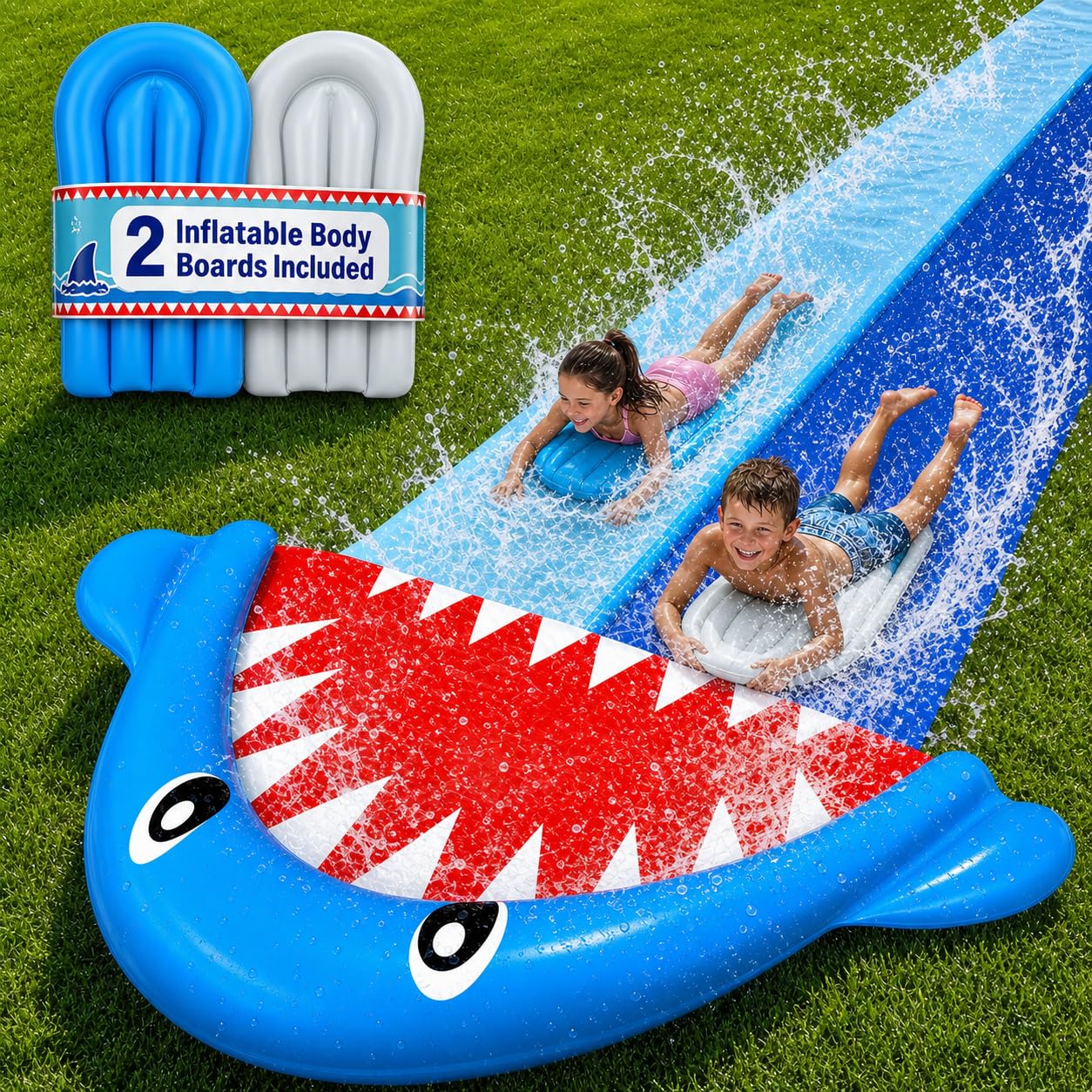
TOY Life Shark 20 ft
Key Features
- Lanes: 2
- Age range: 3 to 10 years
- Slide size: 20 ft
- Ground stakes: 6
- Price: Midrange
The shark arch is why a hesitant four-year-old walks toward the mat instead of away from it, and the splash pool at the end is why they come back for another go. Twenty feet of two-lane slide runs underneath, with sprinklers misting the track and a cushioned wall of water where the ride finishes. For the three-to-ten crowd it’s the most persuasive shape a slip and slide takes.
Under the theme it’s a conventional mat: two bodyboards, six ground stakes, a hose connector and double-welded seams on puncture-resistant PVC. The low inflatable walls are the part we found genuinely useful, since they keep a small slider pointed down the lane, and the run is long enough that an eight-year-old still gets a slide out of it. Six stakes also pin the head of the run, which is where a mat usually starts walking.
What you’re buying is the theme and the finish, not extra length — our top pick is longer. If your kids are past about eight and want speed, that matters more than a shark. If you have a reluctant little one who needs a reason to get wet, the arch is the reason, and it earns its place on that alone.
Pros
- Shark arch and splash pool draw in young kids
- 20 feet still gives older kids a real ride
- Stakes and hose connector included
Cons
- More to inflate, drain and dry than a flat mat
Buy it if the shark arch and splash pool are what gets your youngest onto the mat; older kids will race straight past the theme.
How We Chose and Tested the Slip and Slides
We started by pulling every slip and slide we could find from big-box shelves and online listings, then narrowed by length, width, weight limits, number of sprayers, and what came in the box, from stakes to repair patches. Anything that listed a weight limit for only one child, or shipped without a way to anchor it, was out. That left 14 slides, which we ran through one full summer on backyard lawns, on flat ground and on a gentle slope.
Setup was timed solo with a stopwatch, from opening the box to the first kid on it, and we noted whether the anchors held after ten runs or pulled loose and needed resetting. Kids ages 4 to 10 used them in two very different situations: weekday afternoons with two siblings and a birthday party with a dozen children queuing. We watched where the water actually went, whether it reached the far end or died out halfway, how much of the lawn turned to marsh, and whether anyone had to keep re-wetting the runway with the hose.
Durability decided more of these picks than anything else. After each session we checked seams, stake grommets, and the spots where knees and elbows land, and by August we could tell which plastic was thick enough and which had gone chalky and thin. We also looked at how each one handled water: whether the surface stayed slick when soaked or turned grabby, whether the underside soaked through and killed the glide, and whether it drained or sat in a puddle overnight. Size got measured against a small yard and a wide one, so we could say which lengths realistically fit a family with limited lawn or a slope.
How to Choose a Kids Slip and Slide
The most useful thing we can tell you about this category is that almost every disappointment comes down to water landing beside the mat instead of on it.
Start with where the sprinkler sits
A slip and slide is a wet sheet of plastic, and the water has to reach the plastic. Mats with holes along the outer edge push a good share of the spray onto the lawn, which is why so many of them go dry in the middle of a run. Holes down both sides, or a channel running between the lanes, put water where the sliding actually happens.
Coverage also fades along the length: the head of the run gets soaked and the last few feet stay dry once pressure drops. An evenly wetted mat beats one that is six feet longer, so check for a picture of the thing running before you order.
Match length to the lawn you have
Eighteen feet is plenty for preschoolers and a small yard. Twenty-two is the versatile middle, long enough for a seven- or eight-year-old to build real speed. The thirty-foot mats want a long, gently sloped run and older kids to justify them.
A mat longer than your clear lawn bunches at the bottom, and a bunched mat stops a slider dead. Pace out the run first, leave a couple of feet of runoff, and pick a strip with a slight slope — flat ground works, but the kids end up pushing themselves along with their hands.
Seams and stake holes are what fail
The failures that end a mat’s summer usually happen at a welded seam or a stake hole rather than in the middle of the sheet. Heat, dry grass and a mat pulled drum-tight against its pegs all concentrate stress at exactly those points.
A stated thickness of .25mm PVC is the common figure in this group; we don’t treat a bigger number as proof of toughness, because how the seams are joined matters just as much. Keep the patch kit somewhere you can find it without emptying the shed.
Lanes and bodyboards, matched to your crowd
Two lanes cover the common case: siblings, a friend, a race. Three lanes only pay off when there are genuinely three kids waiting at the top — otherwise you’re carrying a wider mat that needs a flatter, more open piece of lawn.
Bodyboards earn their place with younger or lighter sliders, who otherwise stick and stall halfway down. Older kids tend to abandon them and go on their stomachs. Check the board against your biggest kid, since the included ones are almost always child-sized.
Setting up and putting it away
Setup is a hose, a few pegs and five minutes. What people underestimate is the end of the afternoon: a wet mat folded into a heap grows mildew and smells like a pond by the next weekend.
Drain it, hang it over a fence or a clothesline until it’s dry, then fold along the original creases and store it out of the sun. Drying properly is the difference between a mat that gives you a season and one that sours in the garage.
Frequently Asked Questions
Do slip and slides need strong water pressure to work?
They are open holes fed from a garden hose, so pressure does the work. On a weak flow the water barely reaches the last few feet and the bottom of the mat stays dry no matter how long you leave the tap open. Run the hose straight from the faucet without a splitter, test the far end before the kids get on, and shorten the run if you can’t get water to the bottom of it.
Will a slip and slide kill the grass underneath?
It can. A mat left in place under a summer sun smothers the turf, and the runoff keeps the surrounding patch saturated until it yellows. Lift and move the mat between sessions rather than leaving it down for days, and expect a worn patch by August.
Point the hose so the runoff runs toward garden beds or a border instead of pooling on one square of lawn.
How do you stop the mat from pulling out of the ground?
Pegs walk loose on dry or sandy ground, which is the usual reason a mat shifts mid-slide. Water the stake points first, drive the pegs in at an angle away from the mat rather than straight down, and leave a hand’s width of slack so the plastic isn’t drum-tight. On sandy soil, swap in longer metal pegs.
How much water does an afternoon on one use?
It runs off a hose the whole time kids are on it, so treat it as an afternoon of lawn watering rather than a splash pad’s worth. Throttle the tap to the point where the mat glistens but water isn’t sheeting off the sides, and shut it off between turns. Your lawn will still be soft by evening.
Final Verdict
For most families the Spring Water 22-footer is the one to buy: two lanes, a length that gives a real ride without demanding half an acre, and a sprinkler layout that gets both lanes wet. It isn’t the cheapest mat here and it isn’t the fanciest, but it’s the one we reach for first.
If your yard is small or your sliders are young, the stargo at 18 feet does the job for less and puts its sprinkler in the smarter place. And if three kids are queuing at the top of the run, the Funscape’s third lane is worth the wider strip of lawn it asks for in return.
