This post contains affiliate links. We may earn a small commission when you buy through our links — at no extra cost to you.
I’ve watched a sleepover go sideways fast when the sleeping bag is too thin, too short, or has a zipper that eats fabric at 10 p.m. The right kids sleeping bag keeps a kid warm without cooking them, gives them room to turn over, and lets them pack up without a parent hovering. Over the past four months, we put 14 kids sleeping bags through sleepovers, backyard campouts, and a couple of chilly cabin weekends.
The category splits into two camps: trail-ready bags with stuff sacks and weatherproof shells, and slumber-party sets that feel like a soft blanket. Neither is automatically better; the trick is matching the bag to where it will actually live. We looked for bags kids wanted to climb into, not just ones that photographed well—and the ones that made the list survived zipper tug-of-wars, the washing machine, and repeated stuff-sack abuse.



Best for Cold-Weather Camping
Teton Sports Junior 20°F
Key Features
- Fill: SuperLoft Elite hollow fiber
- Weight: 2.7 lb
- Dimensions: 66"L x 26"W
- Temperature rating: 20°F
- Price: Premium
The number that decided this one for us is 20°F. Every other camping bag on this page is rated 40°F or warmer, and that gap is the difference between a bag that’s fine at a July campout and one that still works on a September weekend when the temperature drops after dark. Teton backs the rating with a full-length draft tube behind the zipper, two-way zippers, and a semi-rectangular cut that holds its shape around the shoulders instead of collapsing into a tube.
At 66 by 26 inches it sits in the middle of this group on size, with enough length that most kids get several seasons before their feet reach the bottom. The hollow-fiber fill lofts back up after being squashed, the taffeta shell shrugs off tent condensation, and there’s a small pocket inside the lining for a flashlight — the detail that ends the two-in-the-morning hunt for a light. The limited lifetime warranty covers defects in materials and workmanship, which is more coverage than any other bag here carries.
Repacking is the chore nobody mentions. The stuff sack is cut close, and the first few times it genuinely takes two people: one to hold the sack, one to feed the bag in from the bottom rather than rolling it. Practice once at home and it becomes a two-minute job a kid can handle alone; skip the practice and you’ll be wrestling with it in a parking lot. A slightly larger aftermarket sack solves it permanently.
Pros
- 20°F rating covers shoulder-season camping
- Full-length draft tube and two-way zippers
- Limited lifetime warranty on defects
- Interior pocket holds a flashlight or phone
Cons
- Crinkly shell is loud in a quiet tent
- Cut long for a 3- or 4-year-old
For families who camp in shoulder seasons, we think this is the bag to buy: a real 20°F rating, a full draft tube, and a lifetime warranty.
Best for Car Camping
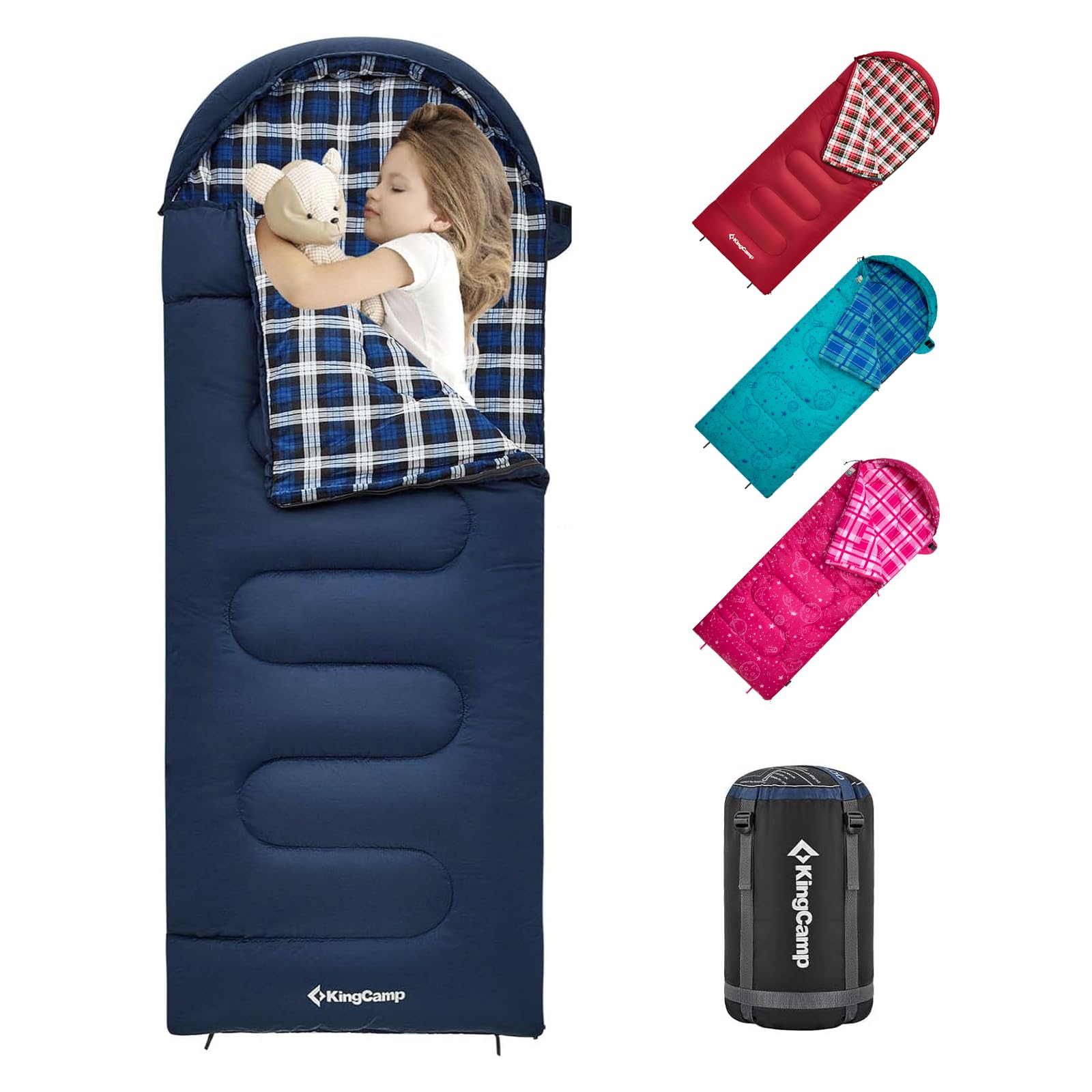
KingCamp Flannel Kids
Key Features
- Fill: 300 g/m² hollow fiber
- Lining: 100% cotton flannel
- Weight: 3.09 lb
- Dimensions: 66.9"L x 27.5"W
- Price: Midrange
The inside of this KingCamp bag is cotton flannel, and that one material choice changes what it’s like to sleep in. Roll over in a nylon bag and the whole tent hears it; roll over in this one and it’s close to silent, which is why it works so well for a kid sharing a tent with a light sleeper. It feels like a blanket with a zipper, and that’s the reason it gets dragged out at home on a Saturday morning as often as it gets packed for a trip.
We like it best for car camping and cabin weekends, where three pounds never has to be carried far and the extra width earns its keep. At 27.5 inches across it’s the widest camping bag here, which matters once a kid is inside a fleece and a hat and still wants to turn over. The 66.9-inch length leaves room for a tall 8- or 9-year-old that the 61- and 54-inch bags don’t, and 300 g/m² of hollow fiber handles a cold night comfortably — a step below the Teton for real winter camping, and plenty for everything short of that.
The zipper is the part we watched, because this bag is meant to open flat like a quilt and a misaligned zipper takes that away. Open and close it a dozen times before a trip, and keep the fabric clear of the teeth when a kid zips up alone; ours ran clean from the first night.
Pros
- Cotton flannel lining is quiet and blanket-soft
- Widest camping bag here at 27.5 inches
- 66.9-inch length leaves room to grow
- 300 g/m² hollow fiber fill for chilly nights
Cons
- About three pounds, heavy for a kid to haul
- One-year warranty is the shortest here
We point families toward this one for car camping and cabins: the flannel is quiet, the cut is roomy, and it fits kids the shorter bags here don’t.
Best for First Camping Bag
tuphen Kids Sleeping Bag
Key Features
- Weight: 2.1 lb
- Carry sack: Compression sack with straps
- Dimensions: 61.02"L x 23.62"W
- Temperature rating: 40°F to 77°F
- Price: Budget
Just over two pounds packed, this is the lightest camping bag in the group, and the sack does the rest of the work: it’s a compression sack with shoulder straps, so it rides on a kid’s back like a small daypack instead of swinging from one hand all the way to the campsite.
That combination is why we reach for it as a first camping bag. A 6-year-old who has been told to carry their own gear can actually manage it, and the price sits at the bottom of this group, so a summer that ends in lost interest isn’t an expensive lesson. The trade-off is warmth: the 40°F to 77°F rating covers summer and early fall, and a cold-sleeping kid will feel the limit on a night that dips toward 40.
Sixty-one inches suits most kids through the early elementary years, and the polyester shell handles dew and a damp tent floor. This is a bag for a warm-weather trip where someone has to walk it in — for an October car-camping weekend, the KingCamp or the Teton is the bag you want instead.
Pros
- Lightest camping bag here at about two pounds
- Compression sack with shoulder straps
- Lowest price tier in this group
Cons
- Narrow 23.62-inch cut limits thick layers
- Maker offers no warranty
Buy this if your kid carries their own gear: about two pounds, a strap-on sack, and the lowest price in this group make it the easiest first bag.
Best for Ages 3 to 8
Wake In Cloud Kids
Key Features
- Shell: 210T water-repellent polyester
- Dimensions: 61"L x 26"W
- Suggested age: 3 to 8 years
- Temperature rating: 45°F to 77°F
- Price: Budget
The unicorn print is what a 4-year-old sees first, and the backpack-style sack is what sells it to a parent: a small kid can wear it in from the car and hang it on a hook afterward instead of dragging it by one strap. At 61 by 26 inches it’s a short bag with a little wiggle room across.
The build is honest for the money. A 210T polyester shell with a water-repellent finish handles dew on a tent floor and wipes clean, and the pongee lining is smooth and cool to the touch — pleasant in a warm house, and slick enough that a restless sleeper will slide around on it. The 45°F to 77°F rating puts it in the same summer-and-early-fall band as the tuphen, a touch warmer at the cold end.
Where it fits is the first bag, the preschool sleepover, the spare that lives in the car. For a kid who mostly sleeps over at Grandma’s or camps once in July, that’s the right trade; a family planning a cold-weather trip should step up to the Teton, and a kid who needs room to grow has more of it in the KingCamp.
Pros
- Backpack-style sack small kids can wear
- Water-repellent 210T shell handles dew
- Rated 45°F to 77°F for three seasons
Cons
- Slick pongee lining slides under kids
- 61-inch length stops fitting around age 8
For a first bag or a preschool sleepover, we like this one: light, easy for a small kid to carry, and priced with room to buy two.
Best for Indoor Sleepovers
Jay Franco Disney Princess

Key Features
- Use: Indoor only
- Care: Spot clean only
- Includes: Slumber bag and pillow
- Dimensions: 54"L x 27"W
- Price: Midrange
The maker calls this one indoor use only, and that’s the right way to read it: a printed polyester bag with a zip and a small pillow, made for carpet, a hotel-room floor, or a cousin’s spare room. At 54 by 27 inches it’s blanket-length, generous on a 4-year-old and short on a tall 8-year-old.
What it has going for it is the thing kids care about: the characters, printed big, plus a pillow that measures 17 by 11 inches — more headrest than pillow, but enough to make a strange floor feel like theirs. Unzipped, the whole thing lies flat as a blanket, which is how most kids will actually use it at home, and the fabric is genuinely soft.
Where it earns its place is the trip to Grandma’s, the birthday party, the living-room campout — nights that are about the ritual rather than the temperature. If there’s any chance the bag ends up in a tent, put the money toward one of the camping bags here; this one has no warmth rating and nothing to keep a cold ground from coming through.
Pros
- Character print kids choose for themselves
- Comes with a 17 by 11 inch pillow
- Unzips flat into a blanket
Cons
- Thin padding over hard floors
- Spot clean only, no machine washing
For indoor sleepovers and Disney-obsessed 3- to 6-year-olds, we like this set: the print they pick, a pillow included, and a bag that unzips into a blanket.
Best for Movie Nights
Marvel Spider-Man Slumber Bag
Key Features
- Use: Indoor only
- Weight: 2.7 lb
- Includes: Slumber bag and stickers
- Dimensions: 56"L x 54"W
- Price: Midrange
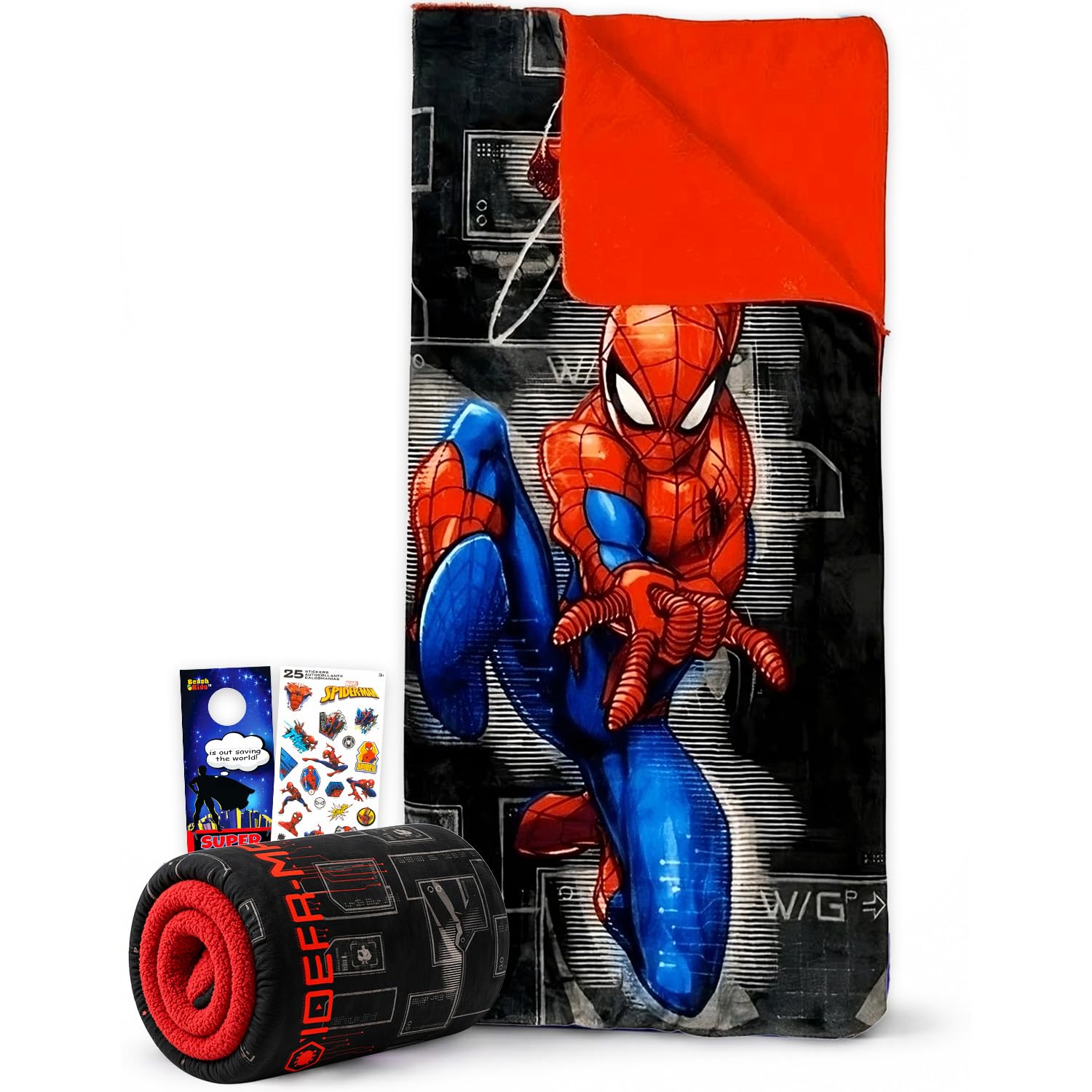
At 54 by 56 inches this is very nearly square, which tells you what it is: a printed blanket zipped around three sides rather than a bag with a real foot box. For movie nights, sleepovers, and living-room forts, that’s the right shape — feet can tuck under or stick out. On a cot with a tall 9-year-old, the edge arrives at the ankles.
The fabric is the pleasant surprise. It’s a silk-touch polyester that feels like a plush throw rather than the slick nylon of a camping bag, and the Spider-Man print is loud in exactly the way a 6-year-old wants. The bundle adds stickers, which does more for the gift factor than for the sleeping.
This is a bag for the kid who wants to be seen carrying it — the sleepover, the school camp-in, the living room. It isn’t pretending to be camp gear: no warmth rating and no weather-ready shell. Buy it for the fan, not for the forecast.
Pros
- Plush silk-touch fabric feels like a throw
- Nearly square cut suits movie nights
- Sticker bundle makes it gift-ready
Cons
- Square cut leaves no foot room for tall kids
For a Spider-Man fan heading to sleepovers, we like this one: plush fabric, a print that gets noticed, and a shape built for movie nights.
How We Tested Kids Sleeping Bags
We started by scanning reviews and spec sheets, filtering by size, warmth rating, and price, then narrowed the field to 14 models across a range of fills, shapes, and packability. Testing ran for four months, from late spring into early fall, so we got living-room sleepovers, backyard campouts, and a couple of chilly cabin weekends. We handed the bags to families on my team with kids from ages 3 to 11 and asked them to use them on the floor, in tents, at grandparents’ houses, and in the car.
We watched the full routine, not just the sleeping part. Kids had to open and close each bag on their own, climb in, roll over, and get out without help; we noted where feet hit the bottom and whether taller kids could stretch out. We zipped and unzipped each bag repeatedly, looking for snags, separated teeth, and fabric caught in the track. After each trip, we stuffed every bag back into its carry sack and timed how long it took a kid to do it solo, because a bag that only packs up with adult help tends to stay home.
Warmth and comfort got the overnight test: we sent bags out on 45- to 55-degree nights and asked whether anyone woke up cold, sweaty, or tangled. We spilled water on each shell to see if it beaded up or soaked through, and washed every bag according to its care label, checking seams, shell fabric, and fill for clumping or thinning. At the end, we compared how each bag held up against what it cost—not just the price tag, but whether it still worked like it should. We also noted which bags kids reached for on their own, since a bag that feels like a chore won’t get used.
How to Choose a Kids Sleeping Bag
Buy for the coldest night you’ll actually camp and the distance your kid will actually carry the bag; almost everything else is decoration.
Start With Where It Sleeps
A temperature rating describes the cold end of a bag’s useful range, so match it to your plans. Bags in the 40°F to 45°F band, like the tuphen and the Wake In Cloud, cover summer camp, sleepovers, heated cabins, and a backyard tent in July. A 20°F bag like the Teton Junior is what you want for spring and fall trips, when a 45°F evening turns into a 35°F night at three in the morning.
Two traps sit here. "3 seasons" is a marketing phrase, not a promise, so find the actual number and assume a kid sleeps colder than it suggests. And indoor slumber bags carry no rating at all, which makes that Disney or Spider-Man bag a sleepover item rather than tent gear.
Fit It to the Child, Not the Age Range
Measure your kid against a wall and buy a bag a few inches longer than they are. Too short and their shoulders jam into the top; too long and there’s a pocket of cold air at the feet a small body can’t warm. The camping bags here run 61 to 66.9 inches, which covers most kids from about 4 to 10, while the 54-inch slumber bags are blanket-length by design.
Width gets ignored and shouldn’t. A wiggly kid or one who sleeps in a fleece needs the 26- to 27.5-inch cuts; the 23.6-inch tuphen is a slimmer bag for a slimmer kid.
Decide Who Carries It
Weights in this group run from about two pounds to just over three, and that gap decides who carries what. A bag under two and a half pounds with a backpack or compression sack can go on a kid’s back; a three-pound flannel bag is one an adult carries to the cabin.
The sack matters as much as the weight. A snug stuff sack that only closes with adult effort ends up living permanently unfolded in the trunk. Practice the repack at home before the trip — stuff from the bottom of the bag rather than rolling — and if it’s still a fight, buy a slightly larger sack.
Check the Zipper and the Draft Tube
The zipper is what ends a bag’s life early, so it’s the first thing to open and close. A two-way zipper lets a kid vent the foot without unzipping the whole bag, and a draft tube — a fabric tube running behind the zipper — stops cold air from coming through the teeth. The Teton has both, which is part of why it’s rated for colder nights.
Let a kid practice the zipper before the trip. A child who can work it alone stays zipped in at night instead of calling for help at 2 a.m., and the fabric stays out of the teeth.
Frequently Asked Questions
Can my child just use an adult sleeping bag?
For car camping, sure — cinch the hood and tuck the extra length under. The catch is that adult bags are longer, wider, and heavier than a kid needs, so there’s more empty space to warm up and more weight to carry. Once your child is hauling their own gear, a junior bag in the 60- to 66-inch range is the better buy.
How do I wash a kids sleeping bag?
Read the label first, because the category splits. The Disney Princess slumber bag is spot clean only, while the polyester and flannel camping bags here go through a front-loading machine on cold and gentle and air-dry afterward. Skip the top-loader agitator and the high-heat dryer, both of which stress seams and fill. Wash after every trip — kids eat in these.
Does my kid need a sleeping pad under the bag?
On a tent floor or any hard floor, yes. The fill under a sleeping body compresses flat and stops insulating, so the pad is what keeps a kid warm from below — a closed-cell foam pad costs little and never deflates. On carpet at a sleepover, the bag and its own padding are enough.
Final Verdict
For most families, the Teton Sports Junior is the bag to buy. It’s the only one here that handles a cold shoulder-season night, and the draft tube, two-way zipper, and lifetime warranty make it a hand-me-down rather than a one-summer purchase.
If your camping is car-based and your kid sleeps warm, the KingCamp’s flannel lining and roomier cut are more comfortable and easier to live with. If the bag never leaves the house, one of the licensed slumber bags is the honest buy — just don’t take it into a tent.
