This post contains affiliate links. We may earn a small commission when you buy through our links — at no extra cost to you.
The first time a young shooter asks to try a BB gun, the gap between a plastic toy and a real air rifle becomes obvious. A good youth BB gun closes that gap without overwhelming the shooter: light enough to hold steady, simple enough to load and cock with adult supervision, and accurate enough that hitting a can feels like a real skill. That balance of quality, size, and ease of use is what separates a gun a kid can grow into from one that sits in the closet.
Over four months, my team and I put 12 youth BB guns through weekend target sessions and family-range afternoons, and the differences showed up fast. Some were reliable and easy to cock but too long for smaller shooters; others felt solid but threw wide groups past 15 yards. The ones that earned a place in this guide combined accuracy, range, and durability with the kind of fun that keeps kids practicing under supervision.

Best for Most Young Shooters
Daisy Red Ryder 1938
Key Features
- Action: Lever-action
- Length: 36 in
- Velocity: 350 fps
- BB capacity: 650
The Red Ryder is our top pick because it keeps the first-rifle job simple: one lever stroke, a 350 fps steel BB, and a 650-shot reservoir that lets a kid shoot for a long session without stopping to reload. The manual lever is the teaching feature we care about most, because it slows the pace and makes every shot deliberate. The stained wood stock also gives the rifle enough balance to feel like a real rifle rather than a toy, which helps when you are teaching a child to keep the muzzle pointed in a safe direction.
At 36 inches and 1.9 pounds, the Red Ryder has a full-length feel. That suits most kids who are ready to shoulder a rifle, and the weight is light enough to carry around a backyard range. The ramped rear sight adjusts easily, and the smoothbore barrel is at its best at the 10- to 20-yard distances where a young shooter can actually see and correct misses. The 650-BB reservoir is the most practical feature here: fewer interruptions means more trigger time and less fumbling with small BBs.
We do not ignore the weak spot. A rifle that will not cock or fire is the failure to check for before handing it over, so buy where returns are easy and fire a few shots yourself first. The lever also needs a firm stroke; a child who cannot complete it is not ready to shoot without you standing right there. For a kid who can cycle it deliberately, though, that same manual action is what makes the Red Ryder such a good teacher.
Pros
- 650-shot reservoir cuts reloading
- Lever action slows the pace for safety
- 350 fps keeps power in the youth class
- Wood stock gives real-rifle balance
Cons
- 36-inch length is long for very small shooters
We recommend the Red Ryder as the default first BB rifle for most families: 350 fps, a simple lever, and a 650-shot reservoir make supervised practice easy.
Best for Smaller Shooters
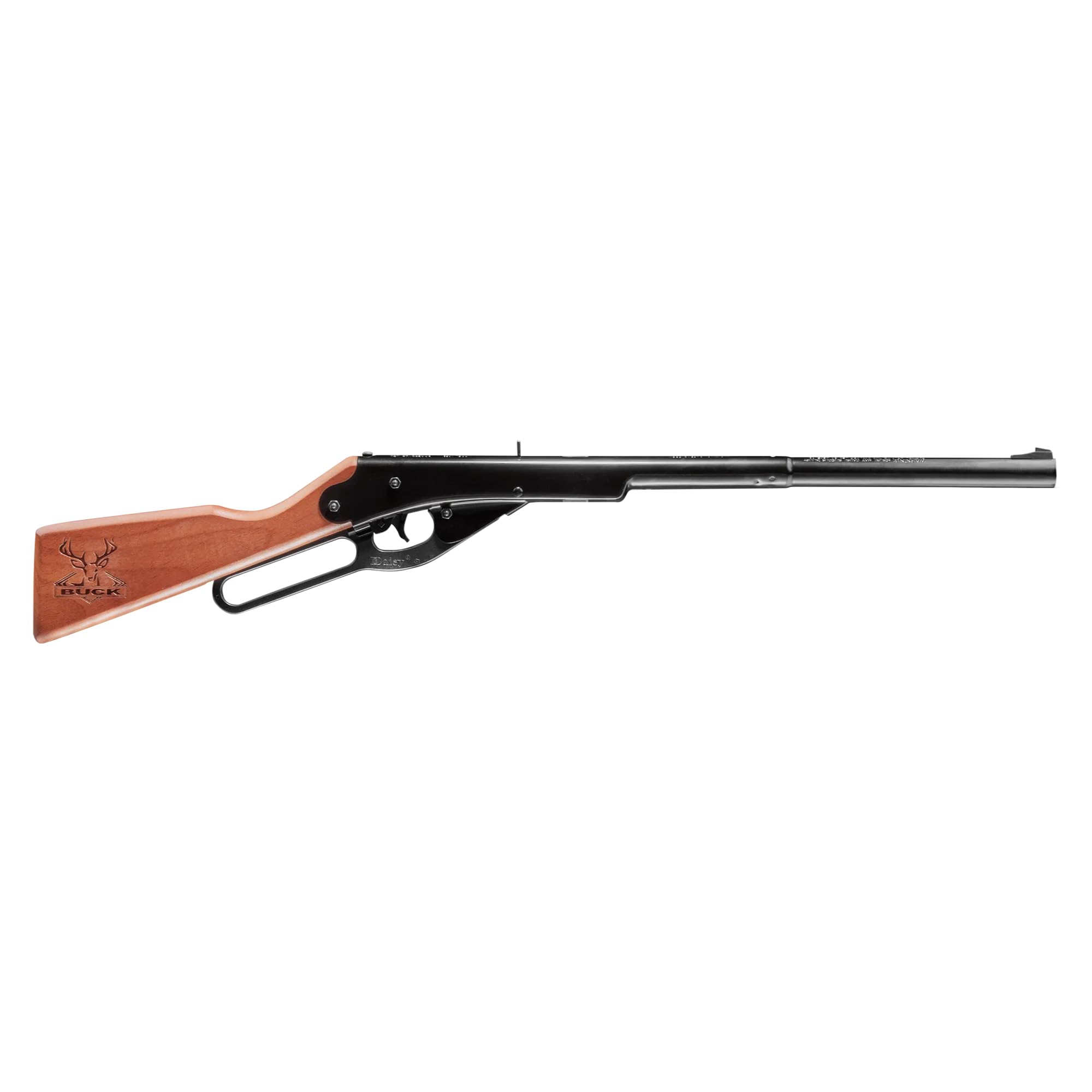
Daisy Buck Youth
Key Features
- Action: Lever-action
- Length: 30.75 in
- Velocity: 350 fps
- BB capacity: 400
At 30.75 inches, the Buck is 5.25 inches shorter than the Red Ryder, and that shorter stock is the first thing to check against a small shooter’s reach. It keeps the same 350 fps lever-action layout as the Red Ryder, so the power stays in the youth class and the manual cycle is still deliberate. The 400-shot reservoir is smaller, but still generous for backyard plinking.
We prefer the Buck for a child who cannot comfortably shoulder a 36-inch rifle. The shorter length lets them keep their cheek down and reach the lever without stretching, while the 2.2-pound weight is manageable, though it is actually a little heavier than the longer Red Ryder. The simple sights suit close targets, and the lever gives an adult an easy way to supervise each shot. Most kids will not outshoot the 400-shot reservoir in one session.
A stock that fits is not a luxury for a young shooter; it is what lets them stay steady enough to learn from each shot. The Buck is at its best on a close backyard target, where a child can see the hit and repeat the process.
Pros
- 30.75-inch length fits smaller shooters
- Same 350 fps youth power as the Red Ryder
- 400-shot reservoir limits reloads
- Lever action keeps each shot deliberate
Cons
- Durability can be inconsistent
The Buck is the one we hand to a smaller child: its 30.75-inch stock shortens the reach to the lever while keeping the same 350 fps youth power.
How We Tested Youth BB Guns
We started by comparing youth air rifles on paper: adjustable stocks, cocking effort, velocity ratings, sight type, and owner feedback on feeding and durability. From that pool, we narrowed to 12 guns that represent the sizes and styles families actually shop for, then spent four months using them the way a young shooter would—under adult supervision, with eye protection, and plenty of paper targets.
On a backyard range, we set up paper targets, soda cans, and spinner targets at 10, 15, and 20 yards. Each shooter fired bench-rested groups first, then standing, and we measured how tightly the shots landed and where accuracy began to fall off. We also logged every misfeed, jam, and hard-cocking complaint across 100-shot strings, then checked stocks and sights for wobble after repeated use.
Ease of use got its own pass: we watched kids load BBs, work the safety, and cock each gun while we timed the steps and noted where small hands fumbled. We asked each young shooter to hold and carry the gun unloaded, which made size and weight obvious fast—some stocks swallowed smaller frames, while short lengths of pull felt cramped for older kids. Fun was harder to score, but not mysterious: we paid attention to which guns kids reached for again without being asked, and which ones kept them engaged after the novelty wore off.
How to Choose a Kids Bb Gun
The right kids BB gun is the one a child can shoulder, cock, and load safely with you standing beside them, not simply the one with the highest velocity.
Fit Comes Before Firepower
A youth label is not a size guarantee. The two rifles here show the range: the Buck is 30.75 inches long, while the Red Ryder runs 36 inches. A shorter stock lets a smaller child keep their cheek on the comb and reach the lever without stretching; a longer one can leave them holding the rifle away from their body. Before you buy, have the child shoulder the rifle in a safe setting and check whether they can reach the lever and keep the muzzle pointed downrange. If the stock is too long, choose the shorter rifle rather than cutting one down.
Lever or Pump: Match the Action to the Child
Both of our picks are lever-action rifles, which we prefer for beginners because one firm stroke prepares each shot and the rifle cannot be fired again until the lever is cycled. A pump-action youth rifle can be a good step for an older kid who is ready for more deliberate pumping, but the extra motion and effort can be awkward for small hands. Watch the child cock the empty rifle several times. If they cannot complete the stroke smoothly while keeping the muzzle safe, the rifle is too much for them yet.
Treat Velocity as a Ceiling
Youth BB rifles commonly sit around 350 fps, and that is where we put the ceiling for a first rifle. Higher-velocity pump guns that reach 700 or 800 fps can punch harder, but they also demand more maturity, better eye protection, and a more carefully planned backstop. Variable pumping does not make a high-power rifle child-safe by itself; it just gives an adult another setting to supervise. Start at the lower end, shoot steel BBs at soft targets, and wear impact-rated eye protection.
Plan for Loading, Storage, and Wear
A 650-shot reservoir like the Red Ryder’s is a convenience, not a safety feature; you still load and unload with the muzzle pointed in a safe direction. Smaller reservoirs mean more handling of loose BBs, which is a good reason to keep a loading tray and an adult in charge of refills. Youth spring rifles can have mixed durability, so buy from a seller with an easy return, check the rifle before handing it over, and store it unloaded with BBs in a separate container.
Frequently Asked Questions
Do kids’ BB guns need CO2 cartridges or batteries?
Not these two. The Red Ryder and Buck are lever-action spring rifles, so the only consumable is .177 steel BBs; there are no cartridges or batteries to buy. That keeps the ongoing cost low and removes one thing that can go wrong at the range. Budget for BBs and impact-rated eye protection for everyone who shoots or watches.
How far should a child shoot a BB rifle?
Treat both rifles as close-range plinkers. The Red Ryder is at its best from about 10 to 20 yards, while the shorter Buck is a closer target rifle for young shooters. Set a paper or can target against a safe backstop, shoot from a bench or rest, and keep the distance short enough that the child can hit the target and learn from each shot.
Can I use pellets in the Daisy Red Ryder or Buck?
No. Both are .177 BB rifles with smoothbore barrels, so use steel BBs rather than pellets. Pellets belong in airguns designed for them, usually rifled models or dual-ammunition rifles. Stick with clean, round BBs, discard any that are dented, and keep the muzzle pointed at a safe backstop while loading.
Final Verdict
Buy the Red Ryder for most families. It keeps the first-rifle job simple: one lever stroke, 350 fps, a 650-shot reservoir, and a stock that feels like a real rifle. The shorter Buck is the better buy when a small child cannot comfortably shoulder a 36-inch gun; its 30.75-inch stock is the difference between pointing the rifle and properly holding it. If neither length fits, wait rather than moving to a higher-power pump.
