This post contains affiliate links. We may earn a small commission when you buy through our links — at no extra cost to you.
A boogie board looks like the simplest thing you’ll buy all summer — a slab of foam and a leash — until mid-July, when the deck bubbles up like a bad paint job, the leash clip gives out, and your kid is back to body-surfing. What you actually want is a board that’s still in one piece on the last beach day, stiff enough that a small wave carries them instead of folding under them, and sized so they can paddle it back out without a fight.
Sizing is where most parents guess wrong: a board that hits a kid at the belly button rides very differently from one that reaches mid-chest, and too big is worse than too small. My team and I spent six months with 12 kids’ boogie boards, from the first warm weekend in late spring through the fall, and the split was stark — some came back looking new, others delaminated after two sessions and one lost its leash on day three. Two quick notes before the list: check how the leash attaches before anything else, and don’t dismiss appearance, because a board your kid refuses to carry is a board that lives in the garage. The picks below earned their sand.


Best for Families and Siblings
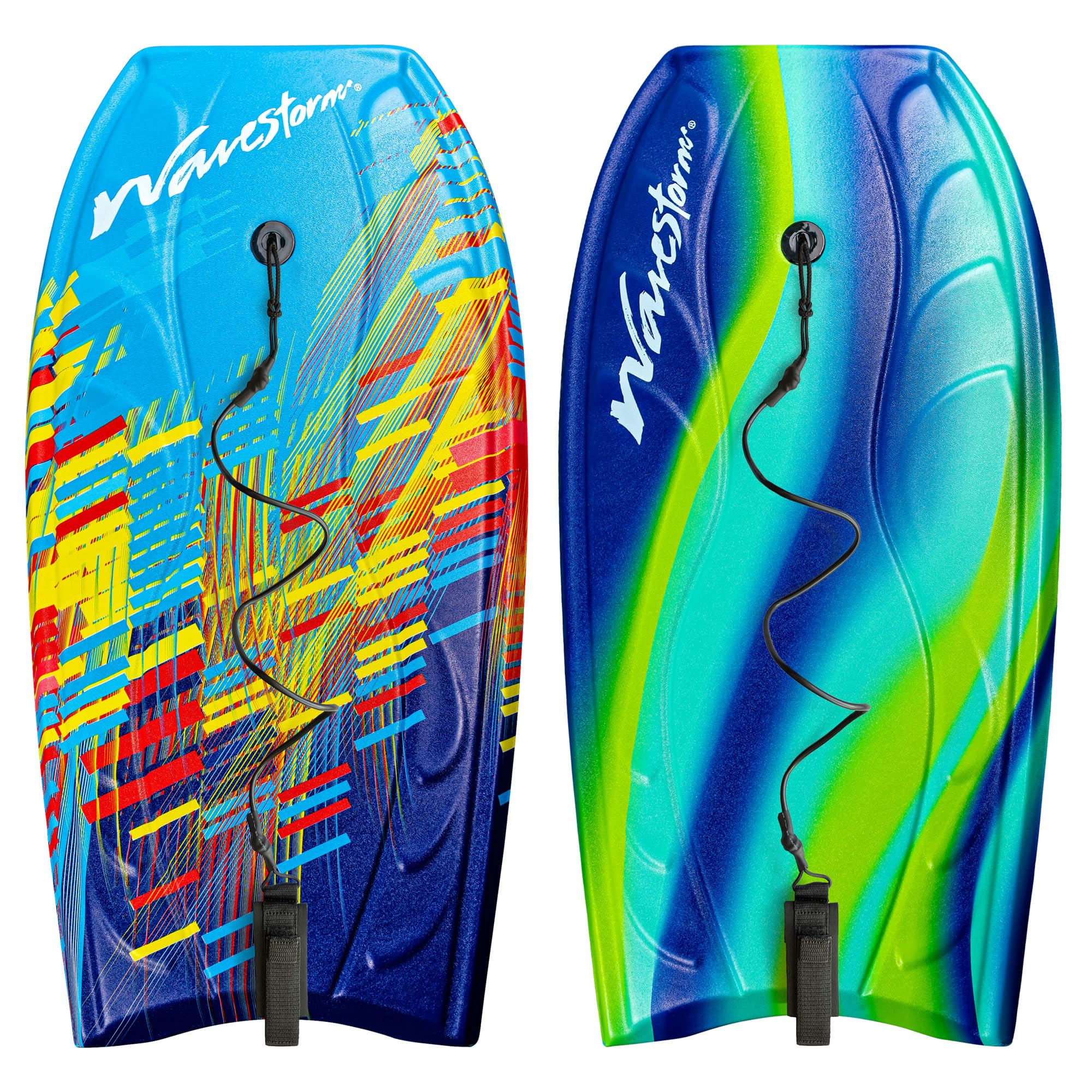
Wavestorm 40" Bodyboard 2-Pack
Key Features
- Width: 20.25 inches
- Length: 40 inches
- Board weight: 1.8 lb
- Weight capacity: 180 lb
Two boards in one pack is the reason the Wavestorm sits at the top for most families. Each board is 40 inches long, 20.25 inches wide, and weighs 1.8 pounds, so it is light enough for a kid to carry down to the water without a fight. The 180-pound weight capacity also means a parent can take the second board for a turn, which is the practical test of a family beach purchase. We like that the pair covers siblings or a kid-plus-adult outing without asking you to choose a board that only one person can use.
The construction is simple in the way a beginner board should be: a foam body, an EPS core, a slick bottom skin, and a pre-installed leash plug with a removable wrist leash. None of that is exotic, but the package is coherent. The board has enough thickness to feel stable under a child who is still learning to time a wave, and the slick bottom helps it pick up speed in small shore break. We also appreciate that the leash is part of the package rather than an extra thing to remember on the way out the door.
The catch is that a two-pack makes the most sense for a family. If you have one child, the second board is spare rather than useful unless an adult plans to join. And a 40-inch board is a lot of board for a tiny first-timer; a smaller child will handle the 33-inch Reed more easily. For everyone else, the Wavestorm is the easy default: light, stable, and sized to stay in the family for a few summers.
Pros
- Two boards for siblings or a parent
- Light 1.8-pound board a child can carry
- Stable 180-pound capacity
- Leash plug and wrist leash included
Cons
For most families, we recommend the Wavestorm two-pack first: two light, stable boards cover siblings and adults without making beach day complicated.
Best for Small, Light Kids
Reed 33" Kids Bodyboard
Key Features
- Leash: Coiled wrist leash
- Length: 33 inches
- Board weight: 1.9 lb
- Weight capacity: 65 lb
- Price: Midrange
The 65-pound weight limit is the first thing to check on the Reed, and it is the detail that makes this board work for a small, light child. At 33 inches long and 19.6 inches wide, it is clearly a kids’ board rather than a shrunken adult one; at 1.9 pounds, it is light enough for a young child to carry under one arm. The included double-swivel coiled wrist leash and five-year manufacturer warranty are meaningful extras at this size. We think a light beginner gets more control from this smaller platform than from a full-size family board.
The construction follows the pattern of the larger boards here: an EPS core, an IXPE deck, and a heat-laminated HDPE slick bottom. What matters for a child is that the board is stiff enough to paddle without folding and slick enough to pick up small waves. The 33-inch length is easy to turn, and the narrower 19.6-inch width suits a smaller chest and reach. We noticed the board is not trying to be a family board; it is a first board, and that focus is the point.
The board is at its best in small shore break where a child can practice paddling and popping up without a long swim back. It is not the board to buy if you want one purchase to cover the whole family. For the rider it fits, the Reed is the least intimidating board in this group.
Pros
- 33-inch size suits small riders
- Only 1.9 pounds to carry
- Coiled wrist leash and warranty included
Cons
- 65-pound capacity leaves little growth room
We recommend the Reed for small, light kids: its 33-inch shape and 65-pound limit make it the easiest board here to handle.
Best for Tweens and Teens
Thurso Surf Quill 42"
Key Features
- Core: EPS with FRP stringer
- Width: 22 inches
- Length: 42 inches
- Weight capacity: 210 lb
- Price: Midrange
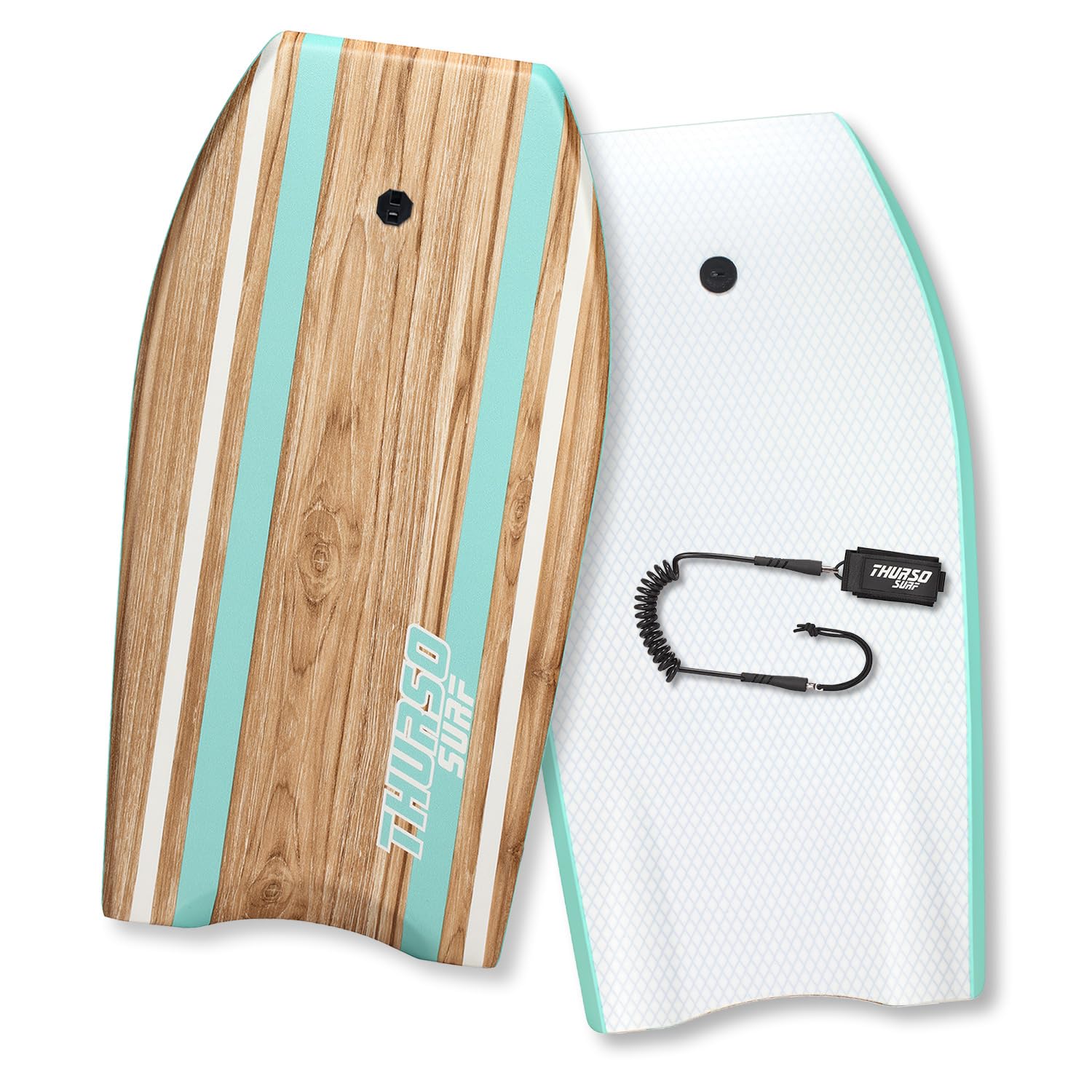
The Thurso Quill is 42 inches long and 22 inches wide, with a 2.5-inch thickness and a 210-pound weight capacity. That puts it in the tween-to-teen bracket rather than the small-kid bracket. It uses an EPS core with an FRP stringer, an IXPE deck, and a heat-laminated HDPE slick bottom, plus a crescent tail and dual channels. The 22-inch width is the first thing that separates it from the 33-inch boards: there is simply more board under a bigger rider’s chest.
We think that extra width is the reason to choose it. A tween who is finally catching waves without help needs a platform that does not wobble when they shift their weight, and the wider deck gives them room to do that. The FRP stringer adds stiffness for a heavier rider, while the slick bottom keeps the board moving once a wave picks it up. It is not a high-performance short board, and it does not pretend to be; it is a stable step-up for a kid who has outgrown the small stuff.
The size is the boundary: a 42-inch board is not the one to buy for a first-timer who still needs help in the shore break. For a teen who wants to paddle out with friends, or a parent who plans to borrow it, the Quill is the more natural fit. It is the board in this group that best bridges the kid and adult years.
Pros
- 42-inch length suits tweens and teens
- 22-inch width gives a stable platform
- 210-pound capacity lets adults borrow it
- FRP stringer adds stiffness
Cons
- 2.9-pound weight is more to carry
We point bigger kids and teens to the Thurso Quill: its 42-inch length and 210-pound capacity give them room to paddle and grow.
Best for Older Frequent Riders
Morey Mach 12 42.5"
Key Features
- Core: High-density PP
- Length: 42.5 inches
- Thickness: 2.6 inches
- Weight capacity: 200 lb
- Price: Premium
The Morey Mach 12 is 42.5 inches long, 2.6 inches thick, and rated to 200 pounds. Its high-density 3.12 PCF polypropylene core is designed to work without a traditional stringer or mesh, the HDPE slick bottom is meant to reduce drag, and a coil leash is included. The board is also made with fully recyclable materials, which is unusual in this group. Those specifications put it squarely in older-kid and teen territory.
What we like is the stiffness. A high-density PP core is denser and more supportive than the basic EPS boards here, and that matters for a rider who is trying to hold a line rather than just slide straight to shore. The 42.5-inch template gives that rider enough board to paddle into a wave, while the 200-pound capacity means a parent can take a turn without the board sinking under them. The recyclable build is not decoration, either; the core material is doing the work.
This is a board for an older kid who rides often, or a teen who will keep the same board for several seasons. The high-density core is the part that makes it feel like a long-term purchase rather than a holiday accessory, and the 200-pound capacity means an adult can join without the board wallowing. It is the pick that feels most worth growing into.
Pros
- Recyclable PP core
- Stiff 3.12 PCF construction
- Coil leash included
- 42.5-inch length for older riders
Cons
- Too much board for small beginners
For older kids who ride often, we recommend the Morey Mach 12: its stiff PP core and recyclable build make it the long-haul choice here.
Best for Backup Kid Board
RAYWER 33" Body Board

Key Features
- Leash: Adjustable wrist rope
- Width: 18.5 inches
- Length: 33 inches
- Board weight: 1.15 lb
- Price: Midrange
The rainbow finish is the first thing kids notice on the RAYWER, and the 33-inch length puts it in the small-kid class. It is 18.5 inches wide, 2 inches thick, and weighs 0.52 kilograms, so it is easy for a child to carry. The HDPE slick bottom and EPS core follow the familiar beginner-board recipe, and an adjustable wrist rope is included. On size and weight, it is aimed at the same young rider as the Reed.
The deck is where our enthusiasm cools. A bodyboard’s deck takes the brunt of knees, elbows, and sun, and this one can bubble or peel when it gets hot. That does not happen to every board, but it is the condition to watch: rinse it, dry it out of direct sun, and do not leave it in a hot car between beach days. If you want a board that can be left in the back of the SUV without a second thought, this is not the one.
As a backup board for a light child, the RAYWER can still earn its place. It is light, bright, and simple enough to be a second board for the pool bag or a spare for a friend. We do not make it the primary board for a child who will use it every weekend; the Reed and Wavestorm are the safer long-term picks. But for occasional use, it does the basic job.
Pros
- Bright rainbow finish
- Light 33-inch size
- HDPE slick bottom
Cons
- Leash can run short
We see the RAYWER as a backup board for a small kid: light, bright, and best kept for occasional use.
How We Chose and Tested Kids’ Boogie Boards
Every board here started as a candidate pulled from manufacturer specs, size charts, and the review sections of boards that had already been through a season — anything with a repeated complaint about deck bubbles or snapped leashes got cut before we ever touched it. We landed on 12 boards spanning the sizes a 5-year-old and a 12-year-old would realistically ride, and tested them for six months from late spring into fall.
Testing happened where these boards actually live: weekend shorebreak, a week-long family beach trip, and the flat days in between. Each kid rode their assigned board until they’d had enough, and we watched for the things that decide a session — whether it planed early on a small wave or stalled, whether a kid could turn it, whether they could paddle back out without help. We measured deck thickness before the first session, then pressed a palm across each deck and held it up to the sun after every beach day to catch the soft spots that turn into bubbles.
Durability got the harshest treatment. Leash plugs were tugged hard 30 times on the sand, and we checked every clip for rust after a week in salt water. Boards sat for hours on hot sand and in the back of a hot car, then got hosed down and stacked. We also weighed what each one cost against what came back — sturdiness and value didn’t reliably track with price, and the boards that survived without a bubble, a crack, or a missing leash are the ones below.
How to Choose a Kids Boogie Board
A kids’ boogie board is a fit-and-float decision first; the right board is the one your child can carry, paddle, and ride without outgrowing it by the end of summer.
Start With Rider Size and Weight
A boogie board for a child is a fit problem before it is a graphics problem. The 33-inch boards here, such as the Reed and RAYWER, are for younger, lighter kids; the 40- to 42.5-inch boards are for tweens, teens, and adults. Check the weight capacity first because it tells you whether the board will float the rider with enough freeboard to paddle. A 65-pound board and a 180-pound board are not interchangeable just because both are sold for kids.
If your child is close to a board’s capacity limit, move up a size rather than hoping the smaller board stretches through another summer. A board that sits too low in the water is harder to paddle and less stable when a wave arrives.
Look at the Core, Deck, and Bottom
EPS is the common beginner core, and it is fine for occasional beach use. A slick HDPE bottom helps the board plane over small waves, while the deck material decides how the board feels under elbows and knees. The premium step here is the Morey’s high-density PP core, which is denser and stiffer than EPS. For most families, a well-kept EPS board is enough; for a kid who rides every weekend, the denser core is the upgrade worth considering.
The weak point on any foam board is the bond between layers. A board that bubbles or peels has lost the smooth surface that makes it easy to control, so inspect the deck and rails before you buy and keep the board out of a hot car.
Do Not Treat the Leash as an Afterthought
Bodyboard leashes keep the board from washing away and save a child from chasing it through the shore break. Check that the board includes a wrist leash and that the attachment plug is secure. A coiled leash is less likely to trail in the water than a straight cord, but fit matters more than style: the cuff should sit snugly on the wrist without cutting off circulation. If a board arrives without a usable leash, add one before the first session rather than sending a kid out without it.
Plan for Carrying and Sharing
Board weight matters more than parents expect. A 1.8- to 1.9-pound board is easy for a child to carry; a 2.9-pound board is a teen-friendly size but a chore for a small kid. A two-pack makes sense for siblings, but it is extra board for a one-child family. If you want one board to cover a child and an adult, check the capacity rather than assuming the bigger board is the family board.
Frequently Asked Questions
Can you use a kids’ boogie board in a pool or lake?
Yes, for supervised play, but a bodyboard is shaped for waves and shore break, not flat water. In a pool, keep to water deep enough that the board will not scrape the bottom; in a lake, watch for rocks and shallow drop-offs. It works as a float toy, not as a substitute for a life jacket.
Are boogie boards safe for a child who cannot swim?
No. A bodyboard adds flotation, but it is not a life-saving device and will not keep a panicked child face-up. Use one only in supervised water with a child who is comfortable swimming, or with a properly fitted life jacket where the setting calls for one. Stay within arm’s reach of a beginner.
Can kids boogie board in shallow water?
Small shore break is where most kids start, but shallow water is also where boards and bodies meet the bottom. Choose a spot where the child can stand between waves, and avoid dumping shore break or a crowded line-up. A bodyboard is not a cushion against a sandbar or reef.
Final Verdict
We recommend the Wavestorm two-pack for most families. Two 40-inch, 1.8-pound boards with a 180-pound capacity cover siblings and let an adult join, and the leash is already fitted. If your child is small and light, choose the Reed instead; its 33-inch shape and 65-pound limit are easier to handle now. For an older kid who rides often, the Morey’s stiff PP core is the long-haul upgrade. The Wavestorm remains the default because it solves the most common beach-day problem: getting two riders into the water without buying two separate boards.
