This post contains affiliate links. We may earn a small commission when you buy through our links — at no extra cost to you.
A baby who arches away from the bottle and spits up after every feed can make mealtime feel like a losing battle. Reflux formula is not a cure, but the right one can bring calmer feeds, fewer outfit changes, and a baby who finishes the bottle. Over six months, my team and a panel of parent testers tried 12 formulas for reflux and sensitive tummies — mixing bottles at 2 a.m., packing them for daycare, and watching what happened after burps and diaper changes.
The pattern was not as simple as thicker equals better. We read ingredient panels, compared protein sources, and checked cost per prepared ounce and how each powder mixed — clumps, foam, and whether it stayed smooth through a feed. Taste and smell mattered more than I expected, especially for babies already refusing bottles. We tracked spit-up, gas, and diaper changes over trials, because tolerance matters as much as the first calm afternoon. The picks below are the ones that held up; if you suspect a milk protein sensitivity rather than plain reflux, ask your pediatrician before switching.



Best for Frequent Spit-Up
Enfamil A.R.
Key Features
- Age: 0–12 months
- Size: 19.5 oz
- Protein: Milk-based
- Reflux approach: Rice-starch thickener
- Price: Midrange
The first thing you notice about Enfamil A.R. is that it is not a gentle formula in the usual sense. Rice starch is added to thicken the feed, and that is the whole point: it is designed for frequent spit-up rather than general fussiness. Enfamil’s claim is that it reduces frequent spit-up by more than half in one week, and the label says it meets the reflux-reduction guidelines set by the American Academy of Pediatrics. We like that it gives you a concrete reason to choose it over a standard gentle powder.
It can foam, so swirl rather than shake and give the bottle a minute to settle. Powder also means you need a consistent mixing routine, and a pitcher helps if you make several bottles at once. Those are small adjustments compared with the aim, but they are real, and they matter at 3 a.m.
We also appreciate that A.R. stays a complete infant formula rather than a cereal add-in. You are not guessing at the ratio or adding rice to a bottle yourself, which is the more controlled way to get the thickening effect. The can is a standard powder format, so it travels well once you portion it, though you need to keep the mixing routine consistent. It is the only formula here that treats thickness as the main event.
Pros
- Rice starch targeted at frequent spit-up
- Reflux-specific recipe with AAP-aligned claim
- Complete formula, not a cereal add-in
Cons
- Thickened feed may need a faster nipple
- Not for suspected milk-protein allergy
When spit-up is the main problem, Enfamil A.R. is the can we put first: its rice starch is aimed squarely at frequent reflux, not just general fussiness.
Best for Suspected Milk Allergy
Similac Alimentum
Key Features
- Form: Ready-to-feed, 8 oz cans
- Pack: 24 cans
- Protein: Extensively hydrolyzed
- Key feature: 2′-FL HMO
- Price: Premium
Sometimes reflux is not simple spit-up. If a baby is arching, crying after feeds, or reacting to standard cow’s-milk formula, the next step is often an extensively hydrolyzed formula like Similac Alimentum. The milk protein is broken into tiny pieces, which is what makes it hypoallergenic rather than merely gentle. It is a different tool from a rice-starch anti-reflux formula, and that distinction matters before you buy.
We like the ready-to-feed format for the first weeks of a formula trial. You are not committing to a full can of powder before you know whether your baby tolerates it, and the small cans are easy to keep by the crib or pack in a diaper bag. The formula also includes 2′-FL HMO, an immune-nourishing ingredient, and Similac’s claim is that it can start reducing colic symptoms from protein sensitivity within 24 hours in most infants. That is a meaningful claim for a distressed household, though it is not a guarantee.
The limitation is the one that comes with the category: this is a specialist formula, not a casual swap. It is meant for babies with a suspected or diagnosed milk-protein allergy, and it is not the first thing to try for ordinary gas and fussiness. If your baby is simply uncomfortable after feeds, a gentler standard formula is the better first move. For the right baby, though, the difference is not marginal.
Pros
- Extensively hydrolyzed for suspected milk allergy
- Ready-to-feed bottles for easy night feeds
- Includes 2′-FL HMO for immune support
- Fast colic-symptom relief claim
Cons
- Premium price for a specialist formula
- Can cause constipation in some babies
If you suspect a milk-protein allergy behind the crying and spit-up, Similac Alimentum is the hypoallergenic pick we trust for the first trial, especially in ready-to-feed bottles.
Best for Gas and Fussiness
Good Start Soothe Pro
Key Features
- Form: Powder
- Size: 30.6 oz
- Protein: 100% whey, partially hydrolyzed
- Probiotic: L. reuteri
- Price: Budget
Not every reflux baby is a volume spitter. Some are gas machines: knees to the chest, grunting, and a bottle that takes an hour to get through. Good Start Soothe Pro is aimed at that baby. It uses 100% whey protein, partially hydrolyzed in a two-step process, plus the probiotic L. reuteri, and the brand’s claim is that it can reduce fussiness with the first bottle. It is not a dedicated anti-reflux formula, but it is a sensible first gentle powder when gas and fussiness dominate.
The value story is strong. A large can makes it one of the better-value gentle powders here, and the formula mixes smoothly enough for a standard pitcher or bottle. The protein is entirely whey, which the brand says avoids the curdling associated with casein. In practice, that is the kind of detail that can make a bottle feel less heavy for a sensitive tummy.
Spit-up is where it is less certain. The formula is aimed more at gas and fussiness than at frequent, volume reflux, so it is not the can to choose if spit-up is the defining problem. Enfamil A.R. is the more targeted pick for that. Soothe Pro earns its place for the gassy, uncomfortable baby who needs a gentler everyday formula without paying specialist prices.
Pros
- 100% whey, partially hydrolyzed protein
- L. reuteri probiotic for gut support
- Good value in a large can
Cons
- Can cause constipation in some babies
For the gassy, fussy baby who is still spitting up, Good Start Soothe Pro is the gentle powder we choose when we want a lower-cost, everyday option.
Best for Everyday Gentle Feeding
Enfamil Gentlease
Key Features
- Form: Powder
- Size: 19.9 oz
- Protein: Easy-to-digest milk proteins
- Key feature: DHA and choline
- Price: Midrange
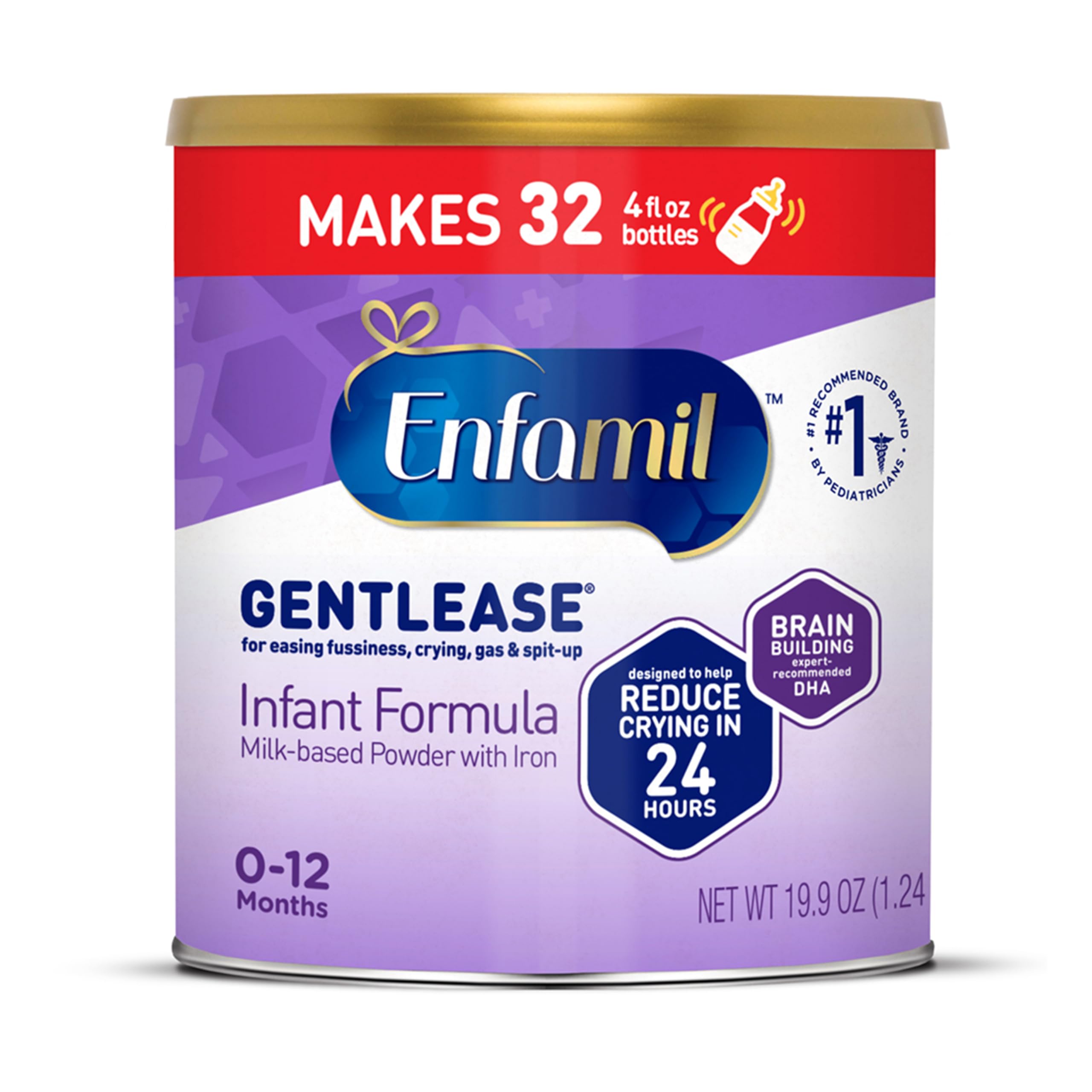
Gentlease is the gentle formula that shows up in nearly every diaper bag and supermarket aisle for a reason. It uses easy-to-digest milk proteins, and Enfamil’s claim is that the recipe eases fussiness, crying, gas, and spit-up within 24 hours. It is not as targeted as A.R. for volume spit-up, but it is broader than a specialist formula and easier to live with day to day. That balance is why it remains a mainstream pick.
We like the powder for a first gentle trial. It mixes cleanly, the can is a practical size, and the texture is light enough for a standard nipple, so you are not automatically changing your bottle setup the way you might with a thickened anti-reflux formula. It is also one of the more affordable gentle formulas here, which matters because formula is a recurring cost, not a one-time purchase.
The trade-off is that gentle is not the same as anti-reflux. It is not the can to choose if spit-up is the main event; A.R. is the more targeted pick. If you want a lower-cost gentle powder for gas and general fussiness, Gentlease is the one we reach for.
Pros
- Easy-to-digest milk proteins
- Claims to ease fussiness, gas, and spit-up in 24 hours
- Affordable gentle powder
- DHA and choline for brain support
Cons
- Can cause constipation in some babies
Enfamil Gentlease is the gentle formula we keep coming back to for everyday fussiness and gas, especially when you want a familiar powder that is easy to find and easy to mix.
Best for Organic Gentle Feeding
Earth’s Best Organic Gentle
Key Features
- Form: Powder
- Size: 21 oz
- Protein: Easy-to-digest milk proteins
- Key feature: Organic milk
- Price: Midrange
Organic formula used to feel like a compromise: you paid more and gave up some of the digestive engineering. Earth’s Best Organic Gentle is the pick here that makes the least of that trade-off. It uses organic milk from grass- and grain-fed cows, with lutein, prebiotics, DHA, and ARA, and the proteins are partially broken down for easier digestion. For a parent who wants an organic can without abandoning a gentle formula, it is a credible choice.
The formula is easy to mix and has a consistency that works in a standard bottle. It is positioned for fussiness, gas, and crying due to upset tummies rather than making a hard reflux claim. That honesty matters: it is a gentle formula, not an anti-reflux formula. If your baby has frequent, volume spit-up, Enfamil A.R. remains the more targeted choice. If you are supplementing breast milk or want an organic everyday powder, Earth’s Best is a comfortable fit.
We like it most as an organic option for mild sensitivity, not as a reflux cure. The caveats are the usual organic ones: it costs more than the conventional gentle powders, and it is not the can to choose if spit-up is the main problem. The formula also has a distinct smell that some babies notice. If organic ingredients are the priority and the symptoms are mild, it earns its place; if reflux is severe, start with a more targeted formula.
Pros
- Organic milk from grass- and grain-fed cows
- Easy-to-digest proteins for sensitive tummies
- Lutein, prebiotics, DHA, and ARA
- Mixes easily for everyday bottles
Cons
- Premium price for organic formula
- Can still cause gas in sensitive babies
If organic ingredients are non-negotiable, Earth’s Best Organic Gentle is the gentle formula we recommend first, provided you are not expecting a dedicated reflux thickener.
Best for Travel and Night
Similac 360 Sensitive

Key Features
- Age: 0–10 months
- Diet: Kosher, halal, gluten-free
- Form: Ready-to-feed
- Volume: 24 fl oz
- Price: Premium
At 2 a.m., a ready-to-feed bottle is not a luxury; it is the difference between a feed and a project. Similac 360 Total Care Sensitive comes in pre-mixed bottles, so there is no scooping, no pitcher, and no trying to remember whether you counted the right number of scoops. That is the entire appeal.
The formula is labeled sensitive and is kosher, halal, and gluten-free, which helps in a mixed household or daycare setting. It is not a thickened anti-reflux formula, though, so it does not do the job of A.R. for frequent spit-up. Think of it as a convenience formula for a baby who already tolerates a sensitive powder, or as a short-term trial when you are away from home.
We like it most as a travel and night-feed tool. The small pack is easy to try without committing to a case, and the bottles are ready when a baby is too hungry to wait. The downside is volume: a small pack disappears quickly if you use it for every bottle. For convenience, it earns its place. For reflux, it is a supporting player.
Pros
- No mixing or measuring required
- Small pack suits travel and night feeds
- Kosher, halal, and gluten-free
Cons
- Premium ready-to-feed price
For travel, night feeds, or a short trial, Similac 360 Total Care Sensitive ready-to-feed bottles are the convenience pick we keep for the diaper bag, not the can we choose for heavy spit-up.
How We Tested Reflux Formulas
We built the shortlist by scanning formulas marketed for reflux, sensitive tummies, and spit-up, then reading ingredient panels and comparing protein sources, added thickeners, scoop sizes, and price per prepared ounce. We also checked whether each formula was easy to restock and whether it had a clean recall history. That cut the list to 12 formulas, which we tested over six months with parent testers and our own families.
Each formula went through the same real-life scenes: one-handed bottle prep at 2 a.m., a shaker bottle rattling in a daycare bag, an evening feed when everyone was already tired, and the burp-and-diaper check that follows. We watched how the powder dissolved — clumps at the bottom, foam on top, or a bottle that thickened before the baby finished — and noted the smell and first taste, since a baby who turns away is not getting any benefit.
Parents kept simple logs over each trial period, noting how much of the bottle was finished, how often the baby spit up within 30 minutes of a feed, and what burps and diapers looked like. We tracked gas and fussiness, and whether a baby who had been squirming through feeds seemed more comfortable as the trial went on. We followed each family’s pediatrician-approved switch schedule rather than swapping overnight. Price came last, calculated by the prepared ounce, because a formula that gets refused is expensive at any sticker price.
How to Choose a Formula for a Reflux Baby
The right reflux formula depends less on the thickest recipe than on whether your baby is spitting up, gassy, or reacting to milk protein.
Match the formula to the symptom
Start with what you see after a feed. Frequent, volume spit-up points toward an anti-reflux formula thickened with rice starch, like Enfamil A.R., because the thicker feed is harder to bring back up. Gas, grunting, and general fussiness point toward a partially hydrolyzed gentle formula such as Good Start Soothe Pro or Enfamil Gentlease. If the baby is arching, crying after feeds, or reacting to standard cow’s-milk formula, that is a different problem: ask your pediatrician about an extensively hydrolyzed formula such as Similac Alimentum. The trap is assuming gentle means anti-reflux. It does not; a gentle formula may ease digestion without doing much for volume spit-up.
Read the protein line
The protein is where the real difference sits. Partially hydrolyzed formulas break milk protein into smaller pieces to make it easier to digest; they are the right first step for gas and fussiness. Extensively hydrolyzed formulas break it down much further and are designed for suspected cow’s-milk protein allergy. A standard milk-based anti-reflux formula is not hypoallergenic, even though it is gentle on spit-up. If your baby has a diagnosed allergy, a gentle formula is not a substitute for the hypoallergenic type. Look for the words extensively hydrolyzed or hypoallergenic on the can, and confirm the choice with your pediatrician.
Prepare for a thicker feed
Anti-reflux formulas with rice starch pour thicker than standard powder, and that changes the bottle routine. A newborn nipple can be too slow, so keep the next flow size on hand before the first feed. Swirl the bottle instead of shaking it to cut down on foam, and give it a minute to settle. Do not add rice cereal or extra thickener to a standard formula unless your pediatrician directs it; using a formula that is already thickened is the more controlled route. Ready-to-feed bottles are the easier travel option, but they cost more per feed than powder.
Budget for the can, not the first bottle
Formula is a recurring cost, and the specialist cans are the ones that sting. Hypoallergenic formulas are the most expensive category here, while large gentle powder cans such as Good Start Soothe Pro give you more prepared formula for the money. Start with the smallest size that lets you judge tolerance, then move to a larger can once your baby is settled. Watch stools, gas, and comfort before you decide, rather than switching after one bad bottle. If a formula seems to help, the cheapest version you can reliably find is usually the right one to keep.
Frequently Asked Questions
How long should I give a reflux formula before deciding it is not working?
Give it several days, not one bottle. Some formulas claim improvement within 24 hours, and Enfamil A.R. claims a reduction in frequent spit-up over one week, but you are looking for a trend in comfort, spit-up volume, and diapers. If symptoms are getting worse, or your baby is vomiting forcefully or not gaining weight, stop trialing and call your pediatrician.
Is soy formula better for reflux?
Not automatically. Soy formula is not a standard treatment for reflux, and it is not the same as a hypoallergenic formula for cow’s-milk protein allergy. Some babies with reflux also react to soy, so switching on your own can add confusion. Ask your pediatrician before trying soy, especially if there is blood in the stool, eczema, or poor weight gain.
Can I warm ready-to-feed formula?
Yes. Serve it at room temperature or warm it gently in a bottle warmer; do not microwave it. Once a bottle is started, follow the label’s discard time. Ready-to-feed formula is convenient, but it still needs the same feeding hygiene as powder, so wash your hands and keep unused cans closed and cool.
Final Verdict
Enfamil A.R. is the formula we recommend first when spit-up is the defining problem. The rice starch is not a gimmick; it is the closest thing here to a purpose-built reflux formula, and it stays a complete infant formula rather than a cereal add-in. If your baby is gassy and fussy rather than a frequent spitter, Good Start Soothe Pro is the gentler, lower-cost everyday pick. If you suspect a milk-protein allergy, skip the gentle formulas and ask your pediatrician about Similac Alimentum.
