This post contains affiliate links. We may earn a small commission when you buy through our links — at no extra cost to you.
At 3 a.m., nobody is whisking. You’re holding a baby on one hip, a bottle in the other hand, and shaking powder into water with whatever wrist mobility you have left — which is how you end up with clumps stuck to the bottom of the bottle and a foam cap that seems to bother your baby more than it bothers you. A formula mixing pitcher fixes both at once: you make a batch ahead, the powder dissolves fully, and the bubbles settle out before the bottle ever reaches your kid. It’s a small, inexpensive piece of plastic that quietly removes one decision from your night.
I’ve mixed a lot of bottles, and over the past five months my team and I have put 14 pitchers through the wringer: night feeds, Sunday batch prep, the dishwasher, the fridge door. What separates them is boring — whether the handle feels solid when the pitcher is full, whether the lid seals when you shake it, whether the ounce markings survive a few months of washing. The picks below are the ones that managed all three.


Best for Daily Formula Batches
Dr. Brown’s Formula Mixing Pitcher
Key Features
- Lid: Locking, no-drip spout
- Care: Top-rack dishwasher safe
- Mixing: Blade with adjustable stopper
- Capacity: 36 oz
- Price: Budget
Thirty-six ounces is four eight-ounce bottles, which is the whole point of owning a pitcher: mix once in the morning and you’re covered until bedtime. This is the one we hand to a first-time formula feeder, and the adjustable stopper is why. It keeps the mixing blade from rising above the liquid line, so the powder gets stirred into the water rather than whipped through the air above it. Fewer bubbles, less foam, and bottles you can feed straight away instead of leaving to settle on the counter.
The rest of it is quiet competence. The lid locks, the spout doesn’t drip, and pouring into a narrow bottle neck doesn’t leave a ring behind. It breaks down into four pieces — pitcher, blade, stopper, lid — and all of them go on the top rack of the dishwasher. Five inches across and eight tall, it takes a fridge door shelf without a fight and holds a batch at an angle in a crowded fridge. Plunge with the jug flat on the counter, though; lean on it and formula comes out over the top. That’s a habit, not a fault, and it takes about one batch to learn.
What it doesn’t offer is a choice of material. The body is plastic, so if you’ve decided against plastic for warm formula there’s nothing here for you, and the glass picks below are the answer. Those four parts are the other small tax — more washing than a single jug, though they rinse in seconds before they go in the rack. Everything else about it is the least complicated version of this job we’ve used, and the cheapest way to stop hand-shaking bottles every night.
Pros
- Mixes 36 oz, four bottles, in one go
- Stopper keeps the blade under the surface
- Locking lid with a no-drip spout
- Cheapest pitcher in this group
Cons
- Plastic body only, with no glass version
- Four separate parts to wash after each batch
Our default recommendation for most families: a four-bottle batch mixed without foam, a lid that pours clean, and the lowest price in this group.
Best for Glass with Dating
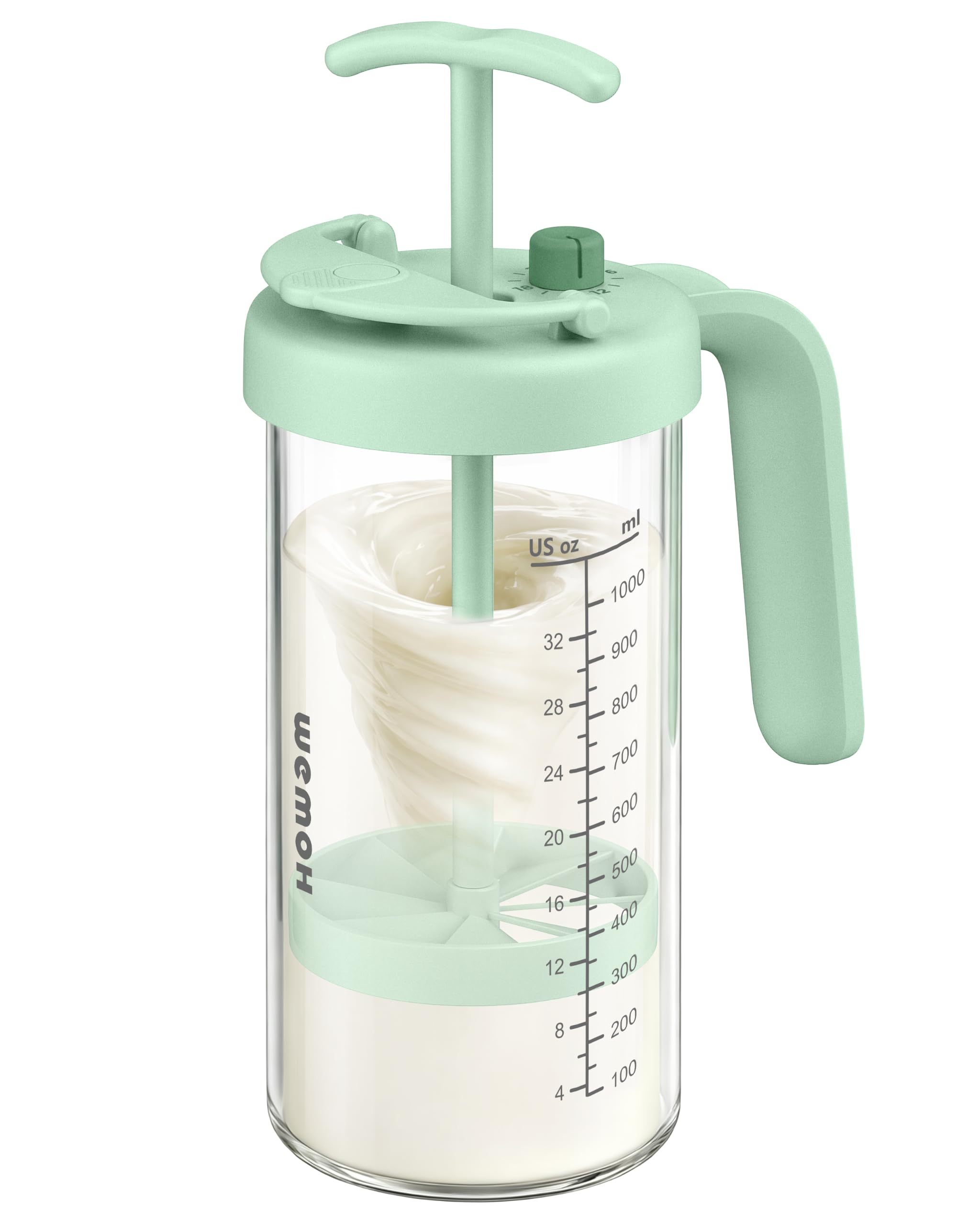
WEMOH Borosilicate Glass Pitcher
Key Features
- Mixing: Straight-rod handle
- Capacity: 32 oz (36 oz total storage)
- Material: Borosilicate glass
- Freshness: Hour dial in lid
- Price: Premium
A dial set into the lid sounds like a gimmick until it’s late, the fridge is full, and you can’t remember whether the batch in front of you went in this morning or yesterday morning. WEMOH’s version rotates to the hour you mixed, so the answer sits on the lid instead of in your head. Given how hard the clock runs on prepared formula, that’s a small feature doing real work.
We rate it highly for a second reason: this is the better of the two glass pitchers here. The borosilicate body is rated to move from a cold fridge into hot water without cracking, though we still warm it gradually rather than testing that claim in the sink. Thirty-two ounces is a true 32 ounces with headroom above it, so you’re not filling to the lip and wearing the last of the batch. The straight-rod handle blends a full jug without clumps and without a foam cap, and every part is dishwasher safe.
Two things to plan around. Glass is heavy and unforgiving, so wash it in a basin rather than under a running tap — a slip into a steel sink ends the pitcher. And the dial tracks the hour, not the day, so a batch that will sit overnight still wants a strip of tape and a marker. Neither is a reason to avoid it. If you’ve been uneasy about warm formula sitting in plastic, this is the pitcher that answers that, and it’s the nicest object in this group to use.
Pros
- Borosilicate glass rated for hot and cold swings
- Freshness dial marks the hour it was mixed
- Full 32 oz fill with headroom above it
Cons
- The priciest pitcher in this group
The glass pitcher we keep coming back to: borosilicate, a true 32-ounce fill, and a dial that tells you when the batch was mixed.
Best for Hands-Free Night Feeds
Tenmonth Electric Formula Mixer
Key Features
- Care: Dishwasher safe except lid
- Power: 3 AA batteries
- Mixing: Motorized, one-touch
- Capacity: 28 oz (830 ml)
- Price: Midrange
There is one moment this pitcher is built for: one hand holding a baby, one hand free. Press the button and a wand turns through 28 ounces without you holding a plunger or counting strokes. We think that’s worth paying for in the first few months, when three bottles seem to be needed at once. The wand reaches the corners of the jug, which is exactly where thick and hypoallergenic powders sit and sulk.
Everything else is ordinary in a good way. The markings are clear enough to hit a water-to-powder ratio without squinting, the lid locks and the spout doesn’t drip, and the whole thing weighs about a pound, so it travels to a grandparent’s house without a second thought. It runs on three AA batteries, which aren’t in the box; the maker rates a set at 730 two-minute mixes, so keep spares in the diaper bag rather than discovering the problem at midnight.
The motor and the battery bay are the two things a manual pitcher doesn’t have, and they’re the only parts that can let you down. Buy it somewhere with an easy return and use it hard in the first month. Twenty-eight ounces is also the smallest batch in this group — three and a half bottles — which is fine for one baby and tight for two. If you want the stirring handled for you, none of that will matter.
Pros
- One-button mixing leaves a hand free
- Wand reaches the corners of the jug
- About a pound, so it travels easily
Cons
- AA batteries aren’t included; budget for spares
- Lid is hand-wash only
Buy this one if you want the mixing done for you; it’s the only electric pitcher here, and one-handed bottle prep is exactly what it’s built for.
Best for Wide-Mouth Glass Prep
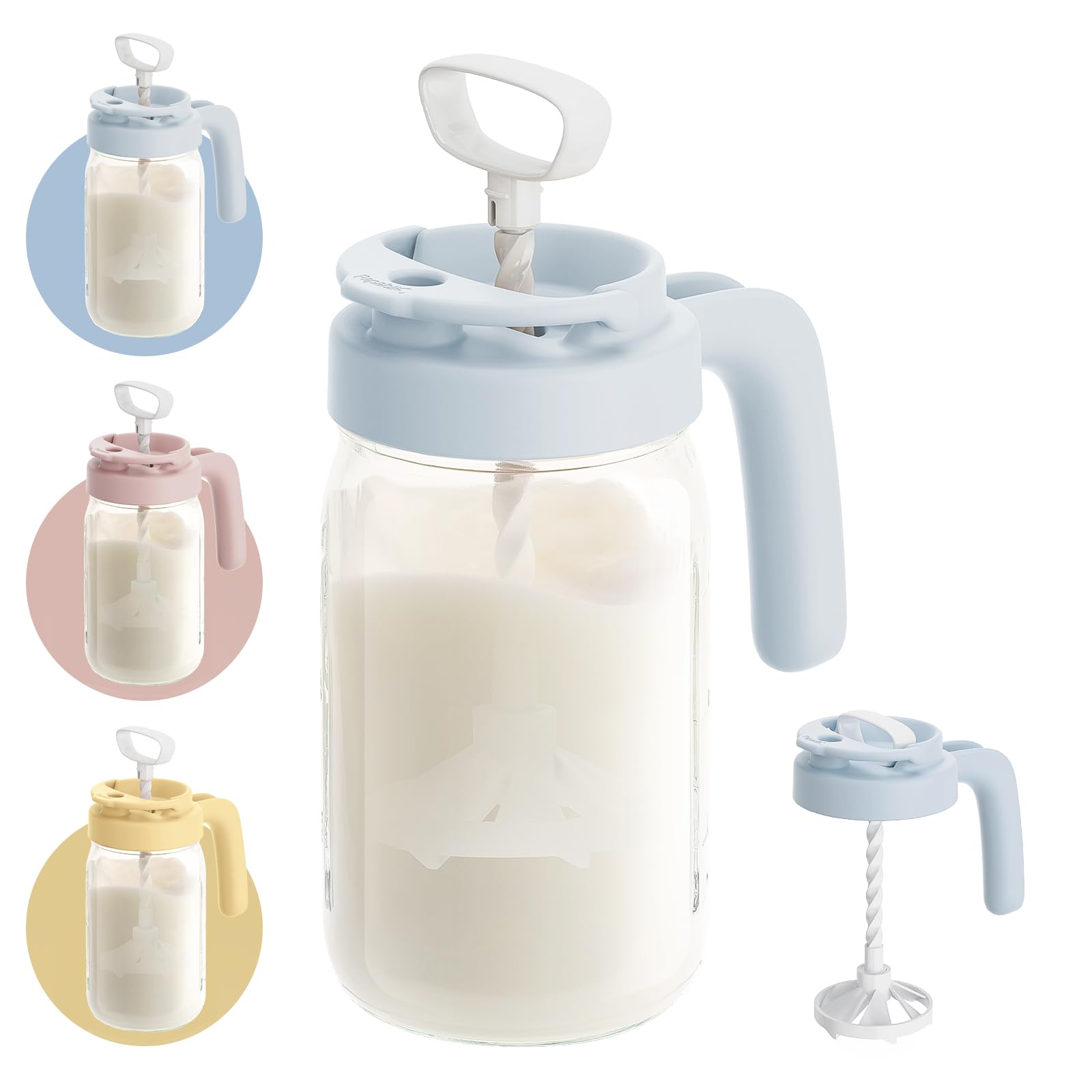
Papablic Glass Breast Milk Pitcher
Key Features
- Care: Top-rack dishwasher safe
- Mixing: Integrated handle
- Material: Glass with BPA-free lid
- Dimensions: 5.5"W x 7.5"H
- Price: Premium
A mason jar with a mixing handle running through the lid is a sensible shape for this job, and Papablic’s version is the one to look at if you want glass without a dial or a battery. The mouth is wide enough to get a hand and a bottle brush inside, the glass is thick, and the whole thing is compact — five and a half inches across, seven and a half tall — so it sits on a shelf rather than taking one over.
It handles formula and pumped milk the same way: water in first, powder second, work the handle up and down until the jug is even. It blends a full batch without clumps, and smooth glass doesn’t hold onto the film a scratched plastic jug does, which matters more than it sounds when you’re washing it twice a day. The lid seals well enough for the walk from counter to fridge, everything is top-rack dishwasher safe, and it takes a standard mason jar lid, so the mixing lid can come off once the batch is made.
What you accept for the glass is weight: about a pound and a half empty, the heaviest pitcher here, which you notice with a baby on the other arm. It’s also why the jar feels as solid as it does. Fill it over the counter rather than the sink and it’s a pleasant thing to use. If the mason-jar shape suits your fridge and your dish rack, this earns its spot; if what you want from glass is the smoothest possible mix, the WEMOH is the one.
Pros
- Wide mouth makes filling and scrubbing easy
- Takes a standard mason jar lid
- Compact footprint for a crowded shelf
Cons
- Mixing handle can stick on the return stroke
- About a pound and a half empty
A wide-mouth mason jar with a mixing handle through the lid is the friendliest thing here to fill and scrub, and that’s most of why it’s on this list.
Best for Twins, Big Batches
AIIHAC 64 oz Mixing Pitcher

Key Features
- Mouth: 4.5 in inner diameter
- Mixing: Angled blade and plunger
- Capacity: 64 oz / 2000 ml
- Material: Polypropylene
- Price: Midrange
Sixty-four ounces is two liters — eight bottles, or a full day for twins. Hardly anyone needs that, and the people who do need it badly: a parent mixing for two babies, or anyone filling a day’s worth of bottles before work. This is the only pitcher in the group that holds it, and it’s worth saying plainly that the extra capacity is also extra fridge.
The plunger is the part we liked. Pulling straight up through the jug is easier on the wrist than cranking a handle, and the angled blade on the end moves through the water instead of skating around it. The mouth is about four and a half inches across — wide enough to fill from the tap without splashing and to get a brush inside. It has done double duty for iced tea in our kitchen, which is the sort of second job a two-liter jug makes easy.
Two catches worth measuring. The jug is nearly eleven inches tall and close to eight wide, so check the shelf before you commit; it won’t slide under a low drawer. And the plunger stops short of the base, so the last of the powder wants a quick swirl of the jug to catch — a five-second habit, not a dealbreaker. For one baby, a 36-ounce pitcher is easier to live with; for two, or for a full day away from the kitchen, this is the one that earns the shelf space.
Pros
- Holds a two-liter batch for twins or daycare
- Plunger mixes with one hand
- 4.5-inch mouth fills and cleans easily
Cons
- Nearly 11 inches tall; check shelf clearance
- Plunger stops short of the base
Twins or a full day of daycare bottles change the math; this is the only pitcher here that mixes two liters at once, and the plunger works one-handed.
How We Mixed, Poured, and Washed 14 Pitchers
We started by gathering every pitcher sold specifically as a formula pitcher rather than a general kitchen measuring cup, which trimmed the field fast. From about 30 candidates we narrowed to 14 based on capacity (most households want a full day of bottles in one batch), whether the lid locked down, and whether the markings were printed clearly in ounces and milliliters instead of vague lines that disappear in a dim kitchen. None of these cost much, so a pitcher that dripped or cracked had no excuse.
Each pitcher went home with a tester and lived on the counter next to the bottles for five months. We used them the way anyone actually does: prepping a night’s worth of bottles before bed, mixing powder into cold tap water, and pouring into narrow bottle necks one-handed while something else occupied the other arm. We watched whether powder sank into a paste at the bottom, whether a few swirls did the job or it took real agitation, and how long the foam took to settle before we’d hand a bottle over.
Durability and leaks got their own rounds. Every pitcher ran through the top rack of a dishwasher at least a dozen times, and we dropped full ones onto the counter to see whether the handle flexed or the plastic split at the seam. We filled each to its top line and carried it across the kitchen one-handed to judge the handle, then laid it on its side in the fridge overnight and shook it hard with the lid on to check the spout and gasket. Leftover formula sat until morning before washing, because that’s what happens in real life.
Cleanability came last: hand-washing with a bottle brush to see whether the inside corners of the spout were actually reachable, then checking after a month whether the printed markings had faded or the plastic had gone cloudy. Value, in the end, was less about the sticker than about whether a pitcher still looked and worked like new after all of that — a cheap one you replace twice isn’t cheap.
How to Choose a Formula Mixing Pitcher
The right pitcher matches your batch size, your fridge shelf and your tolerance for washing parts — not the one with the longest feature list.
Batch size, and the fridge space it costs you
Start with how many bottles you make in a day. Thirty-six ounces is four eight-ounce feeds, which is why the Dr. Brown’s pitcher suits most single-baby households; 28 ounces lands closer to three and a half bottles. Bigger isn’t automatically better, because prepared formula is working against a clock and a two-liter jug makes a batch that has to be finished on schedule.
Then measure the shelf. The AIIHAC jug stands nearly eleven inches tall, so it won’t slide under a low dairy drawer, while the Papablic jar is compact enough to sit on a shelf rather than own it. A pitcher that doesn’t fit gets left on the counter, and formula left on the counter is formula you throw away.
Blade, plunger or motor: how the powder meets the water
The mechanism is what you’re actually paying for. Dr. Brown’s pairs a blade with an adjustable stopper that keeps it below the surface, so it stirs rather than whips — the closest thing here to a guarantee against a foam cap. A plunger, as on the AIIHAC, gives a firm even pull and suits a big jug. A motor, as on the Tenmonth, removes the effort altogether.
Whichever you pick, put the water in first. Powder dropped into an empty pitcher cakes at the base, and no handle or wand gets it back.
Plastic or glass
Plastic is lighter, cheaper and forgiving when it lands in a sink at speed. Glass doesn’t stain, doesn’t keep a smell, and lets you watch the powder go into solution instead of guessing at it through a cloudy wall.
The glass pitchers here are the premium picks, and that gap is the real decision. If you mix several batches a day and wash by hand, plastic’s weight and durability are the practical choice. If the pitcher will live on the table and you want to see what’s in it, glass earns the extra. Neither glass option is drop-proof.
Parts, cleaning and the dishwasher fine print
Count the pieces. A pitcher that comes apart into four pieces washes genuinely clean in a way a one-piece jug never does, but you’re washing four things twice a day instead of one. Wide mouths matter more than anything else here: the Papablic and AIIHAC both open far enough for a bottle brush, while a narrow jug forces you to swirl soapy water and hope.
Read the care line closely, because it usually isn’t the whole product. Tenmonth’s lid is hand-wash only even though the jug is dishwasher safe, and Dr. Brown’s parts are top rack only.
Lids, spouts and what a seal actually covers
Every pitcher here has a lid, and none of them is a travel bottle. A lid keeps fridge smells out and stops a pour running over the rim; that’s the job. If you’re pouring into narrow bottle necks, a no-drip spout is the feature to look for, because a wide jug lip sends formula down the side of the bottle and over your hand.
If a batch needs to ride in a diaper bag, decant it into a bottle first. No pitcher on this list is built for that trip, and buying one expecting it to be is how formula ends up in the bottom of a bag.
Frequently Asked Questions
Do I really need a formula pitcher, or can I just shake each bottle?
Shaking dissolves the powder but folds air into it, and that foam is what you’re waiting out at 2 a.m. A pitcher earns its place at three or more bottles a day: you mix once, pour four, and skip the per-bottle shaking entirely. Below that, a shaker cup and one bottle is less washing.
How long does mixed formula keep in the pitcher?
Work to 24 hours in the fridge and one hour from the moment a feed starts, and follow the formula tin if it specifies anything shorter. The clock starts when you mix, not when you pour, so mark the lid or set the dial. Whatever is left in a bottle after a feed gets thrown out.
Will these pitchers work for pumped breast milk too?
Yes, and the glass ones are sold for exactly that. Milk separates in the fridge, so the job is swirling the fat back in rather than dissolving powder, which a plunger or handle does gently. Swirl rather than shake, and use the clear glass to check the sides are clean before you pour.
Final Verdict
For most households the Dr. Brown’s pitcher is the easy answer: four bottles in one go, a stopper that keeps the blade under the surface so the formula doesn’t foam, and the lowest price of anything here. It’s the one we point to first, and nothing in this group beats that combination.
Change the requirement and the pick changes. Want glass and a way to tell today’s batch from yesterday’s? The WEMOH. Want the mixing done for you? The Tenmonth. The 64-ounce AIIHAC only earns its shelf space if you’re mixing for two babies or a full day away from the kitchen.
