This post contains affiliate links. We may earn a small commission when you buy through our links — at no extra cost to you.
The tricky part of buying a baby snowsuit isn’t finding something warm — it’s finding something warm that doesn’t turn your baby into a rigid starfish who can’t be buckled into a car seat. I’ve wrestled a wriggling 9-month-old into a puffy suit in a cold parking lot, and it’s the kind of experience that makes you want to cancel the whole outing. The right suit solves that problem: it slides over a onesie without a fight, holds heat through a long stroller walk, feels soft against bare skin, and looks cute enough that you’ll actually want the photos on the fridge.
Over one full winter, my team and I put 12 snowsuits through stroller commutes, backyard snow, and the car seat shuffle, and the differences came down to things you can’t see in a listing photo — how the lining feels at the wrist, whether the zipper catches, whether the cuffs stay where you put them. Here’s one thing I’ve learned the hard way: a suit that’s technically the right size but has no room through the shoulders is worse than one that’s a touch long in the leg. What follows is what actually held up.


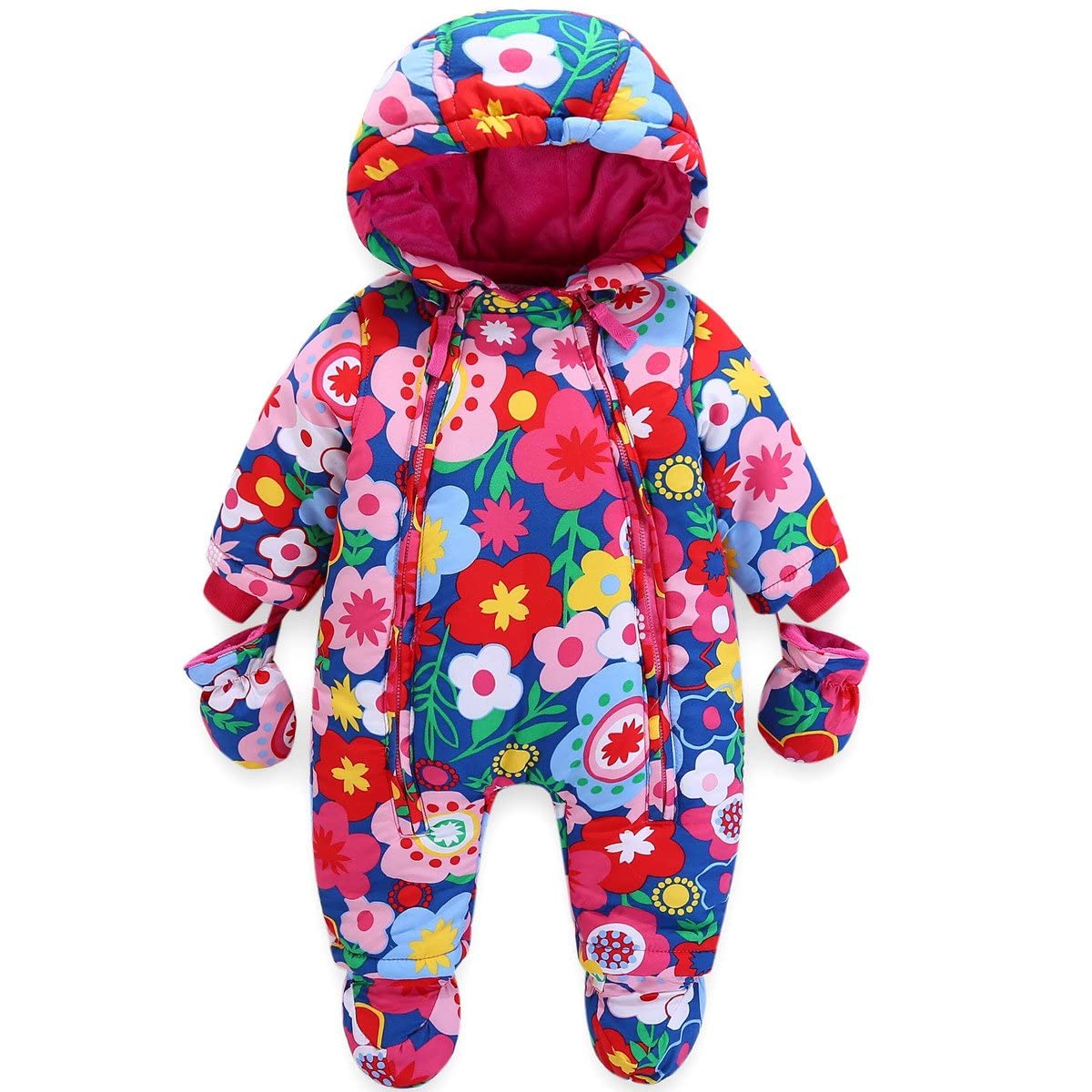

Best for Everyday Winter Outings
Fumdonnie Baby Snowsuit
Key Features
- Type: One-piece snowsuit
- Closure: Full-length back zip
- Insulation: Thick padding, low bulk
- Diaper access: Back zip plus leg buttons
- Price: Budget
Getting a baby into a snowsuit is a two-person job in most houses: one person to hold the arms, one to work the zip. This suit cuts that down by running the zip down the back and adding buttoned openings at the legs, so the whole thing opens flat on the bed, the baby goes down on top of it, and a diaper change does not require undressing anyone all the way.
What puts it at the top of this group is the warmth-to-bulk balance. The padding is genuinely thick, and the suit still lets a baby kick, sit and be lifted without turning into a rigid parcel, which is where a lot of puffy outerwear fails. We noticed it most in the car-to-door dash: the chest and shoulders are warm immediately, so there is no extra blanket to arrange on the way out, and the hood is roomy enough to sit over a hat without sliding back. The lining is soft rather than scratchy at the neck, which is the sort of thing a baby tells you about by screaming.
Fit runs generous. That is the right call for a suit meant to go over clothes, but it does mean the smallest sizes will swallow a small newborn, so treat the label as a starting point. Once a baby has some length on them, the extra room works in your favor and the leg openings keep the hem from riding up into a bundle.
Pros
- Warm without restricting movement
- Back zip and leg buttons speed up changes
- Easy on and off a wriggling baby
- Good value for a full winter suit
Cons
- Leg buttons can pull loose if you rush
We point most families here: it is warm, it opens flat for dressing, and the back zip turns a diaper change in a cold parking lot into a thirty-second job.
Best for Tight Budgets
XMWEALTHY Hooded Snowsuit
Key Features
- Type: One-piece hooded jumpsuit
- Shell: Quilted puffer
- Lining: Soft insulated lining
- Closure: Back zip
- Price: Budget
This is the cheapest snowsuit in the group, which is usually where we start looking for the corners that were cut. We did not find many. The shell has the quilted look and slight sheen of a proper snowsuit rather than a costume, the lining is thick and soft instead of crunchy, and the zip runs down the back, the same trick that makes our top pick so easy to put on a baby who cannot sit up yet.
Warmth has not been the issue. Babies come back from stroller walks warm through the body, and the insulated lining does not leave them clammy the way a heavy fleece can when they are bundled into a car. What it does not do is finish the job at the edges: the hood is on the shallow side, so a hat underneath is doing real work, and the finish is plain enough that you are buying function rather than a keepsake.
Sizing runs generous and the puffer build is bulky, which is fine for layering and less fine in a carrier or a front pack. For a baby who travels by stroller and gets carried from the car to the door, that trade is easy to accept. For a toddler who wants to run and fall in the snow, a slimmer suit will serve you better.
Pros
- Back zip speeds up diaper changes
- Warm lining that does not overheat
- Lowest price in this group
Cons
- No built-in mittens or footies
The cheapest snowsuit here, and the one we suggest first when money is the constraint: warm, easy to zip, and simple to live with.
Best for Snow Play
JiAmy Baby Snowsuit
Key Features
- Hood: Fleece-lined
- Type: One-piece snowsuit
- Closure: Full-length double zip
- Extremities: Built-in mittens and booties
- Price: Midrange
Mittens are the first thing a baby loses, usually somewhere between the front door and the car door. JiAmy builds them in, along with soft booties over the feet and a fleece-lined hood, so there is nothing to match, find or wrestle onto a clenched fist before you leave the house. In deep cold, that is the difference between a suit that covers a baby and one that covers most of a baby.
The rest of the suit holds up its end. The padding is thick, the double zip opens the entire front so you can lay it flat and slide a baby in, and the booties detach when a child wants to wear shoes instead. We found the double zip does most of the work in the first months, when dressing is a two-handed operation and anything that opens wider is worth having. It is a substantial suit, though, and a baby in this much filling moves like a parcel until they get used to it.
Sizing is the sticking point. The suit runs small against its label, so order a size up unless your child is already at the top of their range, and do that before the weather turns rather than after. Bought in the right size for a toddler who spends real time outdoors in the cold, the built-in coverage is worth the fuss.
Pros
- Mittens and booties built in
- Thick padding for deep cold
- Double zip opens the front flat
- Fleece-lined hood
Cons
- Mittens and booties pull loose
We buy this one for snow rather than errands: the built-in mittens and booties cover everything, as long as you size up before the first cold snap.
Best for Walking Toddlers
Carter’s 2-Piece Skisuit
Key Features
- Type: Two-piece ski suit
- Pieces: Jacket and full bib pants
- Warmth: Heavyweight insulation
- Price: Premium
Two pieces sound like more work than one. In practice, the jacket-and-bib-pants arrangement is what makes this suit work for a toddler who is upright all day: the pants stay on when the jacket comes off in a warm car, and a child who wears one size in tops and another in bottoms is not forced into a single cut.
The bib is the part we appreciate most. It comes up over the chest, so sitting down in a snowbank does not send snow up the back, and the pant legs are cut to go over ordinary snow boots. The jacket is heavyweight and warm enough to wear alone on a dry, cold morning, which stretches the set across more of the winter than a one-piece manages.
The shell is where we have reservations. It is warm and thick, but it is built for dry cold rather than slush: on a wet day the fabric at the knees and seat can soak through sooner than a proper rain shell would. That is the ordinary cost of a suit this padded at this price, and it is why we keep it for cold snaps and mountain days rather than a rainy city January.
For a toddler who sits down in snow, though, this is the most practical set of the group. A one-piece is warmer for its weight and faster to put on a baby who cannot stand; a two-piece is what a child can actually play in. That is the trade, and for a walking child it tips clearly this way.
Pros
- Bib pants keep snow off the back
- Jacket works alone on mild days
- Heavyweight warmth for real cold
- Pants fit over regular snow boots
Cons
- Pant legs run short on taller toddlers
Once your child is walking, this is the set we reach for: bib pants that keep snow out and a jacket that still works on its own.
Best for Cold, Dry Days
Cuddle Club Fleece Bunting

Key Features
- Type: One-piece fleece bunting
- Sizes: Newborn to 5T
- Fabric: Fleece
- Extremities: Fold-over hands and feet
- Price: Budget
Most winter suits are bought for a baby who is going to the childminder, the shop and back, not for a child who is going to sit in a snowbank. The Cuddle Club fleece bunting is built for exactly that day: a hooded fleece bodysuit with cuffs that fold over the hands and the feet, so a baby is covered from the neck down without a single loose sock to lose in the footwell.
That is the job we like it for, and it does it well. The pile is soft and stays soft through repeated washing, which is the thing that decides whether a fleece gets handed down or binned. Fleece is not a shell, though: a toddler who sits down in wet snow will feel it through the seat in minutes, so treat this as a cold-and-dry suit for the car, the stroller and the dash between them, not for the park after a snowfall.
Sizing is generous to a fault. The next size up from your baby’s age will swim on them, and the extra length bunches at the ankles long before a small baby grows into it, so size down if you are between sizes. The cuffs are the detail that keeps this one in the bag: they work over a bare foot or a thin sock and they do not get lost.
Pros
- Fold-over cuffs cover hands and feet
- Soft pile that survives washing
- Easy to put on a baby who hates dressing
Cons
- Runs about a full size large
For cold, dry days and a baby who lives in a stroller, we have not found a better fleece bunting here.
Best for Pram and Carrier
Columbia Foxy Baby Bunting

Key Features
- Type: Sherpa bunting
- Sizes: Infant
- Fabric: Sherpa fleece
- Extremities: Fold-over hand and foot flaps
- Price: Premium
Sherpa fleece is what this bunting is made of, inside and out: a dense, curly pile that looks more like a good blanket than outerwear and makes a baby resemble a small, well-dressed bear. The cuffs at the hands and the feet fold over to close the suit completely, so there is no gap at the wrist or the ankle and nothing separate to keep track of.
It is warm in the trapped-air way rather than the puffy way, so a baby can bend, be carried and be lifted in and out of a pram without turning rigid. That softness is also what people notice: this is the suit that gets comments from strangers, and the ears on the hood do a lot of the work.
Where it stops is weather. Sherpa is not a shell, and this is not a suit for a child who will end up on wet ground. It is for the cold, dry, mostly-upright part of winter: the pram, the carrier, the walk from the door to the car. Paid for that job, it is lovely. Paid for expecting it to handle a snowball fight, it will disappoint you.
At the top of the price range here, you are paying for the fabric and the finish rather than for weatherproofing, and we think that is a fair trade when the suit’s main work is looking lovely in a pram. If it is going to meet a snowbank, put the money into a padded suit instead.
Pros
- Sherpa pile is soft and dense
- Fold-over flaps at hands and feet
- Room to layer underneath
Cons
- Fleece, so wet snow soaks it
If you want the softest thing here for a pram ride, we think the sherpa finish is worth it, as long as you are not expecting a snow shell.
Best for Winter Newborns
Simple Joys Pram Suit

Key Features
- Type: One-piece pram suit
- Fabric: Fleece with plush lining
- Warmth: Thick, soft padding
- Price: Budget
A pram suit is a different animal from a snowsuit, and this is the one that made the distinction click for us: no shell, no hardware at the neck, just a thick, plush all-in-one that turns a baby into a small ivory bear. On a cold morning it is warm within seconds, and it looks considerably more considered than its position at the bottom of the price range suggests. For a first winter, that is a lot of suit for very little money.
The catch is how short the window is. This is a suit for the months when a baby is mostly carried, and by four or five months most children have outgrown the cut, so buy for the baby in front of you rather than the one you will have in February. The plush lining holds heat well enough that a normal indoor outfit underneath is plenty, and the padding means you are not reaching for a second blanket on the way to the car.
Pros
- Plush, warm and inexpensive
- Thick enough for a first winter
Cons
- Little stretch through the chest and arms
Our pick for a winter newborn on a budget: thick, plush and instantly warm, as long as you buy the size that fits today.
Best for Bassinet Strollers
London Fog Pram Bag

Key Features
- Hood: Attached, with ear detail
- Type: Pram bag bunting
- Shell: Quilted puffer
- Sizes: Newborn
- Price: Midrange
A pram bag asks nothing of a baby. There are no legs to post into leg holes and no arms to thread; you lay the sack in the bassinet, settle the baby into it and close it up. The London Fog version is the best-looking one here, with a quilted puffer shell and small stitched ears on the hood that make it recognizable from across a parking lot.
Warmth is not in question. The bag is thickly insulated and neatly stitched, with the construction of a coat rather than a novelty, and the quilting keeps its shape instead of collapsing around a wriggling baby. It also does something a one-piece cannot: there is no zipper running past a face, so a newborn who objects to being dressed has very little to object to.
It is an infant’s tool rather than a toddler’s, and it is not a car-seat accessory: nothing this thick belongs between a baby and a harness, so use it in the bassinet and put a blanket over the straps in the car instead. For a first winter made of pram trips and doorways, we think it is the gentlest option here.
Pros
- No legs or arms to wrestle
- Thickly insulated and well stitched
- Hood with a bit of character
Cons
- Runs large; fits closer to three to six months
We recommend this for the bassinet winter, with one caveat: it fits more like a three-month-old than a newborn.
How We Tested These Snowsuits
We started with a shortlist of roughly 40 suits sold in sizes from newborn through 24 months, reading fill and shell specs, checking temperature claims against how families actually use them, and cutting anything without a two-way zipper or fold-over cuffs — two features you don’t appreciate until you’re mid-change in a cold parking lot. That left 12 suits, which we rotated through one family’s winter from November through February.
Every suit went outside. We did 30-minute stroller walks on mornings in the 20s, backyard snow sessions, and a car seat test in which we buckled the baby in the suit, then in a thin fleece, and timed how long each took. After every outing we felt the chest and the back of the neck for cool or damp skin, which told us more about warmth than any hangtag did.
Softness and comfort we judged with our hands and the baby’s mood: how the lining felt against a bare wrist, whether the fleece pilled after washing, whether arms swung freely during 15 minutes of crawling and toddling, and whether anything rubbed at the neck. Fit got measured — sleeve and inseam, plus room to grow — and tried over both a onesie and a sweater. For durability, each suit went through five wash cycles, and we tugged at seams and inspected cuffs and knees after time on concrete and a sledding hill. Appearance was a real test too: we photographed every suit fresh out of the bag and again in February to see what faded, fuzzed, or lost its shape.
How to Choose a Baby Snowsuit
The right snowsuit is the one that matches how your baby actually travels, because that single question decides whether you need a waterproof shell or a warm fleece.
Weather first, label second
Most of what is sold as a baby snowsuit is one of two things: a fleece bunting or a padded shell. Both keep a baby warm; only the second shrugs off wet snow. Fleece is warmer for its weight, washes more easily and is the right pick for a baby who goes door to car to door.
The moment a child is set down on the ground, you want a woven shell that water beads on rather than a pile fabric that drinks it. Buying a fleece bunting for snow play is the most common mistake we see in this category, and it usually surfaces on the first slushy day.
How it opens decides how often you use it
Zips come in three useful arrangements: a front zip from chin to ankle, a double zip that opens the whole front flat, and a back zip that lets you lay the suit down and set the baby on top of it. For a baby who cannot sit or stand, the flat-open front and the back zip are the ones that save your morning. For a toddler, a front zip with an opening at the legs for diaper checks is quicker.
Wherever the zip ends at the neck, look for a fold of fabric behind the pull. A cold metal tab against a chin is the detail that turns an expensive suit into a shelf ornament.
Size for the baby you have
Baby outerwear sizing is closer to a suggestion than a measurement. The same twelve-month label can fit a small one-year-old with room to spare or barely close over a bigger baby, so buy for the child in front of you plus one thin layer, not for the child you expect in February.
The check takes a minute: put the suit on over the clothes your baby actually wears, then see whether a flat hand slides in at the chest without the suit pulling at the crotch. Legs that bunch and feet that disappear mean size down; a straining zip means size up.
The car seat rule
Nothing thick goes under a car seat harness. Padded outerwear compresses in a crash, and a harness that felt snug in the driveway can be far too loose when it matters. Wear the snowsuit for the walk to the car, take it off, buckle the baby in normal clothes, and put a blanket or a fitted cover over the top.
The same logic rules out pram bags and thick buntings inside a harnessed seat, however warm they look. It is also the reason the lightest suit that does the job is often the smarter buy.
Frequently Asked Questions
What should my baby wear under a snowsuit?
One thin base layer and the clothes your baby would wear indoors. The suit’s padding is doing the insulating, so adding a fleece underneath usually just makes a baby sweat. Check the back of the neck after ten minutes outside and take a layer off if it feels damp.
Judge by the neck and chest rather than the fingers, which stay cool long after the body is warm.
Can a baby sleep in a snowsuit?
No. A snowsuit is outdoor gear, and a baby who falls asleep in one can overheat and cannot move freely. Unzip it or take it off as soon as you are inside, and if your baby drops off on a stroller walk, open the front and check the back of the neck before letting them stay that way.
How long will a baby snowsuit fit?
About one season, sometimes less. Babies typically move up a clothing size every three months in the first year, so a suit that fits with room in November can be tight by February. Buy one size up at most, since two sizes up swallows the hands and drags the hem, and check leg length first because it runs out earliest.
Final Verdict
Most families should buy the Fumdonnie. It is the snowsuit that gave us the fewest reasons to complain on a cold morning: warm without turning a baby rigid, and the back zip means a diaper change in a parking lot does not become a wrestling match.
If your baby is still in the bassinet and most trips are a pram and a doorway, the London Fog pram bag is the gentler thing to own. Once your child is walking and sitting down in snow, move to the Carter’s two-piece and keep the one-piece for the newborn stage.
